Childcare compliance
Regulation 115 Building Design: ACECQA\u2019s New National Guidance on Supervision and Child Safety
On 10 August 2026 ACECQA released new national guidance on Regulation 115 — premises designed and maintained to facilitate supervision of children at all times. The guidance sets out nationally agreed design principles: clear sightlines, minimised blind spots and fewer isolated spaces. It lands nine months after the 27 February 2026 change that removed the ability to apply for service waivers of Regulation 115. Here is what the guidance means for every centre-based service — new builds, renovations and existing premises — and the 30-day workflow to align your environment.
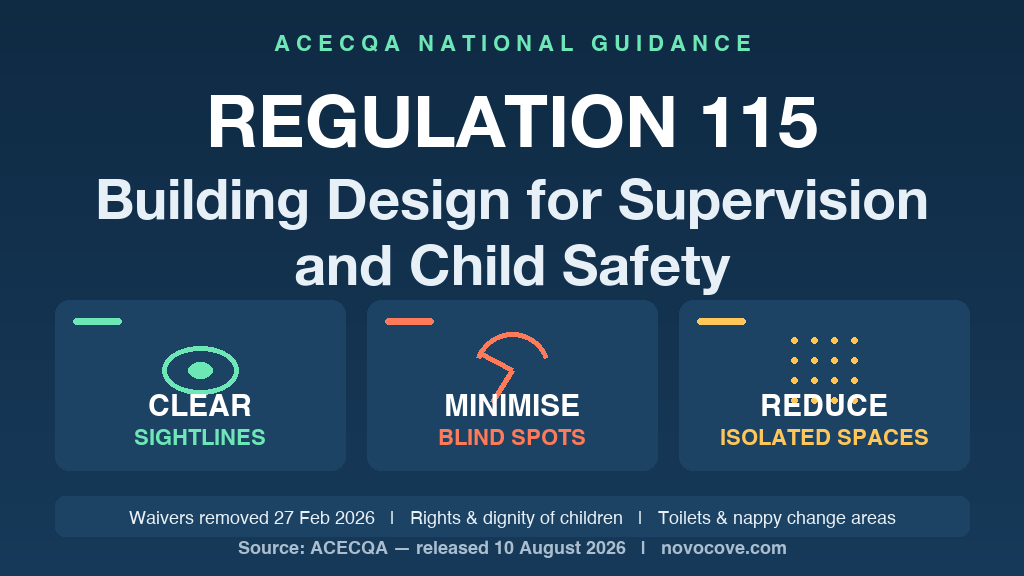
On 10 August 2026, ACECQA released new national guidance — Facilitating Supervision and Child Safety through Building Design: Regulation 115 — that tells every approved provider, in one nationally agreed document, what premises designed for supervision actually look like. It covers new builds, renovations and existing environments, and it comes with a sharp regulatory edge: since 27 February 2026, providers can no longer apply for service waivers of Regulation 115. The waiver door is closed, and the design standard is now explicit.
Background: what Regulation 115 has always required
Regulation 115 of the Education and Care Services National Regulations is not new. It has required, since the National Quality Framework began operating in 2012, that the premises of a centre-based service — including toilets and nappy change facilities — are designed and maintained in a way that facilitates supervision of children at all times, having regard to the need to maintain the rights and dignity of the children.
The regulation sits inside a deliberate legislative stack. Section 165 of the National Law makes it an offence to inadequately supervise children; section 167 makes it an offence to fail to protect children from harm and hazards. Regulation 115 is the design-layer requirement that makes those duties achievable: if the physical environment creates blind spots, the educator's job of keeping children in sight and hearing becomes harder, no matter how well the roster is written. The National Quality Standard reflects the same logic — Quality Area 3 (Physical environment) includes Element 3.7 on premises designed to enable supervision, and Quality Area 2 Element 2.2.1 requires that reasonable precautions and adequate supervision protect children from harm at all times.
What was missing, until now, was a national statement of what "designed to facilitate supervision" means in practice. Providers and architects had the regulatory text but not a nationally agreed design vocabulary. That is the gap today's guidance fills.
One carve-out matters for context: Regulation 115 does not apply to a centre-based service delivering a preschool program in a school, in a class where a full-time education program is also being delivered to school children. For every other centre-based service — long day care, preschool, outside school hours care — the design requirement applies in full.
What changed and when: the guidance, the waiver removal and the DRIS commitment
Three linked developments define the current position:
- 10 August 2026 — new national guidance released. ACECQA published Facilitating Supervision and Child Safety through Building Design: Regulation 115, a guidance document designed for planning a new service, undertaking renovations, or reviewing existing environments. It highlights design principles including clear sightlines, minimising blind spots and reducing isolated spaces, and includes practical examples, 3D renderings, reference photographs and nationally agreed approaches to designing safer environments. ACECQA has indicated additional case studies will follow through its We Hear You blog, showcasing services that have strengthened supervision through environmental and design enhancements.
- 27 February 2026 — service waivers removed. Under the National Regulations amendment implementing the Child Safety Review, providers can no longer apply for service waivers of Regulation 115 (premises designed to facilitate supervision of children). The change does not impact the ability to apply for temporary waivers, or existing service waivers of Regulation 115 — but no new service-level waiver of the design requirement can be sought.
- 22 August 2025 — the Decision Regulatory Impact Statement commitment. Education Ministers agreed at a special meeting to remove the ability to apply for service waivers related to Regulation 115 as part of the national Child Safety Review package. The waiver removal and today's design guidance together close the loop: ministers removed the escape hatch, and ACECQA has now published the design standard that fills the vacuum.
The guidance also connects to a second DRIS commitment: the review of structural building requirements under the National Construction Code with the Australian Building Codes Board, to ensure building design facilitates unimpeded supervision of children at all times. ACECQA's progress reporting on the Child Safety Review recommendations described nationally consistent guidance materials as under development — this document is that deliverable, and the ABCB work continues in parallel.
Operational impact: six things to do now
The guidance is voluntary in the sense that it is guidance — but it is guidance for a regulation that can no longer be waived, and it will inevitably inform how regulators and assessors interpret Element 3.7 and Element 2.2.1. Six actions follow:
- Conduct a sightline walk of every room. Stand where an educator stands during peak flow — nappy change, meal time, sleep and rest transitions — and ask whether every child in the room is visible. Where sightlines break, note it. The guidance's core test is whether the environment supports constant, active supervision.
- Map the blind spots and isolated spaces. Corridors, storage rooms, staff-only areas, outdoor corners behind sheds and cubby houses, and the far side of play equipment are classic blind-spot zones. List each one and record the mitigation that exists today — mirrors, repositioned furniture, open-door policies, rostered educator positioning — and the design fix that would remove the spot entirely.
- Treat toilets and nappy change facilities as supervision-critical. Regulation 115 names them explicitly, and the guidance applies the same design principles to them. Check sightlines into and out of these areas, the positioning of change benches, and how an educator maintains dignity and privacy while keeping children in view.
- Put design on the renovation checklist. Any upcoming renovation — new fencing, new outdoor equipment, a room reconfiguration — should be screened against the guidance before work starts. It is far cheaper to design sightlines in than to retrofit them, and the guidance includes 3D renderings and reference photographs precisely so the design conversation happens before the builder starts.
- Document your design-based risk assessment. Regulators ask how you know your environment facilitates supervision. A dated, signed risk assessment that references the design principles — sightlines, blind spots, isolated spaces — and records mitigations is the evidence that turns a walk-through into a compliance position.
- Review your waiver and approval records. If your service holds an existing service waiver of Regulation 115, confirm its status and expiry — the February 2026 change preserves existing waivers but they remain temporary in nature. If you previously relied on the ability to apply for a new waiver as a fallback for a design problem, replace that plan with a design remediation plan.
A 30-day workflow to align your environment with the guidance
Bringing an existing service into line with the new guidance is a project, not a memo. This 30-day workflow is designed for a centre director or approved provider working with a nominated supervisor:
- Days 1-5 — Sightline audit. Walk every indoor room, toilet, nappy change area, sleep room and outdoor zone with the guidance's three design principles. Photograph every sightline break. Mark a floor plan of each room with blind-spot zones in one colour and isolated spaces in another.
- Days 6-10 — Supervision practice cross-check. Compare the environment audit against your actual supervision arrangements: educator positioning, roster allocation during peak transitions, and how staff hand over information about children moving between indoor and outdoor areas. Design gaps and practice gaps are different problems with different fixes — separate them now.
- Days 11-15 — Quick-win fixes. Implement the low-cost changes: reposition furniture that blocks sightlines, adjust door stops, add open-door protocols for storage and staff rooms, reposition educators during nappy change and sleep transitions. Photograph the before and after for your evidence record.
- Days 16-20 — Design remediation plan. For the blind spots and isolated spaces that need structural change — new windows, internal glazing, equipment relocation, fencing changes — cost and schedule the work. Prioritise by risk: highest risk is any zone where a child could be out of sight and hearing for any period.
- Days 21-25 — Document and evidence. Write the design-based risk assessment for the whole premises, reference the specific guidance principles, attach the floor plans and photographs, and record the remediation schedule and responsible owners. Review your service policies (Regulation 168 requires a child safe environment policy) to reference the environment design review.
- Days 26-30 — Governance sign-off and review cadence. Have the approved provider or governing body formally review and sign the assessment. Schedule the next environment review — quarterly is sensible, and always before any renovation begins. Add the environment design review to your Quality Improvement Plan so it is visible to assessors.
How NovoCove supports this
Regulation 115 is fundamentally about the physical environment — the building, the rooms, the sightlines. NovoCove does not replace an architect, a builder or a supervision plan. It provides the evidence layer around the obligation: the records that show your service assessed its environment, reviewed its policies, trained its educators and tracked the follow-up actions to completion.
NovoCove centralises the compliance records that surround a Regulation 115 position: policy review dates and versions (including your child safe environment policy under Regulation 168), staff certification and training expiry for 40+ Australian ECEC credential types across all states, WWCC and clearance expiries, incident and notification records, and compliance tasks with owners and due dates. The 7-tier alert cadence means a policy review that has slipped, or a first aid certificate expiring in a room where supervision is the top risk, surfaces weeks before it becomes an assessor's finding — not after.
The dashboard's RAG compliance score and daily ComplianceSnapshot trend capture give leaders the same continuous picture a regulator builds: you can see your service's evidence position move as actions are completed. When the assessor arrives and asks how your service ensures premises are designed and maintained to facilitate supervision, the answer is a searchable, exportable evidence pack — the design risk assessment, the floor plans, the policy review history, the training records — assembled in minutes rather than overnight from spreadsheets and filing cabinets.
It does not replace the supervision practice itself. It gives leaders the underlying data and evidence layer: the same workforce, training, policy and incident data the regulator sees is the same data any future expansion of the National Early Childhood Worker Register will look for. Book a 20-minute demo and we will show you how your service's evidence position looks through that lens.
Sources / further reading
- New National Guidance released: Facilitating Supervision and Child Safety through Building Design: Regulation 115 — ACECQA news release, 10 August 2026 (T1)
- Facilitating Supervision and Child Safety through Building Design — Regulation 115 — ACECQA national guidance document (T1)
- Progress on Child Safety review recommendations — ACECQA, confirming waiver removal from 27 February 2026 (T1)
- Joint action on strengthening the safety and quality of early childhood education and care across Australia — Department of Education, Decision Regulatory Impact Statement commitments (T1)
- Quality Area 3: Physical environment — Element 3.7 Premises designed to enable supervision — ACECQA (T1)
- QA2 information sheet — Active Supervision: Ensuring safety and promoting learning — ACECQA (T1)
- Summary of current National Child Safety Reforms — Victorian ECEC Regulatory Authority, March 2026 (T2)
This guide is general information and is not legal advice.