Childcare compliance
Childcare Excursion Risk Assessments in 2026: What the G A Holdings Prosecution Means for Every Australian Centre
On 8 June 2026, a Queensland provider was fined $15,000 after a toddler was unsupervised for 23 minutes on a bush excursion. With maximum National Law penalties tripled from 2 January 2026, excursion risk assessments have become the highest-stakes compliance artefact your centre produces. Here is what the law actually requires, what the magistrate found, and the workflow that protects you.
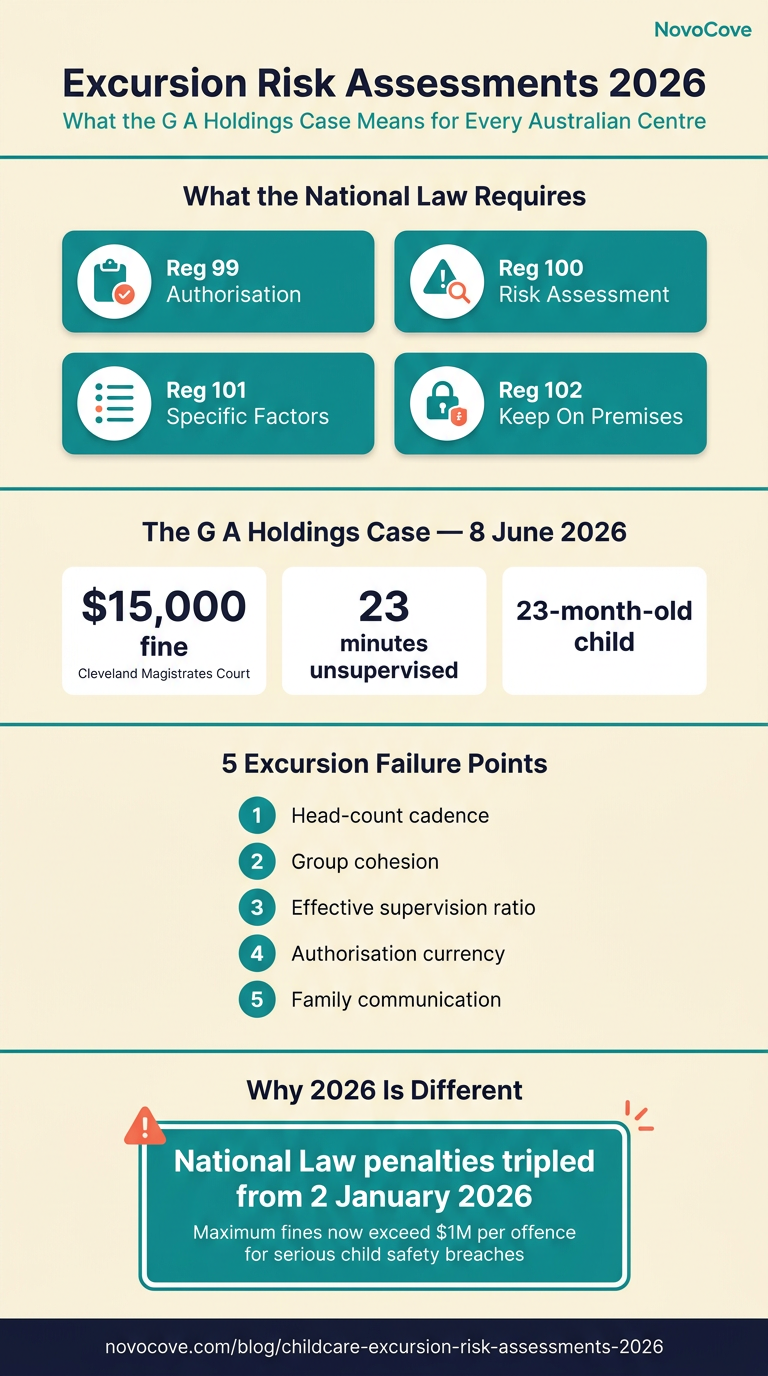
On 8 June 2026, Magistrate Michael Holohan fined G A Holdings (Qld) Pty Ltd $15,000 in the Cleveland Magistrates Court after a 23-month-old child wandered away from a bush excursion at Alexandra Hills Early Education in September 2024 and remained unsupervised for up to 23 minutes before a member of the public returned the toddler to the service. No conviction was recorded, but the sentence is now the highest-profile reminder Australian childcare has had in 2026 that excursion risk assessments are not paperwork — they are the single most scrutinised compliance artefact your centre produces, and the financial consequences of getting them wrong have just tripled.
This guide walks through what the G A Holdings case actually decided, what the National Law and National Regulations require from every excursion risk assessment (Regulations 99 to 102), how the 2 January 2026 penalty tripling changes the calculus for approved providers, and the operational workflow NovoCove recommends for keeping every excursion audit-grade.
What happened at Alexandra Hills Early Education
The incident occurred on 25 September 2024 during a bush excursion involving children from the service. According to information released by the Queensland Early Childhood Regulatory Authority and reported by The Sector, educators discovered a 23-month-old child was missing during a head count. The child had left the excursion group unnoticed and was unsupervised for up to 23 minutes before being located by a member of the public and safely returned to the service.
The approved provider pleaded guilty to two offences under the National Law:
- Section 165 — Offence to inadequately supervise children. The headline supervision offence, carrying the highest maximum penalty in the National Law for a Category 1 offence.
- Section 167 — Offence relating to protection of children from harm and hazards. The general duty to take reasonable steps to protect children from foreseeable risks of harm.
The Regulatory Authority's public statement following the decision made the operational expectation explicit: approved providers have an overriding responsibility to ensure children are adequately supervised and accounted for at all times, including during excursions and other activities away from the service environment. The prosecution is now on the public register in Queensland and will be cited by every state and territory regulator in the next round of assessment contacts.
What the National Law actually requires from an excursion
Excursion compliance sits inside a small but unforgiving cluster of National Regulations. Regulations 99 to 102 are the legal frame; ACECQA's Excursions Policy Guidelines are the operational interpretation every state regulator applies. Together they spell out four obligations that must be evidenced on file before, during, and after every outing — including regular outings such as bush kindy, library visits, and walks to the local park.
- Regulation 99 — children must not be taken outside the service premises unless written authorisation is in place. The authorisation must name the child, the destination, the date or dates, and the method of transport. A blanket annual consent is not enough — the regulation expects service-specific detail.
- Regulation 100 — a risk assessment must be conducted before any excursion. The risk assessment must identify and assess risks the excursion may pose to the safety, health, and wellbeing of children, and specify how those risks will be managed.
- Regulation 101 — the risk assessment must consider specific factors.These include the proposed route and destination, the transport method, the number and ages of children, the number and qualifications of educators, the activities to be undertaken, the duration, and any water hazards, animals, or environmental risks.
- Regulation 102 — parent authorisation must be obtained and the assessment kept on the service premises. For regular outings, the assessment must be reviewed at least every 12 months, but ACECQA expects re-assessment whenever the environment, group, or activity changes.
What the G A Holdings case makes clear is that a regulator will not accept a generic one-page template where the destination column reads "local bush area" and the supervision column reads "educator-to-child ratios." The magistrate's finding that the assessment was "insufficient" is now the benchmark — risk assessments must be tailored to the specific environment, the age and capabilities of participating children, and the supervision strategies required to mitigate foreseeable risks.
Why 2026 is a different risk environment
The G A Holdings $15,000 fine would have been the headline on its own. It is not — because the same week, across the country, maximum National Law penalties tripled. From 2 January 2026, every penalty under the Education and Care Services National Law increased threefold, and more administrative breaches were brought into the infringement notice regime. The new penalty exposure for serious supervision and harm-protection offences is now measured in hundreds of thousands of dollars for the largest providers, with the upper range exceeding $1 million per offence for serious child safety breaches.
The 2026 changes are a deliberate consequence of the Child Safety Review and the omnibus NQF reforms. Hall & Wilcox's analysis of the new regime is blunt: a supervision breach that previously cost a $5,000 infringement now exposes the approved provider to a six-figure prosecution. The risk arithmetic of an excursion has therefore changed even though the regulation has not — the same excursion risk assessment, the same group of children, and the same lapse in head count that produced a $15,000 fine in 2024 would now be charged in an environment where prosecutorial sentencing benchmarks have moved dramatically.
The 2026 NQS refinements that took effect on 1 January 2026 — strengthening child safety in Quality Areas 2 and 7 — also brought excursion risk assessment into the explicit evidence base assessors will sample. A centre that can produce a complete, signed, and recent excursion risk assessment for every outing in the assessment window is operating with a fundamentally different evidence profile to a centre pulling folders from a filing cabinet.
The five failure points the G A Holdings case exposes
For directors and nominated supervisors reading the case details, the prosecution surfaces five operational failure points that, taken together, are the checklist your excursion workflow needs to cover.
- Head-count cadence. The magistrate's comments highlight that a missing child was discovered only at a head count. Best practice — and the standard ACECQA expects — is active head counts at multiple points (departure, midway, destination, return) rather than a single count at any one point.
- Group cohesion strategy. The risk assessment should specify how the group will stay together in a bush environment where natural dispersion is the norm. Open-space excursions need a defined regrouping protocol.
- Educator-to-child ratios on excursions. Ratios in regulation remain the same, but the effective supervision ratio in an off-site environment typically needs to be tighter than on-site. The risk assessment should state the actual educator deployment, not just the ratio.
- Authorisation currency. For regular excursions, the 12-month review point must be evidenced. The risk assessment should carry a review date that is visible at a glance.
- Communication with families. Parents should be told where the excursion is, who is attending, and what the supervision plan is. The risk assessment and the parent communication should be cross-referenced.
None of these are new regulatory requirements. They are the operational layers that turn a compliant risk assessment into a defensible risk assessment when a regulator or a magistrate looks at the file. The G A Holdings case is the warning that a one-page document with the right headings is not enough.
The excursion risk assessment workflow that protects you
A defensible excursion risk assessment workflow in 2026 looks like this. It is not a paperwork exercise; it is a six-step operational protocol.
- Build a risk register once. Standardise the hazard categories (environment, transport, water, animals, weather, group dynamics, individual children) and the controls your service applies. The ACECQA Excursion Risk Management Plan template is the right starting point.
- Tailor the assessment to the destination. For each new excursion, work through the site-specific risks. A bush kindy site and a local library are not the same destination and cannot share the same risk assessment.
- Document the supervision plan in detail. Who is the responsible educator? What is the regrouping signal? Where is the head-count card? What is the lost-child protocol? Write it down so the answer is not "we always do it that way."
- Capture authorisations before departure. A parent who has not signed the authorisation for the specific destination and date is a child who cannot go. The workflow should refuse to print a final risk assessment without authorisations attached.
- Sign off on the day. The nominated supervisor signs the final risk assessment on the morning of the excursion, with the educator deployment roster attached. Any change on the day (a child absent, a venue change) is re-signed.
- Retain the evidence. File the signed risk assessment, the authorisations, and the head-count record together. The retention period should align with your state or territory's record-keeping requirements and be searchable by date, destination, and group.
How NovoCove handles excursion risk assessments
NovoCove treats excursion risk assessments the same way we treat every other compliance artefact in the platform: as a version-controlled, evidence-grade record that your team can produce, sign, and retrieve without a paper folder.
Build a risk register once in the platform — hazards, controls, and review dates for your common excursion types — and reuse it across regular outings. When a new destination is added, the risk assessment is generated from the register with the site-specific details filled in. Authorisations are linked to the assessment by child, and the workflow refuses to mark an excursion as ready to depart until every attending child has a current authorisation on file.
On the day, the nominated supervisor signs the final assessment in the platform with a time-stamped audit trail. The head-count record, the attendance roster, and the post-excursion sign-off are attached to the same record. When an ACECQA assessor, a state regulator, or a magistrate asks for the file, the entire chain — risk assessment, authorisations, supervision plan, head-count record, post-event sign-off — is retrievable in one query. That is the audit profile that turns a G A Holdings-style prosecution risk into a manageable, documentable, and defensible compliance outcome.
This guide is general information and is not legal advice.