Regulatory update
NQF Child Safety Reform 2026: Mandatory Training, the National Worker Register & What Your Centre Must Do Now
Australia's biggest child safety overhaul in a decade is now law. Every ECEC educator must complete mandatory training, the National Worker Register is live, and NQS standards have sharpened. Here is the compliance roadmap.
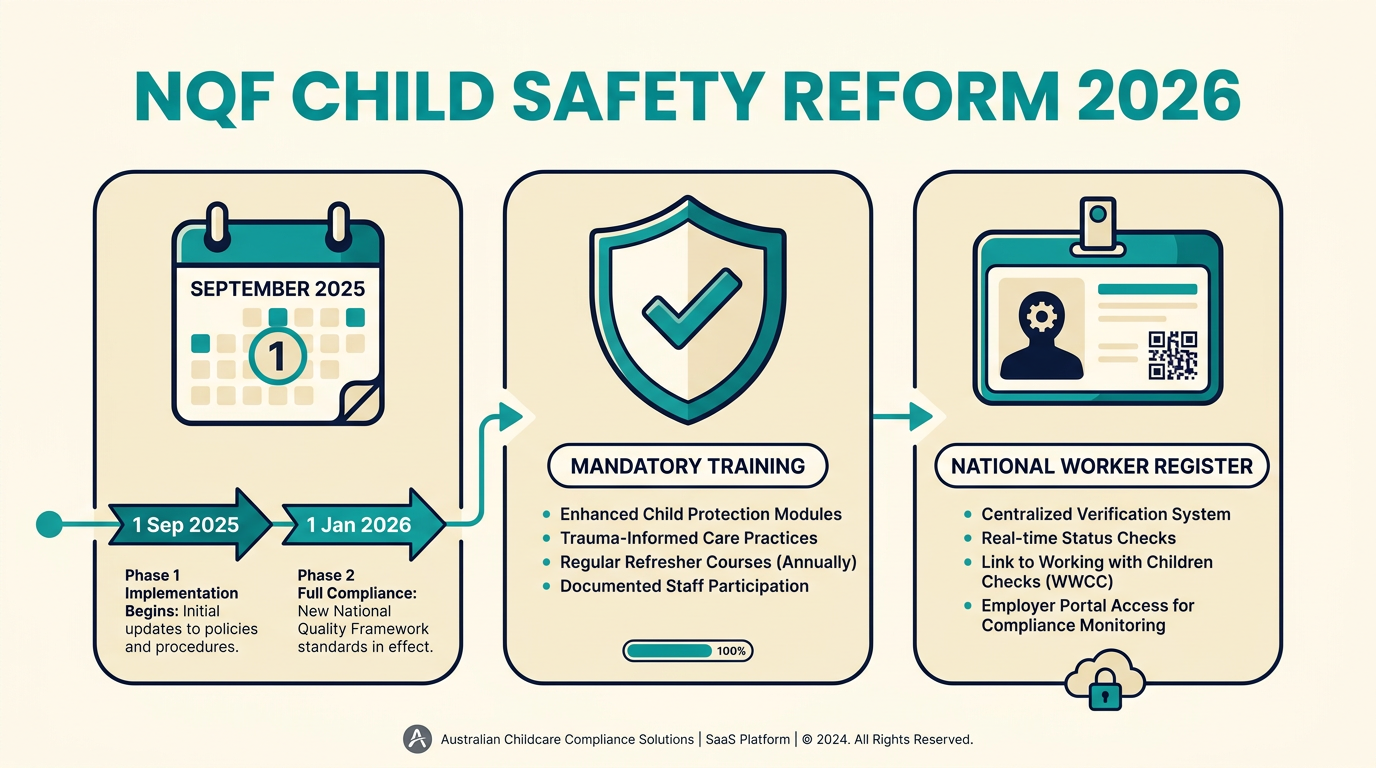
If you run a childcare centre in Australia, 2026 is not the year to set and forget your compliance calendar. The National Quality Framework (NQF) has undergone its most significant child safety overhaul in a decade — and the changes are already in force. From mandatory child protection training for every educator and volunteer, to the launch of the National Early Childhood Worker Register, to sharpened NQS standards that assessors will measure from January 2026, the regulatory landscape has shifted under your feet.
These reforms trace back to the 2023 National Child Safety Review and the Australian Government's agreement with all state and territory governments to strengthen protections for children in education and care settings. The Omnibus amendments to the National Law and Regulations took effect on 27 February 2026, following a first wave of policy and procedural changes that kicked in on 1 September 2025. If your centre has not yet mapped these obligations, you are already behind.
What Changed on 1 September 2025
The first wave of NQF child safety reforms came into force on 1 September 2025. These changes were procedural and policy-driven, requiring centres to update their documentation and practices before the heavier legislative changes landed in early 2026.
- Digital technology policy: Services must now have a documented policy on the use of digital technologies by staff and volunteers, covering cameras, personal devices, and social media in the service environment.
- Abuse and neglect notification procedures: Updated requirements for how services document and respond to disclosures or suspicions of abuse, including clearer timelines for reporting to child protection authorities.
- Vaping and smoking prohibition: The regulations explicitly ban vaping on service premises, closing a loophole that some services struggled to enforce under older smoking provisions.
- Updated policies for Quality Areas 2 and 7: Policy templates and guidance materials were refreshed to reflect the strengthened child safety focus under NQS Quality Areas 2 (Children's Health and Safety) and 7 (Leadership and Service Community).
The 27 February 2026 Omnibus Amendments — Mandatory Training & the Worker Register
The second and more consequential wave of reforms took effect on 27 February 2026 through the Omnibus amendments to the National Law. These changes introduce two entirely new compliance obligations that every approved provider must meet.
Mandatory Child Protection and Safety Training
From 27 February 2026, every person who works or volunteers in an education and care service must complete mandatory child protection and child safety training before or shortly after commencing work. This is not limited to nominated supervisors or persons in day-to-day charge — it applies to all educators, volunteers, and staff who have any contact with children.
Key details of the mandatory training requirement:
- Who must complete it: All educators, volunteers, and staff at education and care services — no exceptions based on role or hours worked.
- Timing: Training must be completed before commencing work, or within a reasonable timeframe determined by the regulatory authority in your state or territory.
- Content: Training must cover recognising signs of abuse and neglect, understanding reporting obligations, and responding appropriately to disclosures or suspicions of harm.
- Refresher requirements: Ongoing refresher training is required at intervals determined by each jurisdiction, meaning centres must track expiry dates alongside all other certifications.
The National Early Childhood Worker Register
The National Early Childhood Worker Register (the Worker Register) is now operational. Established under the Omnibus amendments, it is a centralised database that records every person working or volunteering in an education and care service across Australia.
The Worker Register serves several critical functions:
- Tracking all workers: Every educator and volunteer must be entered into the Register, creating a national picture of the ECEC workforce.
- Linking to Working with Children Checks: The Register connects to state and territory WWCC systems, ensuring that no person with a negative notice or barred status can work undetected in a different jurisdiction.
- Supporting continuous checking: As the National Continuous Checking Capability comes online, the Register will enable real-time monitoring of WWCC status changes, rather than relying on periodic re-checks.
- Deadline for entry: ACECQA indicated that all existing workers needed to be entered into the Register by late March 2026. New workers must be registered before or shortly after commencing employment.
The national WWCC reform agreement, endorsed by all jurisdictions on 14 November 2025, commits to mutual recognition of negative notices across state borders and the rollout of a National Continuous Checking Capability. While the full continuous checking system is not expected to be fully operational for another two to three years, the Worker Register is the foundational infrastructure — and it is live now.
NQS Refinements from 1 January 2026
Alongside the legislative amendments, the National Quality Standard (NQS) was refined effective 1 January 2026. These refinements sharpen the child safety focus across several Quality Areas:
- Quality Area 2 (Children's Health and Safety): Strengthened expectations around risk assessment, supervision, and incident response — assessors will now look for evidence of systematic child safety practices, not just policy documents.
- Quality Area 7 (Leadership and Service Community): Enhanced requirements for governance arrangements that prioritise child safety, including evidence that leadership actively monitors and reviews safety practices.
- Cross-cutting child safety standard: The refined NQS embeds child safety considerations across all Quality Areas, not just QA2, reflecting a whole-of-service approach to keeping children safe.
For centres preparing for assessment and rating, this means your evidence pack needs to demonstrate active, documented child safety practices — not just written policies gathering dust on a shelf. Assessors will be looking for proof that training is current, the Worker Register is populated, and that your service has responded to the 1 September 2025 procedural changes.
Penalties for Non-Compliance
The NQF child safety reforms carry real enforcement teeth. Under the Education and Care Services National Law, failure to comply with mandatory training or Worker Register requirements constitutes an offence. Penalties vary by jurisdiction but can include:
- Fines for approved providers who fail to ensure staff complete mandatory training
- Conditions placed on service approvals
- Suspension or cancellation of service approval in serious or repeated cases
- Individual penalties for persons who work without completing the required training
Regulatory authorities in each state and territory are responsible for enforcement, and early indications are that child safety compliance will be a priority focus for assessment and rating visits in 2026.
Your NQF Child Safety Compliance Checklist for 2026
Here is a practical checklist to make sure your centre meets every obligation under the reformed NQF:
- Update your policy handbook to include the digital technology policy, updated abuse notification procedures, and vaping prohibition (1 September 2025 requirements).
- Verify mandatory training completion for every educator, volunteer, and staff member — check that records are current and refresher dates are tracked.
- Register all workers in the National Early Childhood Worker Register — confirm that every person on your roster has been entered.
- Review your WWCC status for all staff across all jurisdictions — ensure no worker's check has expired and that you are ready for continuous checking when it comes online.
- Prepare your NQS evidence pack — document active child safety practices across all Quality Areas, not just QA2, to reflect the refined standards from January 2026.
- Set up tracking for refresher training deadlines — mandatory training is not a one-and-done obligation; you need a system that alerts you before certificates expire.
- Brief your leadership team on the QA7 governance expectations — assessors want evidence of active safety leadership, not just documentation.
How NovoCove Handles This
The 2026 NQF child safety reforms add new certification categories, new deadlines, and a new national register to your compliance workload — on top of everything you were already tracking. NovoCove is built for exactly this scenario.
Our platform tracks mandatory child protection training alongside every other certification your centre manages — First Aid, Anaphylaxis, Asthma, WWCC, Food Safety Supervisor, and more — with seven-tier expiry alerts that notify you well before anything lapses. When new obligations like the mandatory training requirement or Worker Register deadline land, you can add them as custom certification types and set your own reminder schedule, so nothing falls through the cracks.
For the National Worker Register, NovoCove's staff management module gives you a single view of every worker's WWCC status, training records, and registration details across all eight Australian jurisdictions. When the National Continuous Checking Capability comes online, the same tracking infrastructure will be ready to surface real-time status changes — so you will not be caught relying on outdated periodic checks while the rest of the sector moves to continuous monitoring.
This guide is general information and is not legal advice.