Regulatory update
NSW Child Safety Reforms: What the 24 April 2026 Changes Mean for Your Centre
On 24 April 2026, NSW fast-tracked its own child safety regime on top of the national NQF Omnibus. Thirty-plus reforms commenced under the Children (Education and Care Services National Law Application) Amendment Act 2025. Here is the operator's compliance roadmap.
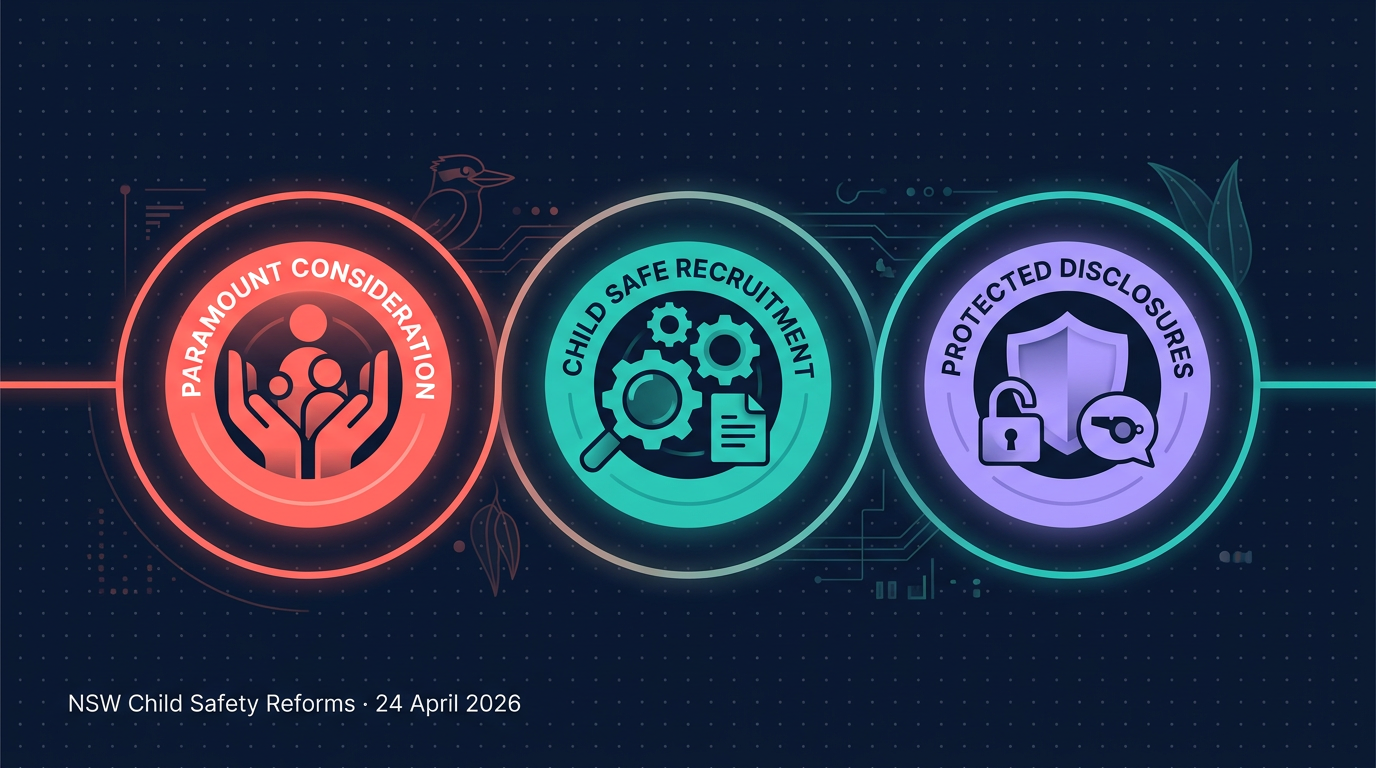
If you operate an early childhood education and care (ECEC) service in New South Wales, the regulatory ground shifted again on 24 April 2026. On that date, the next stage of NSW-specific child safety reforms under the Children (Education and Care Services National Law Application) Amendment Act 2025 came into force, fast-tracking and significantly expanding on the national Omnibus amendments that landed on 27 February 2026. The Act legislates more than 30 reforms, with the first wave requiring direct action from approved providers, centre directors, and educators from day one.
The reforms were developed in response to the independent review into early childhood education and care regulation in NSW, and they sit alongside (not instead of) the national child safety reforms we covered earlier this year. For NSW operators, this means running two parallel compliance programs: the national NQF changes, and a new NSW-specific layer that touches recruitment, whistleblowing, personal devices, transparency, and regulatory powers.
What the 24 April 2026 Reforms Actually Cover
The NSW Department of Education groups the reforms into three categories. Understanding which bucket each reform sits in helps you prioritise:
- New and strengthened requirements — obligations that did not exist before 24 April 2026, or existing obligations that are now enforced more rigorously. Expect to update policies, procedures, and day-to-day practice.
- Clarifying existing obligations — reforms that do not add new duties but sharpen the language and interpretation of rules that were already in the National Law and Regulations. These still require a documentation review to make sure your policies reflect the clarified expectations.
- Enhanced regulatory powers — reforms that give the NSW Department of Education and the NSW Early Learning Commission stronger tools to monitor, investigate, and act on identified risks.
The Reforms Requiring Action on 24 April 2026
The NSW Department of Education has published a list of reforms that require direct action from approved providers and services. The most consequential are summarised below.
1. The Paramount Consideration Principle
This is the philosophical centrepiece of the reforms. From 24 April 2026, the safety, wellbeing, and best interests of children must be the paramount consideration in every decision, policy, and procedure at your service. It is no longer acceptable to balance child safety against operational convenience, staff preferences, or parent complaints. Where there is a conflict, the child wins.
In practice, this means your policies and procedures need an explicit paramount consideration clause, and your leadership team needs to be able to demonstrate that operational decisions are being made through that lens. The NSW Early Learning Commission has indicated it will look for evidence of this in assessment and rating visits.
2. Child Safe Recruitment and Ongoing Employment Practices
Recruitment is no longer a one-and-done background check at hire. The 24 April reforms require approved providers to implement child safe recruitment and ongoing employment practices, meaning:
- Documented child safe recruitment policy and procedures covering advertising, interviewing, reference checking, and WWCC verification.
- Ongoing monitoring of staff suitability, not just a one-off pre-employment check.
- Clear processes for responding when a staff member's circumstances change — for example, a new criminal charge, a WWCC suspension, or a child safety concern raised by a parent or colleague.
3. Protected Disclosures (Whistleblower Protections) — Section 300E
The reforms insert a new protected disclosures regime into the National Law as it applies in NSW. Under section 300E, staff who report child safety concerns, suspected breaches of the National Law, or other wrongdoing at their service are legally protected from retaliation. Approved providers must have a written protected disclosures policy, train staff on it, and make the protections visible.
The NSW Department of Education has published a Protected Disclosures Model Policy that providers can adapt. At a minimum, your policy needs to define what a protected disclosure is, how to make one, who receives it, what protections apply, and what happens if someone breaches those protections.
4. Restriction on Personal Devices in ECEC Settings
Personal mobile phones, smart watches, and other personal devices are now subject to tighter restrictions in ECEC settings. The reform is NSW-specific and goes further than the national digital technology policy that took effect on 1 September 2025. Providers must implement and enforce a personal device policy that:
- Defines which devices are restricted, where, and when.
- Sets out secure storage for staff personal devices during work hours.
- Addresses the use of personal devices for taking photos or videos of children — generally prohibited, with narrow exceptions.
- Applies to visitors, contractors, and family day care educators, not just permanent staff.
5. Displaying Compliance and Quality History
Services will be required to display their compliance and quality history in a manner accessible to families. This includes current and prior assessment and rating outcomes, any conditions on the service approval, and any enforcement actions. The exact display mechanism (physical notice, website, or both) is being finalised by the NSW Early Learning Commission, but the principle of transparent publication is settled.
6. Notification of Negative Notices
Approved providers must notify the NSW Early Learning Commission when they become aware that a staff member or volunteer has received a negative WWCC notice (or equivalent in another jurisdiction). The notification must be prompt, documented, and trigger a review of the worker's role and access to children. This reform closes a gap where workers with negative notices could move between services without the regulator being told.
7. Powers of Entry for Assessment of Family Day Care Services
Authorised officers now have explicit, expanded powers of entry to assess family day care (FDC) residences and venues. FDC educators and approved providers should expect assessors to arrive with broader authority to inspect the physical environment, interview FDC educators in their home, and review records on the spot.
8. Preventing Inappropriate Conduct
The reforms strengthen the regulator's ability to act on inappropriate conduct that falls short of a serious incident but nevertheless poses a risk to children. This includes patterns of behaviour, repeated lower-level breaches, and conduct that erodes trust even where no single incident is reportable.
9. Incentive Schemes and Updates to Incident, Injury, Trauma and Illness Records
The Act also enables new incentive schemes to reward services that demonstrate strong child safety practice, and updates the requirements for incident, injury, trauma, and illness records. Expect more detailed record-keeping expectations and clearer triggers for when an entry must be made.
Penalties and Enforcement
The reforms carry real enforcement teeth. The NSW Early Learning Commission has explicit new powers to investigate, enter, inspect, and act. Non-compliance can attract:
- Conditions or variations placed on the service approval.
- Suspension or cancellation of service approval in serious or repeated cases.
- Prosecution of approved providers or individuals for specific offences under the National Law (NSW).
- Public disclosure of compliance and quality history (see reform 5 above), which has its own reputational consequences.
Early signals from the NSW Department of Education indicate that child safety compliance will be a priority focus for assessment and rating visits across 2026 and 2027.
Your NSW Child Safety Compliance Checklist
Here is a practical 30-day plan to bring your service into compliance with the 24 April 2026 reforms:
- Add a paramount consideration clause to every relevant policy and procedure, with explicit language that the safety and wellbeing of children prevails over all other considerations.
- Update your Recruitment, Selection and Employment Policy to cover ongoing employment practices — not just pre-employment checks — and document the process for responding to changed circumstances.
- Adopt and customise the Protected Disclosures Model Policy from the NSW Department of Education, train every staff member on it, and display the protections prominently in your staff area.
- Implement a Personal Device Policy that goes beyond the national digital technology policy — restrict personal devices, define secure storage, and address photo/video of children explicitly.
- Update your WWCC and negative notice notification process so that any negative notice is reported to the NSW Early Learning Commission within the required timeframe.
- Prepare for public display of compliance history — audit your current and historical assessment and rating outcomes, and make sure you can present them clearly.
- Update your incident, injury, trauma and illness record templates to capture the additional details required under the reformed regulations.
- Brief family day care educators specifically on the expanded powers of entry and the personal device policy — they are often the most exposed to non-compliance because they work from their own homes.
- Schedule a refresher training session on child protection, mandatory reporting, and the new protected disclosures regime — all three are now interrelated.
How NovoCove Handles This
The 24 April 2026 reforms add another layer of policy, training, and reporting on top of the national NQF Omnibus, mandatory child protection training, the National Early Childhood Worker Register, and the ongoing WWCC and certification tracking you were already doing. For a NSW centre director, the administrative load is now genuinely heavy.
NovoCove centralises the whole lot. The platform tracks every policy revision, every training certificate, and every WWCC status in one place, with seven-tier expiry alerts that notify you well before a deadline lands. When a new obligation like the paramount consideration principle or the protected disclosures policy lands, you can update the relevant policy in the platform and assign it to staff for acknowledgement — with a timestamped audit trail that proves it was read and understood.
For the new personal device and recruitment obligations, NovoCove's staff management module gives you a single view of every worker's status across WWCC, training, signed policies, and incident history. If a negative notice is issued in any state, the platform surfaces it immediately so you can meet your notification obligation to the NSW Early Learning Commission. The protected disclosures policy can be linked from the same staff record, so every team member has clear guidance on how to report and what protections apply.
Sign up and we will walk you through the NSW-specific configuration — pre-built with the 24 April 2026 reforms, the national NQF Omnibus, and the National Early Childhood Worker Register ready to switch on.
This guide is general information and is not legal advice.