Childcare compliance
Queensland's Reportable Conduct Scheme: What Childcare Providers Must Do by 1 July 2026
On 1 July 2026 — 16 days from today — every QLD early childhood service becomes subject to a new state-level safeguarding regime with a 3-business-day notification clock, a $17,000 penalty for missing it, and a 30-day investigation report obligation. Here is exactly what is in scope, what triggers a report, and the workflow that keeps you compliant without dropping a shift change in the cracks.
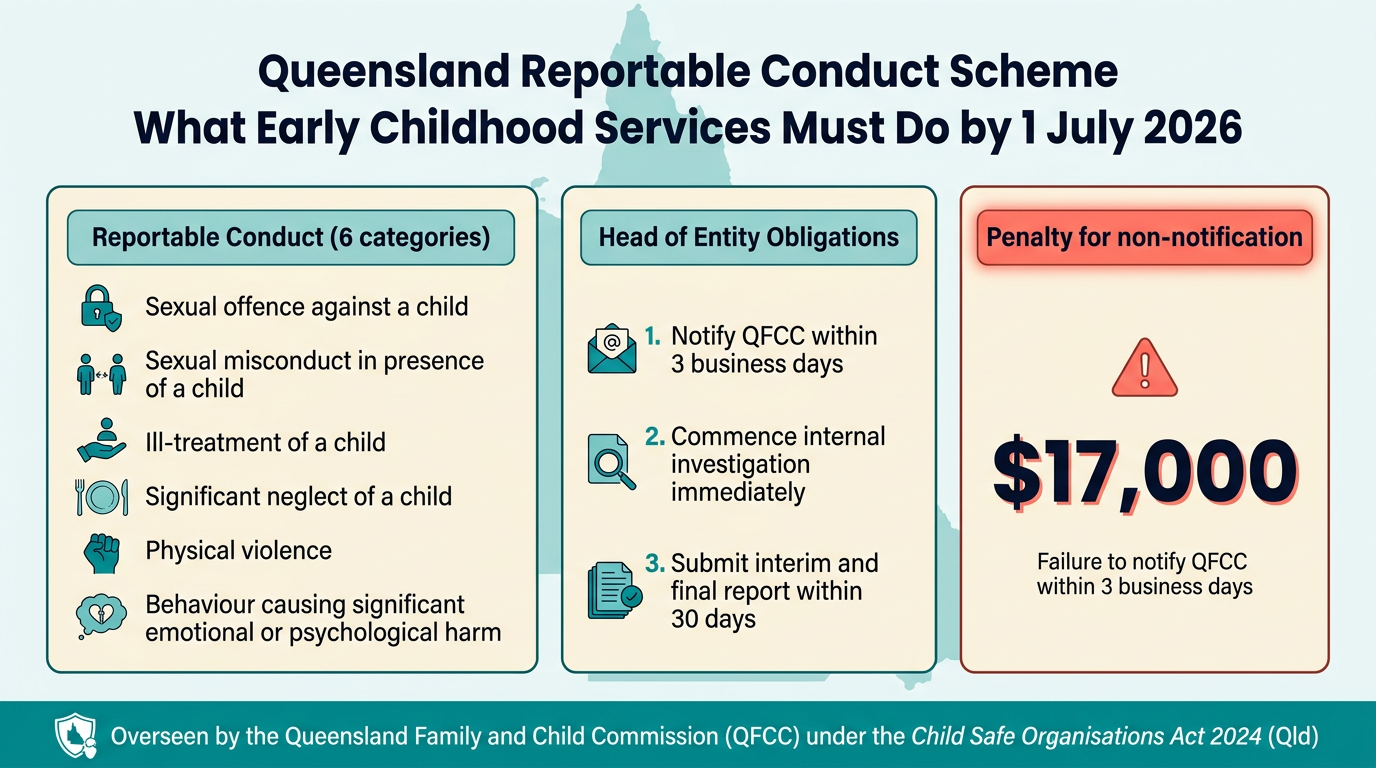
On 1 July 2026 — sixteen days from the date of this post — Queensland's new Reportable Conduct Scheme becomes fully operational. The Scheme sits under the Child Safe Organisations Act 2024 (Qld) and is overseen by the Queensland Family and Child Commission (QFCC). It applies to every organisation that delivers services to children in the state, including — for the first time in a national first — every approved early childhood education and care service.
The Scheme introduces a tight, three-step statutory workflow for the head of every in-scope entity, a $17,000 penalty for missing the notification window, and a 30-day clock for submitting investigation findings to the regulator. Most QLD centre directors, nominated supervisors, and compliance leads have heard the announcement from the Crisafulli Government's October 2025 joint statement, but few have mapped the obligations against their existing incident reporting, mandatory reporting, and WWCC workflows. This guide does that mapping, with the exact wording from the QLD Government's own release, the heads of obligation every head of entity must accept, and the pre-1 July 2026 action checklist.
What the Reportable Conduct Scheme actually is
A Reportable Conduct Scheme is a state-level safeguarding regime that sits alongside (not in place of) existing mandatory reporting laws. Where mandatory reporting is concerned with abuse or neglect occurring in a child's home or family environment, a Reportable Conduct Scheme is concerned with abuse, misconduct, and concerning behaviour occurring inside an organisation — perpetrated by the organisation's own workers, volunteers, contractors, or students on placement.
The Schemes were a key recommendation of the Royal Commission into Institutional Responses to Child Sexual Abuse, which identified systemic failures in how institutions responded to allegations involving their own workforce. Victoria, NSW, the ACT, and Western Australia already operate Schemes. Queensland is the fifth jurisdiction to introduce one, and the first to capture early childhood education and care services in the initial rollout.
The QLD Scheme is administered by the QFCC — an independent statutory body — and applies to a broad range of reporting entities, including schools, childcare providers, out-of-home care services, religious organisations, sporting organisations, healthcare services, and youth and community organisations. The definition of "worker" is broad: paid employees, volunteers, contractors, and students on placement are all captured.
What counts as "reportable conduct"
The QLD Government has set out a defined list of six categories of reportable conduct, taken from the joint ministerial statement of 16 October 2025. Reportable conduct includes:
- A child sexual offence. Any sexual offence against a child, including (but not limited to) those that meet the criminal threshold.
- Sexual misconduct committed in relation to, or in the presence of, a child.
- Ill-treatment of a child. A category that captures conduct that may not reach the criminal threshold but is nonetheless inappropriate. QLD is one of only a small number of jurisdictions that expressly names "ill-treatment" in the definition, giving the QFCC broader behavioural coverage.
- Significant neglect of a child. Sustained or serious failure to meet a child's basic needs by a worker in the course of their engagement.
- Physical violence committed in relation to, or in the presence of, a child.
- Behaviour that causes significant emotional or psychological harm to a child.
The 3-step head-of-entity workflow
The Scheme places a direct statutory duty on the head of the reporting entity — for an approved ECEC service, this is the approved provider or their delegate. The workflow is fixed, and the timeline is unforgiving:
- Notify the QFCC within 3 business days of becoming aware of the allegation, or face a $17,000 fine. The 3-day clock starts the moment the head of entity becomes aware — not the moment the incident occurred, and not the moment the regulator's mandatory report is lodged. It is the earliest possible trigger.
- Commence an internal investigation as soon as practicable. The investigation does not need to be completed in 3 days, but it must be visibly underway. The QFCC will look for evidence that the entity has acted on the allegation immediately — not deferred it pending an internal HR process.
- Prepare an interim and final report to the QFCC within 30 days of the concern being raised. The interim report sets out what the entity knows so far, what action has been taken, and what is still in flight. The final report records the investigation's findings, any disciplinary or protective action taken, and the entity's longer-term response.
A failure at any step has consequences. A missed 3-day notification triggers the $17,000 fine; a missing or inadequate 30-day report can lead to QFCC oversight, public findings, and a regulatory record that flows into future licensing and ratings assessments. For providers with multiple services, the reputational exposure compounds.
How it differs from mandatory reporting
This is the part that catches the most directors off guard: a QLD early childhood service can face obligations under both the Reportable Conduct Scheme and the state's mandatory reporting regime — and the two have different triggers, different destinations, and different deadlines.
- Mandatory reporting is triggered when an early childhood educator forms a reasonable belief, in the course of their professional duties, that a child is in need of protection from physical or sexual abuse. The report is made to Child Safety Services (the Department of Children, Youth Justice and Multicultural Affairs) and is concerned with the child's home environment.
- Reportable conduct reporting is triggered when the head of the entity becomes aware of an allegation against a worker, volunteer, contractor, or student on placement. The report is made to the QFCC and is concerned with the conduct of the entity's own people.
The two regimes interact. An allegation that a worker has physically assaulted a child can trigger a mandatory report to Child Safety, a Reportable Conduct notification to the QFCC, an internal investigation, an incident notification under the National Law, and — depending on severity — a WWCC re-check. Each has its own form, its own deadline, and its own evidence trail. Treating them as a single workflow (rather than five separate processes) is the only realistic way to keep all of them current.
The rest period staffing ratio change
The Scheme's rollout is paired with a second, less-discussed reform that will affect every QLD centre's daily roster. From the same 1 July 2026 commencement,early childhood centres will be required to maintain staffing ratios during sleep times at the same ratio as all other times. The current practice in some services — reducing the educator-to-child ratio during rest periods — will no longer be permissible.
The change is being introduced via amendments to the Education and Care Services National Law (Queensland) Act 2011 and the Education and Care Services Act 2013. For services that have built their sleep-time rosters around a lower ratio, the operational impact is significant: more educators on the floor at the same time, more breaks to be planned around sleep windows, and — for some services — a hard conversation about whether the current staffing budget can absorb the change.
What to do before 1 July 2026
Sixteen days is not a long runway. The following checklist is the minimum a QLD approved provider should complete before the Scheme goes live:
- Map your current incident reporting workflow against the Scheme. Identify the gap between your current mandatory report path and the new QFCC notification path. The 3-business-day clock starts at a different trigger event, and the 30-day report has a different audience.
- Document the head-of-entity delegation. The Scheme places the duty on the head of entity. If your approved provider is a company, that is the board or its delegate. Make the delegation explicit in writing so the 3-day clock does not stall waiting for a decision.
- Brief every educator, coordinator, and nominated supervisor on what counts as reportable conduct and on the difference between a mandatory report to Child Safety and a Reportable Conduct notification to the QFCC. The two are not interchangeable.
- Pre-build the QFCC notification form as a template, with the fields filled in as much as possible. When a 3-day clock starts ticking, you do not want to be drafting the form from scratch.
- Plan the rest period roster. Map the new sleep-time ratio against your current staffing budget, identify the gap, and either roster additional educators or redesign the sleep window.
- Set up the 30-day investigation timeline. The interim and final report to the QFCC must be submitted within 30 days of the concern being raised. Pre-define the investigation milestones, the report template, and the escalation path so the deadline is not a surprise.
- Preserve the audit trail. The QFCC will want to see evidence that the 3-day notification was met, that the investigation was independent, and that the 30-day report was substantiated. A timestamped, tamper-evident record of every step is the only defensible position.
How NovoCove handles the QLD Reportable Conduct Scheme
NovoCove was built for the operational reality of running an early childhood service in Australia — which is to say, the reality of running five regulatory workflows at once without dropping any of them. The QLD Reportable Conduct Scheme slots directly into the existing NovoCove incident management module, with the following built-in capabilities:
- 3-business-day QFCC notification clock. The moment an incident is logged and triaged as potential reportable conduct, a statutory timer starts. The timer is visible to the head of entity, the approved provider delegate, and the compliance lead. At T-minus 24 hours an alert fires. At T-minus 0 the notification form is auto-drafted with the available incident data and queued for the head of entity's review and submission.
- Pre-built QFCC notification form template. The fields match the QFCC's expectations: the worker's name, role, the allegation category (from the 6-category list), the date the head of entity became aware, and the action taken to date. No drafting from scratch under deadline pressure.
- 30-day investigation timeline tracker. Milestones for the interim report, the investigation checkpoints, and the final report are pre-loaded. Each milestone has a due date, an owner, and an alert. A 7-day pre-deadline warning fires automatically.
- Rest period ratio enforcement. The staff scheduling module is configured with the new QLD sleep-time ratio. The roster is blocked if the ratio falls below the threshold during a sleep window. The change cascades to payroll, to the staff app, and to the daily sign-on sheet.
- Mandatory report pathway preserved. The Child Safety Services mandatory report (Qld) is a separate workflow within the same incident record. Both the mandatory report and the QFCC notification are tracked on the same incident timeline, so the head of entity can see at a glance what has been notified, to whom, and on what date.
- Audit trail preserved for 7 years. Every notification, every investigation milestone, every report submission is timestamped and stored. The audit trail is available to the QFCC, to the regulator under the National Law, and to the approved provider's own board.
The QLD Reportable Conduct Scheme is not the only piece of 2026 safeguarding reform absorbing the sector's attention. The tripled National Law penalties, the 14-day Worker Register update rule, the mutual recognition WWCC scheme, the NQS Quality Area 2 and 7 refinements, and the ongoing rollout of the National Continuous Checking Capability have all landed in the last six months. Each of them, on its own, is manageable. Together, they make the case for a single system of record that ties staffing, certification, incident, and notification workflows together — rather than five separate spreadsheets and a shared inbox that someone forgets to check.
Get the 1 July 2026 deadline right, and the rest of the 2026 safeguarding calendar is far easier to manage. Miss it, and the $17,000 fine is the cheapest part of the consequence.
This guide is general information and is not legal advice.