Childcare enforcement
WA ECRU OSHC Inadequate Supervision Penalty Blitz 2026: $151,500 in Three SAT Orders, Three Provider Names, One Clear Compliance Lesson
Between 1 July and 21 July 2026 the WA Department of Communities Education and Care Regulatory Unit (ECRU) published three State Administrative Tribunal orders against three of Australia's largest OSHC operators — Camp Australia ($82,000), Extend ($39,500) and OSHClub ($30,000). All three penalties were for inadequate supervision of children at OSHC services under section 165 of the Education and Care Services National Law (WA). Here is what each case actually found, the four operative facts every approved provider should pull from the orders, and the 30-day plan to evidence active supervision before your next regulatory visit.
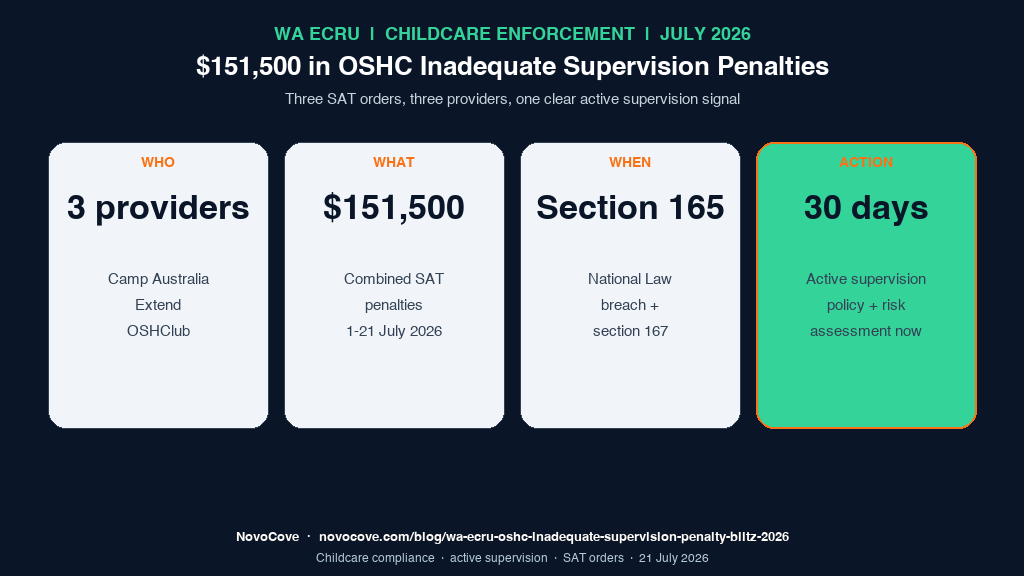
In the 30 days between 1 July and 21 July 2026, the Western Australia Department of Communities' Education and Care Regulatory Unit (ECRU) published three State Administrative Tribunal (SAT) orders against three of Australia's largest outside school hours care (OSHC) operators — Camp Australia, Extend (Australia) and OSHClub. The three penalties total $151,500. Every order named inadequate supervision of children as the operative breach, every breach engaged section 165 of the Education and Care Services National Law (WA), and every incident involved a child whose whereabouts were either unknown for a sustained period, or who was found at a location that placed them at serious risk of harm.
The three orders are not isolated. Read together with ECRU's 24 June 2026 message that "inadequate supervision within the education and care services sector is a significant concern" and with ACECQA's 24 June 2026 republished guidance "Beyond visibility: Rethinking supervision in education and care settings", they form a single, coherent regulatory signal: active supervision — not just ratio compliance, not just roster approval — is the operative standard of care the regulator will enforce in the second half of 2026.
The three SAT orders — what each one actually found
The three orders are public documents on the WA Government's website and on the eCourts Portal. They share a common factual shape but each carries a distinct operational lesson. Read them in chronological order so the regulatory pattern is visible.
- Order 1 — OSHClub Pty Ltd (Treeby OSHClub), $30,000, published 1 July 2026. A 6-year-old boy exited the service premises through the school gates on 6 October 2025 and ran home. The child crossed roads and traversed a busy shopping centre complex car park before being found at his home unharmed. The Department of Communities investigation found that the provider breached the National Law by failing to adequately supervise a child in their care. The regulator's written finding: "Even a momentary lapse of supervision can significantly increase the risk of harm to children."
- Order 2 — Extend (Australia) Pty Ltd (Marmion Primary School OSHC-Extend), $39,500, published 8 July 2026. Nine children attended an excursion to Perth Zoo on 16 April 2025 with only one educator present. On arrival, four children aged 7–11 ran off. The educator was unable to follow because she was responsible for the other five. The four children walked unsupervised around the Zoo for approximately one hour. The Department found breaches of section 165(1) (failure to adequately supervise) and section 167(1) (failure to take all reasonable precautions to protect children from harm or hazard). The regulator's written finding: "One educator cannot be expected to effectively supervise nine children for an excursion to a large venue such the Perth Zoo" and "Services must ensure that all risks are appropriately mitigated which included staffing to the assessed risks not just to the minimum ratio requirements."
- Order 3 — Camp Australia Pty Ltd (Camp Australia – Victoria Park Primary School OSHC), $82,000, published 21 July 2026. A 7-year-old boy with autism left the service alone and unsupervised on 30 January 2025. The child crossed Shepperton Road and Albany Highway — two busy Perth arterial roads — before a member of the public noticed him and alerted police. The child was returned to the service unharmed. The Department found breaches of section 165 (inadequate supervision, $40,000) and section 167 (failure to take every reasonable precaution to protect from harm and hazard, $40,000). The regulator's written finding: "The consequences of the child crossing two busy highways and several roads could have very easily been catastrophic. We know of tragic instances where children have been hit by vehicles in driveways on quiet suburban streets. The risk to the child in this situation was extremely high" and "Services must ensure that their staff are suitably trained and supported to actively supervise all children in their care, no matter their needs or circumstances. This includes developing and following Behaviour Support Plans for those children." The release also confirmed that Camp Australia has now faced disciplinary action before the Tribunal on 16 separate occasions.
Each order is fact-specific. Read them as a set and the regulator's message becomes legible: staffing to the minimum ratio is no longer sufficient; staffing to the assessed risk is the operative standard. Excursions to large venues, children with Behaviour Support Plans, school grounds with multiple access points — every one of these scenarios imposes a duty that goes beyond the bare ratio under Regulation 123.
The four operative facts every approved provider should pull from the orders
The orders are not just stories about three provider brands. They are public documents that name a standard of care. Approved providers and nominated supervisors across Australia — not just in WA — should read them for the four operative facts that survive the specific facts of each case.
- Active supervision, not roster presence. The Extend order explicitly says staffing to the assessed risk rather than the minimum ratio. The Camp Australia order explicitly says staff must be trained and supported to actively supervise children no matter their needs or circumstances, including following Behaviour Support Plans. The OSHClub order uses the phrase "momentary lapse" — the regulator is treating supervision as a continuous duty, not a checkbox on a roster.
- Behaviour Support Plans are an enforceable artefact. The Camp Australia order treats the absence of a developed and followed Behaviour Support Plan as evidence of failure to take reasonable precautions under section 167. For services that enrol children with disability, neurodivergence, or known behaviours, a current, signed, communicated Behaviour Support Plan is no longer best practice — it is evidence the regulator will look for.
- Excursion risk assessments must scale with venue, not with ratio. The Extend order is the clearest statement in this set. Nine children, one educator, ratio nominally met for a small-group excursion, but the venue was Perth Zoo. The regulator's finding is that staffing must reflect venue, group size, and assessed risk — the minimum ratio is the floor, not the ceiling. The same logic applies to vacation care excursions, in-service physical education sessions, and any OSHC activity that takes children off-site.
- Section 167 sits beside section 165. Two of the three orders (Extend and Camp Australia) engaged section 167 as well as section 165. Section 167 is the duty to take every reasonable precaution to protect children from harm or hazard likely to cause injury. It is the regulator's second front: even where active supervision was theoretically in place, the failure to anticipate and mitigate the foreseeable risk is a stand-alone breach. The pair of sections is what gives the regulator the room to penalise both the supervision failure and the risk-management failure separately, which is why Camp Australia's $82,000 order was the sum of two $40,000 penalties.
Why this matters now — ACECQA's 24 June 2026 guidance reframes active supervision
On 24 June 2026, the same week as the second SAT order against Extend, ACECQA published "Beyond visibility: Rethinking supervision in education and care settings", a blog by ACECQA's National Education Leader that reframes the active-supervision test in language that aligns almost word-for-word with the regulator's findings in the three orders.
ACECQA's reframing centres on five observations that now read like a regulator's checklist:
- Active and intentional monitoring. Supervision must be deliberate, not residual. The educator is not supervising because nothing else is happening; the educator is supervising because that is the active task.
- Clear lines of sight and auditory awareness. Position matters. The educator who is at the activity is not necessarily the educator who can see and hear the children who need monitoring.
- Educator positioning across indoor and outdoor environments. Coverage matters. Multiple educators across an OSHC space, with a positional plan, is the difference between supervision and presence.
- Risk assessment of high-risk areas. Quiet corners, transition points, entry and exit points, toilets, food-prep areas — these are the places where inadequate supervision events originate. ACECQA is naming them.
- Effective supervision during transitions. Drop-off, pickup, excursion boarding, meal transitions, end-of-session clean-up — these are the moments when supervision is most often delegated to "whoever is free." The Extend order is a case study in transition failure.
The reframing also introduces a concept that is conspicuously absent from most providers' policies: supervision as a relational practice, not a technical task. ACECQA explicitly notes that effective supervision depends on the educator's deep knowledge of each child — who is more likely to wander, who is more likely to seek a quiet corner, who is at risk in a crowd. The provider who treats supervision as a roster task is the provider whose staff cannot answer the regulator's question: "What did you know about this child that should have changed how you supervised them?"
ACECQA's reframing does not change the law — the operative standards remain sections 165 and 167 of the National Law, Regulation 122 (adequate supervision), Regulation 123 (educator-to-child ratios), and Regulation 168 (education and care service must have policies and procedures). What it does is give the regulator's framing a vocabulary it can use in tribunal findings. The three July 2026 orders use that vocabulary.
What the regulator will look at during the next assessment visit
Approved providers should expect the next assessment visit to test the active-supervosition standard on at least four dimensions. None of these dimensions is new in law — they are all already part of the National Quality Framework — but the regulator's emphasis is.
- Active supervision policy and procedure. The provider must have a written active supervision policy that names the standard (sections 165, 167; Regulations 122, 123, 168), the operative practices (positioning, scanning, transitions, excursions), the role of educator-child relationships, and the named owner of the policy. The provider who has a policy that recites the minimum ratio as the standard has a gap the regulator can name in a single line.
- Excursion risk assessment for every off-site activity. The provider must be able to produce, on demand, the risk assessment for every OSHC excursion — vacation care, after-school care visits, sports days, swimming lessons — that names the venue, the group, the staffing, the supervision plan, the head-count process, the missing-child procedure, and the communication plan. The Extend order is a working example: the provider had a risk assessment, but the staffing decision was made to the minimum ratio rather than to the assessed risk.
- Behaviour Support Plans for children who need them. For every enrolled child whose behaviour, disability, neurodivergence, or family circumstances indicate a need for a Behaviour Support Plan, the provider must produce a current, signed, communicated plan that names the supervision adjustments the educator team will apply. The Camp Australia order explicitly named the absence of a developed and followed Behaviour Support Plan as evidence of failure to take reasonable precautions under section 167.
- Educator training and qualifications evidence. The provider must be able to evidence that every educator on the roster — including casual and relief educators — has completed the active supervision training that the provider's policy requires, and that the training records are current. The active supervision training record is now the second training record the regulator will ask for (after the 27 August 2026 Foundation child safety training deadline).
The 30-day plan to evidence active supervision before your next visit
The approved provider that wants to convert the three SAT orders into a defensive evidence pack has 30 working days to build it. The plan is paced, evidence-led, and aligned to the regulator's own framing.
- Day 1 to Day 3 — Read the three orders as a leadership team. Print the three ECRU media releases and the ACECQA "Beyond visibility" blog. Hold a 60-minute leadership read-through. The output is a one-page summary of the four operative facts and the regulator's vocabulary, distributed to every nominated supervisor, person in day-to-day charge, and educational leader in the service.
- Day 4 to Day 7 — Rewrite the active supervision policy. Replace the existing policy's recital of Regulation 123 minimum ratios with the active supervision standard set out in ACECQA's 24 June 2026 reframing. Add positioning, scanning, transitions, excursion staffing, Behaviour Support Plan obligations, and the named owner of the policy. Sign off by the approved provider. Date the policy. Distribute to every educator and acknowledge receipt.
- Day 8 to Day 12 — Audit every excursion risk assessment on the books. Pull every excursion risk assessment scheduled for the next 90 days. For each one, test the staffing decision against the assessed risk — venue, group, transitions, head-count process, missing-child procedure. If the staffing decision was made to the minimum ratio rather than to the assessed risk, re-roster and re-document. The Extend order is the template for what "staffing to the assessed risk" actually means.
- Day 13 to Day 17 — Refresh the Behaviour Support Plan register. Pull every Behaviour Support Plan on file. For each one, confirm it is current, signed by the family, communicated to every educator who works with the child, and reviewed within the last 12 months. For any child without a plan where the family circumstances indicate a need, open the conversation with the family. Document the conversation. The Camp Australia order is the working example of what happens when this artefact is missing.
- Day 18 to Day 22 — Run the active supervision drill. Pick a real OSHC session or vacation care excursion. Walk the leadership team through the active supervision standard — positioning, scanning, transitions, head-counts, missing-child procedure. Time the drill. Identify the bottleneck. Update the policy for the bottleneck. The output is a dated drill record, signed by every participant.
- Day 23 to Day 26 — Refresh the training records. Pull every educator's training record. Confirm active supervision training has been completed in the last 12 months. Confirm the 27 August 2026 Foundation child safety training has been completed or is scheduled. Confirm the educator's qualification is current. The training evidence pack is the second artefact the regulator will ask for.
- Day 27 to Day 30 — Audit the evidence pack. Pull the active supervision policy, the excursion risk assessments, the Behaviour Support Plan register, the drill record, and the training records. Confirm every artefact is dated, signed, and current. Identify any gap. Remediate. Store the evidence pack in a single folder the leadership team can produce on demand. The Camp Australia, Extend and OSHClub orders will all be available to the regulator as comparators — the approved provider that produces an evidence pack that names active supervision as the standard, and can evidence it on demand, is the provider that does not become the fourth order in this series.
How NovoCove handles this
NovoCove centralises the artefacts the WA ECRU and ACECQA will look at during the next assessment visit. The platform stores the active supervision policy with version history and named owner, the excursion risk assessment template with staffing-to-assessed-risk prompts, the Behaviour Support Plan register with review-date alerts, the drill record, and the training records evidence pack in one workflow.
The active supervision policy is versioned, with a hard review-date alert 12 months after the last review. The excursion risk assessment template prompts the educator to name the venue, the group, the staffing decision against the assessed risk, the head-count process, and the missing-child procedure — the five artefacts the Extend order named as the regulatory checklist. The Behaviour Support Plan register carries review-date alerts, communication-of-plan receipts, and a signature log for every educator who works with the child.
The same platform covers the rest of your OSHC and ECEC compliance obligations — the National Quality Framework evidence pack, the Assessment and Rating visit preparation, the staff rostering and qualifications register, the 7-tier expiry alert cadence for every WWCC, first aid, asthma, anaphylaxis and food safety credential, the National Early Childhood Worker Register 14-day update rule, and the Foundation child safety training completion record for the 27 August 2026 deadline. If your OSHC service is the next name on the regulator's enforcement register, NovoCove is built to make sure the active supervision evidence pack is the artefact the regulator sees first.
Official sources
- Approved provider in Victoria Park penalised after seven-year-old child found one kilometre from service (Camp Australia, $82,000) — WA Department of Communities ECRU (T1, 21 July 2026)
- $39,500 penalty for inadequate supervision of children during Zoo visit (Extend, $39,500) — WA Department of Communities ECRU (T1, 8 July 2026)
- Approved Outside School Hours Care provider in Treeby penalised for inadequate supervision (OSHClub, $30,000) — WA Department of Communities ECRU (T1, 1 July 2026)
- Beyond visibility: Rethinking supervision in education and care settings — ACECQA (T1, 24 June 2026)
- Quality Area 2: Children's health and safety — Adequate supervision — ACECQA (T1)
- Child safety changes: National Quality Framework strengthening safety in education and care — ACECQA (T1)
- Notification types and timeframes — ACECQA (T1)
- WA State Administrative Tribunal recent decisions — eCourts Portal (T1)
- Education and Care Services National Law (WA) — WA Legislation (T1, sections 165 and 167)
This guide is general information and is not legal advice.