Childcare compliance
End of 'Under the Roof' Ratios: What the 2026 Reform Means for Childcare Staffing Compliance
In February 2026, Education Ministers accepted all four of ACECQA's recommendations to close the 'under the roof' ratio loophole — the long-contested practice of counting educators anywhere in the building, not just in the room they are supervising, toward the mandatory educator-to-child ratios under Regulation 123. The National Law and Regulations have not yet been formally amended, but the policy intent is unambiguous and ACECQA is drafting binding guidance. This is the practical guide for every approved provider, nominated supervisor and centre director: what the loophole actually is, why it has been controversial for over a decade, and the concrete steps to re-architect your staffing before ACECQA's new advice takes effect.
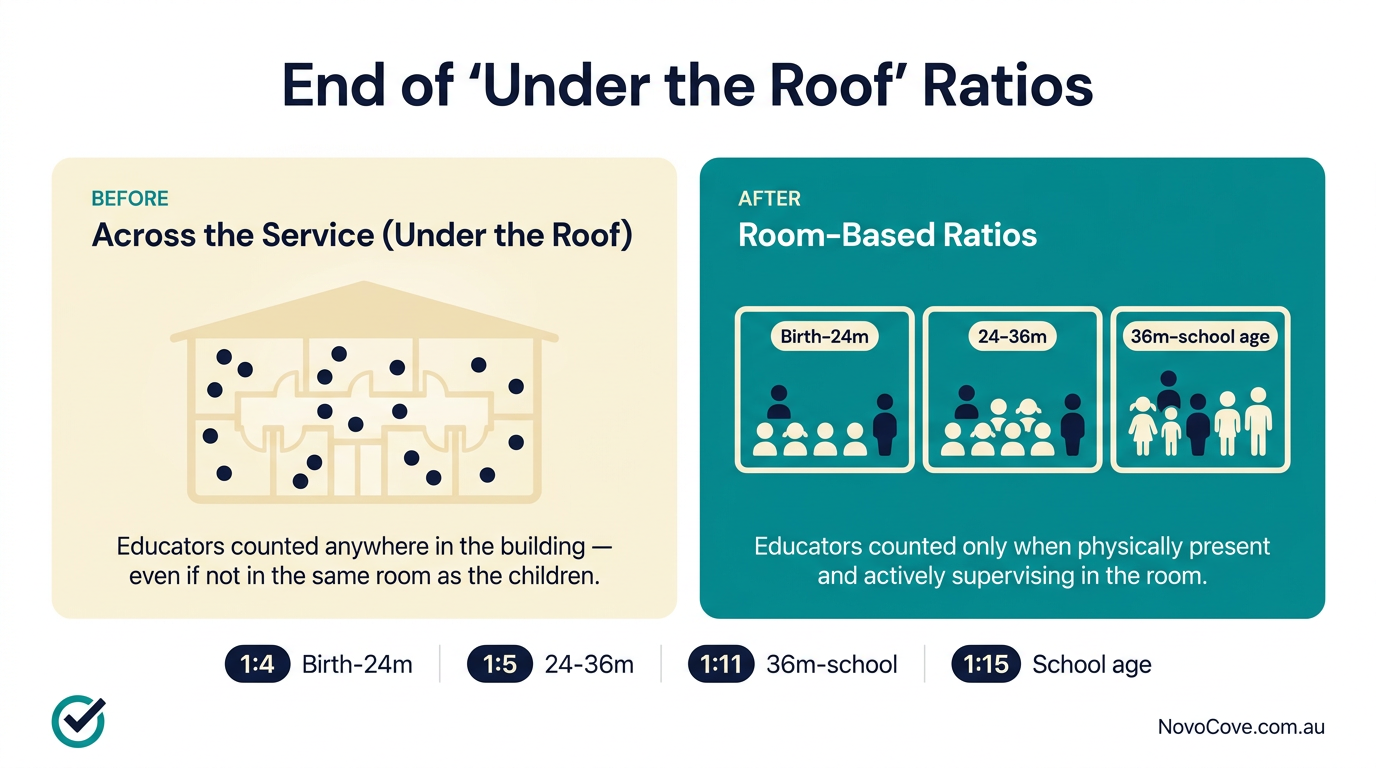
For more than a decade, Australian childcare centres have been able to count educators anywhere in the building — not in the same room as the children — toward the mandatory educator-to-child ratios under Regulation 123 of the Education and Care Services National Regulations. That practice, known as "under the roof" or "across the service" ratios, has been the single most contested loophole in the National Quality Framework. In February 2026, Education Ministers from every Australian jurisdiction accepted all four recommendations in ACECQA's rapid assessment of child safety practices, including a binding commitment to remove the practice from the National Law. ACECQA is now drafting the operational guidance that will determine what compliant staffing looks like from the day the new regulation takes effect. This guide is for every approved provider, nominated supervisor, and centre director who needs to act before that day arrives.
What "under the roof" ratios actually mean
Under Regulation 123 of the Education and Care Services National Regulations, every centre-based education and care service must maintain minimum educator-to-child ratios in any room where children are being educated and cared for. The national ratios are:
- 1:4 for children from birth to 24 months
- 1:5 for children aged 24 to 36 months
- 1:11 for children aged 36 months up to school age
- 1:15 for school-age children in outside-school-hours care
The "under the roof" loophole, formally described as "across the service" ratios in the National Regulations, allowed approved providers to demonstrate compliance with these ratios by aggregating the total number of educators and children across the entire service, rather than within each individual room. In practice, this meant a centre could run a toddler room with fewer than 1:5 in the room itself, as long as an educator somewhere else in the building — a cook finishing food prep, an admin officer at the front desk, a float educator on a coffee break — was counted in the maths.
Why the loophole became a child safety problem
The "under the roof" loophole was always controversial, but it became a frontline child safety issue in 2024 and 2025 after a series of high-profile supervision failures — most notably the runaway child incident at a NSW centre that triggered the original ABC investigation and the federal government's rapid review of child safety practices in ECEC. ACECQA's review found that the practice had three predictable failure modes:
- Misleading compliance. Rosters showed ratios were met. Rooms did not. Authorised officers and ACECQA assessors had no way to verify per-room staffing from the documentation alone.
- Supervision lapses. An educator counted in the ratio for one room was physically in another. The 2024 ABC investigation documented multiple incidents where the supervising educator had been counted against a different age group while a child in their nominal room had a toileting accident, an unwitnessed fall, or an unsupervised interaction with another child.
- Workforce pressure. Centres that genuinely could not fill the roster on a given day used the loophole as a permanent workaround, masking the underlying staffing shortage rather than addressing it. The royal commissioners and ACECQA both noted that the loophole effectively subsidised understaffing.
What changed in February 2026
On 27 February 2026, Education Ministers from every Australian state and territory met under the Education Council and accepted all four recommendations of ACECQA's rapid assessment of child safety practices. Two of those recommendations directly affect staffing:
- Remove the "across the service" provision — the formal name for the "under the roof" loophole — from the National Law, closing the loophole created in 2014. Ratios must be met in each room, not across the service.
- Clearly define the meaning of "adequate supervision" under Regulation 122, so the test is the educator's physical presence with the children, not a paper roster.
The same announcement bundled the change with the package of other 27 February 2026 reforms covered elsewhere on this blog — the paramountcy provision, mandatory child safety training, the National Early Childhood Worker Register, and the new "inappropriate conduct" offence. Unlike those measures, the under-the-roof change is not yet law. As of mid-2026, the National Law and Regulations have not been formally amended; ACECQA is preparing binding guidance to issue in the interim so services understand what compliant practice looks like the moment the amendment lands.
Current legal status (June 2026)
Approved providers should be clear-eyed about what has and has not yet changed:
- Policy intent is settled. Every Education Minister has signed on to the removal. There is no realistic prospect of the change being deferred, weakened, or scoped down.
- The law has not yet been amended. The National Regulations still permit "across the service" calculations until the amendment is made. Centres using service-wide rosters today are not, strictly, in breach.
- ACECQA guidance is the next milestone. ACECQA has flagged that when the binding guidance issues, ratios will be required per room, with educators counted only when physically present and actively supervising children.
- Authorised officers and assessors are watching. Even within the existing law, Reg 122 requires "adequate supervision." Inspectors investigating a serious incident are increasingly applying the standard the new law will formalise — if the supervising educator was not in the room, the service is at risk regardless of the rosters.
What the new regime will require
Once the regulation is amended and ACECQA's guidance takes effect, compliant staffing will look materially different. Approved providers should plan for the following operational changes:
- Room-based ratios, not service-wide. Each room must independently meet the 1:4 / 1:5 / 1:11 / 1:15 requirement for the age group in that room. An educator in a different room does not count.
- Float staff only count when physically present. A relief educator moving between rooms can only be counted toward the ratio of the room they are actually in at that moment. They cannot be double-counted across two rooms, even if they are moving between them.
- Break coverage must be explicit. Ratios must remain intact during staff rotations, meal breaks, and toilet breaks. A cook or admin officer cannot be counted toward the ratio under any circumstance.
- Adequate supervision is a separate test. Even with the right number of educators in the room, Reg 122 will require each educator to be actively supervising. Sitting in the staffroom with a baby monitor does not meet the new standard.
- Rosters must be auditable per room, per shift. A roster that shows total educators on the floor is no longer sufficient evidence. Assessors and authorised officers will want to see room-level assignments and live sign-in/sign-out data.
What to do now to prepare your service
The February 2026 announcement gives approved providers a clear runway to fix the operational and roster plumbing before the law catches up. The services that handle this well will use the next six to twelve months to do five things:
- Audit your current rosters at the room level. Pull the last four weeks of rosters and map every educator to the room they were scheduled in, not the building. Identify the rooms where you have been relying on service-wide counting to appear compliant.
- Re-cost your staffing model. Room-based ratios will increase the total educator hours you need, particularly during peak periods, breaks, and the first and last hours of the day. Build the cost into the next budget cycle before CCS rate changes and the increased regulatory fee regime compound the impact.
- Train nominated supervisors and educators on "adequate supervision."The new Reg 122 wording will require every educator to understand that presence in the room is not optional and that the active supervision standard is the test, not the roster.
- Update your rostering system to capture room-level data. If your current system only tracks sign-in and sign-out at the building level, it cannot produce the per-room evidence an assessor will ask for. Move to a system that records room assignment at sign-in.
- Document the transition. Capture the policy decision to move to room-based ratios, the communication to staff and families, and the date each room started operating on the new model. This becomes part of the evidence pack for your next assessment and rating visit.
How NovoCove handles this
NovoCove was built for exactly this kind of regulatory shift. The platform maps every educator to a specific room, qualification, and current certification, so the moment ACECQA's new guidance takes effect, your service can produce a per-room, per-shift staffing record without re-architecting your rostering workflow.
Live alerts flag the day a casual reliever has not yet signed in, when a float staff member is being double-counted across rooms, or when break coverage drops a room below ratio — the exact failure modes that will surface in any investigation after the amendment takes effect. The same evidence pack flows through to your assessment and rating visit, your next authorised officer inspection, and your Family Assistance Law compliance file, so the change is visible to every regulator that asks for it.
If you have been relying on service-wide rosters to get through staffing shortages, NovoCove's ratio modelling tool lets you simulate the move to room-based ratios and see the educator-hour and cost impact before you commit to the change. That is the conversation every approved provider will be having with their finance team over the next twelve months — and the services that start it now will be the ones that meet ACECQA's new standard on day one.
This guide is general information and is not legal advice.