Regulatory update
NQS 2026 Refinements: How Quality Areas 2 and 7 Reshape Child Safety in Every Australian ECEC Service
From 1 January 2026, refinements to the National Quality Standard explicitly embed child safety in Quality Areas 2 and 7. Element 2.2.3 is renamed Child Safety and Protection, and Standard 7.1 makes governance directly accountable. Here is the operator guide to the new wording, the evidence you need at your next assessment and rating visit, and the 90-day plan to get your service ready.
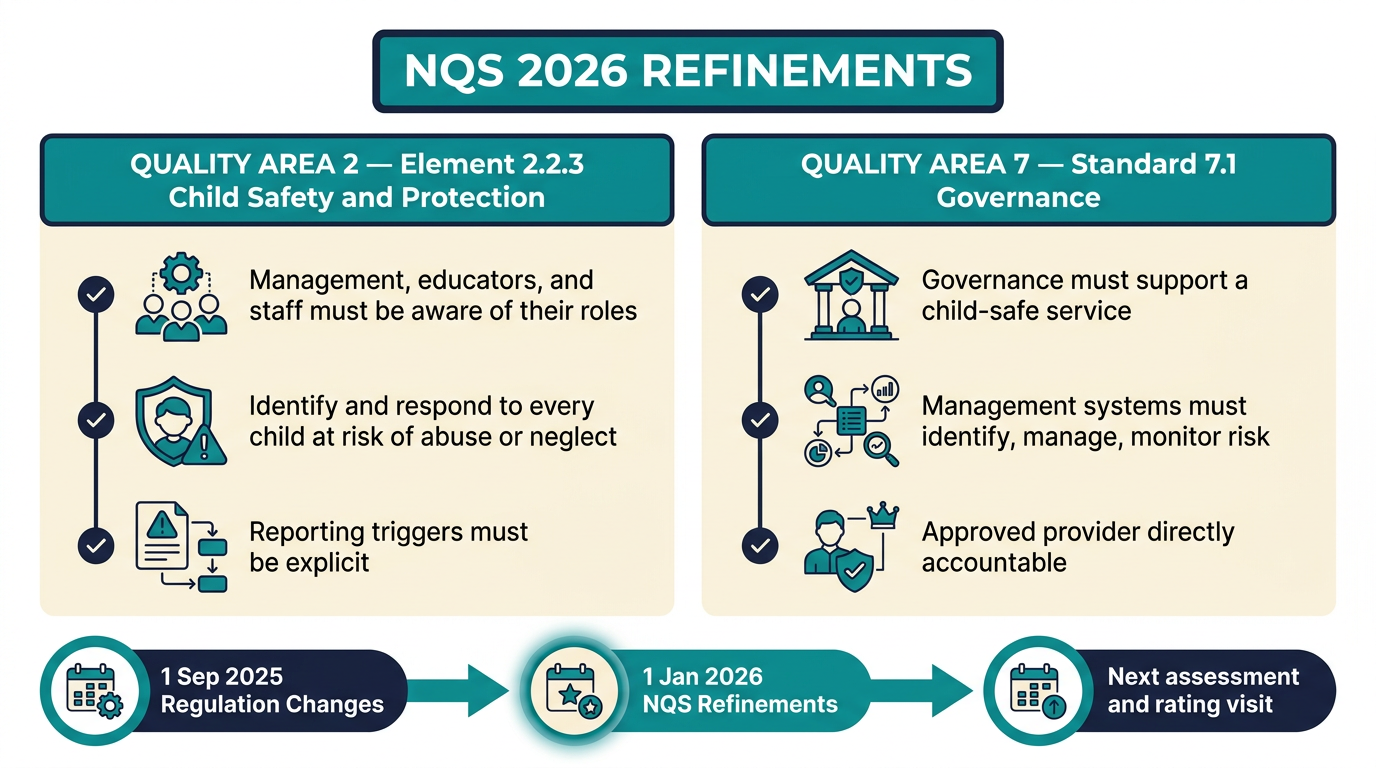
The next time an ACECQA authorised assessor walks into your service — for a reassessment and rating visit, a random assessment under the National Law, or a regulatory investigation — the language in the National Quality Standard (NQS) they will score you against is not the language you prepared for last time. From 1 January 2026, refinements to the NQS explicitly embed child safety into Quality Area 2 (Children's Health and Safety) and Quality Area 7 (Governance and Leadership). Element 2.2.3 is renamed Child Safety and Protection, and Standard 7.1 is rewritten to make governance directly accountable for a child-safe service. This is not a tweak. It is the largest NQS reframing in a decade, and it is the framework against which your service will be assessed at every visit from now on.
Where the 2026 NQS refinements came from
The trigger is the Review of Child Safety Arrangements under the NQF, published by ACECQA in December 2023. The Review found that the NQS contained explicit child-safety language in some Quality Areas but not others, and that Quality Area 2 — the natural home for child safety obligations — relied on implied rather than explicit wording. In response, Education Ministers agreed to a two-stage reform:
- 1 September 2025 — Regulation changes. New obligations in the Education and Care Services National Regulations covering digital technology and online environments, allegations and incidents of physical and sexual abuse, mandatory reporting triggers, and the strengthened child safe standards.
- 1 January 2026 — NQS refinements. Renaming Element 2.2.3 to Child Safety and Protection and rewriting Standard 7.1 to explicitly state that governance must support a quality service that is child safe, with management systems that identify, manage and monitor risk effectively.
The point of the NQS refinement is to make sure the assessment framework scores what the regulations now require. An authorised assessor can no longer tick Quality Area 2 because your policies mention child safety in passing — they now have a specific Element (2.2.3) and a specific Standard (7.1) against which to score the wording, the evidence, and the leadership practice.
Quality Area 2 — what Element 2.2.3 now requires
Quality Area 2 (Children's Health and Safety) has always been the obvious place for child-safety obligations. The 2026 refinement acknowledges that obviousness was not enough and gives the obligation a named, scored element. Under the new wording for Element 2.2.3 — Child Safety and Protection, the service must demonstrate that:
- Management, educators and staff are aware of their roles and responsibilities in identifying and responding to every child at risk of abuse or neglect. This is a per-person obligation, not a service-level policy statement.
- Reporting triggers are explicit and understood by every worker, including the new 1 September 2025 allegations and incidents triggers, the state-level mandatory reporting laws, and the inter-agency reporting pathways (child protection, police, regulator).
- Children at risk of abuse or neglect are responded to appropriately — meaning the service can evidence a real response in a real case, not just describe a hypothetical one.
In practical terms, Element 2.2.3 will be assessed through a combination of policy review, staff interview and evidence of past responses. The evidence expectation has moved from "do you have a child protection policy" to "can every staff member articulate their role, can you show the last three responses, and do your reporting triggers match the current regulation and state law".
Quality Area 7 — what Standard 7.1 now requires
Quality Area 7 (Governance and Leadership) was the more interesting change. Until 1 January 2026, Standard 7.1 was a general governance standard: "Governance supports the delivery of a quality service". The 2026 refinement inserts child safety directly into the governance obligation, stating that governance must support a quality service that is child safe, with management systems that identify, manage and monitor risk effectively.
Three governance obligations have moved from being implied to being explicit:
- Governance accountability for child safety. The approved provider and the nominated supervisor are now directly accountable — not just for policies on paper, but for the live operation of child-safe systems across the service.
- Risk management is a scored element, not a back-office function. The assessor's expectation is that the service can produce a current risk register tied to child safety, not a generic WHS risk register from 2023.
- Continuous improvement is now explicitly child-safe. The Quality Improvement Plan (QIP) is expected to track child-safety outcomes, not just regulatory compliance metrics.
For an approved provider operating multiple services, this is the change with the biggest board-level implications. The 2026 Standard 7.1 wording makes it clear that a single service's child-safety failure reflects on the approved provider's overall governance, not just on the service manager.
How this lands at the next assessment and rating visit
ACECQA has confirmed that all assessment and rating visits from 1 January 2026 onwards will score against the refined NQS. That includes reassessments, random assessments, and reviews triggered by complaint or incident. The Q1 2026 NQF Snapshot showed 92% of services meeting or exceeding NQS, but that data is from the old wording. Under the 2026 refinements, expect:
- Element 2.2.3 is now a scored element. Services that were rated Meeting under the previous implicit child-safety wording may be re-rated Working Towards if the assessor determines that staff role awareness is not demonstrable.
- Standard 7.1 is now a scored standard with an explicit child safety dimension. A service with strong operational compliance but weak governance evidence (think: a thin board pack, no risk register, or a QIP that has not been updated in 18 months) will struggle to hold an Excellent rating under the refined wording.
- The "exceeding" threshold has moved. Exceeding NQS used to mean having a strong quality improvement story. Under the 2026 refinements, exceeding Quality Area 7 specifically means embedding child safety into governance practice — not just having strong policies.
The connection to the 1 September 2025 regulation changes
The two stages of the NQF reform are designed to work together. The regulation changes from 1 September 2025 created new legal obligations in the Education and Care Services National Regulations around digital technology policies, allegations of physical and sexual abuse, and family day care (FDC) arrangements. The 1 January 2026 NQS refinements then create the assessment framework against which compliance with those regulations is scored.
For an approved provider, the practical consequence is that the work you did on 1 September 2025 (policies, staff briefings, digital technology frameworks) is the foundation for the work you need to do for 1 January 2026 (evidence mapping, role-awareness training, risk registers, QIP updates). If you treated the September work as a one-off policy update, you are starting the 2026 work from behind. If you treated it as the first half of a two-stage reform, you are well-positioned.
The 90-day plan: how to get your service ready
The refinements have been live since 1 January 2026. Most services are running 90 to 180 days behind the curve. The plan below has worked across small (20-educator) and large (200+ educator) services and maps the 1 January 2026 NQS refinements to operational actions:
- Week 1-2: Re-baseline against the new wording. Pull your current Quality Area 2 and Quality Area 7 evidence folders. For each item, ask: "Does this still answer the new Element 2.2.3 / Standard 7.1 wording, or is it an artefact of the old implicit language?" Anything that does not answer the new wording gets flagged for rebuild.
- Week 3-6: Rebuild the child-safety evidence stack. For Element 2.2.3, build: a per-staff child-safety role statement, a current incident response log with the last 3-5 real responses, and a current reporting trigger matrix (regulation + state law + internal). For Standard 7.1, build: a current child-safety risk register, a current QIP with child-safety outcomes, and a governance pack showing approved-provider oversight of child safety.
- Week 7-8: Train and interview-prep the team. Run a whole-team briefing on the new Element 2.2.3 wording, the role statements, and the assessment interview process. The interview is the test — give every staff member the chance to practice answering the "what would you do if…" question in a low-stakes setting.
- Week 9-10: Governance review. For approved providers, take the rebuilt child-safety evidence to the next board or management committee meeting. The 2026 Standard 7.1 wording requires that governance can speak to child safety, not just receive a compliance report. Build the governance pack so the board is ready for a Standard 7.1 question.
- Week 11-12: Map evidence to ACECQA's assessment pack. Take the rebuilt evidence and produce the ACECQA assessment and rating evidence pack — organised by NQS Quality Area, with each item mapped to the specific Element or Standard it satisfies. The pack should be ready to hand to an assessor on the day of the visit.
How NovoCove handles this
The 2026 NQS refinements are exactly the kind of change that spreadsheets lose track of within a quarter. NovoCove turns the Element 2.2.3 and Standard 7.1 wording into a tracked evidence map: each child-safety obligation lives as a checklist item on the service record, each piece of evidence (policy version, training certificate, incident log, governance minute) is attached to the obligation it satisfies, and the whole map rolls up into the ACECQA assessment and rating pack in a single click.
On the day an authorised assessor walks in, you open the service record, show the Element 2.2.3 evidence stack (role statements, incident log, training matrix), show the Standard 7.1 governance pack (risk register, QIP, board minutes), and answer the interview questions from the live system. There is no folder to dig through, no PDF to scroll to, no panic about whether the last incident response from March is up to date.
For services operating across multiple states, NovoCove also tracks the state-level child-safety layers (NSW Child Safe Scheme, QLD Reportable Conduct Scheme, VIC Child Safe Standards) in the same record — so the federal NQS refinement, the state-level regulator obligations, and the governance evidence are visible in one place rather than scattered across three different portals and a shared drive. The 1 January 2026 NQS refinements are not a one-off policy update; they are an ongoing evidence obligation that needs to be tracked for as long as the service operates. NovoCove treats it that way from day one.
This guide is general information and is not legal advice.