Childcare compliance
The National Early Childhood Worker Register: The 14-Day Rule, the Hidden Scope, and the Workflow Your Centre Actually Needs
It has been 100 days since the Register went live. The 27 March 2026 initial deadline has passed. And the 14-day update obligation most centres treated as a one-time data entry exercise is now the part regulators will measure.
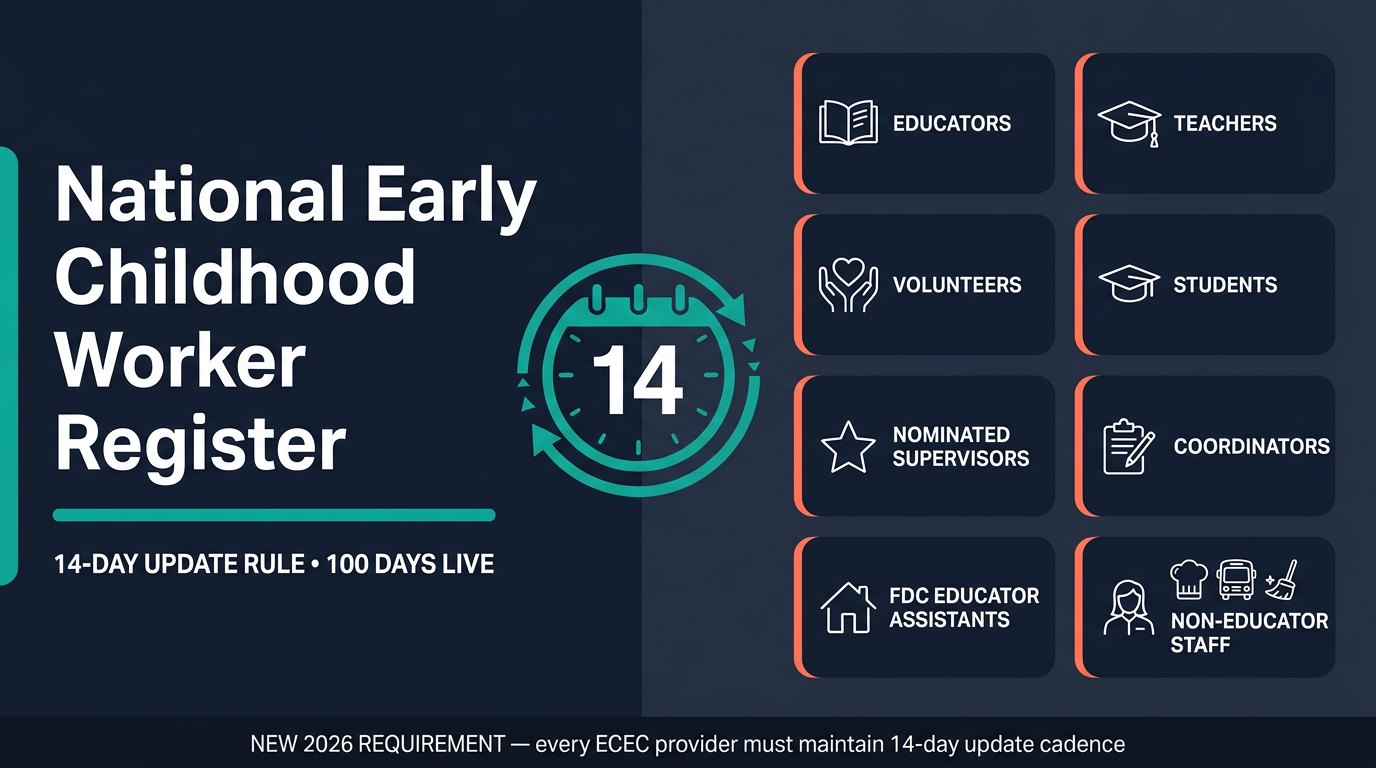
On 27 February 2026, the National Early Childhood Worker Register (the Worker Register) became operational across Australia. By 27 March 2026, every approved provider was required to have entered their current workforce into the Register via the National Quality Agenda IT System (NQAITS). That deadline has now passed. The question for most centre directors, nominated supervisors, and compliance leads is no longer "do I need to be on it?" — it is "am I keeping it current?"
The Register is governed by amendments to the Education and Care Services National Law and the accompanying National Regulations, and the practical obligation is tighter than most providers realised when the system first launched. The headline rule, buried inside the National Regulations, is this:
For a sector used to "set and forget" compliance spreadsheets, that 14-day cadence is the part that catches directors off guard during regulator assessment contacts. This guide walks through what the Register actually requires, who is in scope (it is broader than most centres think), the FDC exception that catches family day care providers out, and the workflow you need to keep the data current without dropping a shift change in the cracks.
What the Worker Register actually is
The Worker Register is a centralised, national database of every person working or engaged in an approved education and care service. It is hosted on the National Quality Agenda IT System (NQAITS) and is operated by ACECQA on behalf of all state and territory regulatory authorities. The purpose, in the regulator's own words, is to provide "a secure, national view of who is working in education and care services and where" — improving regulatory oversight and supporting child safety across the sector.
The Register is the foundational infrastructure for two further reforms that are already in motion:
- Mutual recognition of WWCC negative notices — the "banned in one, banned in all" scheme endorsed by all attorneys-general on 14 November 2025. The Register gives regulators a single source of truth for the workforce, which makes cross-jurisdictional negative notice recognition operationally possible.
- The National Continuous Checking Capability — a planned real-time background checking system that is expected to come online progressively over the next two to three years. The Register is the data layer that continuous checking will read from.
In other words, the Worker Register is not a stand-alone data entry obligation. It is the platform on which the next decade of ECEC workforce regulation will run. The accuracy and timeliness of the data you enter now determines the integrity of every downstream system the regulator builds on top of it.
The 14-day update rule — what is actually changing
The National Regulations require approved providers to update the Worker Register in two specific circumstances, and both run on a 14-day clock:
- Within 14 days of a worker being employed, engaged, or appointed.This covers new starters, returning staff after a break, casual staff added to a roster for the first time, students on placement, and volunteers who join the service. The clock starts on the day the person commences.
- Within 14 days of becoming aware of any change to information.This covers role changes, qualification updates, address changes, name changes, contact detail updates, terminations, and any other change to information already entered in the Register. The clock starts on the day the provider becomes aware of the change — which is typically the day the change is communicated to the centre director or nominated supervisor.
The 14-day window is short by design. State and territory regulators want real-time visibility into who is working in services, not a workforce register that is months out of date. For a large multi-site provider with weekly staff turnover, this means the Worker Register cannot be a quarterly project. It has to be a daily operational workflow tied to the staff management system you already use.
Who is in scope — the broader category most centres miss
The Worker Register scope is broader than just educators. The SA Education Standards Board, publishing on behalf of all jurisdictions, lists the following categories of person that approved providers must record:
- Educators (Certificate III, Diploma, ECT-qualified)
- Teachers (university-qualified early childhood teachers)
- Volunteers (parent helpers, community volunteers, work experience)
- Students (placement students, practicum students, university interns)
- Nominated supervisors
- Coordinators (including FDC coordinators)
- Family day care educator assistants
- Non-educator staff — explicitly including bus drivers, cooks, and cleaners
The non-educator staff category is the one that catches centres out most often. A cook who prepares meals on-site, a bus driver who transports children on excursions, or a cleaner who works in the service after hours — all of them need to be on the Register. The regulator's framing is that any person whose work brings them into contact with the service's operations, premises, or children is in scope.
The implicit logic is child safety: anyone who enters the service environment is a potential risk vector, and the regulator wants visibility of who they are, whether they hold a current WWCC, and what training they have completed. A 2026 service without a fully populated Register — including its cooks and cleaners — is leaving itself exposed to non-compliance findings during an assessment contact.
The family day care exception — and why it trips providers up
For FDC providers, the scope of who must be on the Register is nuanced and the nuance is the source of most non-compliance:
- FDC staff who work solely at a FDC principal office and do not usually visit FDC residences or approved venues are NOT required to be on the Register.This is a narrow exemption. It applies only to office-based staff whose role does not bring them into contact with FDC residences or approved venues in the normal course of their duties.
- FDC staff who are based at the principal office but usually visit FDC residences or approved venues ARE required to be on the Register. This includes nominated supervisors, FDC coordinators, educator assistants, and students — even if they only visit a residence occasionally.
The FDC educator themselves is always in scope, of course — they are the regulated service. The exemption only applies to purely office-based staff (for example, a back-office finance person who never visits a residence). An FDC coordinator who conducts quarterly visits to each residence is in scope, even though the majority of their time is spent at the principal office.
What you have to record for each person
The Register captures a structured set of identity, contact, role, qualification, and training data for every in-scope person. The required fields, as published by ACECQA and confirmed in the NQAITS portal, include:
- First name and last name
- Date of birth
- Gender
- Residential address
- Mobile phone
- Email address
- Role (educator, teacher, volunteer, student, nominated supervisor, coordinator, FDC educator assistant, non-educator staff)
- Work location (which service they work at)
- Employment nature (full-time, part-time, casual, contractor, volunteer)
- Employment start and end dates
- Qualifications held (Certificate III, Diploma, Bachelor, etc.)
- First aid training status and expiry date
The qualification and first aid training fields are the ones that overlap with the broader certification tracking you are already doing. The Worker Register effectively requires you to push your staff certification data into the NQAITS portal in a regulator-readable format, with the dates and qualification details kept current.
The regulator's expectation is that the Register is the canonical source of "who is working in services and what they are qualified to do." If your internal staff management system says a person has a current First Aid certificate but the Worker Register does not, that gap is a compliance finding waiting to happen.
The penalty context — why this matters more than a data entry chore
The Worker Register obligation sits inside a much tougher 2026 enforcement environment. From 1 January 2026, the maximum penalties under the National Law were tripled, with individual penalties of up to $172,000 and corporate penalties for large providers exceeding $500,000 in some states. Failure to maintain the Worker Register carries its own specific penalty under the National Regulations:
- Up to $6,600 for an individual (approved provider, nominated supervisor, or person in management or control)
- Up to $34,200 for a body corporate
- Ongoing non-compliance is an offence under the National Law, with each day of non-compliance being a separate offence
- Pattern non-compliance is a factor in approval renewal, suspension, or cancellation decisions by state and territory regulatory authorities
The practical read is that the Worker Register is not enforced through a single high-profile fine — it is enforced through cumulative low-level findings during assessment and rating visits, and through the trail of evidence regulators pull when investigating other incidents. A 2026 enforcement action in Queensland, for example, cited a centre fined $12,000 for a child safety incident that the regulator's follow-up investigation linked to incomplete workforce records — including Worker Register entries.
Common mistakes specific to the Worker Register
From the sector commentary and provider guidance published since the 27 February launch, the most common mistakes fall into a small number of patterns:
- Treating it as a one-time data entry. Centres that hit the 27 March deadline by uploading their current workforce have treated the obligation as complete. They are missing the 14-day update rule.
- Missing non-educator staff. The cooks, cleaners, and bus drivers are the most commonly omitted categories, because they do not appear in the educator-focused staff management workflows centres have used for years.
- Ignoring the FDC exception for office-based staff. Some FDC providers have registered every staff member (including purely office-based finance and HR staff) because they are worried about getting it wrong. Others have exempted the wrong people. Both directions create compliance exposure.
- Stale first aid and qualification data. The Register requires current training and qualification data. If your staff certifications are tracked in a separate spreadsheet, the two systems drift, and the Register becomes out-of-date within weeks.
- No termination workflow. The Register needs leavers removed within 14 days. Centres that have a strong onboarding workflow often have no corresponding offboarding workflow, so terminated staff stay on the Register.
- No bulk upload or system integration. The NQAITS portal supports individual online entries and bulk upload. Centres that are still keying entries one at a time fall behind within a month of launch.
A compliant Worker Register workflow in 2026
The providers handling the Worker Register well have built it into their existing staff management system, not as a separate compliance project. The key elements of a compliant workflow are:
- Onboarding triggers the Register entry. The moment a new starter's paperwork is signed, a structured record is created with every field the Register requires — name, DOB, contact details, role, work location, employment nature, qualifications, first aid status. The data is collected once, in one place.
- Role, location, and qualification changes auto-flag. A change to any field that maps to a Register field is flagged for the next 14-day update window. The system compiles the change set, the user reviews and confirms, and the NQAITS upload is generated as a single batch.
- Termination triggers removal. A leaver's record is flagged for removal at the same time the offboarding paperwork is signed. The "end date" field is populated, and the record is removed from the Register within the 14-day window.
- Certification expiry triggers a re-entry. When a first aid certificate expires and is renewed, the new expiry date flows into the Register automatically. There is no separate data entry step.
- Bulk upload to NQAITS weekly or daily. For providers with regular staff turnover, a weekly bulk upload to NQAITS is the practical cadence. The upload file is generated from the staff management system, validated, and submitted.
- Audit trail preserved for 7 years. Every change, every upload, every confirmation is timestamped and stored. The audit trail is available to the regulator during an assessment contact, and it is the evidence that the 14-day rule was met.
How NovoCove handles the Worker Register
NovoCove's staff management module was designed to make the Worker Register a byproduct of the work you already do to manage your staff. The same record that holds your educator's qualifications, WWCC status, and first aid certificate is the record that flows to the Register.
When a new starter is added to NovoCove, the system:
- Captures every field the NQAITS portal requires — name, DOB, contact details, role, work location, employment nature, qualifications, first aid status
- Maps the role field to the correct Worker Register category (educator, teacher, volunteer, student, nominated supervisor, coordinator, FDC educator assistant, non-educator staff)
- Generates the NQAITS-ready record set, ready for upload on the next cadence
- Surfaces the 14-day update clock the moment any field changes — role, location, contact details, qualifications, first aid status, employment dates
- Tracks terminations as removals from the Register, not just a status change in your staff file
- Generates bulk upload files in the NQAITS format, with validation against the field requirements before submission
- Preserves the full audit trail — every change, every upload, every confirmation timestamped and stored for 7 years
- Cross-references the Register data against your broader certification tracking, so WWCC status, first aid expiry, and qualification status are consistent across systems
The result is that the Worker Register stops being a compliance chore and becomes a side effect of managing your staff well. By the time the regulator pulls up your service during an assessment contact, the Register is current, the audit trail is complete, and the 14-day rule is demonstrably met.
For a sector that is already absorbing the tripled penalties, the NQS Quality Area 2 and 7 refinements, the National Continuous Checking Capability rollout, and the ongoing WWCC mutual recognition scheme, the Worker Register is one more piece of infrastructure that needs to be in place — but it is also the piece that ties everything else together. Get it right, and the rest of the 2026 child safety reform agenda is far easier to manage.
This guide is general information and is not legal advice.