Queensland ECEC regulation
Queensland ECS Regulation 2026: What Changes for QEC Services from 1 September
On 1 September 2026 the Education and Care Services Regulation 2026 (ECS Regulation) replaces the Education and Care Services Regulation 2013 in Queensland. The new regulation applies to Queensland Education and Care (QEC) approved services — the services regulated under the Education and Care Services Act 2013 that sit outside the National Quality Framework (NQF). Most of the changes bring QEC services up to requirements that NQF services have operated under for years: regular transportation rules with written authorisations and record-keeping, sleep and rest policies with a ban on bassinets, national child safe principles, a 24-hour deadline for reporting suspected physical or sexual abuse of a child, a vaping ban, digital technology policies, and clearer incident, first aid and qualification rules. Some requirements commence immediately on 1 September 2026; others carry 1-month or 3-month transition periods through 1 October and 1 December 2026. Here is what the change means for QEC approved providers, the six operational actions, and the 30-day workflow that gets you compliant before the transition deadlines land.
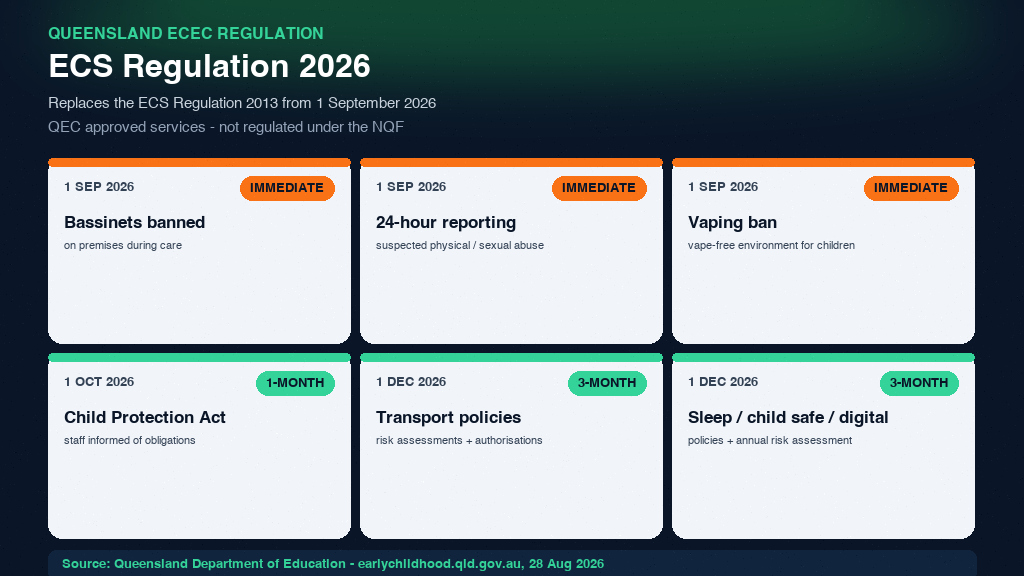
On 1 September 2026, the Education and Care Services Regulation 2026 (ECS Regulation) replaces the Education and Care Services Regulation 2013 in Queensland. For the first time, Queensland Education and Care (QEC) approved services — the services approved under the Education and Care Services Act 2013 and regulated outside the National Quality Framework (NQF) — inherit a suite of child-safety requirements that NQF services have been operating under for several years. Bassinets are banned, suspected physical or sexual abuse of a child must be reported within 24 hours, vaping is prohibited on premises, and new policies are required for transport, sleep and rest, child safety culture, complaints and digital technologies.
Background: what the ECS Regulation is and who it covers
The Education and Care Services Regulation sets out the operational requirements for Queensland Education and Care (QEC) approved services under the Education and Care Services Act 2013. These are services that are not regulated under the National Quality Framework — most commonly in rural and remote areas of Queensland, where the department has confirmed the affected services are concentrated. The regulation covers how these services transport children, manage sleep and rest, keep children safe, handle complaints, record incidents, and ensure staff hold current training.
The 2013 regulation has sat largely unchanged while the NQF, and the national requirements beneath it, moved forward. The new ECS Regulation is explicitly built on reforms introduced in the National Regulations and responds to three things: reviews of the NQF, the Royal Commission into Institutional Responses to Child Sexual Abuse, and a coronial investigation. In practice this means Queensland has pulled the QEC rulebook up to the national line — aligning QEC services with requirements that already apply to NQF services, and adding a small number of Queensland-specific child-safe measures.
The context matters for every provider that operates, or works with, QEC approved services. The transition is not a small set of tweaks: it attaches penalties to policies, risk assessments and notifications that were previously lighter-touch, and it does so on a fixed clock. Three commencement dates now drive the compliance calendar for QEC services — 1 September 2026, 1 October 2026 and 1 December 2026.
What changed and when: the ECS Regulation 2026 commencement calendar
The new ECS Regulation introduces changes across five areas: regular transportation, sleep and rest practices, national child safe principles, recommendations from the 2023 Review of Child Safety Arrangements under the NQF, and miscellaneous clarifications that align QEC requirements with the National Regulations. The changes split into three commencement waves:
- 1 September 2026 — immediate, no transition period. The bassinet ban (section 35), the 24-hour reporting requirement for suspected physical or sexual abuse (section 16(d), via the serious incident definition), the vaping ban (section 20), the narrowed definition of serious incident for emergency services attendance (section 16(c)), the 24-hour parent notification window for illness or injury (section 22), the 24-hour record-making window for incidents, injuries, trauma and illness (section 33), the definition of "current" first aid, anaphylaxis and asthma training (section 70), and the expanded school age care qualification list (section 61).
- 1 October 2026 — 1-month transition. The requirement that QEC approved providers ensure staff are informed about their obligations under the Child Protection Act 1999 (section 23).
- 1 December 2026 — 3-month transition. Transport policies, risk assessments and written authorisations, plus the safe-arrival procedures and notification of starting or stopping regular transportation (sections 26-30, 79-83, 93(2)(g)/(i)); sleep and rest policies and the annual risk assessment (sections 36-40); the child safety culture content in "safe environment for children" policies (section 93(2)(j)); the child-focused complaints policy including harmful sexual behaviours (section 93(2)(r)); and the digital technology and online environments policy covering images and videos of children, CCTV, service-issued devices and children's use of digital devices (section 93(2)(k)).
The 24-hour abuse reporting change deserves a clear reading. Under section 16(d), a QEC approved provider must report to the regulatory authority within 24 hours if it reasonably believes physical or sexual abuse of a child has occurred, or is occurring, while the child is being provided education and care at the service. This is achieved by making such an incident a "serious incident" — and serious incidents carry a 24-hour reporting requirement and a penalty for non-compliance under the ECS Act. The vaping ban (section 20) requires providers to ensure children attending a QEC approved service are provided with an environment free from the use of vaping devices and vaping substances, with a penalty for non-compliance, effective immediately from 1 September.
Operational impact: six things QEC approved providers should do now
The ECS Regulation 2026 is a policies-and-records reform as much as an operational one. The regulator has confirmed that most of the affected services sit in rural and remote Queensland, where a single service is often the only care option in town — which is precisely why the compliance calendar matters. Six actions follow for every QEC approved provider:
- Remove bassinets from your premises today. Section 35 prohibits bassinets at a QEC approved service premises at any time children are being educated and cared for, effective 1 September 2026 with no transition period and a penalty for non-compliance. This is the single most immediate action on the list — do not wait for the 1 December wave.
- Wire the 24-hour serious incident clock into your team. From 1 September, a reasonable belief that physical or sexual abuse of a child has occurred or is occurring while a child is in care at the service is a serious incident, reportable within 24 hours to the regulatory authority. Your team needs a written escalation path: who holds the reasonable-belief conversation, who makes the call, and how the 24-hour clock is evidenced. The narrowed emergency-services definition (section 16(c)) also means the serious incident test is now "attended by emergency services" rather than "was sought, or ought reasonably to have been sought" — so update your incident assessment checklist.
- Stand up the transport policy and authorisation pack by 1 December. Sections 26-30 and 79-83 require policies, procedures and risk assessments for the safe arrival of children being transported between services, written authorisations for regular transportation (other than excursions), specific procedures and record-keeping for children embarking and disembarking, and a notification to the Regulatory Authority if the service starts or stops providing or arranging regular transportation. If your QEC service runs a bus run, a shuttle between services, or any regular pick-up/drop-off, this is a new paper trail with a penalty attached — and the notification duty applies even if you currently provide no regular transportation but are about to.
- Build the sleep and rest policy and annual risk assessment. Sections 36-40 require policies and procedures for managing sleep and rest for children, including specified content, and a risk assessment conducted at least every 12 months that identifies matters specific to the service's unique context. The risk assessment feeds directly into the policies and procedures. Note the family day care-shaped difference: QEC centre-based services assess once for the service, while each separate premises in scope needs its own assessment.
- Refresh the child safe, complaints and digital technology policies. By 1 December, "safe environment for children" policies must promote a culture of child safety and wellbeing (section 93(2)(j)); complaints policies must be child-focused and cover the management of a complaint alleging a child is exhibiting harmful sexual behaviours (section 93(2)(r)); and a digital technology policy must cover the taking, use, storage and destruction of images and videos of children, parent authorisation for images and videos, any optical surveillance device such as CCTV, service-issued devices, and children's use of digital devices (section 93(2)(k)). By 1 October, ensure staff are informed about their obligations under the Child Protection Act 1999 (section 23).
- Confirm training currency and incident records. Section 70 defines when approved first aid, anaphylaxis management and emergency asthma management training are "current", and section 33 prescribes the details to record for an incident, injury, trauma or illness with a maximum 24-hour window for making the record. Section 22 sets a maximum timeframe — not later than 24 hours — for notifying parents of a child's illness or injury. Check that every educator's certificate is current under the new definition and that your incident register is built to capture the required detail inside the window.
A 30-day workflow to complete the ECS Regulation 2026 transition
The regulation's own transition periods give providers a natural 30-day working plan: lock the immediate 1 September requirements first, close the 1 October Child Protection Act item, and finish the 1 December policy wave with a signed-off evidence pack. This workflow assumes a provider starting from today, which leaves roughly a month to the first transition deadline and three months to the main one:
- Days 1-5 — Immediate-action sweep. Physically remove bassinets and confirm none are stored on premises during care hours. Review your incident-assessment checklist against the narrowed emergency-services definition. Stand up the 24-hour abuse-reporting escalation path and make sure every staff member knows what a "reasonable belief" means and who to tell. Record the sweep date and sign-off in your compliance register.
- Days 6-10 — Training and notification baseline. Inventory every educator and staff member's first aid, anaphylaxis and emergency asthma management certificates against the section 70 definition of "current". Flag and schedule any renewals. Prepare the section 23 staff briefing on obligations under the Child Protection Act 1999, including the training or induction record that evidences it, to close the 1 October window.
- Days 11-20 — Draft the policy wave. Draft or update the five policy areas for the 1 December deadline: transport (safe arrival, authorisations, embark/disembark records), sleep and rest (with the annual risk assessment), safe environment/child safety culture, child-focused complaints including harmful sexual behaviours, and digital technologies and online environments (images, CCTV, service-issued and children's devices). Use the ACECQA resources referenced by the Queensland department as the implementation baseline — they already apply to NQF services and are the fastest route to compliant wording.
- Days 21-25 — Risk assessments and authorisations. Complete the sleep and rest risk assessment (section 36-40) and the transport risk assessments and written authorisations (sections 26-30, 79-82). If the service provides or arranges regular transportation, prepare the section 83 notification to the Regulatory Authority — and remember it applies when you start OR stop providing regular transportation. File each assessment with a review date of no more than 12 months out.
- Days 26-30 — Sign-off and evidence pack. Have the approved provider review and formally adopt the updated policies, with a record of adoption date and version. Assemble the evidence pack: the 1 September sweep record, the staff Child Protection Act briefing record (1 October), and the dated policies, risk assessments, authorisations and notification (1 December). This pack is what you show the Regulatory Authority if the transition is reviewed.
How NovoCove supports this
The ECS Regulation 2026 is a deadline-driven policies-and-records reform, and that is exactly the shape of work NovoCove organises. NovoCove is the data and evidence layer for ECEC and aged care providers: it centralises staff certifications and training expiry — first aid, anaphylaxis, asthma management and 40+ Australian ECEC credential types across all states — with a 7-tier alert cadence so a certificate falling out of "current" under the new definition is a visible, dated alert rather than a surprise at an audit. Compliance tasks get owners and due dates, which is how a 24-hour serious-incident follow-up, a 1 October staff briefing, or a 1 December policy review become tracked actions with a completion trail instead of calendar items that drift. Policy review history, service-level records, incident registers and audit trails sit in one dashboard with a RAG compliance score and a daily ComplianceSnapshot trend that show your position moving as each transition deadline is closed. The same workflow is covered on the policy compliance software page.
NovoCove does not replace your approved provider's judgement, your written policies, or your educators' professional decisions about a child's safety. It gives leaders the underlying evidence layer: when the Regulatory Authority asks how the transport risk assessment was reviewed, when the sleep and rest assessment was last updated, or how the 24-hour reporting clock was evidenced, the dated record, the owner and the version history export in minutes. The same workforce and compliance data the regulator sees today is the data that keeps a QEC service audit-ready through this transition.
Book a 20-minute demo and we will show you what your service's transition evidence position looks like through that lens.
Sources / further reading
- Education and Care Services Regulation 2026 — Queensland Department of Education, updated 28 August 2026 (T1)
- Updated Queensland Education and Care Services Regulation 2026 — Queensland Department of Education, 28 August 2026 (T1)
- News for educators and service providers — Queensland Department of Education (T1)
- ACECQA Resource Finder — implementation guidance referenced for the new requirements (T1)
- NQF child safety changes from 1 September 2025 and 1 January 2026 — ACECQA (T1)
- ACECQA resources strengthen focus on sleep safety and supervision across ECEC services — The Sector, 19 August 2026 (T2)
This guide is general information and is not legal advice.