Childcare compliance
The 27 August 2026 Child Safety Training Deadline: The 9-Week Compliance Checklist for Every Australian ECEC Service
National child safety training on Geccko became mandatory on 27 February 2026. Every existing staff member, volunteer and student in your service must complete the Foundation modules by 27 August 2026 — about 9 weeks from today. With maximum National Law penalties tripled from 2 January 2026, here is the operational checklist that gets your service over the line without panic.
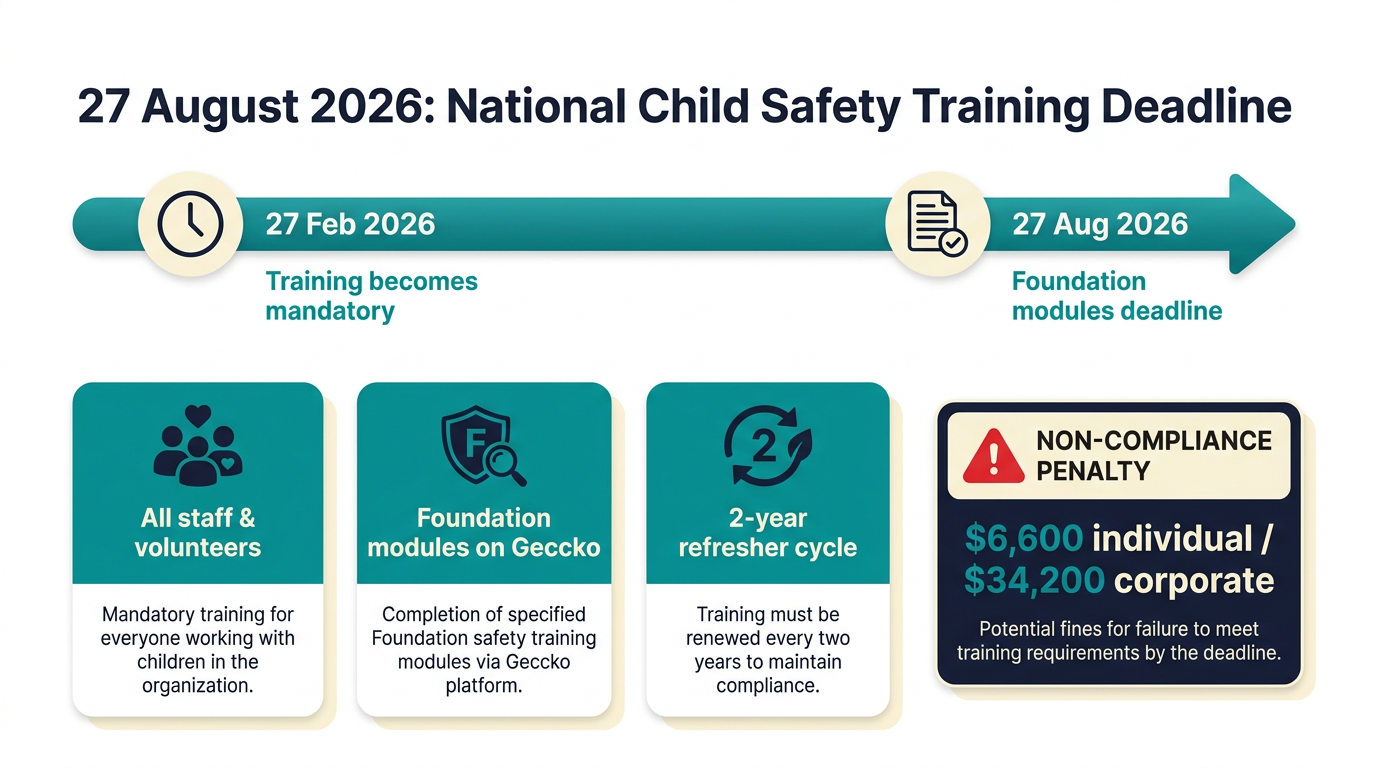
As of today, 17 June 2026, Australian early childhood education and care (ECEC) services have nine working weeks to comply with one of the most consequential workforce obligations in the post-2024 National Law: every existing educator, volunteer, student on placement, cook, cleaner and nominated supervisor in your service must complete the Foundation modules of the new national child safety training on the Geccko platform byThursday 27 August 2026. After that date, non-compliance is a strict-liability offence carrying penalties of $6,600 per individual infringement and $34,200 per corporate infringement — and those figures sit on top of maximum court penalties that tripled from2 January 2026 under the Early Childhood Legislation (Child Safety) Amendment Bill 2025. This is the 9-week operational checklist.
What the training actually is
The Department of Education has built a single national suite of modules delivered through the Geccko online learning platform. It is the only training pathway recognised for the purposes of sections 162A and 162B of the Education and Care Services National Law. There are two stages:
- Foundation modules — the baseline child safety and child protection training that every person working or volunteering in an ECEC service must complete. Covers recognising abuse and neglect, mandatory reporting obligations, safe physical care, and the strengthened child safety standards introduced in the 2025 Omnibus amendments.
- Advanced modules — additional role-specific training required for nominated supervisors, persons in day-to-day charge, and approved providers themselves. The Advanced modules build on Foundation and focus on governance, incident response, and the Statement of Rights.
Every Geccko completion produces an individual completion certificate carrying the learner's name, the module name, the completion date, and a unique Geccko identifier. Approved providers must be able to produce these certificates on request during an authorised officer visit under Regulation 175.
Who must complete it — and by when
The Department has set two deadlines, and getting them mixed up is the single most common compliance error we are seeing in the field:
- Existing staff on or before 26 February 2026: Foundation modules must be completed by 27 August 2026. This is the 6-month transition window that opened when the National Law amendments commenced on 27 February 2026. The 2-year refresher clock starts from this completion date.
- New starters from 27 February 2026 onwards: Foundation modules must be completed within 14 days of commencing at the service, or before working with children — whichever is sooner. The Advanced modules for nominated supervisors must be completed before the person takes on the nominated supervisor role.
Volunteers, students on placement, relief staff, food preparers and cleaning staff are all in scope. If the person interacts with children in any capacity — even briefly, even in a corridor handover — they must hold a current Foundation certificate. The only category explicitly excluded is a person who never enters a children's learning space (for example, a contracted gardener working outside operating hours with no child contact).
State-by-state implementation — what your regulator has published
The training itself is national, but each state regulator has published its own implementation guidance, including state-specific child protection modules that run alongside the Geccko Foundation. As of mid-June 2026:
- NSW (Department of Education): Confirmed Foundation training delivered via Geccko, with a 2-year refresher cycle. NSW has separately mandated the Child Safe Scheme head-of-organisation WWCC requirement under recent amendments to the Children's Guardian Act.
- VIC (Department of Education): Foundation modules on Geccko, plus the EC PROTECT modules for nominated supervisors and approved providers. Victoria has explicitly endorsed service closures for mandatory training days where rosters cannot accommodate release.
- QLD (Department of Early Childhood): Foundation training on Geccko is mandatory for all ECEC staff, and QLD has separately layered on the new Reportable Conduct Scheme that commences 1 July 2026 — nominated supervisors in QLD must complete Foundation, Advanced, and a state-level reportable conduct briefing.
- SA (Education Standards Board): Foundation modules on Geccko, with the ESB confirming the 27 August 2026 cut-over for existing staff. Approved providers in SA must report completion status in their next quarterly compliance return.
- WA, TAS, ACT, NT: All eight jurisdictions have signed on to the national Foundation modules. Implementation guidance is published by each state regulator and the level of state-level supplementation varies.
What happens if you miss 27 August 2026
The penalty regime is layered, and most approved providers we work with are surprised at how quickly the stack adds up. Three separate enforcement pathways apply to a Foundation training breach after 27 August 2026:
- Penalty Infringement Notice (PIN): Authorised officers in every state can issue an on-the-spot PIN for each affected staff member, at $6,600 per individual and $34,200 per corporate entity. With a 20-educator service, a single visit can generate six-figure PINs.
- Court prosecution under the National Law: Maximum penalties tripled from 2 January 2026 — serious offences now attract fines exceeding $1 million for large providers. Failure to ensure mandated training is one of the strict-liability offences prioritised for prosecution.
- Approval status action: A pattern of non-compliance can trigger a suspension or cancellation of service approval under section 29 of the National Law. For an approved provider with multiple services, one centre's training breach can put the entire approval at risk.
The 9-week operational checklist
Use the 9 weeks between today and 27 August 2026 as a single sprint. The checklist below has worked across small (20-educator) and large (200+ educator) services:
- Week 1 (now): Pull the roster. Generate a list of every person who interacts with children — educators, nominated supervisors, volunteers, students, cooks, cleaners, relief staff. Add columns for start date, Foundation status, Advanced status, and last refresher date.
- Week 1-2: Confirm Geccko access. Every staff member needs a Geccko account. Service closures for mandatory training days have been specifically endorsed by multiple state regulators — block out PD days now rather than chase completion during operating hours.
- Week 3-6: Run Foundation modules. Foundation is the bottleneck — run it across all staff in parallel rather than sequentially. Target 100% completion by end of week 7 to leave a 1-week buffer.
- Week 4-7: Advanced modules for nominated supervisors. Do not leave Advanced to last. Nominated supervisors need both Foundation and Advanced, and a service cannot be deemed compliant while its nominated supervisor is incomplete.
- Week 7-8: Audit completion. Download the completion report from Geccko, reconcile against the roster, and chase the gaps. Keep the individual certificates in the staff record with the Geccko unique identifier attached.
- Week 9 (final): Set the 2-year refresher cycle. Each completion certificate carries a 2-year expiry. Build a recurring calendar entry 60 days before each expiry so the refresher is scheduled before the certificate lapses.
How NovoCove handles this
The Foundation training deadline is exactly the kind of obligation that spreadsheets lose track of within 90 days. NovoCove turns each Geccko completion certificate into a tracked evidence record attached to the staff profile, with the 2-year refresher date set automatically from the completion timestamp.
On the day an authorised officer walks in and asks for proof of completion, you open the staff record, show the certificate, show the next refresher date, and move on. There is no folder to dig through, no PDF to scroll to, no panic about whether a relief staff member from March 2026 still has current Foundation status. The compliance pack is the live system.
For services operating across multiple jurisdictions, NovoCove also tracks the state-specific add-on modules (NSW Child Safe Scheme, VIC EC PROTECT, QLD reportable conduct briefing) in the same staff record — so the Foundation, Advanced and state layers are visible in one place rather than scattered across three different portals. The 27 August 2026 deadline is not the end of the work; it is the start of an ongoing training compliance cycle that needs to be tracked for as long as the person works in ECEC. NovoCove treats it that way from day one.
This guide is general information and is not legal advice.