Regulatory update
Child Safety Training Now a Condition of Approval for IHC and CCCFR Services from 1 July 2026
From 1 July 2026, mandatory national child safety training via Geccko is a condition of approval for In Home Care and Community Child Care Fund Restricted services. These services operate outside the NQF under the Child Care Subsidy Minister's Rules, and approval can be withdrawn if staff do not complete the Foundation module by 27 August 2026. Here is the scope, the 5-hour closure rule, the per-educator mechanics, and the 56-day plan for every IHC provider and CCCFR-funded service in Australia.
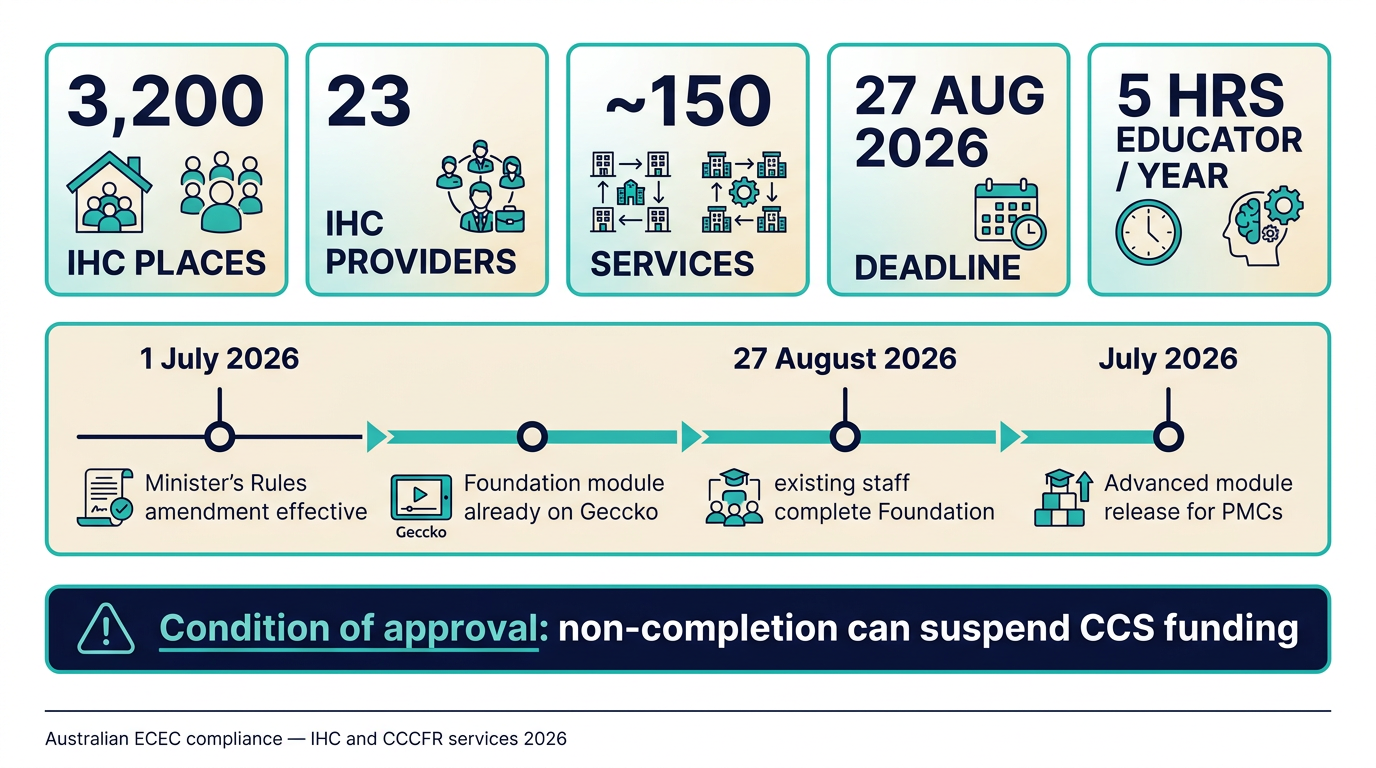
From 1 July 2026, mandatory national child safety training via the Geccko platform is no longer just an obligation on long day care, kindergarten, outside school hours care, vacation care and family day care services. It is now a condition of approval for In Home Care providers and for every service that receives a Community Child Care Fund Restricted grant. The trigger is an amendment to the Child Care Subsidy Minister's Rules 2017, signed by the Education Minister and effective on the first day of the 2026-27 financial year. For the 23 IHC providers and approximately 150 CCCFR-funded services that operate outside the National Quality Framework, the change converts child safety training from a quality-improvement aspiration into a binary funding question: complete the training or risk the loss of approval to claim Child Care Subsidy.
The audience is small but the stakes are high. In Home Care is a capped program with 3,200 places nationally, supporting roughly 800 to 1,000 families who cannot use other approved services because of non-standard work hours, geographic isolation, or complex family circumstances. The CCCFR program funds around 150 services, the majority of them in regional and remote Aboriginal and Torres Strait Islander communities. The combined Children Care Subsidy revenue at stake across the two programs is a small share of the national $9 billion-plus CCS pool, but the families and communities that depend on IHC and CCCFR have no equivalent alternative. Losing an IHC provider or a CCCFR service because of an unrecorded training completion is the kind of compliance failure that does not have a soft landing.
This guide walks through the Minister's Rules amendment, the precise scope (which services are in, which staff are in, what counts as completion), the per-educator 5-hour service closure mechanism, the Advanced module that becomes available in July 2026, and the 56-day operational plan that every IHC provider and CCCFR service should be running between today and the 27 August 2026 Foundation deadline.
What changed in the Minister's Rules on 1 July 2026
The Department of Education published a consolidated announcement titled "Changes to legislation to strengthen child safety in early education" that sets out the package of amendments to the Child Care Subsidy Minister's Rules 2017. The package has three components relevant to IHC and CCCFR operators, and the operative date for all three is 1 July 2026:
- Mandatory child safety training as a condition of approval. From 1 July 2026, completion of the Geccko Foundation module by all staff (and the Advanced module by the relevant senior roles when it becomes available) is a condition of an IHC provider or CCCFR service's continued approval to operate and claim Child Care Subsidy. Non-completion is grounds for the Department to suspend or cancel approval, with the same first-use enforcement precedent that Education Minister Jason Clare set on 30 June 2026 when he announced the cancellation of Commonwealth funding for a Victorian family day care provider that had failed to remediate identified safety hazards.
- Extended scope to IHC and CCCFR. The training mandate that applied from 27 February 2026 to NQF-regulated services is extended to the two service types that operate under the Minister's Rules rather than under the Education and Care Services National Law. The training is the same Geccko Foundation module, with the same content, the same record-keeping requirements, and the same two-yearly refresher cycle.
- Strengthened Additional Child Care Subsidy language. The amendment also tightens the ACCS framework to support vulnerable families, including those using IHC. ACCS-eligible families using an IHC provider whose approval is cancelled may lose access to the higher subsidy rate, which compounds the financial impact of a compliance failure for the affected families.
The "condition of approval" framing is the most important change. A condition of approval is enforced through the Department of Education's Family Assistance Law compliance and enforcement powers, not through the National Law's assessment and rating framework. The consequence of non-completion is a direct action against the provider's ability to receive CCS — which is the revenue stream that funds the service. There is no "Working Towards" rating, no grace period, and no NQS assessment cycle. The Department can, and now will, suspend or cancel approval on the strength of a non-completion finding from a compliance visit or a record check.
Which services and which staff are in scope
The scope of the 1 July 2026 extension is precisely defined. The Department of Education announcement is explicit that the training applies to IHC and CCCFR services "not regulated under the NQF", which captures the full operational footprint of both programs as of mid-2026. The category-by-category breakdown:
- In Home Care (IHC). A capped program with 3,200 places nationally, delivered through 23 approved providers. Each provider coordinates a network of IHC educators who deliver care in eligible families' homes. All IHC educators are in scope, plus the IHC provider's coordination unit staff and any person with management or control of the approved provider entity. The IHC program supports approximately 800 to 1,000 families at any one time, often at non-standard hours and in locations where no other approved service can operate.
- Community Child Care Fund Restricted (CCCFR). Around 150 services nationally, most of them in regional and remote Aboriginal and Torres Strait Islander communities. CCCFR services receive a restricted grant under the Community Child Care Fund and operate under the Minister's Rules rather than under the National Law. All staff, including educators, coordinators, cooks, transport drivers (where the service provides transport), and management committee members, are in scope.
- Persons with management or control (PMC). Every individual who holds a PMC role for an IHC or CCCFR approved provider must complete both the Foundation module and the Advanced module. The Advanced module is the second of the two-tier package and is being released on the Geccko platform in July 2026. The PMC requirement is the same as the requirement that has applied to NQF-regulated providers since 27 February 2026.
- Existing staff vs new starters. Existing staff (employed before 1 July 2026) must complete the Foundation module by 27 August 2026. New starters (employed on or after 1 July 2026) must complete the Foundation module within 30 days of commencing employment. The two-yearly refresher cycle applies to all completions. The Advanced module, once released, is required for PMCs and other senior roles, with the Department of Education indicating that detailed implementation timing will be provided ahead of the formal Advanced module release date in July.
The IHC and CCCFR programs share three structural features that affect how the training roll-out works in practice. First, the workforce is small but geographically dispersed: IHC educators are typically solo workers in family homes, and CCCFR services are often in remote locations. The standard centre-based approach of a half-day in-service training session is not viable. The Geccko online model is the only realistic delivery mechanism, and the Department's per-educator 5-hour service closure allowance is designed around that constraint.
Second, the services are typically the only available option for the families they serve. IHC families by definition cannot access centre-based care, and CCCFR communities often have no alternative service within reasonable distance. A compliance failure that leads to loss of CCS revenue typically leads to service closure, and a service closure typically leaves families with no care at all. The compliance stakes are not theoretical for this audience.
Third, the providers themselves are small operations. The 23 IHC providers are mostly community-based not-for-profits or small private operators, and many of the CCCFR services are run by Aboriginal Community Controlled Organisations. Neither category has the administrative headcount of a multi-site LDC operator. The compliance workload for tracking 5-hour closure allowances, recording Foundation completions, and managing the 30-day new-starter rule falls on a smaller administrative base, which is why an automated tracking workflow is materially more important for these operators than for larger NQF-regulated services.
The 5-hour service closure rule and how it applies to IHC educators
From 27 February 2026, CCS-approved ECEC services have been able to close for up to 5 hours per calendar year so that staff can complete the Geccko Foundation module, with Child Care Subsidy claimable during the closure and families continuing to pay the gap fee. For centre-based and OSHC services, the closure must begin no earlier than 5 pm and the 5 hours applies at the service level. For IHC and family day care, the rule is applied at the individual educator level, not the service level, because each IHC educator works independently in a family home.
The Department of Education's sector guidance on the closure rule is specific about how the 5-hour per-educator cap works for IHC:
- 5 hours per calendar year, per individual IHC educator. Each IHC educator is allocated their own 5-hour annual allowance. An IHC provider with 20 active educators has a collective 100 hours of closure allowance available across the calendar year, but the allowance is not transferable between educators and is not pooled at the service level.
- Unavailability must be between 5 pm and the normal closing time, no later than midnight. IHC educators operate outside standard centre hours by design. The Department's sector guidance sets the unavailability window as 5 pm to midnight to align with the standard centre-based window, recognising that IHC sessions typically run in the early morning, late afternoon, and evening.
- Multiple blocks are allowed. The 5 hours can be used as a single 5-hour block or split across multiple shorter blocks, provided each block falls within the 5 pm to midnight window and the cumulative unavailability in the calendar year does not exceed 5 hours per educator.
- Record-keeping is the proof. The provider must keep accurate records of which educator was unavailable, on which dates, for how long, and confirm that the Foundation module was completed within the unavailability window. The Department's compliance activity under the Family Assistance Law framework can request these records, and a missing or incomplete record is treated as if the closure did not occur.
For CCCFR services, the closure rule is more nuanced. CCCFR services typically operate a regular centre-based or preschool program in a regional or remote community, and the standard 5-hour service-level closure rule applies, beginning no earlier than 5 pm. Some CCCFR services operate only during school hours or only on specific weekdays, in which case the closure window can be adjusted to align with the service's operating pattern, subject to staff being available to complete the training during the closure.
The Foundation module takes approximately 2 hours to complete. Most IHC educators and CCCFR staff can complete it within a single 5-hour closure block. The Department has built in the additional 3 hours of allowance to cover the Advanced module that becomes available in July 2026, additional refresher time, and to accommodate the per-educator cycle of new starters needing to complete Foundation within 30 days of commencing employment.
The Advanced module: roles, release timing, and refresher cycle
The Advanced module is the second of the two-tier Geccko package and is being released on the Geccko platform in July 2026. The module is required for persons with management or control of an approved provider, nominated supervisors (in NQF services), persons in day-to-day charge (in NQF services), and staff working directly with children in roles with a higher child-protection risk profile. For IHC and CCCFR services, the relevant roles are:
- Persons with management or control of the IHC or CCCFR approved provider. Mandatory completion of the Advanced module when it becomes available, with a transition period that the Department of Education is finalising and will publish ahead of the formal release.
- Senior educators in IHC and CCCFR services. Where the service's staffing structure includes a senior educator, head educator, or lead coordinator role, the Advanced module is required.
- All other direct-contact staff. Foundation is sufficient for direct-contact staff in non-senior roles. The Department has signalled that the Advanced module will be required for the broader workforce over time, with phased roll-out by role category.
Both modules are delivered via the Geccko online learning platform, with individual account tracking that records completion against the user's name, role, employer, and date. Each approved provider has access to a reporting dashboard that shows the completion status of every linked educator, the next refresher date for each, and the count of educators who have not yet completed either module. The provider is responsible for ensuring the dashboard is current and for acting on any flagged non-completion before the 27 August 2026 deadline.
The refresher cycle is every 2 years from the date of completion. The two-yearly cadence is the same as the NQF-regulated cohort and aligns with the Geccko platform's automated reminder system. The Department has indicated that refresher reminders will be issued 90 days, 30 days, and 7 days before the refresher due date, and the provider's compliance evidence pack should include a copy of the reminder trail for every staff member to demonstrate proactive compliance management.
What can go wrong: the enforcement precedent and the compliance failure modes
The enforcement precedent for the 1 July 2026 IHC and CCCFR expansion was set on 30 June 2026, when Education Minister Jason Clare used the new Family Assistance Law cancellation powers for the first time against a Victorian family day care provider, Laugh & Learn Family Day Care Education and Training. The Minister's announcement was specific: the provider had failed to remediate identified safety hazards, including accessible rat poison, bleach, and other dangerous substances, and the cancellation was effective from 4 July 2026 across all nine of the provider's sites. The cancellation powers used in that case are the same powers that the Department can use against an IHC or CCCFR provider whose staff have not completed the Foundation module by 27 August 2026.
The compliance failure modes for IHC and CCCFR operators are different in degree from the failure modes for a centre-based service, because the consequences are binary at the service level. A centre-based service that misses a training deadline can absorb the finding as a quality-area 4 or 7 issue and address it in the next assessment and rating cycle. An IHC or CCCFR service that misses the training deadline faces a direct compliance visit, a finding of non-completion against the condition of approval, and a likely suspension or cancellation of approval. The families that depend on the service have no fallback option.
Common failure modes that the Department has flagged in compliance activity for similar conditions-of-approval in the NQF-regulated cohort are useful as a checklist:
- Missing individual records. The most common finding in compliance visits is incomplete per-educator records: the provider has a spreadsheet of "completed" but no per-educator Geccko certificate, no per-educator completion date, and no per-educator refresher due date. The Department treats missing records as missing completions, regardless of what the spreadsheet says.
- Late new-starter completions. A new IHC educator commences on 15 July 2026 and the 30-day window expires on 14 August 2026. If the Foundation completion is not recorded on Geccko by 14 August, the educator is non-compliant from day 31. Providers that onboard in bulk need a workflow that triggers the 30-day training requirement on day 1.
- Closure hours used for non-training purposes. The 5-hour closure allowance is specifically for the completion of the Geccko Foundation (or Advanced) module. Using the closure for any other activity — staff meetings, planning days, professional development unrelated to the mandatory training — is a misuse of the allowance and can be reclaimed.
- Refresher cycle drift. A staff member who completed Foundation on 1 September 2026 is due for refresher by 1 September 2028. If the refresher is missed, the staff member is non-compliant from 2 September 2028. The two-yearly cadence requires a forward-looking tracker that alerts at 90, 30, and 7 days, not a backward-looking one that flags non-completion after the fact.
- PMCs not on the dashboard. For an IHC provider, the PMC cohort is small (often the CEO, the operations manager, and a board director or two). It is common for the PMC roster on the approved provider's record to be out of date, with departed PMCs still listed and incoming PMCs not yet recorded. The Geccko dashboard only counts PMCs that are correctly rostered.
What the 1 July 2026 change means for NQF-regulated services
The 1 July 2026 expansion is narrowly targeted at IHC and CCCFR services, but it has two secondary implications for NQF-regulated long day care, kindergarten, OSHC, vacation care, and family day care services. First, the Advanced module release in July 2026 applies to PMCs, nominated supervisors, and persons in day-to-day charge across the NQF cohort, with a transition period that the Department is finalising. Existing NQF-regulated providers should expect the Advanced module to appear on Geccko in July and should plan the completion of the PMC and nominated-supervisor cohort over the same window.
Second, the first-use enforcement action against the Victorian FDC provider on 30 June 2026 sets a clear expectation that the Family Assistance Law cancellation powers will be used proactively. The Department has signalled that further enforcement action is expected in 2026, and the combination of the cancellation precedent, the broadened condition-of-approval scope, and the increased public scrutiny of the sector means that compliance activity in the second half of 2026 will be more intensive than at any point in the framework's history. NQF-regulated services that have been treating the 27 February 2026 Foundation rollout as a slow-burn obligation should re-prioritise the 27 August 2026 deadline as a hard cut-off.
For IHC and CCCFR operators specifically, the 1 July 2026 change is a binary event. Either the Foundation module is completed by every existing staff member by 27 August 2026 (and by every new starter within 30 days of commencing), or the service is at risk of having its approval suspended or cancelled by the Department. There is no rating, no grace period, and no negotiated outcome. The Department has the powers, the precedent is set, and the deadline is 56 days from today.
How NovoCove handles this
NovoCove's compliance dashboard tracks Geccko child safety training completion for every IHC educator and every CCCFR service linked to an approved provider account. The platform integrates with the Geccko completion records and the Department's Family Assistance Law reporting cycles, so the 27 August 2026 deadline appears as an automated alert at 90, 30, and 7 days, and the per-educator 5-hour closure allowance is tracked at the individual level rather than aggregated to the service level.
For IHC providers, NovoCove's per-educator workflow is built around the operational reality of a dispersed, solo-worker workforce. The 30-day new-starter trigger is set on the educator's commencement date, the refresher trigger is set on the Foundation completion date, and the PMC roster is maintained as a separate compliance artefact with its own alert cadence. The platform also tracks the 5-hour per-educator closure allowance as a per-educator budget, with the unused hours carried forward to the next calendar year (the Department has confirmed that the allowance resets on 1 January each year, and any unused hours are forfeited at the reset).
For CCCFR-funded services, NovoCove's compliance dashboard tracks the training completion of every staff member, the service-level 5-hour closure allowance, the Advanced module completion for PMCs, and the two-yearly refresher cycle for the full workforce. The platform also captures the specific operating pattern of the service (centre-based preschool, mobile service, school-hours-only) so the closure window can be configured to match the service's actual hours of operation. The compliance evidence pack is generated automatically for any Department of Education compliance visit, and includes the per-educator Geccko certificate, the per-educator completion date, the per-educator refresher due date, and the closure record for every closure used in the period.
The 1 July 2026 expansion is the third major compliance milestone of the 2026-27 financial year for IHC and CCCFR operators, after the 27 February 2026 NQF rollout and the 1 July 2026 NQF licence fee increase that applies in NSW and Victoria. Operators that run a single quarterly review across all three changes will land the year well ahead of those that address each change in isolation. The window between today and 27 August 2026 is finite, well-defined, and entirely on the operator side of the table.
This guide is general information and is not legal advice.