Aged care fees & agreements
Extra & Additional Service Fees End 31 October 2026: The HELF Transition Deadline for Residential Aged Care Providers
On 20 August 2026 the Department of Health, Disability and Ageing refreshed its higher everyday living, additional and extra service fees guidance around one date: legacy extra service fee and additional service fee arrangements with residents who entered care before 1 November 2025 can continue only until 31 October 2026. From 1 November 2026 every one of those arrangements must have ceased, or converted to the new Higher Everyday Living Fee (HELF). The department expects providers to have a conversation with each legacy-fee resident before the deadline, and the Aged Care Quality and Safety Commission continues to treat HELF as a compliance focus. Here is the background, the transition rules, the six operational actions, and the 30-day workflow that gets every pre-Act arrangement closed out on time.
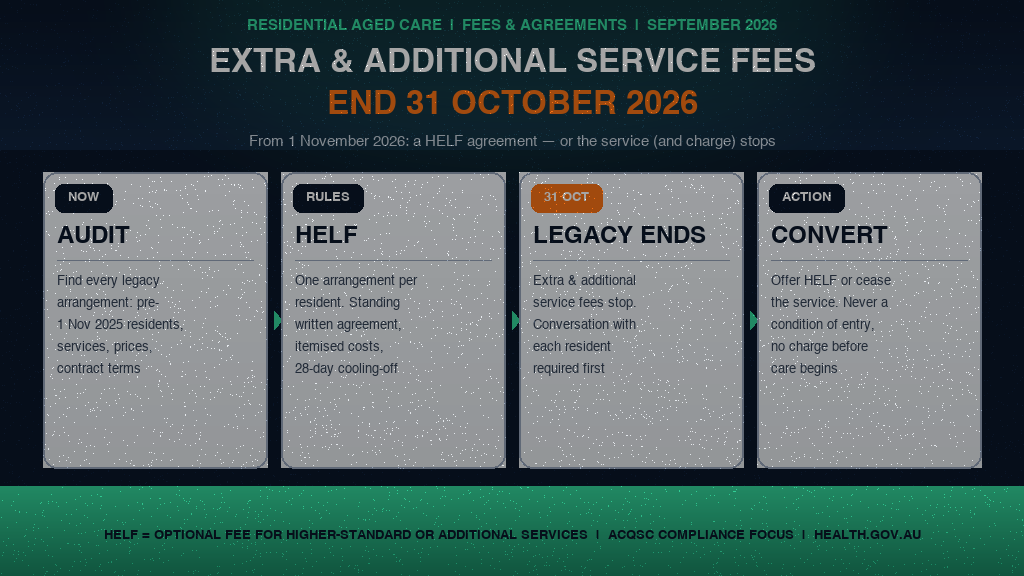
If your residential aged care service still has residents paying an extra service fee or an additional service fee under arrangements signed before 1 November 2025, those arrangements have a hard expiry date: 31 October 2026. The Department of Health, Disability and Ageing made the countdown explicit when it updated its higher everyday living, additional and extra service fees guidance on 20 August 2026 — existing arrangements can continue only until that date, for residents who agreed to them before the new Aged Care Act commenced. From 1 November 2026, any higher-standard or additional service you charge for must sit under a new Higher Everyday Living Fee (HELF) agreement — or the service (and the charge) must stop.
Background: two legacy fee products, one new optional fee
Under the Aged Care Act 1997, providers could charge residents for optional services above the basic care entitlement through two separate products. An extra service fee was the classic hotel-style product — upgraded rooms, meals, amenities and lifestyle offerings delivered above the regulated standard, usually packaged under an Extra Service Agreement with a daily fee. An additional service fee covered services beyond what the provider was required to deliver, agreed individually with the resident. Both sat outside the core daily care fee, and both were common revenue lines for providers running premium or lifestyle-focused homes.
The Aged Care Act 2024 (which commenced on 1 November 2025) replaced that two-product structure with a single optional fee: the Higher Everyday Living Fee (HELF). HELF is available for services — other than accommodation-related services — that are delivered to a higher standard than those on the residential care service list, or that are not already required or listed on the service list. It is optional for a provider to offer and optional for a resident to accept, and every HELF service must be delivered consistently with the Aged Care Quality Standards and the Statement of Rights.
The gap between the old and new products is where the transition problem lives. Providers were not allowed to enter new extra or additional service fee arrangements from 1 November 2025 — but residents already in care on that date, who had agreed to those fees earlier, were protected by transitional arrangements under the 'no worse off' principle. Those transitional arrangements were never intended to run forever: they expire on 31 October 2026, exactly one year after the new Act commenced.
What changed and when: the 31 October 2026 hard stop
Four dates define the new position:
- 1 November 2025 — the new Act commenced and HELF was born. No new extra service fee or additional service fee arrangements could be entered from that date. Residents entering care from 1 November 2025 who want optional services go straight onto HELF (where the provider offers it).
- 20 August 2026 — the department refreshed its guidance with the end date front and centre. The current health.gov.au page states that existing extra and additional service fee arrangements 'can continue until 31 October 2026 for people who agreed to these fees prior to 1 November 2025'. It also confirms providers can increase fees under existing contracts in line with those contracts, without needing approval from the Independent Health and Aged Care Pricing Authority (IHACPA).
- 31 October 2026 — the transitional arrangements end. This is the last day a legacy extra service fee or additional service fee can lawfully be charged. My Aged Care's resident-facing guidance puts it plainly: existing additional and extra service agreements will cease by 31 October 2026.
- 1 November 2026 — HELF only. From this date, any service above the required standard or additional to the service list must be covered by a HELF agreement, or it must cease. There is no second transition and no announced extension.
Two behavioural requirements sit alongside the dates. First, the department says providers should not unreasonably refuse a resident's request to exit an extra or additional service fee arrangement — a resident cannot be trapped in a legacy fee they no longer want while the provider decides what to do. Second, providers should have a conversation with each extra and additional service fee resident prior to 1 November 2026 — the department expects an active, documented conversation, not a letter dropped in the mail in the last week of October.
There is also a structural rule that catches providers out: a resident can only receive services under one arrangement at a time. If any change is required to an existing extra or additional services fee agreement — a price change outside the contract, a service change, a transfer between rooms — a new HELF agreement becomes necessary and the previous agreement ceases. You cannot 'tidy up' a legacy agreement and keep running it; the tidy-up itself triggers the HELF conversion.
The HELF rulebook in brief: agreements, protections and pricing
HELF is not the old extra service fee under a new name — the compliance architecture around it is genuinely new, and providers converting residents need to understand the shape of it:
- Two agreement types. A standing HELF agreement must be in writing and covers services planned and agreed in advance — ongoing (such as Wi-Fi), fixed-term (a term of yoga classes) or one-off (a haircut). An ad-hoc HELF agreement is limited to a single service a resident requests that was not planned in advance, can be verbal, and can only be entered into immediately before or at the time the service is delivered — the classic example is a coffee at an onsite café. Providers are encouraged to prefer standing agreements.
- A HELF agreement cannot be a condition of entry. It must not be agreed or charged before a resident enters care, cannot be used as a condition of entry or to secure a room, and must be a separate document from the service and accommodation agreement. A HELF agreement cannot be signed before the resident has a signed service agreement.
- Itemisation is mandatory. The agreement must set out the cost of each higher or additional service, the standard and frequency at which it will be delivered, and how it will be charged. A resident should not be asked to pay for a service they cannot or will not use.
- Consumer protections are structured. There is a 28-day cooling-off period after signing a standing HELF agreement — the resident can cancel or vary without a cancellation fee and without minimum notice. After that: cancellation or variation with 28 days' notice; if the provider initiated cancellation because it can no longer deliver the service to the agreed standard, it must be cancelled or varied immediately; and where the resident initiates cancellation the provider can pass on unavoidable expenses beyond the 28-day period — for no more than 90 days, and only where they can be demonstrated.
- Annual review and indexation-only increases. The HELF agreement must be reviewed at least once a year to confirm the resident still wants the services and can use them. Once a price is agreed it can only be increased for that resident by annual indexation — but providers can raise the advertised price for new residents without restriction, and never need IHACPA or Government approval for HELF prices.
- Bundles are allowed but bounded. Standing services can be bundled and charged as a group, but residents are not required to accept a bundle, every service in a bundle must also be available individually, and the resident must not be worse off than paying for the services they can use.
Operational impact: six things every residential provider should do now
Fifty-six days is enough time — but only if the work starts now, because the bottleneck is conversations with residents and their families, and those cannot be rushed in the final fortnight. Six actions follow for every provider still running legacy arrangements:
- Audit every legacy arrangement. Build the register: every resident who entered care before 1 November 2025 and is paying an extra service fee or additional service fee, with the service schedule, the agreed price, the contract terms and the review history. Admissions, finance and the care team all hold fragments of this picture — one consolidated list is the spine of the whole transition.
- Decide the default per service: convert, or cease. For each legacy service, decide whether it genuinely qualifies as HELF — a higher standard than the service list, or additional to it — and whether the provider wants to keep offering it. Services that do not qualify, or that the provider no longer wants to deliver, must be communicated as ceasing from 1 November 2026. There is no middle option of continuing the old fee.
- Design the HELF offer before you talk to anyone. Price each service (remembering agreed prices are indexation-only for that resident), decide bundle structures, and map which legacy services move into which standing HELF agreement lines. This is the work that makes resident conversations short and unambiguous — and it is the work providers skip when they start late.
- Hold the conversations — and evidence them. The department expects a conversation with each affected resident prior to 1 November 2026. Use it to explain that the legacy arrangement ends, what HELF offers as the replacement, what changes from the previous arrangement, and the resident's right to decline. Never use HELF as leverage for admission or a room, never refuse an exit request unreasonably, and keep a signed, dated record of every conversation.
- Get the paperwork and systems aligned. Standing HELF agreements must be written, separate from the service and accommodation agreement, and signed only after the resident's service agreement is in place. Billing systems need new product lines and invoice rules (including 28-day cooling-off handling), and admissions, care, lifestyle, administration and accounts staff all need role-relevant training on what changed.
- Build the regulator-ready file. The Commission has made clear it treats HELF as a priority: it has investigated providers over HELF charging practices through 2026, its September Quality Bulletin continues to flag the risks of incorrect HELF use — financial harm, reduced choice and autonomy for older people — and its complaints newsletter now walks residents through HELF. Your file should show, per resident: the legacy arrangement, the conversation record, the signed HELF agreement and the cease notices. If the Commission asks, you should be able to produce that in an afternoon.
A 30-day workflow to transition-complete by 31 October
Working backwards from 31 October, this six-phase workflow leaves the final fortnight for signatures, billing cutover and verification — not for first conversations:
- Days 1-5 — Audit and register. Consolidate every legacy extra and additional service fee arrangement from admissions, finance and care records. Capture resident, service schedule, price, contract terms and next of kin or enduring guardian contacts. Flag residents with capacity or decision-making support considerations early — those conversations need more lead time.
- Days 6-12 — Qualify and price. Test every legacy service against the residential care service list: is it a higher standard of a listed service, additional to the list, or neither? Price the services that stay, design bundles, and draft the standing HELF agreement template with itemised costs, standards, frequency and charging method.
- Days 13-19 — Legal and policy review. Have the template and the per-resident change summaries reviewed against the Aged Care Rules 2025 and the department guidance — by your legal adviser where the arrangements are complex. Confirm the cease letters for services that will not continue, and the conversation scripts for staff.
- Days 20-26 — Resident conversations and agreements. Run the conversation campaign: explain the end of the legacy arrangement, present the HELF replacement, answer questions, and capture decisions. Residents who decline HELF get a clear cease notice with the date the service and charge end. Target having the majority of standing agreements signed by the end of this phase.
- Days 27-31 — Billing and systems cutover. Configure the new HELF product lines, retire legacy fee lines for 1 November, set annual-review reminders on every agreement, and train admissions, care, lifestyle, administration and accounts staff on the new arrangements and the cooling-off mechanics.
- Days 32-38 — Verify and close out. Re-run the original audit register against signed agreements and cease notices until every legacy resident is accounted for. Confirm no legacy charge can be raised after 31 October, file the full evidence pack, and brief the board or governing body on completion. The annual review calendar now starts running for every HELF agreement.
How NovoCove supports this
A fee transition is, underneath the legal work, an evidence and task-management exercise: one register of affected residents, a sequence of dated conversations, a pile of signed agreements and a hard deadline. NovoCove is the data and evidence layer behind that exercise. Compliance tasks with owners and due dates turn the six actions and the 30-day workflow above into a tracked program — each resident conversation, each agreement review, each billing change gets an owner, a due date and a status, so the question "who still has not been spoken to" answers itself from the task board rather than from memory. The RAG compliance score and the daily ComplianceSnapshot trend show the transition position improving as work completes, and the audit log keeps the record of who did what, when — the same trail a reviewer would expect to see.
The same platform centralises the workforce side of the offer: staff certifications and training expiry for aged care — AHPRA registration for registered and enrolled nurses, NDIS Worker Screening and more — with a 7-tier alert cadence, so the nurses and care staff delivering your higher-standard services stay current while the team runs the transition. It does not replace your legal adviser (HELF agreement terms need legal review), your billing system, or your finance team's judgement on pricing — but when the Commission asks how the transition was managed and evidenced, the answer is one register, one task history and one exportable file. The coverage is detailed on the aged care compliance software page.
Book a 20-minute demo and we will show you what your transition looks like as a tracked program with a 31 October due date — before the legacy fee clock runs out.
Sources / further reading
- Higher everyday living, additional and extra service fees — Department of Health, Disability and Ageing, updated 20 August 2026 (T1)
- Service agreements for residential aged care — Department of Health, Disability and Ageing (T1)
- The new Aged Care Act and your aged care home fees — My Aged Care (T1)
- Aged Care Quality Bulletin #8-2026 (September 2026) — Aged Care Quality and Safety Commission (T1)
- Let's talk about complaints — Issue 1 (August 2026) — Aged Care Complaints Commissioner (T1)
- Aged Care Rules 2025 — Federal Register of Legislation (T1)
- Higher Everyday Living Fees: what residential aged care providers need to do before 1 November 2026 — Cowell Clarke, 2 September 2026 (T2)
- Extra fee arrangement for aged care residents — National Seniors Australia (T3)
This guide is general information and is not legal advice.