Aged care compliance
Aged Care Registered Provider Reporting Compliance: Every Deadline, Every Form, Every Penalty for 2025-26
The 2025-26 financial year has brought a new reporting compliance model for every registered aged care provider in Australia. Monthly 24/7 Registered Nurse coverage reports, quarterly QFR and QI Program submissions, and an externally audited Care Minutes Performance Statement inside the annual ACFR now sit on the same compliance calendar as your roster, payroll and funding cycles. Miss a date, submit incomplete data, or get the audit wrong, and the consequences range from a 30 penalty-unit infringement notice to suspension of registration. Here is the full reporting calendar, the penalty regime, the audits that will catch you out, and the workflow that keeps every deadline on the right side of the line.
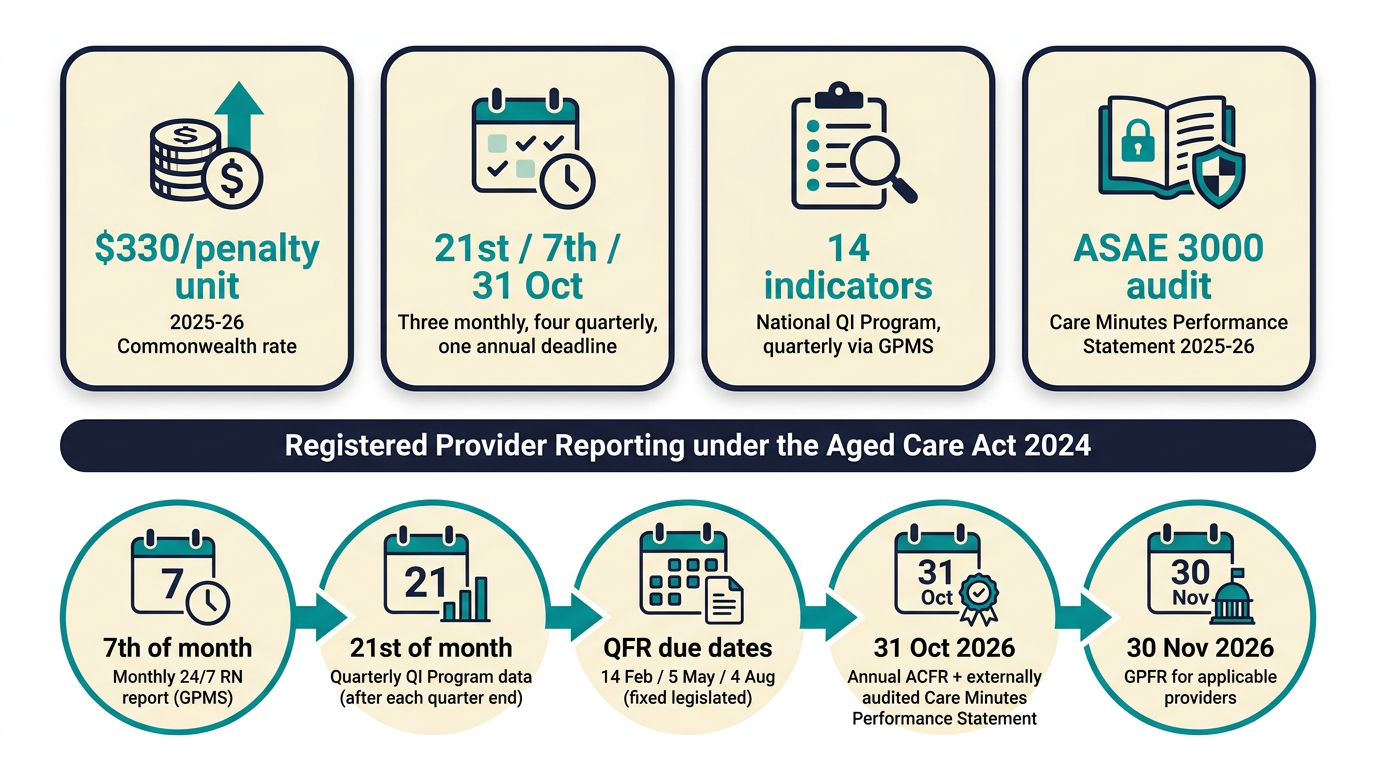
The 2025-26 financial year is the first full year of the new reporting compliance model for every registered aged care provider in Australia. The Department of Health and Aged Care published a consolidated fact sheet on 2 June 2026 that ties together the monthly 24/7 Registered Nurse coverage report, the quarterly QFR and Quality Indicator Program submissions, the externally audited Care Minutes Performance Statement, and the annual Aged Care Financial Report into a single calendar. The Aged Care Quality and Safety Commission reads the same calendar when it audits you. Miss a date, submit incomplete data, or get the audit wrong, and the consequences range from a 30 penalty-unit infringement notice ($9,900 for 2025-26) to a compliance notice that can lead to suspension or revocation of registration under section 63N of the Aged Care Quality and Safety Commission Act 2018.
This is not a soft transition. The 2025-26 reporting cycle is the first year that every residential aged care home must submit the Care Minutes Performance Statement to an ASAE 3000 external audit standard before the ACFR can be lodged. The same statement feeds into the Base Care Tariff adjustment that took effect on 1 April 2026, so the same data drives both funding and compliance. For every registered provider — residential, home care, and the new Support at Home program — the question is no longer "do we have a reporting workflow?" It is "can we prove, on demand, that the workflow meets the date, the form, the standard, and the audit?"
What is the 2025-26 reporting calendar?
The reporting calendar has four layers. Each one runs on a different cycle, has a different form, and is lodged through a different portal or attachment. The Department of Health and Aged Care fact sheet, the ACQSC Reporting for residential aged care page, and the Aged Care Financial Reports Calendar 2025-26 all spell out the same dates, but they are spread across three different pages. The consolidated version is below.
- Monthly: 24/7 Registered Nurse coverage report — due by 11:59 pm AEST on the 7th day after month-end, lodged through the Government Provider Management System (GPMS). Required for every residential provider, even those with an exemption. The report must detail any RN absence of 30 minutes or more and the arrangements in place to cover it. The data feeds the 24/7 RN supplement and the public Star Ratings.
- Quarterly: National Aged Care Mandatory Quality Indicator Program data — due by 11:59 pm AEST on the 21st of the month after each quarter ends (21 October, 21 January, 21 April, 21 July). The QI Program covers 14 indicators, including pressure injuries, falls and major injury, unplanned weight loss, medication management, restrictive practices, and activities of daily living. The 2025-26 program is the most expanded iteration of the program to date.
- Quarterly: Quarterly Financial Report (QFR) — four times per year, on fixed legislated dates: Q1 by early November, Q2 (Oct-Dec) by 14 February, Q3 (Jan-Mar) by 5 May, and Q4 (Apr-Jun) by 4 August. QFRs include direct care labour hours and costs by RN, EN and PCW category per home, and the data drives the care minutes compliance calculation that feeds the Base Care Tariff adjustment.
- Annually: Aged Care Financial Report (ACFR) — due 31 October 2026 for the 2025-26 reporting period. Includes the externally audited Care Minutes Performance Statement for residential providers, prepared under ASAE 3000, and the General Purpose Financial Report (GPFR) where applicable.
The 31 October 2026 ACFR is the milestone that ties everything else together. The audited Care Minutes Performance Statement is part of the ACFR submission, and the audit must be completed before the ACFR can be lodged. That means the audit engagement needs to be in place no later than mid-August 2026 to give the auditor time to test the data, raise findings, and have the statement signed off before the 31 October lodgement window.
What are the penalty consequences for missing a report?
The penalty regime for reporting non-compliance is layered. The Commission can issue an infringement notice for a strict liability or civil penalty offence, accept an enforceable undertaking, issue a compliance notice, or move directly to suspension or revocation of registration under section 63N. The dollar value of the infringement notices is tied to the Commonwealth penalty unit, which sits at $330 for 2025-26 and will rise to $364 on 1 July 2026.
- 30 penalty units ($9,900 for 2025-26; $10,920 from 1 July 2026) for failure to comply with a required action notice issued by the Commission or the System Governor.
- 60 penalty units ($19,800 for 2025-26; $21,840 from 1 July 2026) for failure to comply with an information or reporting period notice — the offence most likely to apply to a missed QFR, a missed QI Program submission, or a Care Minutes Performance Statement lodged without the required audit sign-off.
- Compliance notices that compel a provider to take (or stop taking) specified action within a specified timeframe, with the 30 penalty-unit consequence for non-compliance.
- Sanctions and registration action under section 63N of the Aged Care Quality and Safety Commission Act 2018, including the suspension or revocation of registration — the most serious consequence, and the one that ends the operating model.
- Criminal Code exposure for false or misleading information in a reporting submission. Sector analyses by MinterEllison flag this as a live risk: false or misleading information lodged via GPMS can be prosecuted under the Criminal Code, with a maximum penalty of 12 months imprisonment.
How does the Care Minutes Performance Statement change the workflow?
The Care Minutes Performance Statement is a new annual attachment to the ACFR. Every residential aged care provider must prepare it, and the statement must be externally audited under ASAE 3000 before the ACFR can be submitted. The statement covers quarterly direct care hours and costs (RN, EN, PCW), monthly 24/7 RN coverage percentages, occupied bed days, and a calculation of whether the home met its home-specific care minutes target averaged over each quarter.
The audit is the shift that makes the 2025-26 cycle different from anything the sector has done before. ASAE 3000 is the Australian standard for assurance engagements on non-financial information. The auditor will test the data, walk through the roster and payroll records, and form an opinion on whether the Care Minutes Performance Statement is fairly presented. The audit opinion is signed by the auditor, attached to the ACFR, and lodged with the Department. The same data feeds the Base Care Tariff adjustment, so an audit qualification has a direct dollar consequence on the home's funding.
The workflow implication is that the Care Minutes Performance Statement is not a January-to-June task. The data that feeds the statement is generated month by month through the 24/7 RN reports, the QI Program submissions, and the QFR labour hours data. If the monthly and quarterly data is not reconciled as it goes, the auditor will find discrepancies in September, and there will not be time to fix them before the 31 October ACFR deadline.
What does a defensible reporting workflow look like?
The providers who land the 2025-26 cycle cleanly are the ones who treat the reporting calendar as a single integrated workflow, not four separate compliance tasks. The five-step workflow below is the one that holds up under audit and survives a Commission inspection.
- Anchor the 7th-of-month 24/7 RN report to the roster system rather than to a manual spreadsheet. The roster data is the source of truth — absences, cover arrangements, exemption periods, and bed-day counts all flow from it. A roster-integrated submission takes an hour to compile and prepare; a manual one takes a day and creates the audit risk that the data does not reconcile to the underlying roster.
- Pre-build the 21st-of-month QI Program data from the clinical system. The 14 indicators are recorded continuously in the care management system; pulling the report on the 20th of the month, validating the data, and submitting on the 21st is the discipline that keeps QI Program data current and audit-ready.
- Reconcile the QFR data to payroll before submission. The QFR is the only reporting product that pulls labour hours and costs by RN, EN, PCW, and other categories. If the QFR does not reconcile to payroll at the time of submission, the care minutes compliance calculation will be wrong, the Base Care Tariff adjustment will be wrong, and the Care Minutes Performance Statement will inherit the error.
- Engage the ASAE 3000 auditor in August 2026, not October. The auditor needs to test the data, raise findings, and have the Care Minutes Performance Statement signed off before the 31 October ACFR lodgement window. A September engagement is too late; the auditor will not have time to complete the assurance work and the provider will be lodging the ACFR late or with an unqualified statement.
- Hold a monthly reporting stand-up that walks through the four reporting streams, the data sources, and the submission status. The stand-up is the single point of accountability for the calendar and is the audit trail that shows the Commission that the provider was actively managing the reporting compliance model, not reacting to it.
What changes from 1 July 2026?
The new financial year brings three operational shifts that providers should be planning for now. First, the Commonwealth penalty unit rises from $330 to $364 on 1 July 2026, so any infringement notice issued after that date is calculated at the higher rate. Second, the Aged Care Financial Reports Calendar 2025-26 list shows the 4 August 2026 QFR (for the April-June 2026 quarter) is the last QFR of the 2025-26 financial year, and the data from that QFR feeds the audited Care Minutes Performance Statement. Third, the ACFR for 2025-26 is due by 31 October 2026, with the externally audited Care Minutes Performance Statement attached.
The system is unforgiving but it is not opaque. Every deadline is published, every form is described, and the penalty regime is set out in the Aged Care Quality and Safety Commission Act 2018 and the system governor's compliance framework. The providers who land the cycle cleanly are the ones who treat the four reporting streams as a single integrated workflow, with the roster, the payroll, the clinical system, and the auditor all drawing from the same source of truth. The providers who land it badly are the ones who treat each report as a separate compliance task and hope the dates hold.
How NovoCove handles this
NovoCove gives residential and home care providers a single source of truth for the 2025-26 reporting cycle. The 7th-of-month 24/7 RN report is generated from the roster module; the 21st-of-month QI Program data is generated from the clinical module; the quarterly QFR is reconciled to payroll before submission; and the Care Minutes Performance Statement is pre-built from the same data that feeds the ACFR. The ASAE 3000 audit engagement is tracked as a compliance artefact with a due date, an owner, and a status visible across the management team.
The result is a reporting compliance model that holds up under audit. When the Commission asks for the 2025-26 QI Program data, the QFR, the 24/7 RN report, and the Care Minutes Performance Statement, the same data set is the source for all four, the audit trail is complete, and the dates are inside the legislated windows. The provider's exposure to the 30 or 60 penalty-unit consequence is bounded by the workflow, not by a series of last-minute scrambles in September and October.
The 2025-26 financial year is the year the reporting compliance model becomes the funding compliance model. The same data drives the Base Care Tariff adjustment, the Care Minutes Supplement, the 24/7 RN supplement, and the Star Ratings. Providers who run the workflow as a single integrated system will be the ones who keep the funding intact and the Commission off their back.
This guide is general information and is not legal advice.