Aged care compliance
HELF Compliance Investigation 2026: What Every Residential Aged Care Provider Must Fix After the ACQSC Crackdown
The Aged Care Quality and Safety Commission is investigating several residential aged care providers over Higher Everyday Living Fee (HELF) overcharging, and Quality Bulletin #6-2026 confirms formal notices have been issued. Here is what the Commission has named, the 5 categories of prohibited practice every residential provider needs to recognise, the evidence the Commission will request, and the 4-step audit every home should run this week.
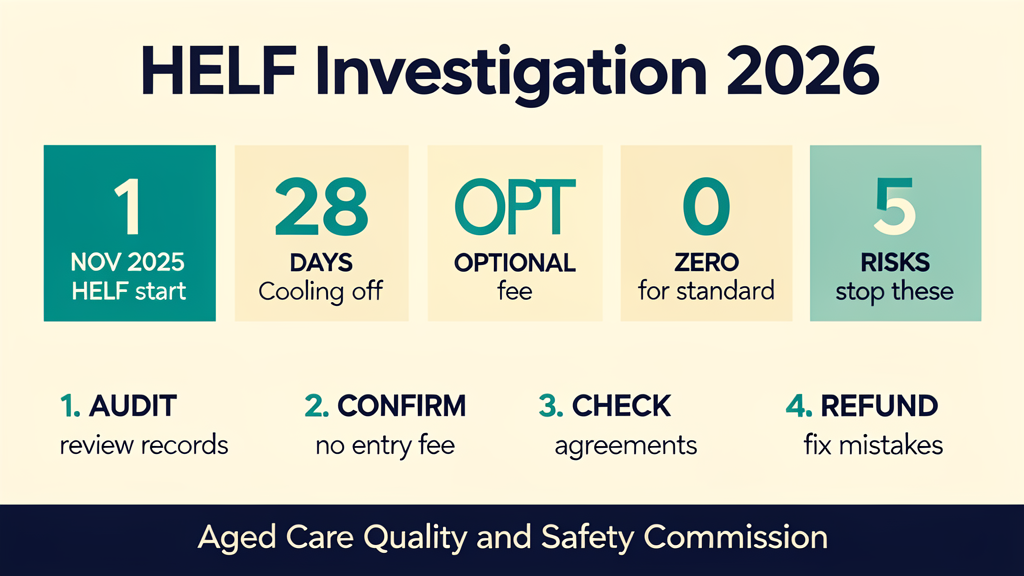
The Aged Care Quality and Safety Commission has confirmed it is investigating several residential aged care providers over the way they are charging Higher Everyday Living Fees, and has already issued formal notices compelling providers to hand over their HELF decision-making and pricing records. Aged Care Quality and Safety Commissioner Liz Hefren-Webb said the Commission will take strong regulatory action where providers fail to meet their obligations, with refunds and reinstatement of withdrawn services the immediate consequences. The Commission has identified examples of providers removing televisions from vacant rooms with the intent of charging new residents for installation, removing basic services and then attempting to charge residents to have them reinstated, and planning to charge residents for performances given by volunteers for free.
The Higher Everyday Living Fee was introduced on 1 November 2025 alongside the new Aged Care Act 2024 as a replacement for the old additional and extra service fee arrangements. It is designed to be an optional fee that residents can choose to pay when they want services over and above the standard services every aged care home must provide. The Commission's investigation is making clear that the line between a legitimate HELF service and a service that should already be delivered as part of standard residential aged care has been crossed by too many providers, too often. Here is what the Commission has actually named, the five categories of prohibited practice every residential provider needs to know, and the four-step audit every home should run this week.
What the Commission actually said in Quality Bulletin #6-2026
Aged Care Quality Bulletin #6-2026, the monthly regulator bulletin published by the Commission, includes a section titled "Regulatory action against HELF overcharging". The opening sentence is unambiguous: "We're investigating several providers in relation to the charging of Higher Everyday Living Fees (HELF) in their residential aged care services." The Commission has issued notices to a number of providers to compel them to give the Commission information about their decision-making processes and practices in applying HELF.
Several providers have already acknowledged errors in their application of HELF and have offered assurances that existing residents will not experience any reduction in services or imposition of new fees for services that were already in place prior to the implementation of HELF. Where existing residents had been inappropriately charged, providers have made refunds. The Commission is now using its formal regulatory powers to compel information, and it has signalled that further enforcement action will follow if the information shows systemic non-compliance.
Commissioner Hefren-Webb reinforced the position publicly: "Higher Everyday Living Fees are optional. They are not an opportunity for providers to charge residents for services that should already be delivered as part of quality aged care. Older people and their families must have transparency, fairness and confidence that they are only being asked to pay for genuine additional services they have freely chosen and can use." The Commission has separately stated it will use its powers to make sure providers promptly issue refunds to residents who have been charged incorrectly or unjustly.
Five categories of prohibited HELF practice the Commission has named
Although the Commission's bulletin does not itemise every prohibited practice, the investigations it has disclosed publicly fall into five clear categories. Every residential provider should treat each one as a red line and check current HELF pricing, marketing and resident agreements against it this week.
- Charging for meals that should be standard care. The Commissioner has said publicly that providers must offer meals that meet the nutritional needs, goals and preferences of residents, and that this is "not optional, not an additional service, and a minimum mandatory requirement." Any HELF line item that describes a meal, a menu upgrade, a wider refreshment selection, or a premium dining option that is positioned as the default residential offering is the single most common type of overcharge the Commission has flagged.
- Removing a basic service so it can be recharged. The Commission has identified providers who removed televisions from vacant rooms specifically so that new residents could be charged a HELF to have them reinstalled. The same pattern has been documented for Wi-Fi, hairdressing and other services that should reasonably be available as part of standard residential care. Removing a service in order to charge for its reintroduction is the clearest possible HELF misuse.
- Charging for volunteer or free services. The Commission has identified at least one provider that was planning to charge residents for performances given by volunteers for free. The relevant test is whether the service is genuinely an additional service that the provider is paying to deliver; if the cost to the provider is zero, a HELF charge cannot be justified.
- Presenting HELF as mandatory or as a condition of entry. The Department of Health, Disability and Ageing position is explicit: a HELF must not be agreed or charged before a resident has entered care, and it cannot be used as a condition of entry or to secure a room. Marketing material, admission packs, and pre-entry communications that imply HELF is a default cost of residency are all direct breaches.
- Charging for services the resident cannot use. A HELF bundle is permissible only if the resident is not worse off than if they paid only for the services they can use. If a bundle includes a service the resident cannot access or use and they end up paying more than they would for the services they can use individually, that bundle is non-compliant.
Each of these five categories maps directly to the regulatory framework that has been in place since 1 November 2025. The Commission's investigation is not inventing new rules; it is enforcing the rules that have applied since day one of the new Aged Care Act. The reason the bulletin matters is that the Commission is now actively using its information-gathering and enforcement powers, and it has signalled to the sector that refunds and service reinstatement will follow any finding of inappropriate charging.
The HELF framework: what is, and is not, a legitimate HELF service
The Department of Health, Disability and Ageing publishes the framework that governs what can and cannot be included in a HELF. The framework has been stable since 1 November 2025 and is the same set of rules the Commission is enforcing. The headline position is that a HELF can be charged for services, other than accommodation-related services, that are of a higher standard than those on the residential care service list, or that are not already required or listed on the service list.
All HELF services must still be delivered in accordance with the Aged Care Quality Standards and the Statement of Rights. A HELF cannot be used to bypass a Quality Standard obligation: if the Quality Standard requires the service, the HELF line item that charges for it is non-compliant by definition.
- Permissible HELF services include Wi-Fi usage, in-room television, subscription services with a streaming television provider, premium menu options, a wider refreshments selection such as alcohol, daily newspaper delivery, and hairdressing and beauty services.
- Required standard services that cannot be charged as HELF include meals that meet nutritional needs, basic clinical and personal care, accommodation-related services, and any service that is on the residential care service list or that the Quality Standards require the provider to deliver.
- Standing vs ad-hoc HELF agreements — a standing HELF agreement must be in writing, must outline the cost of each service, the standards and frequency of delivery, and how it will be charged. An ad-hoc HELF agreement is restricted to situations where a resident requests a single service that has not been planned or agreed in advance.
- 28-day cooling off period after signing a standing HELF agreement. The resident can cancel or vary the services within this period without a cancellation fee.
- Annual review — every HELF agreement must be reviewed at least once a year to confirm the resident still wants the services and is still able to use them.
- Annual indexation only — once a HELF price has been agreed, it can only be increased for that resident through annual indexation. New residents can be charged the new advertised price.
What the Commission will look at during a HELF review
The Commission's information-gathering notices will compel providers to produce the records that show whether HELF has been applied correctly. The five evidence categories the Commission will examine align directly with the five prohibited practices above, and every residential provider should be able to produce each one on demand.
- HELF agreements register — a current register of every standing HELF agreement in the home, with the date the agreement was signed, the date the resident entered care, and the date the cooling-off period ended.
- Service list mapping — a side-by-side map of every HELF line item against the residential care service list and the Quality Standards, showing which items are additional services and which are required standard services that cannot be charged for.
- Marketing and pre-entry material — every brochure, web page, admission pack and pre-entry letter that mentions HELF, with the language checked to confirm HELF is presented as optional and never as a condition of entry.
- Refund and variation register — every refund issued to a resident who was inappropriately charged, every HELF agreement varied during the cooling-off period, and every HELF agreement cancelled under the 28-day cooling-off rule.
- Annual review records — for each standing HELF agreement, the date of the last annual review, the confirmation that the resident still wants the service and is still able to use it, and any changes to the agreement documented at the review.
The four-step audit every residential provider should run this week
The Commission's investigation has been public for two months, and Quality Bulletin #6-2026 is the formal signal that the Commission is moving from education to enforcement. Every residential provider should run the same four-step audit, in order, before the next notice arrives.
- Audit existing HELF agreements against the residential care service list. Pull every current standing HELF agreement, list each HELF line item, and map it to the residential care service list and the Aged Care Quality Standards. Any line item that maps to a service that is required to be delivered as part of standard care must be removed from the HELF agreement, refunded if charged, and reclassified as part of the standard offering.
- Confirm no HELF was charged before entry or as a condition of entry. Pull the pre-entry admission pack, the residential care service agreement, and the first HELF agreement for every current resident. Confirm the HELF agreement was signed after the residential care service agreement, that it is a separate document, and that no language in any pre-entry material presents HELF as a default or mandatory cost.
- Verify the written agreement includes cost, frequency, standards and review date. For every standing HELF agreement, confirm the agreement is in writing and includes the cost of each service, the standards and frequency at which the service will be delivered, how it will be charged, and the date of the next annual review. Ad-hoc agreements should be rare and confined to genuinely unplanned single-service requests.
- Issue refunds where residents have been inappropriately charged. Where the audit identifies any resident who has been charged a HELF for a service that should have been delivered as part of standard care, or who was charged a HELF before entering care, or who was charged for a service they cannot use, issue a refund promptly and document it in the refund and variation register. The Commission's stated position is that refunds must be prompt, and the Commission's notice power means the refund register is the first thing investigators will read.
The compliance artefacts that prove HELF is being run correctly
Documentation is the only way to demonstrate that HELF is being applied correctly to the Commission, to residents and to their families. Five artefacts, kept current, will cover most of what the Commission's information-gathering notices will request.
- HELF register — a single register of every standing HELF agreement with resident identifier, agreement date, services, cost, annual review date and current status.
- Service list mapping — the HELF line items mapped against the residential care service list and the Aged Care Quality Standards, with the rationale for each HELF item recorded.
- Pre-entry material audit — the current admission pack, website and pre-entry letter checked to confirm HELF is presented as optional, never as a condition of entry.
- Refund and variation register — every refund, every variation, and every cooling-off cancellation, with the resident identifier, the reason and the date.
- Annual review records — for each standing HELF agreement, the date of the last annual review and the confirmation that the resident still wants and is able to use each HELF service.
How NovoCove handles this
NovoCove gives residential aged care providers a single source of truth for the HELF framework, from the resident consent record through to the refund register. The platform tracks every standing HELF agreement against the 28-day cooling-off period, flags the 365-day annual review date before it arrives, and maps every HELF line item to the residential care service list so the service list mapping is generated automatically rather than assembled by hand each quarter.
When a refund is issued, the refund register entry is created in the same workflow as the original HELF charge, so the refund trail and the charge trail reconcile on the same screen. The annual review record is generated from the standing HELF agreement register and the resident confirmation, so the Commission's request for annual review evidence becomes a single export rather than a paper chase. For a home that has just been asked for information under a Commission notice, that is the difference between a one-day response and a three-week scramble.
The same platform covers every other aged care compliance obligation your home is operating under — the Care Minutes Supplement quarterly reporting, the 24/7 RN rule, the SIRS incident reporting workflow, the Quality Standards evidence pack, and the registered provider reporting obligations under the new Aged Care Act. If your service is in scope of the Commission's Quality Bulletin #6-2026 line of questioning, NovoCove is built to answer it.
This guide is general information and is not legal advice.