Aged care compliance
ACQSC 1-Hour Evidence Rule: The Hidden Clock Inside Your Next Aged Care Audit (and How to Beat It)
If you are an aged care provider in categories 4, 5 or 6, the Commission is now expecting you to surface any requested evidence within one hour during daily onsite feedback meetings. Here is the workflow that meets the clock.
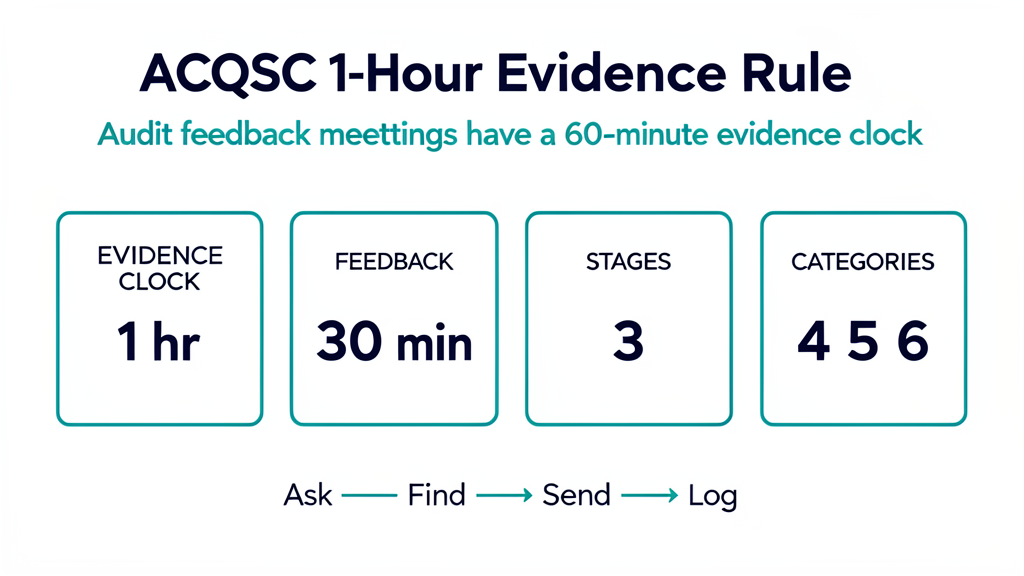
On 29 April 2026, the Aged Care Quality and Safety Commission (ACQSC) opened the new Renewal of Registration Audit Guide (February 2026) for every aged care provider applying to renew their registration in categories 4, 5 or 6. The guide restructures the audit into three formal stages, codifies the four-grade rating model, and replaces the loose evidence-retrieval expectations of the old regime with something specific: if an auditor requests documentation during a daily onsite feedback meeting, the provider is expected to produce it within one hour.
That single sentence - "If we request documentation while we are onsite, we expect you to provide it within an hour" - sits at the bottom of the Feedback meetings section of Stage 2 (Audit delivery) of the Renewal of Registration Audit Guide. It is the new operational reality for every residential and home care provider in Australia. The Commission is no longer measuring whether your policies exist; it is measuring whether you can surface them, walk through them, and confirm them with a timestamped artefact inside a 60-minute window.
This guide breaks down exactly what the rule says, where it sits in the audit flow, what evidence the auditor is most likely to request, and the 5-step operational workflow that lets a provider surface any document in under 10 minutes - giving you a 50-minute buffer for the more complex governance items.
What the ACQSC Renewal of Registration Audit Guide actually says
The Feedback meetings section of Stage 2 of the Renewal of Registration Audit Guide (February 2026) sets out a daily onsite cadence. The Commission holds a 30-minute meeting with the provider's key contact at the end of each audit day. At that meeting the auditor shares observations, raises any issues, and gives the provider a chance to provide extra information or evidence about the matters discussed.
The exact wording in the guide is: "At these meetings we give you the opportunity to provide extra information or evidence about the matters we discuss. If we request documentation while we are onsite, we expect you to provide it within an hour." There is no carve-out for older documents, no extension for archived evidence, and no allowance for the on-call person to be unavailable. The clock starts the moment the request is made and runs against the 30-minute feedback meeting itself.
For context, the same guide states that feedback meetings are 30 minutes long and that you cannot provide more information at the closing meeting - meaning the 1-hour evidence clock and the 30-minute meeting overlap. The auditor is signalling what they want during the meeting and expecting the document in the same conversation. If your evidence arrives 65 minutes later, the rating conversation has already moved on.
Where the 1-hour rule sits in the three-stage audit flow
Understanding the placement of the rule is the difference between treating it as a polite guideline and treating it as a hard operational constraint. The new audit process has three stages.
- Stage 1 - Audit initiation. The Commission emails you with a request to complete the Audit Evidence Collection Tool (AECT) and the Care Delivery Evidence Collection Tool (CDECT), then schedules an audit initiation meeting. The 1-hour rule does not apply here - you have the documented AECT/CDECT submission window.
- Stage 2 - Audit delivery. The auditor collects evidence onsite, conducts opening and entry meetings, holds the daily 30-minute feedback meetings, and runs interviews, observations and file reviews. This is where the 1-hour evidence rule applies. Every document the auditor requests during a feedback meeting must be produced within 60 minutes.
- Stage 3 - Audit reporting. The Commission prepares a preliminary assessment report, an exceeding assessment report (category 6 only) and a final audit report. The 1-hour rule does not apply here, but the evidence surfaced in Stage 2 drives every rating decision in Stage 3.
Why the Commission introduced the 1-hour clock
The strengthened Aged Care Quality Standards (in force since 1 November 2025) shifted the assessment logic from "do you have a policy" to "can you demonstrate the policy has been followed in the last 90 days and what did you change as a result." That shift requires the auditor to test evidence in real time, against observed practice, across multiple strengthened Quality Standards in a single day. The Commission cannot run that test if it has to wait two days for a provider to surface a roster or an incident report.
The 1-hour rule is the operational answer to the strengthened Standards. It forces the provider to maintain a state of audit-readiness throughout the engagement rather than assembling evidence retrospectively. Providers that run continuous evidence capture throughout the quarter will find the 1-hour clock trivial. Providers that rely on a single point-in-time evidence pack assembled the week before the audit will fail the clock every time.
The Commission's own framing in the Renewal of Registration Audit Guide is that the audit team collects evidence to help them make "accurate, reliable and defensible findings" - meaning the Commission itself needs the rule to be defensible. If the rule were "produce it within a week", the Commission would struggle to defend a finding that depended on a document the provider had time to curate, edit or backdate. The 1-hour rule is as much about the Commission's defensibility as the provider's compliance.
What evidence the auditor will most likely request
Feedback meeting requests cluster around a small set of evidence types. Knowing the cluster lets you pre-build the right retrieval workflow rather than building a generic search.
- Rosters and staffing evidence. Confirmation of the 24/7 registered nurse rule, care minute targets (215 care minutes including 44 RN minutes for MM1 metropolitan facilities under the Base Care Tariff Supplement) and the daily skill mix for the audit window.
- Incident and complaint records. SIRS notifications, complaint logs, investigation timelines and corrective action evidence - the auditor will often request a specific incident to walk through end-to-end.
- Policy version control. The current version of every operational policy referenced in observed practice, plus the version-control history showing when the policy was last reviewed and by whom.
- Training and credentialing records. Completion records for the strengthened Quality Standards training, working with vulnerable people checks, English-language proficiency, and any role-specific clinical competencies.
- Consumer experience evidence. Care plan reviews, consumer advisory board minutes, family conference notes, and any consumer-nominated supporter correspondence.
- Governance evidence. Board minutes showing clinical governance oversight, risk register entries, and continuous improvement records tied to the strengthened Standards.
The auditor is not requesting these documents to test your filing system. They are requesting them to test whether the strengthened Quality Standard they are assessing is embedded in daily practice. A policy that exists on a shared drive but is not followed is a minor non-conformance. A policy that is followed but cannot be produced within 60 minutes is also a minor non-conformance. The 1-hour rule penalises the second gap.
The 5-step workflow that beats the 1-hour clock
The 1-hour evidence rule is a workflow constraint, not a content constraint. The evidence already exists in your service. The question is whether you can find it, walk through it, and confirm its currency in under 60 minutes. Here is the 5-step workflow that gets every provider there.
Step 1 - Build a strengthened-Standard evidence map before the audit
Map every strengthened Aged Care Quality Standard Outcome (Standard 1 through Standard 7) to the evidence types the Commission is most likely to request. Each Outcome gets a named owner - usually the Director of Nursing for clinical Outcomes, the Quality Manager for governance Outcomes, and the CEO for the Consumer Dignity and Choice Outcomes. The map is the audit-readiness score for the service and it is the document the key contact consults when the feedback meeting request lands.
Step 2 - Capture evidence continuously, not at audit time
Every roster change, every incident, every complaint, every policy revision and every training completion is logged with a timestamp and a version the moment it happens. Continuous capture is the single biggest determinant of 1-hour retrieval speed. Evidence assembled in the last two weeks before the audit looks like a scramble, and the 1-hour rule is calibrated to expose that scramble.
Step 3 - Stage every evidence pack in 10-minute retrieval buckets
Group the evidence by retrieval time. Bucket A (under 10 minutes) covers high-frequency items: current rosters, recent incident reports, current policy versions, today's training completion log. Bucket B (10-30 minutes) covers governance items: board minutes, risk register entries, care plan reviews. Bucket C (30-60 minutes) covers long-form artefacts: full SIRS investigation files, full policy review packets, full clinical audit trails. The auditor's request will land in one of these buckets, and the key contact should know which bucket to start from before the 1-hour clock starts ticking.
Step 4 - Run a 1-hour evidence retrieval drill monthly
Once a month, run a 1-hour evidence retrieval drill. Pick five evidence types at random, hand them to the audit lead, and time the retrieval. If any artefact takes more than 10 minutes, the system has drifted. The drill should be recorded, signed, and reviewed in the same governance committee that owns the audit-readiness score. The drill is also the training ground for the audit lead and the key contact - both of whom need to be able to perform under the 1-hour clock without a rehearsal.
Step 5 - Document every feedback-meeting exchange in real time
Every feedback meeting request and response should be logged in real time. The log captures the request, the time it was made, the artefact produced, the time it was produced, and any clarifying conversation. The log becomes a primary evidence artefact in its own right - proof that the service met the 1-hour clock throughout the audit. If the auditor later flags a finding, the log provides the contemporaneous record that supports the service's response.
What the 1-hour rule means for portfolio operators
Operators running multiple residential aged care homes or home care services face a compounded version of the 1-hour rule. Each residential home in category 6 is visited onsite and runs its own daily feedback meeting cadence. A 10-home portfolio effectively runs 10 parallel 1-hour clocks, each with its own evidence request stream, each feeding into the provider-level audit that aggregates the rating across all homes.
Portfolio operators should standardise on a single evidence workflow that all homes use, with the same metadata, the same version control, and the same retrieval taxonomy. A standardised workflow is the only way to maintain a 1-hour retrieval speed across 10 sites. Anything less and the provider-level audit will reflect the slowest home, not the fastest.
For category 4 and 5 providers, the same logic applies at the service-type level rather than the residential-home level. The auditor samples services across the provider's portfolio, and the 1-hour clock runs against the sampled service. A service that cannot meet the clock forces a finding against the provider that the provider will then have to defend.
What changes in your pre-audit preparation
Pre-audit preparation under the new guide is no longer a single 60-day plan. It is a continuous evidence workflow with a 1-hour retrieval constraint baked in. The implication is that the 60-day pre-audit prep cycle still matters, but it is now an audit-readiness verification rather than an evidence assembly exercise. The evidence is already in the system; the prep cycle is checking that the system can surface it under the clock.
For most providers, the single biggest change is moving from file-share-based evidence to a structured evidence repository. The file share can hold the artefact but it cannot enforce metadata, version control, or retrieval taxonomy. A structured repository - ideally a compliance platform with strengthened-Standard-aware evidence mapping - turns the 1-hour clock from a stress test into a routine operation.
How NovoCove handles this
The 1-hour evidence rule is exactly the operational constraint the NovoCove platform was built for. Every strengthened Aged Care Quality Standard Outcome has a dedicated evidence map, every artefact is version-controlled and metadata-tagged at the point of capture, and every feedback-meeting request can be answered from a single search across the provider's entire evidence corpus. The 1-hour clock becomes a 10-minute clock, with a 50-minute buffer for the governance items that take longer to walk through.
We use the same workflow internally to keep NovoCove's own aged care customers on the right side of the new audit regime. Every customer gets a monthly 1-hour retrieval drill report, a quarterly audit-readiness score against the strengthened Standards, and a real-time evidence map that the Director of Nursing and the Quality Manager can both navigate without training. If you are operating a portfolio of residential or home care services and want to walk through your last audit feedback live, book a 20-minute demo and we will run the 1-hour drill against your real evidence.
This guide is general information and is not legal advice.