Aged care fees & agreements
HELF 'No Worse Off' Protection: The 1 November 2026 Free-Service Rule for Residential Aged Care Providers
On 1 November 2026, new Higher Everyday Living Fee (HELF) rules come into effect: providers must not charge a HELF for services that residents were receiving at no extra cost immediately before 1 November 2025, and those services must stay free for as long as they are offered to other residents in the home. The Aged Care Quality and Safety Commission set this out in Quality Bulletin #9-2026 and its new Regulatory Bulletin RB 2026-3. Amendments to the Aged Care Rules 2025, made in September 2026, start on 1 November 2026. Here is the background, the six conditions of the protection, the six operational actions, and a 30-day review plan to help you check each HELF arrangement against the rule.
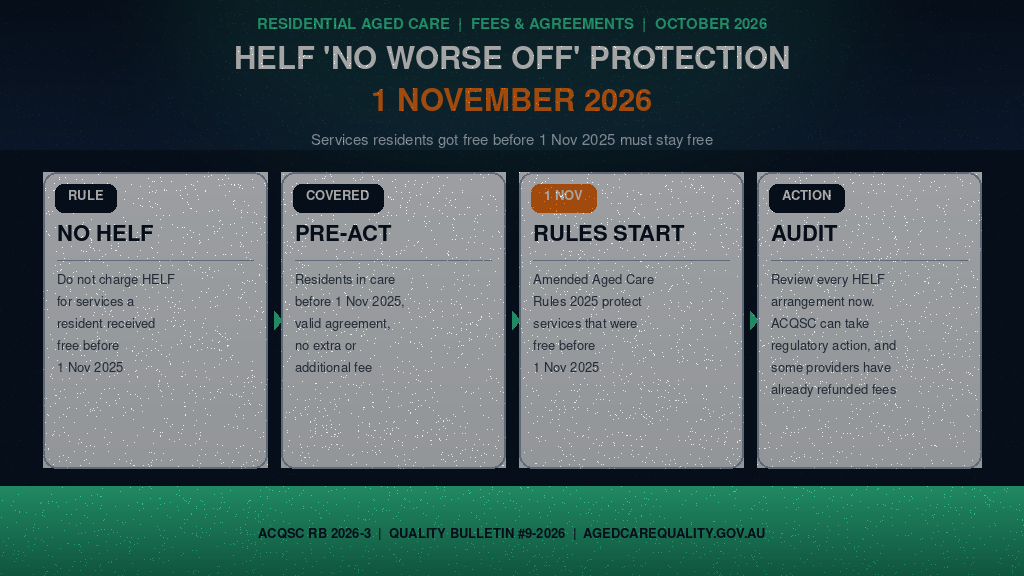
From 1 November 2026, a residential aged care provider must not charge a Higher Everyday Living Fee (HELF) for any service a resident was receiving at no extra cost immediately before 1 November 2025, and if the provider still offers that service to other residents in the home, it must keep providing it to that resident free of charge. The Aged Care Quality and Safety Commission (ACQSC) made the rule explicit in its Quality Bulletin #9-2026 and its new Regulatory Bulletin RB 2026-3. Amendments to the Aged Care Rules 2025, made in September 2026, start on 1 November 2026. From that date, providers must not charge these residents a HELF for those services and must keep providing them while they are offered to other residents in the home.
General information only, not legal or financial advice. Check the current Aged Care Rules and Commission guidance, and get advice for your circumstances.
Background: the 'no worse off' principle and the birth of HELF
The Aged Care Act 2024 commenced on 1 November 2025, replacing the 1997 Act and restructuring how residential aged care is funded and charged. One of its signature changes was the Higher Everyday Living Fee, a single optional fee for services delivered to a higher standard than the residential care service list, or additional to it. HELF replaced the old two-product structure of extra service fees and additional service fees, and it is optional for a provider to offer and optional for a resident to accept.
Alongside the new fee structure came the 'no worse off' principle: residents who were in care when the new Act started should not end up paying more, or losing services, simply because the legal framework changed. That principle has driven a series of transitional rules through 2026: the service agreement transition (pre-Act resident agreements had to be varied or replaced before 1 November 2026), the end of legacy extra and additional service fee arrangements on 31 October 2026, and now the free-service protection that starts the very next day.
The free-service protection answers a specific risk. As providers converted legacy arrangements to HELF through 2026, the Commission and the Department of Health, Disability and Ageing saw the potential for a provider to take a service that had always been included at no cost (a daily newspaper, a weekly outing, barista coffee in the common area) and re-offer it as a paid HELF service. The department clarified in September 2026 that providers should not remove services previously available to residents at no cost and then require a HELF agreement for ongoing access to those same services. Amendments to the Aged Care Rules 2025, made in September 2026, start on 1 November 2026. From that date, providers must not charge these residents a HELF for those services and must keep providing them while they are offered to other residents in the home.
What changed and when: the 1 November 2026 free-service rule
The ACQSC's Quality Bulletin #9-2026 (published October 2026) states the rule in plain terms: on 1 November 2026, new HELF rules come into effect, and under those rules providers must not charge residents a HELF for services they were receiving at no extra cost before 1 November 2025. Providers must continue to provide these services free of charge, if they are available to other residents in the home. The Commission can take regulatory action against providers who do not meet their HELF responsibilities.
Read together, the amended Aged Care Rules 2025 and RB 2026-3 (the Commission's dedicated HELF regulatory bulletin, published on 2 October 2026) point to six conditions. Each relates to a service the provider was providing to a resident:
- Immediately before 1 November 2025: the service was being delivered immediately before the new Act commenced.
- With a valid resident agreement: the resident had a proper agreement in place at the time.
- Without an additional service fee or extra service fee agreement: the service was genuinely free, not already paid for under a legacy fee arrangement.
- Where the provider continues to offer the service to other residents: this decides whether the provider must keep providing the service free. It is not a condition of the ban on charging a HELF.
- Where the service stays the same, or very similar, in purpose, outcome, nature or benefit: a cosmetic rename does not reset the clock.
- Above the old-Act requirement: the service was additional to, or delivered at a higher standard than, what the provider had to deliver under the old Act.
Conditions 1 to 3, 5 and 6 decide whether you can charge a HELF for the service. Condition 4 (still offered to other residents) decides whether you must keep providing it free.
The protection also applies if the service was stopped after 1 November 2025 (s 148-46(3) of the Aged Care Rules 2025). If you still offer it to other residents, the resident is entitled to it again from 1 November 2026.
The bulletin is explicit that providers cannot avoid these protections by changing a service and re-offering it through a HELF arrangement. Repackaging a free service (changing its name, bundling it, or shifting it into a 'premium' tier) does not make it chargeable if it remains the same, or very similar, in purpose, outcome, nature or benefit. The Commission's guidance also confirms the protection does not apply where a resident was already receiving the service under an additional or extra services fee arrangement, or where the resident entered care on or after 1 November 2025.
Two related rules complete the picture. First, Standard 6 of the strengthened Aged Care Quality Standards requires providers to give residents varied, appetising and nutritious food and drinks that meet their needs and preferences. HELF must not be used to compensate for deficiencies in food, nutrition or dining services that providers are already required to deliver under Standard 6: a provider cannot meet its nutritional obligations by offering 'enhanced' meals for a fee. Second, leave arrangements: providers cannot charge for HELF services while a resident is on extended hospital leave (more than 30 days), and cannot charge for services a resident cannot or will not use during leave, like activities, outings or hairdressing.
Operational impact: six things every residential provider should do now
The rule starts on 1 November 2026. The Commission has already shown it treats HELF as a compliance priority: it has investigated providers over HELF charging practices through 2026, and RB 2026-3 notes that as a result of working with the Commission, some providers have changed their practices and refunded fees to older people. Six actions follow for every provider offering HELF:
- Audit what was free before 1 November 2025. Build the register of every service your home was providing at no extra cost immediately before the new Act commenced, from daily newspapers and barista coffee to weekly outings, room amenities and lifestyle programs. Admissions, care, lifestyle and accounts all hold fragments of this picture; one consolidated list is the spine of the whole audit.
- Test every current HELF arrangement against the six conditions. For each resident paying a HELF today, ask: was this service provided to them free immediately before 1 November 2025, under a valid resident agreement, with no extra or additional service fee? Do we still offer it to other residents? Is it the same, or very similar, in purpose, outcome, nature or benefit? Was it additional to, or delivered at a higher standard than, what the old Act required? If conditions 1 to 3, 5 and 6 are met, do not charge a HELF for the service. If you still offer it to other residents, you must also keep providing it free.
- Check for repackaging risk. Review any service that changed name, moved into a bundle, or was re-tiered during 2026. If the change was cosmetic and the service is substantially the same as what was free immediately before 1 November 2025, the protection applies, and the Commission has said providers cannot avoid the protection by changing a service and re-offering it through a HELF arrangement.
- Separate required services from enhanced services. Confirm that nothing on your HELF menu is actually a required service under the Aged Care Rules 2025, the Residential Care Service List or the Quality Standards, including food and nutrition under Standard 6. Required services cannot be charged for at all, and HELF cannot be used to fill gaps in the standard service offering.
- Fix billing and agreements before 1 November. Remove or reclassify any charge that falls inside the protection, update HELF agreements and advertised service lists, and check that billing systems cannot raise the affected charges after the cutover. Check leave arrangements too: no HELF charges during extended hospital leave, and no charges for services not used during leave.
- Organise your own review records. The Commission's regulatory approach escalates from education to required changes, and the Commission can take regulatory action where providers continue not to comply. Your file should show, per resident: the pre-1 November 2025 free-service position, the HELF arrangement, the six-condition test result, and the billing change.
A 30-day HELF review: start now, finish after 1 November
If you are starting with less than 30 days to go, run the first three phases in parallel and prioritise stopping any charge that clearly falls inside the protection before 1 November. The remaining steps continue after that date. The five phases are:
- Days 1-5: Build the free-service register. Consolidate every service that was provided at no extra cost immediately before 1 November 2025, from admissions, care, lifestyle and accounts records. Capture the service, the resident cohort, who received it, and how it was delivered. Flag services that changed in any way during 2026 for closer review.
- Days 6-12: Test every HELF arrangement. Run each current HELF charge through conditions 1 to 3, 5 and 6, and use condition 4 to identify services you must keep providing free. Produce a per-resident outcome: charge continues (service genuinely enhanced or additional, not previously free), charge ceases (service was free immediately before 1 November 2025), or review required (service changed during 2026).
- Days 13-19: Legal and policy review. Have the borderline cases reviewed against the Aged Care Rules 2025, RB 2026-3 and the department's HELF guidance, by your legal adviser where arrangements are complex. Confirm which services are required (and therefore never chargeable) versus genuinely enhanced, and check Standard 6 food and nutrition obligations.
- Days 20-26: Resident communication and agreement updates. Where a charge is ceasing, tell the resident and their family in writing before 1 November, explain that the service continues free of charge, and update or withdraw the affected HELF agreement. Where a charge continues, confirm the agreement still reflects the service actually delivered, including leave and bundling terms.
- Days 27-30: Billing cutover and verification. Reconfigure billing so no protected charge can be raised from 1 November, update advertised service lists and menus, train admissions, care, lifestyle and accounts staff on the rule, and re-run the register against the final billing state until every resident is accounted for. File the evidence pack and brief the board or governing body on completion.
How NovoCove supports this
A 'no worse off' audit is, underneath the legal work, an evidence and task-management exercise: one register of services that were free immediately before 1 November 2025, a sequence of six-condition tests, a pile of agreement updates and billing changes, and a hard deadline. NovoCove can support the task-tracking side of that exercise. Compliance tasks with owners and due dates turn the six actions and the 30-day review above into a tracked program: each service review, each agreement update, each billing change gets an owner, a due date and a status, so you can see which HELF reviews are still open on the task board. RAG shows task progress and records on file, the daily trend shows progress as work is completed, and the audit log records who did what, and when.
The same platform centralises the workforce side of the offer: staff certifications and training expiry for aged care (AHPRA registration for registered and enrolled nurses, NDIS Worker Screening and more) with reminder alerts, to help you see upcoming credential expiries. It does not replace your legal adviser (HELF agreement terms need legal review), your billing system, or your finance team's judgement on pricing, but NovoCove can export your task history and the credential records you hold, to support your own evidence. It is not a HELF register or billing record. The coverage is detailed on the aged care compliance software page.
Sign up to see how a HELF review can be tracked as a task list.
Sources / further reading
- Aged Care Quality Bulletin #9-2026, Aged Care Quality and Safety Commission, October 2026 (T1)
- RB 2026-3 Regulatory Bulletin: Higher Everyday Living Fee, Aged Care Quality and Safety Commission, 2 October 2026 (T1)
- Changes to the Higher Everyday Living Fee, My Aged Care, 21 September 2026 (T1)
- Higher everyday living fees in residential care homes, Department of Health, Disability and Ageing (T1)
- Residential care service list and higher everyday living fee: Guidance for providers, Department of Health, Disability and Ageing (T1)
- Aged Care Rules 2025, Federal Register of Legislation (T1)
- Aged Care Amendment (September Indexation and Other Measures) Rules 2026 (F2026L01252), Federal Register of Legislation (T1)
- Aged care home costs and fees, My Aged Care (T1)
This guide is general information and is not legal advice.