ECEC workforce compliance
15% ECEC Educator Pay Rise Locked In: The $3.6 Billion Amendment, the July 2027 NQS Safety Condition and the Provider Checklist
On 12 August 2026 the Australian Government introduced legislation to amend the Wage Justice for Early Childhood Education and Care Workers (Special Account) Act 2024 — a further $3.6 billion for the 15 per cent educator pay rise, and a new legislated condition: services must meet national safety standards to receive the payment. From July 2027, funding can be cut or suspended for services that do not meet the National Quality Standard when it comes to safety. Here is what the amendment means for the 80%+ of eligible services receiving the payment today, the six operational actions, and the 30-day workflow that turns your service's safety evidence into a protected funding line.
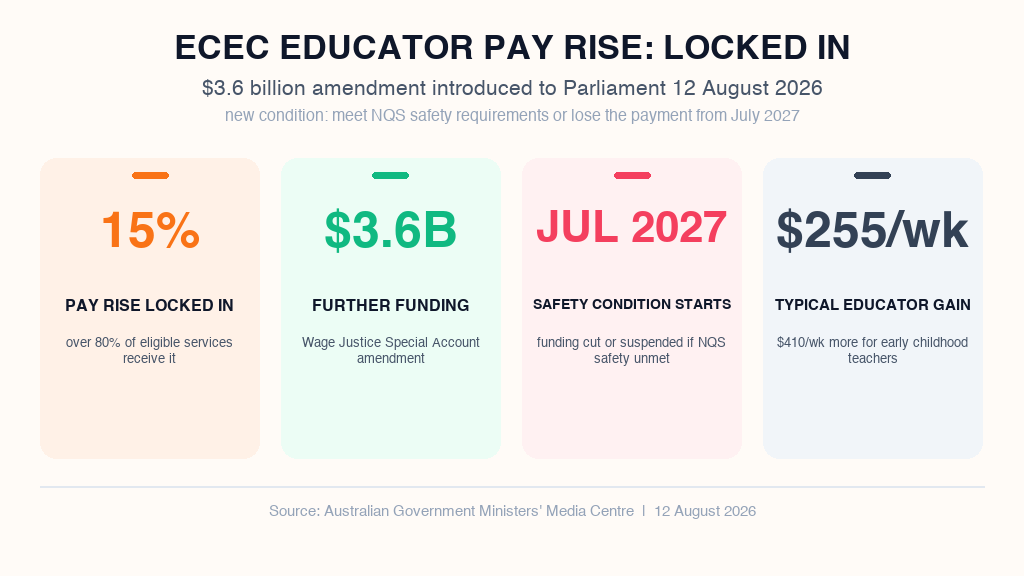
On 12 August 2026, the Australian Government introduced legislation to amend the Wage Justice for Early Childhood Education and Care Workers (Special Account) Act 2024 — a further $3.6 billion to lock in the 15 per cent early childhood educator pay rise, and, for the first time, a legislated condition that ties that funding to safety. From July 2027, if a service does not meet the National Quality Standard when it comes to safety, its educator pay rise funding can be cut or suspended.
Background: the pay rise, the special account and the safety reform wave
The 15 per cent pay rise began in December 2024, funded through grants from the Wage Justice for Early Childhood Education and Care Workers Special Account established by the 2024 Act. It was a deliberate answer to a workforce crisis: early educators had been leaving the sector, vacancies were high, and remuneration sat well below comparable roles. The design was conditional from the start — services receiving the payment had to limit fee increases so that wage gains were not simply passed to families.
The program has produced numbers the Government is now citing as the case for locking the funding in permanently. More than 80 per cent of eligible services currently receive the payment. Since the pay rise was announced, there are 20,000 more early educators in the workforce and job vacancies have decreased by more than 31 per cent. At Goodstart Early Learning, use of agency staff fell 69 per cent in the first year of the program. For a typical full-time educator the pay rise, combined with minimum wage increases, means $255 more per week than before the program began — and $410 more per week for an early childhood teacher. Fees at participating services have grown at around half the rate of services not receiving the payment, and the Government estimates the average family will save about $1,500 over the next two years.
The same period has seen the most significant safety reform wave in the history of the NQF. From 27 February 2026, changes to the National Law and National Regulations made child protection training mandatory for all staff who work with children, strengthened working with children check requirements, introduced offences for inappropriate conduct, restricted digital device use, and laid the legislative foundation for the National Early Childhood Worker Register. These reforms came out of the ACECQA Child Safety Review and the rapid child safety reviews commissioned after high-profile abuse allegations. The 12 August 2026 amendment connects those two streams: the workforce funding program and the safety agenda are now legally wired together.
What changed and when: the amendment, the $3.6 billion and the July 2027 condition
Three elements define the new position:
- 12 August 2026 — legislation introduced. The Government introduced amendments to the Wage Justice for Early Childhood Education and Care Workers (Special Account) Act 2024 to deliver a further $3.6 billion for the 15 per cent pay rise. The bill is now before Parliament; once passed, it locks the funding stream in beyond the current appropriation.
- A legislated safety condition. The amendments put into law the requirement that early childhood education and care services meet the national safety standard — the safety requirements of the National Quality Standard — as a condition of receiving the payment. Today, 95 per cent of early learning services meet the safety standard; the Government wants the rest closed before the condition bites.
- July 2027 — the enforcement date. From July 2027, services that do not meet the NQS when it comes to safety can have their funding cut or suspended. That is roughly 11 months from now — enough time for a deliberate evidence-building program, and a very short time if a service discovers its safety records are scattered across spreadsheets and filing cabinets.
The fee-increase condition continues unchanged: participating services must keep limiting fee increases, and the funding remains tied to that commitment. The amendment therefore creates two permanent funding conditions for the pay rise — fee restraint for families, and safety performance for children.
Operational impact: six things every approved provider should do now
The amendment converts safety performance from a quality question into a funding question. Six actions follow for every approved provider receiving — or eligible for — the retention payment:
- Confirm your service's participation status. Know whether your service receives the retention payment, under which agreement, and what conditions are attached. If you are eligible but not participating, understand the funding you are leaving on the table for educator wages — and the conditions you would take on.
- Map your service against the NQS safety requirements today. The condition references the National Quality Standard when it comes to safety — Quality Area 2 (children's health and safety) is the core of it: supervision, incident and injury management, hygiene practices, and the safety of the environment. Run a structured self-assessment now so you know your baseline, not in June 2027.
- Close the training and clearance gaps that already have deadlines. The child safety reforms put firm dates on training: foundation child safety training must be completed by 27 August 2026, and new staff entering the sector from 14 August 2026 must complete it within 14 days of starting. First aid, anaphylaxis and asthma management certifications, and current WWCCs for every staff member, are the same evidence the safety condition will test. A certificate expiring in the gap between now and July 2027 is a funding risk with a known expiry date.
- Treat your safety evidence as a funding file. From July 2027 the question will be how your service demonstrates it meets the NQS safety requirements — through the Quality Improvement Plan, policies (including the Regulation 168 suite), incident and notification records, supervision documentation, and training records. These documents should be assembled, versioned and reviewable as a pack, not scattered.
- Model the workforce cost now that the pay rise is legislated. The funding is being locked in, which is good news for educators and for retention — but it also makes the wage line a permanent, known cost. Budget the uplift: roughly $255 per week per full-time educator and $410 per week per early childhood teacher, on top of minimum wage increases, funded through the retention payment.
- Govern your fee decisions. The fee-increase limit is now a permanent condition of funding. Document every fee decision against the condition, keep the record of what fees changed and why, and ensure the responsible person can produce that trail — the condition has been in place since 2024 and is now being put into law explicitly.
A 30-day workflow to protect your funding line
Preparing for July 2027 does not require a special project — it requires a deliberate, documented routine. This 30-day workflow gives a centre director or approved provider a complete safety-funding position:
- Days 1-5 — Confirm status and inventory your evidence. Pull the funding agreement and confirm participation, fee conditions and reporting obligations. Inventory every document the safety condition will test: QIP, policies and review dates, incident and notification records, training records, WWCC register, supervision and excursion documentation.
- Days 6-10 — Run the NQS safety self-assessment. Work through the safety elements of the NQS — supervision (Element 2.2.1), incident and injury management (Element 2.2.2), and the child health and safety requirements across Quality Area 2. Rate each element as evidenced, partially evidenced or not evidenced, and capture the evidence reference for each rating.
- Days 11-15 — Close training and clearance gaps. Reconcile every staff member's child safety training (foundation module completed by 27 August 2026), child protection training, first aid/anaphylaxis/asthma certifications, and WWCC status. Flag every expiry before December 2026 so renewals happen ahead of the July 2027 enforcement date. New staff onboarding must include the training requirements from day one.
- Days 16-20 — Audit notifications and incident records. Check the records behind the obligations regulators test: 24-hour notifications, serious incident records and their review and reporting timeliness, and the enrolment and attendance records that sit behind supervision. A clean, complete record here is the fastest way to evidence safety performance.
- Days 21-25 — Build the funding-file evidence pack. Assemble the self-assessment, training matrix, WWCC register, policy review history, incident log and QIP into a single structured pack with dates and owners. This is the file you would hand an assessor — or your accountant — when asked how your service meets the NQS safety requirements.
- Days 26-30 — Governance sign-off and a quarterly cadence. Have the approved provider formally review and sign the safety-funding position. Schedule quarterly re-reviews of the same pack — every certification renewal, policy review and incident becomes an update to the file, so the position never goes stale before July 2027.
How NovoCove supports this
The July 2027 safety condition turns a quality question into an evidence question: how does your service prove it meets the NQS when it comes to safety? NovoCove is the data and evidence layer behind that answer. It centralises staff certifications and training expiry for 40+ Australian ECEC credential types across all states, with a 7-tier alert cadence that surfaces a first aid certificate, WWCC or child safety training expiry weeks before it becomes a finding — or a funding risk. Policy review dates and versions, incident and notification records, and compliance tasks with owners and due dates all live in the one dashboard, so the evidence trail behind Quality Area 2 is assembled in minutes rather than reconstructed from spreadsheets. The same approved-provider policy and NQF evidence workflow is covered on the ACECQA approved provider policy compliance software page.
NovoCove does not replace a service's supervision plan, its QIP, or the operational judgement of a nominated supervisor. It gives leaders the underlying evidence layer: the RAG compliance score and daily ComplianceSnapshot trend show your safety position moving as actions are completed, and any Quality Area evidence pack exports in a format an assessor — or a funding decision — can review. The workforce data the regulator sees today is the same data the National Early Childhood Worker Register will look for, and the same data that will answer the July 2027 question.
When the funding condition starts, the providers with a continuous, documented safety position will be the ones who never notice the change. Book a 20-minute demo and we will show you what your service's evidence position looks like through that lens.
Sources / further reading
- Legislation introduced to lock in 15% pay rise for early educators — Australian Government Ministers' Media Centre, 12 August 2026 (T1)
- Wage Justice for Early Childhood Education and Care Workers (Special Account) Bill 2024 — Parliament of Australia (T1)
- Legislation introduced to lock in 15 per cent pay rise for early educators, with safety requirements for services — The Sector, 13 August 2026 (T3)
- Child safety reforms — ACECQA, including the 27 August 2026 foundation child safety training deadline (T1)
- QA2 information sheet — Active Supervision: Ensuring safety and promoting learning — ACECQA (T1)
This guide is general information and is not legal advice.