Regulatory update
2026 ECEC National Workforce Census Opens: Mandatory Compliance Guide for Approved Providers
Every CCS-approved provider must register, prepare, and submit before the November 2026 field work window closes. Here is the workflow.
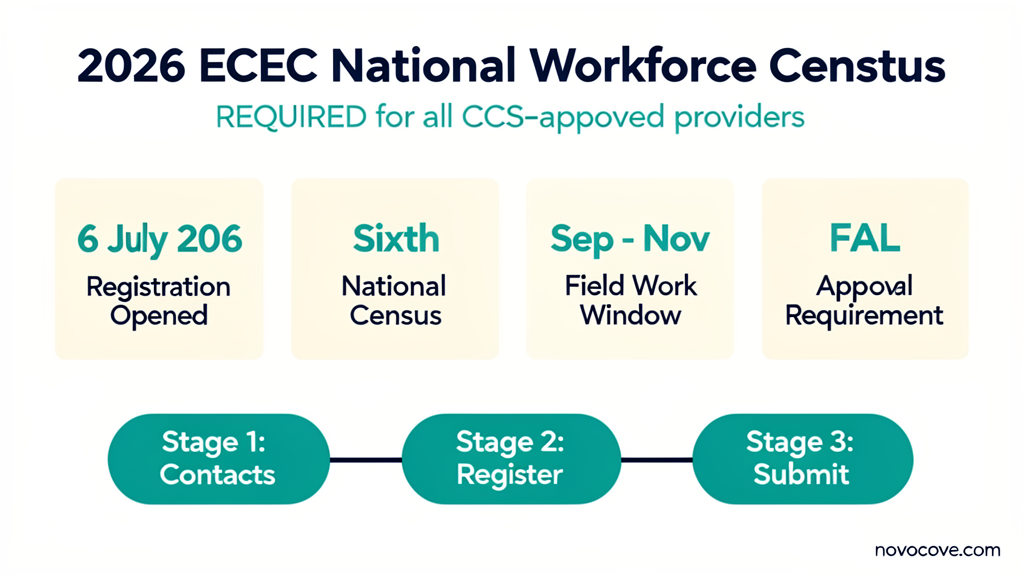
Registration for the sixth Early Childhood Education and Care National Workforce Census opened on 6 July 2026. Every Child Care Subsidy approved provider and every dedicated preschool and kindergarten in Australia is required to participate. This is not a voluntary sector survey. It is a condition of approval under the Family Assistance Law, and the field work window closes in November.
For most centre directors and approved providers, the census lands on top of the National Early Childhood Worker Register handover, the 1 January 2026 NQS refinements, the 27 February 2026 child safety training deadline, and the 1 July 2026 tripled penalty regime. The good news is that the 2026 census is shorter than the 2024 cycle. The Department of Education and the Social Research Centre have stripped out the per-worker detail and aligned the questions to the Worker Register, so the data you already submit for the Register carries most of the weight. The bad news is that missing the window still carries a Family Assistance Law compliance consequence, and the contact detail reconciliation step has to happen before 6 July or your registration email will go to the wrong person.
What the 2026 census actually measures
The census is the Australian Government Department of Education's primary workforce evidence base for the early childhood sector. It feeds the National Children's Education and Care Workforce Strategy and informs funding, qualification, and pipeline decisions across all eight jurisdictions. In 2026, the Department has confirmed the census will collect service-level data only. Per-worker information is no longer requested, because that information is now held in the National Early Childhood Worker Register, which became mandatory on 27 February 2026.
The 2026 collection covers five service-level data groups:
- Service use patterns: hours of operation, session types, and occupancy categories
- Children with additional needs: counts and support categories at the service level
- Access to preschool programs: kindergarten and preschool delivery arrangements
- Staff details aggregated to the service: headcounts, role mix, qualification bands, tenure bands, and wage bands
- Workforce development: professional development activity in the past 12 months and current educator study
The shift away from per-worker questions is the most significant design change in the history of the census. The previous 2024 cycle asked providers to enumerate each educator by name and employment status. The 2026 cycle asks for the same underlying data points, but aggregated. If your Worker Register is up to date, the answers already exist.
The three stages of the 2026 census window
The Department has split the census into three distinct windows, each with its own compliance obligation. Stage one has already started.
Stage 1: Contact detail reconciliation (May to June 2026)
Every approved provider must ensure the contact details recorded in the Child Care Subsidy System are correct for the provider, every service, and every Person with Management or Control (PMC). This window closed at the end of June, but if you missed it the Social Research Centre registration email may have gone to an ex-employee, an unmonitored inbox, or the wrong PMC. The fix is to update the details in CCSS now and then call the NWC Helpline on 1800 800 996 to trigger a re-send of the registration invitation.
Stage 2: Registration (6 July to August 2026)
Registration opened on 6 July 2026 and will run through August. The Social Research Centre will contact providers, services, and PMCs directly during July with login credentials and the registration link. Registration is the moment you commit to participation: it locks in your service list and assigns your census advisor. Approved providers who do not register during this window will be flagged as non-responsive and escalated to the Department of Education's compliance branch.
Stage 3: Field work (September to November 2026)
The Social Research Centre conducts the census from September through November 2026. Approved providers receive their service-level questionnaire, complete it online, and submit before the closing date published in their registration confirmation. The 2024 cycle took the median service approximately three hours to complete; the 2026 service-level design is expected to be shorter for services with a maintained Worker Register and longer for services whose register has drifted.
Why the Worker Register alignment matters for the census
The Department of Education has publicly aligned the two collections to reduce double-handling. If your Worker Register is current, the staff details section of the census can be completed from the register's existing headcounts, qualification bands, and tenure summaries. The register is also the primary evidence base the Department uses to validate census submissions. Where census answers disagree with the register, the Department may follow up under the same compliance powers that produced the 17 June 2026 update to the federal Enforcement Action Register.
The practical implication: the register is no longer a separate compliance system. It is upstream of every other workforce data submission you make to the Department in 2026, including the census. If your register has drifted since the 27 March 2026 deadline, the first three weeks of the field work window will be consumed by reconciliation rather than answering the questionnaire.
The Family Assistance Law compliance exposure
The census is mandatory under Family Assistance Law. The same law governs Child Care Subsidy approval, the Conditions of Approval framework, and the civil penalty regime that produced 216 sanctioned services between July 2025 and June 2026. The Department has confirmed that census non-compliance is treated as a breach of approval conditions, not as a separate offence. The practical consequence is that a missed census can sit alongside other FAL compliance findings on your provider record and accumulate toward the threshold for provider-level sanctions.
The civil penalty provisions cover four pathways the Department can use: infringement notices for summary matters, enforceable undertakings for remediable breaches, conditional continuation of approval for borderline cases, and provider disqualification for repeated or wilful non-compliance. Census non-response falls in the lower two pathways in the first instance but escalates quickly if the provider also has other outstanding compliance matters.
The 90-day compliance workflow
The field work window opens in September. Providers who treat the next 90 days as a structured workflow will finish the census in the first week of field work. Providers who treat it as an ad-hoc task will spend October and November chasing data.
Step 1: Reconcile CCSS contact details now
Pull your current CCSS records for the provider, every service, and every PMC. Confirm the email address for each is monitored and reaches a person who can act on it. Where the PMC has changed since the last approval review, update both the CCSS record and your internal personnel file. The registration email will go to whichever contact the Department holds on the day you register, not the day the Social Research Centre sends the invitation.
Step 2: Build the census service profile
Pull a one-page profile per service covering hours of operation, session structure, additional needs categories currently supported, and preschool program access arrangements. This data sits in your operational policy library, not in the Worker Register. Building it once means the field work submission becomes a copy operation rather than a research task.
Step 3: Audit the Worker Register against the census staff categories
The register already records the per-worker data the census used to ask for. Run a register audit to confirm every current educator is recorded with the right qualification band, role type, and tenure bracket. Where the register has drifted (educator left and not marked inactive, role changed and qualification band not updated), fix it before the census opens. The Department's cross-validation will detect gaps.
Step 4: Aggregate staff counts to service level
Convert the per-worker register into the service-level aggregates the 2026 census asks for: headcount by role, headcount by qualification band, headcount by tenure bracket, and headcount by wage band. Most of this is a pivot table in your existing register data; the rest is a manual count of professional development activity over the past 12 months.
Step 5: Complete the census in the first week of field work
Once registration confirms, complete the online questionnaire within the first seven days of your assigned window. The Social Research Centre assigns advisors to providers who need support, and advisors' time is allocated on a first-come basis. Early submission also gives you a buffer if a service-level answer needs internal sign-off.
How NovoCove handles the census workflow
The census is the third workforce data submission the sector has to make to the Department in 18 months, after the Worker Register and the staff qualification reporting under the National Law. Each one was designed separately, in a different department, with a different data model. Running all three in parallel without a unified compliance system means reconciling the same staff list three times in three formats.
NovoCove was built to unify this workflow. The platform's staff records module is the source of truth for the Worker Register, the staff qualification reporting, and now the census aggregates. When you complete the Worker Register onboarding in NovoCove, the same record generates the headcount, qualification band, tenure bracket, and wage band summaries the census questionnaire asks for. The platform maps your data to the census categories, exports the submission file in the Social Research Centre's required format, and flags any service whose profile disagrees with the CCSS records. The result is a census submission that takes hours rather than days, and an audit trail that proves participation if the Department ever asks.
What to do this week
- Confirm your CCSS contact details are current for provider, every service, and every PMC
- Watch for the Social Research Centre registration email and forward it to your compliance lead
- Run a Worker Register audit against the 27 March 2026 baseline and reconcile any drift
- Build a one-page service profile for every service you operate
- Add the field work closing date to your compliance calendar with a 14-day buffer
The 2026 National Workforce Census is the first major Department of Education data collection where compliance is provable in advance. Providers with a maintained Worker Register, current CCSS contacts, and a documented submission workflow will finish the cycle as a background task. Providers without those artefacts will spend the back half of the year reacting to escalation emails from the Department. The 90 days between registration and field work close are the window. Treat them as the compliance artefact they are.
This guide is general information and is not legal advice.