Aged care compliance
Aged Care Work Value Case Final Pay Rise: The 1 August 2026 Uplift, the $36,000 RN Increase and the ACQSC Unacceptable-Practices Warning
From the first full pay period on or after 1 August 2026, registered and enrolled nurses in aged care receive the final instalment of the Fair Work Commission's work value case. A registered nurse on the most common classification is now paid more than $36,000 a year more than in 2022 — and the Aged Care Quality and Safety Commission is simultaneously warning providers that award changes cannot be used to cut service minutes, inflate after-hours charges or impose minimum shift lengths. Here is what to pay, what to fix, and how to prove both.
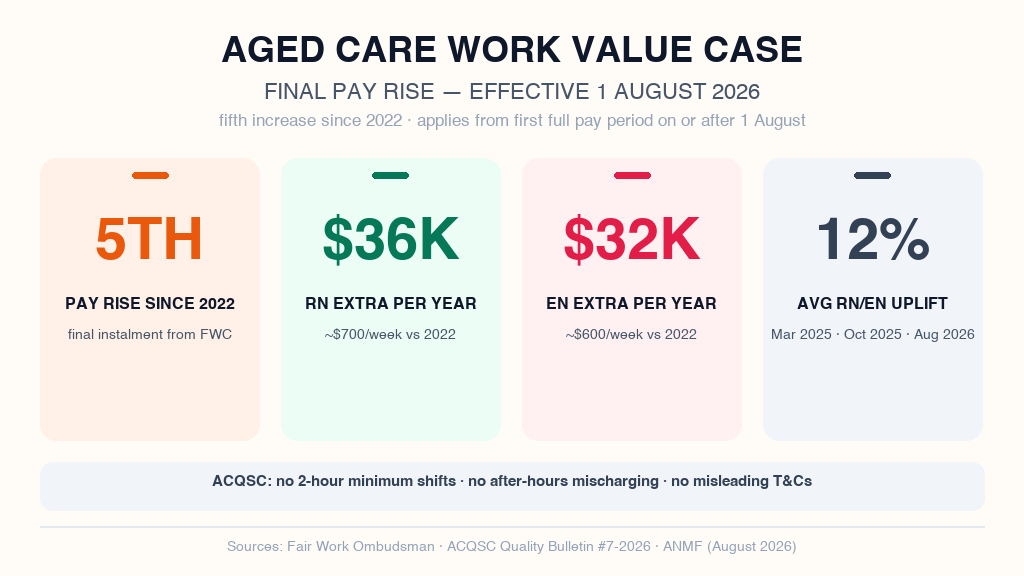
On 1 August 2026, the last pay rise of the Fair Work Commission's Aged Care Work Value Case came into effect for registered and enrolled nurses working in aged care. It is the fifth increase since the case began in 2022, and it lands at the same moment the Aged Care Quality and Safety Commission (ACQSC) is publicly warning providers about three specific ways award changes are being misused — minimum service times in service agreements, incorrect after-hours charging, and misleading terms and conditions.
Background: how the work value case rebuilt aged care pay
The Aged Care Work Value Case began before the Royal Commission's final report was even delivered. In 2020, the Australian Nursing and Midwifery Federation (ANMF) and unions asked the Fair Work Commission to rule that aged care work had been historically undervalued — that direct care workers and nurses were paid less than the value of the work they do, compared with equivalent roles in health and other sectors.
The Commission agreed. In its 2022 and 2023 decisions it found aged care work was undervalued, and it delivered increases in stages: a 15 per cent increase for direct care workers awarded in 2023, then a package for registered and enrolled nurses averaging 12 per cent, delivered in three tranches on 1 March 2025, 1 October 2025 and 1 August 2026. Each tranche changed minimum pay rates in the Aged Care Award, the Nurses Award, and the Social, Community, Home Care and Disability Services (SCHADS) Award — the three awards that cover most of the aged care workforce.
Because the case moved through the awards system, the increases flow to employees on minimum award rates and act as a floor for enterprise agreement negotiations. The Australian Government has funded the increases through the aged care funding system, and the total Commonwealth investment in aged care wages now stands at almost $18 billion. The government has reported that workforce turnover has fallen by around 30 per cent over the period of the increases — the retention signal the sector has been chasing for a decade.
What changed and when: the 1 August 2026 final tranche
The final instalment applies from the first full pay period starting on or after 1 August 2026. The Fair Work Commission published the final determination (PR 812118) covering the new minimum rates, and the Fair Work Ombudsman has updated its Pay and Conditions Tool and pay guides for the Nurses Award and Aged Care Award with the new figures.
In dollar terms, the August 2026 tranche adds:
- Enrolled nurses: $1.72 per hour more — around $65.40 per week for a full-time employee on the minimum award rate.
- Registered nurses at Grade 2: $1.49, $1.63 or $1.60 per hour more depending on years of experience — around $56.62, $61.94 or $60.80 per week full-time.
- Registered nurses at Grade 5: around $1.47 per hour more — around $55.80 per week full-time, with a slightly lower increase applying where a classification received a higher uplift in March 2025.
Those are the minimum award-rate numbers published by the ANMF for the final tranche. The cumulative effect is the headline figure: a registered nurse on the most common classification is now paid more than $36,000 a year more than in 2022, and an enrolled nurse almost $32,000 a year more — roughly $700 and $600 a week extra respectively. Employees covered by enterprise agreements should see the uplift paid on top of their existing agreement rate, and the ANMF has told members to check payslips for two things: the uplift on top of the 31 July 2026 rate, and increases to wage-related allowances.
Employers are required to pass on the Commonwealth funding they receive for the work value increases in the form of higher wages, allowances and on-costs. The government has published guidance for providers, workers and unions on the 1 August 2026 increases.
The ACQSC warning: three practices that will attract action
The pay rise is only half the story for providers. In its Quality Bulletin #7-2026, the ACQSC used the award changes as the hook for a compliance warning aimed directly at pricing and service agreement practices. When an award changes, providers may need to adjust business and pricing models — but the Commission is explicit that those adjustments cannot have a negative effect on the quality and safety of care for people receiving funded aged care services. The practices it names as unacceptable:
- Minimum service times in service agreements. A standard 2-hour minimum shift in every service agreement is not acceptable. Providers should only provide and charge for services for the time actually needed, based on the person's assessed needs. Two-hour services are sometimes appropriate — but they cannot be a blanket minimum.
- Incorrect charging across standard and after-hours periods. Where a service extends across both periods, providers must charge time worked during standard hours at the standard rate, not at the higher after-hours rate.
- Misleading terms and conditions. Claiming that award changes require longer minimum service times is not acceptable. Award changes may affect staffing costs and pricing, but they do not change the amount of care a person needs. Care must always be based on the older person's assessed needs, goals and preferences.
The Commission says it will take action to protect older people where providers engage in any of these practices. That action can include compliance notices, infringement notices, conditions on approval, and — for serious or persistent breaches — cancellation of registration. The same bulletin reminds providers that non-compliance discovered during a review must be declared in the Annual Prudential Compliance Statement even if it has already been fixed.
Operational impact: six things to do now
The August 2026 tranche and the ACQSC warning land together, and they touch different parts of the business. Six actions to take this month:
- Confirm the new rates are loaded and paid. Update your payroll system with the 1 August 2026 award rates from the Fair Work Ombudsman pay guides, and confirm the uplift is paid on top of existing enterprise agreement rates — not absorbed into them.
- Audit wage-related allowances. The ANMF has flagged that shift allowances and other wage-related allowances should also have increased. Check every allowance line, not just base rates.
- Review every service agreement for minimum service times. If your templates state a 2-hour (or any fixed) minimum shift, remove it as a standard term. Document that service length is set by assessed needs.
- Fix after-hours charging logic. Check how your billing system splits time across standard and after-hours boundaries, and correct any practice of charging the whole period at the higher rate.
- Update terms and conditions language. Remove any wording that links service duration or pricing to award changes. Pricing and care duration must be traceable to assessed needs, goals and preferences — not to a wage decision.
- Check your Annual Prudential Compliance Statement position. If any pricing, service agreement or wage issue was identified in a review, it must be declared in your APCS for the period it occurred — even if you have already fixed it.
A 14-day workflow for the August 2026 tranche
Wage compliance and the ACQSC warning are really one workflow: the pay rise must be paid correctly, and the evidence that it was paid correctly — and that service agreements were adjusted — must be provable. This 14-day plan gets both done:
- Days 1-3 — Payroll uplift verification. Pull the new award rates from the FWO pay guides, verify your payroll configuration for RN Grade 2, RN Grade 5 and EN classifications, and run a comparison of gross pay before and after 1 August 2026 for a sample of nurses. Confirm allowances moved too.
- Days 4-6 — Service agreement audit. Review all active service agreements for fixed minimum service times, after-hours charging clauses and terms that reference award changes. Flag every agreement that needs amending and notify affected people in writing.
- Days 7-9 — Billing logic review. Check how your systems allocate time across standard and after-hours periods. Identify and correct any overcharging, and record the correction and any refunds processed.
- Days 10-12 — Documentation and evidence pack. Assemble the evidence: payroll reports showing the new rates applied, service agreement change logs, billing corrections, and any communications with residents about pricing changes. This is the pack an ACQSC review or site visit will ask for.
- Days 13-14 — Governance sign-off. Have the responsible person (or governing body) review and sign off the changes, and confirm any non-compliance found along the way is declared in the relevant APCS reporting period.
How NovoCove supports this
The August 2026 tranche is a payroll event, and NovoCove is not a payroll system. But the compliance risk the ACQSC is warning about is an evidence problem: can you show, on demand, that every nurse is correctly classified and paid, that every service agreement was reviewed, and that care is being delivered against assessed needs?
That is the layer NovoCove provides. Staff certifications and training expiry are tracked centrally with automatic alerts and RAG status per service, so the qualification and registration data behind your wage bill — AHPRA registration for nurses, qualification records, supervision and training history — is current, searchable and exportable in minutes. The dashboard's RAG compliance score and daily ComplianceSnapshot trend capture show leaders where risk is rising before a regulator review finds it. Incident and evidence records attach to the right people and the right obligations, so the evidence pack a targeted review or site visit asks for can be assembled the same day it is requested. For the broader ACQSC compliance policy software and Quality Standards evidence workflow, see aged care compliance software Australia.
It does not replace your payroll, billing or clinical systems. It gives leaders the underlying workforce evidence layer: the same data the regulator sees today — classification, qualifications, registration status, training currency — is the data any future wage-compliance or prudential review will look for. When the Commission asks how you verified the 1 August uplift was applied, the answer is a timestamped record, not a spreadsheet someone found in a drawer.
The final work value case tranche is the end of one case and the beginning of the next compliance cycle. Providers that pay it correctly, adjust their agreements correctly, and can prove both will absorb the change without a compliance action. Book a 20-minute demo and we will show you how NovoCove keeps the workforce evidence behind your wage bill regulator-ready all year.
Sources / further reading
- Changes to minimum pay rates in the Nurses Award — Fair Work Ombudsman, updated July 2026 (T1)
- Aged Care Work Value Case: Changes to awards — Fair Work Ombudsman (T1)
- Better and fairer wages for aged care workers — Department of Health, Disability and Ageing (T1)
- Aged Care Quality Bulletin #7-2026 — Aged Care Quality and Safety Commission (T1)
- Nurses wage uplift: Aged Care Work Value case — wage increase coming in August 2026 — ANMF On the Record, 4 August 2026 (T2)
- Aged Care Industry Work Value Case — decisions and determinations — Fair Work Commission (T1)
This guide is general information and is not legal advice.