Aged care wages & funding
Aged Care Historical Leave Liabilities Grant 2026: The $12 Million Reimbursement for the 1 August 2026 RN/EN Wage Rise
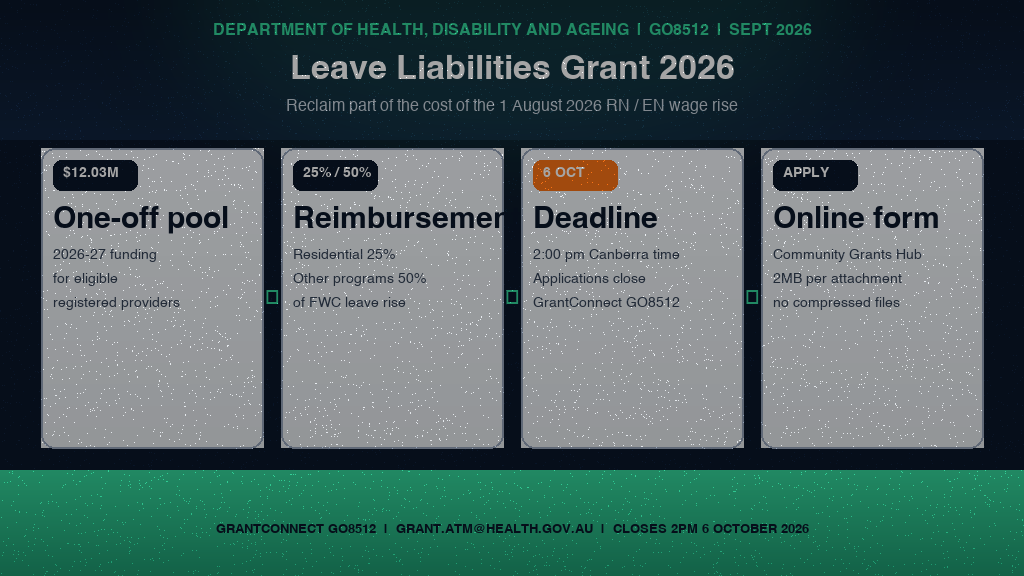
On 25 August 2026 the Department of Health, Disability and Ageing published grant opportunity GO8512 — $12.033 million in one-off 2026-27 funding that reimbursed part of the increased annual and personal leave costs registered providers faced because of the final Fair Work Commission nurse wage rise that took effect on 1 August 2026. The grant paid eligible providers 25% (residential) or 50% (other Commonwealth funded programs) of the increase in leave entitlements for eligible registered and enrolled nurses. Applications for this round closed at 2:00 pm Canberra time on 6 October 2026. Here is what the grant covered, who qualified, the six operational actions, and the 30-day workflow providers used to get an application in before the deadline.
Kept for reference. Check GrantConnect for any new opportunity before acting.
On 25 August 2026, the Department of Health, Disability and Ageing published grant opportunity GO8512 — Aged Care Award Wages – Historical Leave Liabilities Increases – 1 August 2026 on GrantConnect. The grant puts $12.033 million of one-off 2026-27 funding on the table for registered aged care providers whose payroll costs rose when the final instalment of the Fair Work Commission (FWC) Aged Care Work Value Case took effect for registered and enrolled nurses on 1 August 2026. The money exists because wage increases do not just cost more per hour worked — they silently increase the value of every hour of annual leave and personal leave your nurses had already accrued at the lower rate.
Background: why a wage rise creates a leave liability problem
Australia's aged care award wage rises have been delivered in stages since the FWC's Aged Care Work Value Case began. The 2023 interim decision awarded a 15% increase for many direct care workers, backed by an $11.3 billion government commitment (the earlier grant GO6625). The FWC's June 2024 Stage 3 decision then funded further increases from 1 January 2025 with a further $3.8 billion over four years, and the Commonwealth has committed more than $17.7 billion across the case in total, covering over 400,000 aged care workers.
Nurses covered by the Nurses Award have received their increases in three staged instalments — 1 March 2025, 1 October 2025, and 1 August 2026, the final instalment that completed the nursing phase of the work value case. The cumulative movement across the instalments ranges from roughly 4% to 25% depending on classification and pay point, and a separate 4.75% Annual Wage Review increase applied to all Aged Care Award rates from 1 July 2026. For a registered nurse on the most common classification, the combined effect since 2022 is an annual difference of tens of thousands of dollars.
Here is the part that does not appear on a payslip: leave accrues at the rate in force while it is earned, but is paid out at the rate in force when it is taken. A nurse who accumulated four weeks of annual leave per year while classified at the pre-August 2026 rate now takes that leave — or cashes it out — at the higher post-August rate. The same applies to personal (sick and carer's) leave. Every provider with eligible nurses therefore carries a balance-sheet liability that grew on 1 August 2026 without a single extra shift being worked. That is the "historical leave liabilities" the grant is named after: the increased cost of leave that was accrued before the wage rise and will be paid after it.
What changed and when: GO8512 published 25 August 2026
Three elements define the new position:
- 25 August 2026 — the grant opened. The Department of Health, Disability and Ageing published GO8512 on GrantConnect with an internal reference of P8302, administered by the Community Grants Hub. The selection process is demand driven — it is eligibility-based rather than competitive, so every provider that satisfied the criteria and submitted a complete application within the window was considered on the merits.
- What it covers — and only this. The grant covers the 1 August 2026 wage increases for eligible registered and enrolled nurses working in aged care as a result of the FWC Aged Care Work Value Case decision, only. It is a narrower scope than the earlier Stage 3 Historical Leave Liabilities grant, which covered direct care and general aged care workers under the Aged Care Award 2010 for the 1 January 2025 increase. Providers should check their earlier assumptions against the GO8512 guidelines rather than reusing them.
- 6 October 2026 — the closing date and time. Completed applications, with all necessary attachments, had to be submitted by 2:00 pm Canberra time. Enquiries could be emailed to [email protected], and questions had to be received no later than 5:00 pm Canberra time five business days before the close date.
The total amount available is $12,033,000 in one-off funding for 2026-27. The grant recognises that accumulated leave liabilities for eligible nurses increased as a result of the decision, and that the cost to registered providers when nurses take that leave has increased correspondingly.
How the grant works: rates, eligible programs and the MPS exclusion
The funding model is a partial reimbursement of the increased leave cost, not a payment per nurse:
- 25% of the FWC increase in leave entitlements for residential aged care providers.
- 50% of the increase for other eligible aged care program providers.
- Eligible registered providers are those that deliver one or more of: Residential Aged Care, the Support at Home Program, the Commonwealth Home Support Programme (CHSP), the Transition Care Program, or the National Aboriginal and Torres Strait Islander Flexible Aged Care Program (NATSIFACP).
- Multi-Purpose Services (MPS) providers are excluded from applying. They receive funding through their existing funding agreements instead — an application would be rejected as ineligible.
- No double-dipping. The department cannot consider an application where the provider already receives funding from another government source for the same purpose or activity, except where a joint state, territory or local government contribution is specified in the guidelines.
The application itself was a form exercise: the completed online application form and all necessary attachments were submitted through the GrantConnect "Grant Opportunity Documents" portal, and applications were due by 2:00 pm Canberra time, 6 Oct 2026. The practical rules matter: a 2 MB limit per attachment, no compressed or zip files, multiple documents scanned into a single file where needed, unique file names without foreign characters, and keep a copy of everything. You should receive an automated acknowledgement email with a Submission Reference ID within 48 hours — if not, email [email protected] and retain the reference ID for any follow-up.
Operational impact: what eligible providers needed to prepare for GO8512
At publication there was a little over five weeks to the close date. Six actions followed for every provider that employs registered or enrolled nurses under the Nurses Award:
- Confirm your eligibility against the GO8512 guidelines, not the 2025 version. Check that you are a registered provider delivering at least one of the five eligible programs, that your nurses' 1 August 2026 increase came from the FWC Aged Care Work Value Case decision, and that you are not an MPS provider already funded through an existing agreement. The eligibility section of the guidelines is the authoritative test.
- Build the eligible-nurse register. Identify every RN and EN on your books whose wage rate changed on 1 August 2026, with their classification, employment start date, and leave balances at the transition. This register is the spine of the application — and it is exactly the kind of workforce record an auditor would ask to see even without the grant.
- Quantify the leave liability increase. For each eligible nurse, calculate the difference between the leave accrued before the increase (at the old rate) and the same leave paid at the new rate. This is the figure the reimbursement percentages apply to. Payroll, rostering and finance need to agree on the methodology before the form is submitted, because the application asks you to stand behind the numbers.
- Prepare attachments to the 2 MB rule. The application form accepts attachments up to 2 MB each, rejects compressed or zip files, and requires unique file names. Scan multi-page documents into single files, name them meaningfully, and assemble the pack before you start the online form so the submission can be completed in one sitting.
- Diary the deadline and the enquiry cut-off. Applications closed 2:00 pm Canberra time on 6 October 2026, and questions had to reach the department by 5:00 pm Canberra time five business days before close. Do not leave clarification until the final week — and treat the 2:00 pm Canberra time cut-off as a hard system deadline, not a close-of-business date.
- Beware grant-related scams. GrantConnect itself has published a warning about phishing and scam emails impersonating the platform. The genuine application path is the GrantConnect portal and the published department email address — a provider should never pay a fee, share banking details, or click links in unsolicited emails claiming to expedite a grant.
Reference: the 30-day application workflow (GO8512 applications closed 6 Oct 2026)
Running from the publication of this guide, a 30-day workflow gets a complete, defensible application in with margin to spare:
- Days 1-5 — Read the guidelines and confirm eligibility. Download the GO8512 grant opportunity guidelines and application form from GrantConnect. Confirm your program mix against the five eligible programs, confirm the MPS exclusion does not apply to you, and list the people responsible for payroll, finance and governance sign-off.
- Days 6-10 — Build the eligible-nurse register. Extract from payroll or your workforce system every RN and EN whose rate changed on 1 August 2026. Capture classification, employment date and leave balances at the transition. Reconcile the list with AHPRA registration data so the register matches the credentials the department expects of an "eligible registered or enrolled nurse".
- Days 11-15 — Calculate the liability increase. Agree the calculation methodology between payroll and finance, produce the per-nurse and total figures, and document the assumptions. This is the number your reimbursement is based on, so a written, signed-off methodology is worth the time.
- Days 16-20 — Assemble attachments. Scan and consolidate supporting documents into single files under 2 MB each, with unique, descriptive names and no compressed formats. Test that every file opens and matches the application's attachment list.
- Days 21-25 — Complete the online form. Submit the application via the GrantConnect online application form, keep a copy of every entry, and confirm the automated acknowledgement email with the Submission Reference ID arrives within 48 hours. Chase [email protected] if it does not.
- Days 26-30 — Verify and close out. Re-read the eligibility criteria against your final submission, confirm the 2:00 pm Canberra time 6 October deadline is met with days to spare, and file the submission records in the same governance folder where an auditor would expect grant documentation to live.
How NovoCove supports this
A leave liabilities application is, underneath the finance, a workforce-data exercise: which nurses are eligible, what are their classifications, when did they start, what does their credential register say. NovoCove is the data and evidence layer behind that exercise. It centralises staff certifications and training expiry for aged care — AHPRA registration for registered and enrolled nurses, NDIS Worker Screening and more — with a 7-tier alert cadence, so the eligible-nurse register can be built from one authoritative workforce record rather than a spreadsheet assembled from memory. Compliance tasks with owners and due dates turn the six actions above into tracked obligations: each step of the grant workflow gets an owner, a due date and a status, and task progress and the daily ComplianceSnapshot trend show records on file as work is completed. The same workforce data the department asks about in a grant application is the data an assessor or auditor asks about in a review — the same records can support both.
NovoCove does not calculate your leave liability, prepare your financial statements, or replace your payroll and finance teams' judgement. It gives leaders the underlying evidence layer: when the grant question comes, the eligible-nurse list, the credential checks and the task history can be exported from one register, and when the auditor asks how a workforce obligation was tracked, the answer is the same register. The coverage is detailed on the aged care compliance software page.
This round has closed. If a future round opens, it may ask for similar workforce records. NovoCove can help keep staff and credential records organised. You can see how NovoCove works on the aged care compliance software page, or book a 20-minute demo whenever it suits you.
Sources / further reading
- GO8512 — Aged Care Award Wages – Historical Leave Liabilities Increases – 1 August 2026 — GrantConnect, published 25 August 2026 (T1)
- GO8512 Grant Opportunity Documents (guidelines + online application form) — GrantConnect (T1)
- Funding available for increased leave costs in aged care — Department of Health, Disability and Ageing, published 26 August 2026 (T1)
- Better and fairer wages for aged care workers — Department of Health, Disability and Ageing (T1)
- Funding Opens to Help Aged Care Providers With Higher Leave Costs — MedTree, 26 August 2026 (T3)
- Aged Care Wages – Stage 3 Historical Leave Liabilities – Tranche 1 (2025) Grant Opportunity Guidelines — GrantConnect, prior-tranche precedent (T1)
This guide is general information and is not legal advice.