QLD childcare compliance
QLD ECEC Services Census 3-9 August 2026: The Reference Period, the 23 August Deadline and the 3-Week Survey Workflow That Decides Next Year\u2019s Kindergarten Funding
The Queensland Department of Education opens the 2026 Early Childhood Education and Care Services Census on Monday 3 August 2026. Every QLD-approved ECEC service has a one-week reference period (3-9 August) and until Sunday 23 August 2026 to respond. Here is what is collected, who in the centre must own the response, the staff-data fields that catch under-resourced services, the privacy rules on child-record uploads, and the 3-week workflow that delivers a high-quality submission on time.
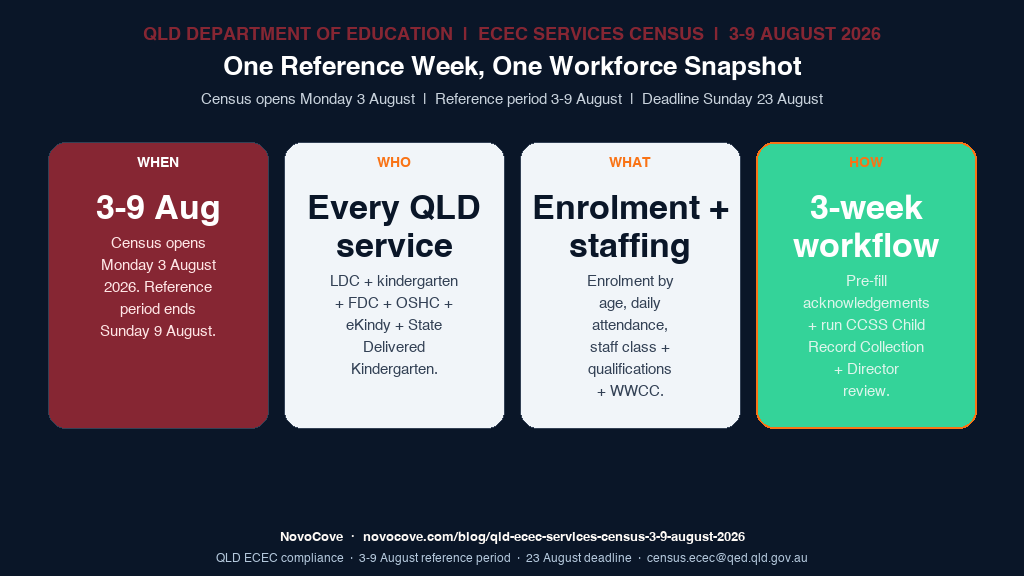
On Monday 3 August 2026 the Queensland Department of Education opens the 2026 Early Childhood Education and Care Services Census. The Census has a one-week reference period running from 3 August to 9 August 2026, and every Queensland-approved early childhood education and care service \u2014 long day care, kindergarten, family day care, outside school hours care (OSHC), eKindy and State Delivered Kindergarten in Aboriginal and Torres Strait Islander communities \u2014 has until Sunday 23 August 2026 to submit. The data collected feeds a funding calculation that decides how much Queensland gets from the Commonwealth under the Preschool Reform Agreement next year, and what the Department publishes as the official picture of the state\u2019s sector.
The 2025 collection recorded a 100.0% response rate \u2014 the third time in the census\u2019s history that every QLD-approved service submitted. The Department has now extended the requirement to families of services that did not previously meet the threshold: every service type is now in scope and a missed submission is a documented gap in the Department\u2019s view of the sector. The Census is also where under-resourced services start to show up in workforce and attendance data that is used by ACECQA, the Commonwealth Department of Education and the Australian Bureau of Statistics in year-ahead policy work.
What the QLD ECEC Services Census actually collects
The Census is an annual data collection run by the Queensland Department of Education under the Education and Care Services Act 2013 (Qld) and the Education and Care Services National Law (Queensland) Act 2011. The 2026 Census is the sixth annual collection. The data is reported back to the Australian Bureau of Statistics (ABS) and the Australian Institute of Health and Welfare (AIHW) as part of national funding agreements for early childhood education.
For each service the Census collects three blocks of data, and the staff block is where most data-quality issues occur in practice:
- Service-level data \u2014 service name, approval number, type (LDC, kindergarten, FDC, OSHC, eKindy, State Delivered Kindergarten), operating hours per day, weeks of operation per year, and any government-funded kindergarten program delivered.
- Child enrolment and attendance \u2014 enrolled children by age group, attendance patterns during the reference week, the count of children in attendance at the centre on each day of the reference period, and (for funded kindergarten services) detailed information about kindergarten participants captured in the Child Record Collection (CRC) upload.
- Staff data \u2014 every staff member and volunteer who was employed, engaged or appointed at the service during the reference week, with role classification (lead educator, educator, assistant, coordinator, ECT, director, etc.), relevant qualifications, working visa details where relevant, hours worked, and the staff acknowledgement of consent.
Children who participate in a kindergarten program that does not receive Queensland Government kindergarten funding are asked a smaller subset of summary questions; services that do receive government funding for an approved kindergarten program must submit the full CRC upload against the census template.
What changed for the 2026 Census \u2014 and why it matters more in 2026
Two regulatory shifts in the last 12 months have made the 2026 Census a more consequential submission than the 2025 one. First, the 27 February 2026 child safety reforms took effect under the Education and Care Services National Law, expanding the definitions captured under "staff" and "volunteer" (now including students on placement and visitors with unsupervised access). The Census mirrors that expanded definition \u2014 a service that completes only the staff list it had in 2025 will under-report the workforce scope the Department is now using for workforce planning. Second, the National Early Childhood Worker Register is now live, with ACECQA confirming every approved provider is required to use the Register to enter and update worker information. The QLD Census and the Worker Register do not duplicate fields, but the role, qualification and WWCC fields overlap, and a workforce census submission that does not match the Worker Register will now flag as a workforce-data inconsistency.
The Census is still annual, still mandatory, and still anonymous in publication \u2014 the Department does not name individual services in published summaries. But the data is increasingly used to model workforce pressures, qualification-mix gaps and OSHC capacity issues at the state level, and a submission with poor staff completeness now becomes a service that disappears from a regional workforce map.
Six operational impacts for QLD ECEC providers \u2014 in priority order
Treat the Census as a three-week project with a defined mid-point (start of reference week). Six concrete things to do, in the order that prevents rework:
- Confirm the centre inbox is monitored from 3 August. The Census team emails the unique link to the Director or nominated Supervisor on 3 August 2026. If the inbox is unattended or the email is filtered as junk, the service loses a week of working days. Add
[email protected]to the safe-sender list in the days before, and confirm the CCSS contact email matches the centre\u2019s authorised primary contact. - Issue the staff acknowledgements of consent one week before. There is a separate acknowledgement form for centre-based services (LDC, kindergarten, limited hours care and state delivered kindergarten), for family day care and for outside school hours care. The Census field for \u201cconsent to supply personal information\u201d must be backed by a signed acknowledgement on file for every staff member and volunteer who was present during the reference week. A staff member who cannot be contacted in the reference week cannot be reported in the Census without their signed acknowledgement.
- Lock in the CCSS (Child Care Subsidy System) report for the reference week. The Census asks for total enrolled children on each day of the reference week plus attendance counts. The CCSS software produces a Child Record Collection (CRC) report that maps onto the Census template almost line-for-line. Confirm your software vendor can produce the CRC report dated 3\u20139 August 2026; if it cannot, request the upload template from [email protected] and the uploading instructions PDF (468KB) before the reference period begins.
- Reconcile the staff list to the National Worker Register. Pull the Worker Register snapshot from ACECQA\u2019s NQA IT System on or after 3 August and reconcile against the staff actually rostered in the reference week. Cross-check role classification, qualification, current Blue Card (or equivalent WWCC for the staff member\u2019s state of origin) and most recent training expiry. Mismatches here are the ones the Department follows up on after submission.
- Decide who completes the online form and who signs the CRC upload. The Department requires that the submission is signed off by a person authorised to approve and submit the information on behalf of the service \u2014 almost always the Director or the nominated Supervisor. If that sign-off is not in place when the form is submitted, the submission is treated as incomplete. Decide this in week two, not on 23 August.
- Schedule a 30-minute review window on 22 August. Last year\u2019s most common submission defect was a staff member added under the wrong role classification, which forced a re-submission and missed the response-rate cut-off for that financial year\u2019s data. A 30-minute review on the day before deadline, with the staff acknowledgement file and the Worker Register snapshot on screen, catches the bulk of these defects before submission.
Step-by-step workflow \u2014 the 3-week Census plan
The following plan is the same rhythm we recommend to NovoCove customers for any QLD ECEC data submission. It assumes one Director and one Responsible Person (often the Educational Leader or the Compliance Officer) own the response end-to-end.
- Week one (before 3 August \u2014 owner: Director). Confirm the CCSS contact email is current in the Child Care Subsidy System; reply-test the inbox; pre-fill the staff acknowledgement forms for the staff rostered in the reference week; verify the Worker Register snapshot is downloadable. Print a one-page checklist of fields the service will need to supply (enrolment by age group, daily attendance counts for 3\u20139 August, staff classification, qualifications, working visa category for any non-citizen staff).
- Reference week (3\u20139 August \u2014 owner: Responsible Person + educators). Document the actual attendance per day; collect the signed staff acknowledgement forms for any staff member not already on file; record any roster change (a new starter or a leaver) before the end of the week so that the CCSS Child Record Collection report is complete; flag any staff member with an expired WWCC or qualification expiry in the reference week \u2014 the Census wants the record, the Worker Register wants the update, and the same data feeds the Quality Area 4 evidence pack.
- Week two (10\u201316 August \u2014 owner: Responsible Person). Export the CCSS Child Record Collection report; populate the upload template (30KB XLSX); reconcile the staff list to the Worker Register; print the draft submission for review; identify any service-level data field that has changed since the 2025 submission (operating hours, contact details, ownership/approved-provider change).
- Week three (17\u201323 August \u2014 owner: Director). Sign in to the Census portal; work through the service-level block, the children block (with the CRC upload attached) and the staff block; save and exit as many times as needed \u2014 the tool retains previous entries; schedule the 30-minute review on 22 August to catch the role-classification and qualification typos; submit on or before 23 August with the Director as the authorised submitter.
- Day-after (24\u201330 August \u2014 owner: Director). The Department sends confirmation of receipt within a week. If the confirmation does not arrive, contact Census Support on 1300 613 188 (9am\u20135pm Mon\u2013Fri) or
[email protected]. Archive the submission file, the staff acknowledgements, the CCSS report, and the Worker Register snapshot to the service\u2019s compliance evidence pack \u2014 these are the artefacts a regulatory visit will ask for under the National Law (Qld).
How NovoCove supports this
NovoCove centralises the workforce, qualification and roster data the QLD ECEC Services Census depends on, so the 2026 reference period can be answered from a single dashboard view rather than re-typed into an online form.
The same data feeds the National Early Childhood Worker Register update, the ACECQA NQF Quality Area 4 staffing evidence (qualification mix, educator-to-child ratios, ECT coverage), the CCSS Child Record Collection report used for the Census upload, and the regulatory evidence pack if a QECEC (or future VECRA-style) visit lands during the Census window. Where the centre uses roster software, NovoCove pulls the actual attendance per day from the roster feed and consolidates the role classifications into the form-set the Department has published for 2026. Where the service is multi-site, the data rolls up to a provider-level view so the Director can sign off all sites in a single review window.
NovoCove does not replace a provider\u2019s CCSS software, nor does it submit the Census on the provider\u2019s behalf \u2014 the Census is a departmental data collection and the sign-off sits with the Director. What it gives the Director is the single live workflow that answers the Census, the Worker Register update and the regulatory evidence pack from one record of truth, on the day the Department calls for it.
Sources and further reading
- Early Childhood Education and Care Services Census 2026 \u2014 Queensland Department of Education (T1, state regulator)
- Frequently asked questions (PDF, 276KB) \u2014 Queensland Department of Education (T1)
- How to prepare guide (PDF, 266KB) \u2014 Queensland Department of Education (T1)
- Staff acknowledgement of consent \u2014 centre-based services (PDF, 514KB) \u2014 Queensland Department of Education (T1)
- Staff acknowledgement of consent \u2014 family day care (PDF, 525KB) \u2014 Queensland Department of Education (T1)
- Staff acknowledgement of consent \u2014 OSHC (PDF, 555KB) \u2014 Queensland Department of Education (T1)
- Child Record Collection (CRC) child data upload template (XLSX, 30KB) \u2014 Queensland Department of Education (T1)
- ECEC Services Census data collection manual (PDF, 457KB) \u2014 Queensland Department of Education (T1)
- Queensland ECEC Services Census data \u2014 historical published tables (2021\u20132025) \u2014 Queensland Department of Education (T1)
- Education and Care Services Act 2013 (Qld) \u2014 Queensland Legislation (T1)
- Education and Care Services National Law (Queensland) Act 2011 \u2014 Queensland Legislation (T1)
- National Early Childhood Worker Register \u2014 ACECQA (T1, federal regulator)
This guide is general information and is not legal advice.