Childcare compliance
ACECQA Quality Support Program 2026: The Meeting NQS Pathway, the NSW Eligibility Filter and the 4 December 2026 EOI Deadline
On 1 July 2026, ACECQA opened Round 5 of the Meeting NQS Pathway under the Quality Support Program. The Pathway is free, 21 weeks long and is open to NSW services currently rated Working Towards NQS. Round 5 began on 20 July 2026; Round 6 starts on 1 February 2027 with an EOI closing date of 4 December 2026. This guide turns the eligibility rules, the support package and the EOI workflow into a 90-day plan for every approved provider and nominated supervisor in NSW.
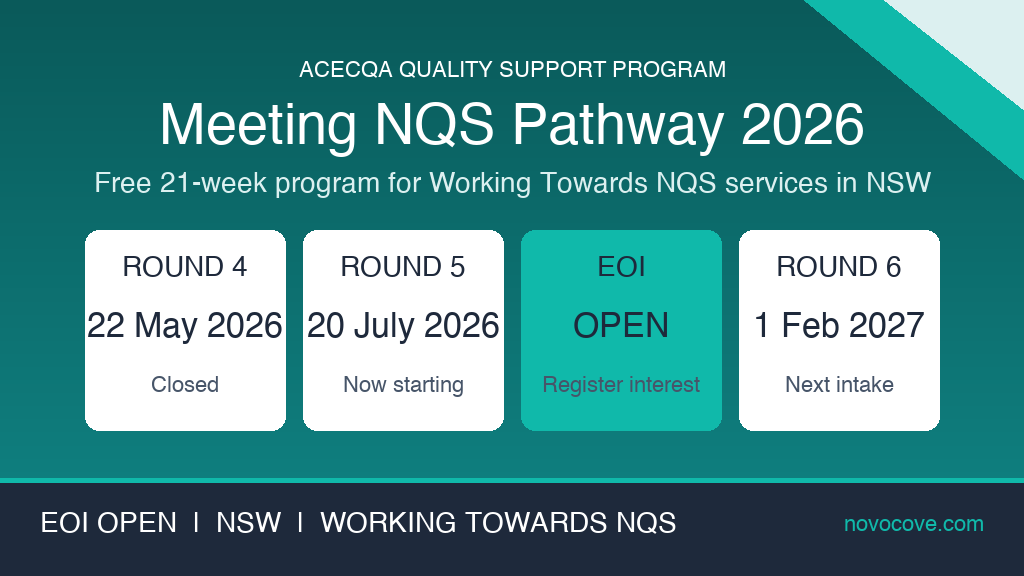
On 1 July 2026, ACECQA opened the next round of the Meeting NQS Pathway under the Quality Support Program. The Pathway is free, runs for 21 weeks, and is open to NSW services currently rated Working Towards NQS. Round 5 began on 20 July 2026; Round 6 starts on 1 February 2027 with an expression of interest closing date of 4 December 2026. For NSW approved providers with a Working Towards NQS rating, the program is the most concrete piece of regulator-funded support available right now.
The Quality Support Program is not a marketing exercise. It is funded through ACECQA's regulatory practice capability stream and is positioned alongside the strengthened Quality Standards, the National Early Childhood Worker Register, and the ongoing child safety reform agenda. The Meeting NQS Pathway is the element that targets services most at risk of regulatory action — those that have already received a Working Towards NQS rating — and gives them a structured 21-week improvement cycle before they are re-rated.
Background: what the Quality Support Program did before July 2026
ACECQA has run continuous improvement programs for several years. The Quality Uplift Program in South Australia started in March 2025 with a second support period in July 2025 and a third in February 2026. The Meeting NQS Pathway in NSW has been running since 2024, with rounds on 21 July 2025, 27 October 2025, 26 January 2026, 22 May 2026 and now 20 July 2026. Each round has a defined EOI closing date, a defined start date and a 21-week support period.
Until 2026, the program was framed primarily as a coaching and mentoring initiative. Services received some remote mentoring, online communities of practice, and a smaller set of resources. The 2026 expansion formalised the support package: up to 20 hours of remote mentoring, three live online workshops, up to two face-to-face visits per service, a hard and soft copy of the QSP Tool Kit, and access to the ACECQA online resources library and eLearning modules. The program is now a defined program of work, not a series of ad hoc consultations.
Two structural changes matter operationally. First, the program's eligibility, suitability and approval roles are now split between ACECQA, the NSW Department of Education, and the NSW Early Learning Commission (formerly NSW Early Childhood Education and Care Regulatory Authority). Second, services that complete the program are scheduled for assessment and rating within 12 months of completion, with the possibility of a partial or full reassessment. The program is now a gateway to a re-rating, not an excuse to defer one.
What changed on 1 July 2026 and when the next deadlines land
From 1 July 2026, ACECQA invited eligible NSW early childhood education and care services to register their interest in the Quality Support Program. The communications layer is the ACECQA newsletter and email subscription, the SurveyMonkey EOI form, and the NSW Department of Education's provider portal. The Service-level obligations are unchanged. What is new is the formal cadence: a guaranteed Round 5 start on 20 July 2026, a guaranteed Round 6 start on 1 February 2027, and a fixed EOI window for Round 6 that closes on 4 December 2026.
Two participation avenues are now open at the same time. A service can be directly referred by the NSW Early Learning Commission, where assessment and rating data is used to identify services that will benefit most from the program. Alternatively, a service can submit its own EOI through the SurveyMonkey form on the ACECQA website. Final approval sits with the NSW Early Learning Commission and is decided two weeks before the program start date. Services that have previously completed the Pathway and still meet the eligibility criteria are welcome to express interest again.
The support package itself has stabilised. Each service receives up to 20 hours of remote mentoring, three live online workshops, online communities of practice, a QSP Tool Kit in hard and soft copy, access to the ACECQA resources library and eLearning modules, and up to two face-to-face visits per service. The program is designed to take one hour per week over 21 weeks, so educators can participate fully without leaving the floor. The EOI form fields are short: service name, contact officer, current rating, ratings history, one paragraph on the priority quality area being addressed, and confirmation of the governing body's support.
Providers with multiple services must complete a separate registration for each service. The same provider operating five Working Towards NQS services in NSW would need five EOIs. The reverse is also relevant: a NSW service rated Meeting NQS or above is not eligible for the Meeting NQS Pathway, although it may be eligible for other QSP streams such as the Excellence or Leadership pathways. The eligibility filter is jurisdictional, not merely operational.
Eligibility: who is in and who is out
The Meeting NQS Pathway is available to NSW services that are currently rated Working Towards NQS. Eligible service types include long day care, family day care, preschools, mobile preschools, occasional care, Multifunctional Aboriginal Children's Services (MACS), and outside school hours care services including vacation care services. In-home care is not currently listed as an eligible service type for the NSW Pathway, which is consistent with the in-home care reform agenda being progressed separately.
Services rated Meeting NQS, Exceeding NQS, Excellent, or Significant Improvement Required are not eligible. A service that has been re-rated from Working Towards NQS to Meeting NQS during the program is unlikely to continue into the assessment and rating phase, because the program is targeted at services that have not yet met the Standard. A service that has been referred by the NSW Early Learning Commission for serious safety concerns is more likely to be considered for non-Partnership regulatory action than for the Pathway.
Approval is the NSW Early Learning Commission's call, not the service's. The Commission reviews the EOI, the service's rating history, any prior compliance actions, the priority quality area identified and the suitability of the service to complete the program. The Commission can refuse a service even if it meets the eligibility criteria. The Commission makes the final suitability decision two weeks before the program starts, so a service that submits an EOI late in the window may not receive a final answer before the round closes.
The same ACECQA Quality Support Program has different streams in other states. The Quality Uplift Program in South Australia targets services rated Working Towards NQS in that state. The Excellence and Leadership pathways are the cross-jurisdictional streams. None of these other streams are the same as the Meeting NQS Pathway. A NSW service that wants the Mentoring and Coaching stream must apply through the NSW Department of Education pathway, not the ACECQA Excellence pathway.
Operational impact: six things NSW providers should do now
- 1. Confirm the current rating on the national register. Open the ACECQA national register and confirm both the overall rating and the rating for each Quality Area. Working Towards NQS at the overall level is the eligibility entry point. Working Towards NQS in two or more Quality Areas is the realistic priority for the program.
- 2. Identify the weakest Quality Area and the unit responsible. The Pathway targets a priority quality area. Without an agreed priority, the mentoring team cannot sequence the 21-week plan. Most Working Towards NQS services in NSW rate Quality Area 7 (Governance and Leadership) and Quality Area 2 (Children's Health and Safety) as their weakest areas. Pick the one you can evidence change in within 21 weeks.
- 3. Get governing-body sign-off before the EOI. The EOI requires confirmation of the governing body's support. The Pathway is a 21-week commitment of approximately one hour per week per educator, plus the face-to-face visits and the live workshops. The board or the approved provider must understand the staff time, the assessment and rating consequence, and the political exposure of a partial or full reassessment within 12 months.
- 4. Reserve the EOI window now. For Round 6, the EOI closes on 4 December 2026. The form is a SurveyMonkey link on the ACECQA website. Draft the response in late November 2026, have the nominated supervisor sign off the priority quality area, and submit the form no later than the first week of December 2026. Late EOIs are not accepted.
- 5. Set up the data layer before the program starts. The mentoring team will need access to current policies, Quality Improvement Plans, the staff roster, qualifications, training records, supervision plans, child safety documentation, and incident reports. The data layer that the ACECQA quality support team works against is the same data layer that the NSW Regulatory Authority will sample at the next assessment and rating visit.
- 6. Plan for the assessment and rating consequence. The EOI commits the service to a partial or full reassessment within 12 months of program completion. Schedule a mock assessment and rating visit in the final two weeks of the program. The mock should be led by someone who has not been on the service's QSP team, so the service is tested against the regulator's evidence expectations rather than the mentor's preferred framing.
The 21-week program structure: what a service actually receives
The Meeting NQS Pathway runs for 21 weeks and is designed to take one hour per week of educator time. The schedule comprises an introductory phase of online orientation and baseline evidence review, a middle phase of three live online workshops delivered on different days and times to accommodate casual staff, and a closing phase of two face-to-face visits per service. The remote mentoring wrap is up to 20 hours per service across the 21 weeks, allocated on the basis of the priority quality area nominated in the EOI.
Resources supplied to participating services include the Quality Support Program Tool Kit in hard and soft copy, access to the ACECQA online resources library and eLearning modules, and membership of the online communities of practice. The Tool Kit covers the seven Quality Areas, the assessment and rating process, the Quality Improvement Plan template, and worked examples of evidence an authorised officer will sample. The QSP is not a coaching service; it is a structured 21-week program with a defined syllabus.
Participating services are also expected to contribute to the program's evidence base. ACECQA uses the program to refine its understanding of the support that Working Towards NQS services need. Services that join the program should expect to share their Quality Improvement Plan, their assessment and rating history, and the evidence pack produced during the 21 weeks. The NSW Early Learning Commission will see the same pack when it schedules the next assessment and rating visit.
The program has a defined end. The NSW Department of Education and the NSW Early Learning Commission will schedule the next assessment and rating visit within 12 months of program completion. A service that has not moved past Working Towards NQS by the time of the next assessment and rating visit will face the same regulatory exposure it would have faced without the program, plus the reportable history of a participating but non-improving service. The program is an opportunity, not a deferral.
The 90-day provider plan: from EOI to assessment and rating readiness
- Days 1-10 — readiness check. Confirm the current rating, the priority quality area, the governing-body support for the program, and the budget allocation for staff time. Calculate the cost of the program in terms of educator hours, the nominated supervisor's hours, and the cost of the mock assessment and rating visit in the final two weeks. Discount the program to the value of the funded support if needed for the finance case.
- Days 11-25 — EOI preparation. Draft the EOI in advance: priority quality area, why the program is needed, the staff team that will participate, and the contribution the service will make. Share the draft with the mentor's predecessor or with a service that has completed the program in an earlier round. Revise based on feedback. Confirm the governing body's sign-off before submission.
- Days 26-40 — submit the EOI and lock the data layer. Submit the EOI through the ACECQA SurveyMonkey form. Once the EOI is acknowledged, lock the data layer: current Quality Improvement Plan, current policies, current staff qualifications, current training records, current supervision plans, current child safety documentation, current incident register. The data layer should be exportable as a single evidence pack with file names that match the relevant Quality Area.
- Days 41-60 — orientation and baseline review. When the program starts, attend the orientation. Walk the mentor through the data layer. Confirm the priority quality area. Agree on the 21-week schedule. Map the three live online workshops to the staff roster. Reserve the two face-to-face visit dates. Identify the educator who will lead the Quality Improvement Plan review.
- Days 61-120 — the middle phase. Attend the three live online workshops. Implement the changes from the workshops. Update the Quality Improvement Plan. Use the remote mentoring hours as allocated. Share evidence with the mentor as it is produced. Use the online communities of practice to test ideas against other services in the same pathway.
- Days 121-140 — closing phase and mock assessment. Complete the two face-to-face visits. Run the mock assessment and rating visit in the final two weeks. Have someone who has not been on the QSP team lead the mock. Capture the evidence against the seven Quality Areas. Revise the Quality Improvement Plan based on the mock findings. Present the final pack to the governing body.
- Days 141-365 — assessment and rating preparation. After the program ends, the NSW Early Learning Commission will schedule the next assessment and rating visit within 12 months. Use the year to refine the Quality Improvement Plan, embed the changes from the program, and prepare the staff team for the visit. The service's regulatory exposure is highest in the first three months after the program while the changes are still being embedded.
Common failure modes to avoid
Submitting the EOI without governing-body alignment. The form asks for confirmation of the governing body's support. A board or approved provider that signs off on the EOI without understanding the commitment can withdraw mid-program, leaving the mentors with a half-finished engagement and the service with a non-completion on the record. Get the governing-body minute before the EOI is submitted.
Treating the program as a substitute for the Quality Improvement Plan. The QSP Tool Kit is a resource, not a replacement for the Quality Improvement Plan. The Plan is the service's own document. The mentors work from the Plan, not the other way around. A service that hands the mentor a blank Plan and waits to be told what to do is a service that will not move past Working Towards NQS.
Choosing the wrong priority quality area. The most common mistake is to nominate the area where the service is weakest, on the assumption that the most mentoring hours will be allocated there. The program allocates hours based on the nominated area, but the strongest improvement usually comes from the area where the service is closest to meeting the Standard. Nominate the area where the service has the strongest evidence base and the clearest gap to close.
Ignoring the assessment and rating consequence. A service that goes through the program but does not prepare for the next assessment and rating visit will be re-rated against the same evidence it had before the program. The program is a 21-week accelerator for a 12-month consequence. If the service cannot evidence the changes during the next visit, the regulator will treat the program as if it did not happen.
Submitting the EOI late for Round 6. The Round 6 EOI closes on 4 December 2026. The NSW Early Learning Commission makes the final suitability decision two weeks before the program starts. A service that submits the EOI in the last week of November has effectively confirmed the appointment before the decision is made. Submit the EOI no later than 30 November 2026 to allow the Commission time to consider the application.
How NovoCove supports this
NovoCove supports the workforce evidence layer that the Quality Support Program, the National Early Childhood Worker Register, and the next assessment and rating visit will all look at. It centralises staff certifications and training expiry across the 40+ Australian ECEC credential types, applies automatic alerts through a 7-tier expiry cadence, and gives each service a RAG compliance view. Daily ComplianceSnapshot records preserve the trend so leaders can see whether workforce credential risk improved or deteriorated before the next regulatory visit.
For multi-site providers, the multi-tenant architecture and tenant-scoped audit logging help keep service records separated and traceable. That is useful when the EOI requires evidence per service, when the mentor's Quality Improvement Plan review needs a snapshot of each service's training evidence, or when the NSW Early Learning Commission schedules the next assessment and rating visit and the service has to produce a defensible evidence trail quickly.
NovoCove does not replace the Quality Support Program, the EOI form, the QSP Tool Kit, the mentor's coaching, or the next assessment and rating visit. It does not provide the ACECQA rating, the National Quality Standard, or the Statement of Rights. Its role is narrower and concrete: keep staff credential and training evidence current, surface gaps early, and give leaders an auditable workforce data layer that can be supplied alongside the Quality Improvement Plan evidence maintained elsewhere.
Official sources and further reading
- ACECQA — Quality Support Program overview
- ACECQA — Meeting NQS Pathway (NSW) eligibility and program structure
- NSW Department of Education — Meeting NQS Pathway provider guidance
- The Sector — ACECQA invites services to register interest in Quality Support Program (1 July 2026)
- ACECQA — Quality Uplift Program (SA) supporting materials
- ACECQA Newsletter Issue 2 2026
This guide is general information and is not legal advice.