Regulatory update
July 2026 Education Ministers Meeting: The 7 ECEC Reforms Every Provider Should Prepare For Now
Education Ministers have moved a second tranche of national ECEC safety reform towards legislation, while a possible national commission could reshape ACECQA. The laws are planned for 2027, but the operational evidence providers will need is already clear.
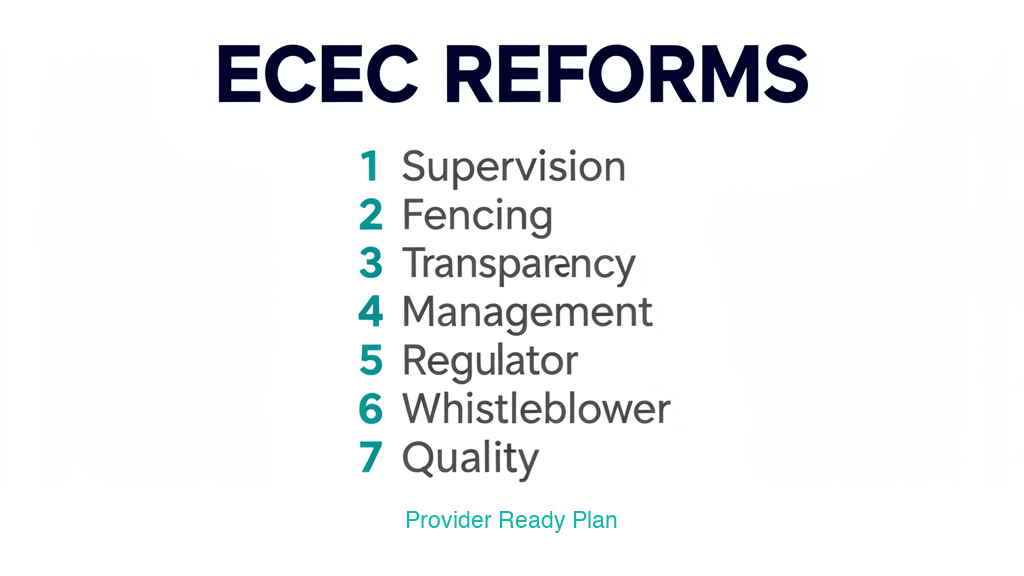
Education Ministers met in Parramatta on 15 July 2026 and agreed to advance the next national package of early childhood education and care safety reforms. This is not yet a new compliance deadline. The Commonwealth says legislative amendments are planned as soon as possible in 2027. But for approved providers, the meeting is a strong operational signal: supervision, transparency, fencing, governance and workforce suitability are moving from policy discussion towards enforceable controls.
The official communiqué also opened a larger structural question. Ministers agreed to explore an Early Education and Care Commission that could strengthen safety and quality, help plan where services are needed and produce workforce analysis. If it is established, Ministers agreed it should involve reform of ACECQA. A working group must return advice at the next Education Ministers Meeting in October 2026, supported by targeted consultation with a time-limited expert panel.
This guide separates settled obligations from proposals, explains the seven reform areas already tested through national consultation, and gives providers a practical readiness plan that improves child safety today without pretending the final 2027 legislation has already been written.
What Education Ministers actually agreed in July 2026
The Department of Education recorded three decisions with direct relevance to ECEC operators. First, Ministers agreed to explore an Early Education and Care Commission and to receive detailed advice in October. Second, they agreed to continue supporting the National Early Childhood Worker Register and National Child Safety Training. Third, they agreed to progress a second tranche of safety and quality reform covering supervision, transparency and fencing safety, with legislation planned for 2027.
The communiqué adds operational detail. It says the wider safety program is supported by around half a billion dollars: $226 million from the Australian Government and more than $271 million from states and territories. It reports that 99 per cent of educators have completed the first round of mandatory training, with advanced training available at the end of July. The Department separately identifies 31 July 2026 as the availability date for advanced training.
The investment and participation figures matter because they show this is not an early-stage policy idea. Governments have already funded national workforce visibility, mandatory training, stronger enforcement and transparency. The next tranche is designed to close the practical gaps that remain after those first measures.
The 7 ECEC reform areas providers should map now
The national implementation consultation, which closed on 28 April 2026, identified seven reform areas. The July communiqué does not reproduce all seven, but it confirms that Ministers agreed to implement further reforms and specifically names service-wide ratios, qualifications, supervision, transparency and fencing. Read together, the consultation and communiqué give providers a reliable readiness map.
- Supervision practices. Services will need to show that the organisation and positioning of educators supports adequate supervision, safety, learning and development across the service — not merely that a roster met the numerical ratio.
- Transparency for families. Families are expected to receive robust, accessible safety and quality information that supports informed choice.
- PMC fitness and propriety. Regulators are considering a broader range of responses to ensure persons with management or control remain fit and proper.
- Directions and information sharing. Suspension, supervision and training directions may be aligned with existing National Law approaches, with related information-sharing powers.
- Whistleblower protection. The reform aims to make it safer for workers and others to raise concerns where children may be at risk.
- Quality ratings during investigations. Regulators may be able to update the status of a quality rating during or immediately after an investigation, rather than leaving families with stale information.
- Fencing safety. Centre-based services face a sharper focus on physical perimeter risk, awareness and maintenance.
The communiqué also names two connected workforce reforms: service-wide ratio settings and a review of the use of educators who are working towards qualifications. Those matters may be expressed through the supervision and workforce provisions of the final package. Until draft legislation is published, providers should track them as specific watch items rather than assume the final formula.
Why supervision is becoming an evidence problem, not a roster problem
ACECQA's June guidance describes active supervision as intentional positioning, listening, scanning, anticipating risk and remaining engaged with children's play and learning. That is a broader test than counting educators in a building. It asks whether the service's deployment decisions work in the real environment: blind spots, transitions, mixed-age groups, meal preparation, staff breaks, bathroom access, outdoor zones and the predictable rush around drop-off and collection.
A provider should therefore be able to connect five pieces of evidence: the floor plan and known blind spots; the roster and qualification mix; the daily zone or positioning plan; the risk assessment for high-transition periods; and records showing that leaders observe, test and improve the arrangement. An adequate-supervision policy without those operating records will be increasingly difficult to defend.
Transparency will compress the time between an incident and family scrutiny
Transparency is already expanding. The Australian Government says families can see more information on StartingBlocks.gov.au, including regulatory visits, enforcement actions and conditions. The new reform direction could go further by allowing a quality rating to reflect an investigation while it is underway or immediately after it concludes.
For providers, this changes the communication clock. A serious allegation, compliance direction or investigation may affect public information before the next assessment and rating cycle. The organisation needs one verified source for regulator correspondence, family notices, approved public wording, remediation actions and board oversight. Inconsistent records across email, spreadsheets and site folders create both compliance risk and reputational risk.
Review the incident communication chain now: who receives the allegation; who decides whether a notification is required; who verifies facts; who communicates with families; who approves updates; and where each step is time-stamped. The goal is not defensive messaging. It is accurate, rights-respecting information produced from the same evidence the provider is giving the regulator.
Fencing safety: treat the perimeter as a live safety control
Safer fencing was one of the seven consultation areas and is expressly included in the July reform package. Centre-based services should expect closer attention to how a fence performs, not just whether it existed at approval. Gates can drift out of alignment, latches can become reachable, landscaping and movable equipment can create climbing aids, and construction or deliveries can temporarily compromise the boundary.
A practical fencing control should include a mapped perimeter, a pre-opening check, defect escalation, repair evidence and a documented temporary control where a defect cannot be fixed immediately. After storms, maintenance, building work or a near miss, the provider should trigger an extra inspection rather than wait for the next monthly checklist.
Multi-site providers should standardise the minimum evidence but retain site-specific photos and risks. A central template cannot show whether bins, play equipment or tree branches changed the climbing risk at a particular centre on a particular day.
Governance, whistleblowers and management suitability
The proposed reforms increase the importance of evidence about who controls the provider and how leaders respond when concerns are raised. Fitness and propriety is not a one-time approval form. Providers should maintain current evidence for persons with management or control, including role changes, relevant checks, conflicts, declarations and regulator correspondence. The evidence needs an owner and a trigger for review.
Whistleblower protection also needs to work beyond a policy document. Workers must know where to report a child-safety concern outside their immediate line manager, how confidentiality is protected, what retaliation looks like and how the provider records action without exposing the reporter. Test the channel with a tabletop scenario and make sure casuals, students and contractors can use it.
For any suspension, supervision or training direction, create a control that links the person, the direction, its effective date, restrictions, responsible manager, evidence of completion and closure approval. The National Early Childhood Worker Register improves visibility, but the provider still needs an internal process that prevents a restricted person from being rostered into the wrong role or site.
What the possible national ECEC commission means for providers
The Commission is a proposal, not an established regulator. Ministers have asked a working group co-chaired by the Australian and South Australian governments to provide advice in October 2026. The proposed functions mentioned so far extend beyond enforcement: safety and quality, service location, system analysis and workforce development. Ministers also said any Commission should involve reform of ACECQA.
Providers should not infer that state and territory regulatory authorities are disappearing. The design, powers, governance and relationship with existing bodies remain unsettled. The practical task before October is to identify where fragmentation currently costs time or weakens safety: duplicate reporting, inconsistent definitions, multiple evidence requests, workforce data that cannot be reconciled and different communication channels. Those examples will be more useful in consultation than a generic argument for or against a new body.
A 90-day ECEC reform readiness plan
Days 1–30: establish the baseline. Nominate an executive owner and create one reform register covering the seven areas, service-wide ratios, working-towards qualifications and the October Commission advice. Run supervision and fencing walks at every site. Inventory PMC evidence, directions, whistleblower channels and family communication templates. Record gaps with owners and due dates.
Days 31–60: strengthen the controls. Update zone plans and transition risk assessments where observation found weaknesses. Add trigger-based fencing checks after works or incidents. Test the confidential reporting pathway. Reconcile the Worker Register with rosters and qualification records. Prepare one approved process for family-facing updates during a regulator investigation.
Days 61–90: test the evidence. Run a tabletop regulatory scenario involving an allegation, a worker restriction and a perimeter defect. Ask leaders to retrieve the roster, supervision plan, check status, notification record, family communication, corrective action and board oversight. Close any retrieval or ownership gaps and prepare a concise evidence pack for each service.
How NovoCove supports July 2026 ECEC reform readiness
NovoCove is built around the data the new reform direction will test: the people roster, the certifications and training records behind every educator, and the RAG status of each compliance item across every site. It does not replace a provider's supervision plan, fencing log, whistleblower channel or family-comms process. It gives leaders the underlying evidence layer that those processes rely on, in one place, with the expiry visibility that the next reform tranche will expect.
Concretely, NovoCove centralises staff certifications and training expiry (WWCC, first aid, anaphylaxis, child protection, mandatory training and the rest of the 40+ credential catalogue), with automatic alerts as renewal windows approach and RAG scoring per centre so directors can see at a glance which sites are compliant, which are at risk and which need intervention. For multi-site operators, the dashboard rolls this up to a provider-level view, so a single overdue WWCC at one centre cannot hide behind a clean bill of health elsewhere.
That data feeds the workforce visibility the next reform package will draw on. Service-wide ratio planning needs an accurate current roster and qualification mix; the working-towards-qualifications review needs to know which educators are still completing their qualification and on what timeline; any future expansion of the National Early Childhood Worker Register will need a clean source of staff identity, role and credential data. Providers who can produce that data from one system, with an audit trail, will be best placed to respond to consultation, implementation and any new regulatory directions that flow from the 2027 legislation.
This guide is general information and is not legal advice.