Working with children check reform
National WWCC Reform 2026: The SCAG 31 July Disqualifying Offences Baseline, Risk Assessment Benchmarks and the 30-Day Screening Workflow for Childcare and Aged Care Providers
On 31 July 2026 the Standing Council of Attorneys-General agreed a meaningfully consistent approach to disqualifying offences, a framework and benchmarks for risk assessments, and the information types to be shared across jurisdictions under the Agreement to Deliver National Working with Children Check Reform. Seven jurisdictions have legislated mutual recognition of negative notices, Western Australia has a Bill expected to pass shortly, and the National Continuous Checking Capability pilot continues. Every childcare and aged care provider that relies on WWCCs, blue cards, WWVPs and ochre cards must now prepare for automatic disqualification baselines, continuous checking and cross-jurisdiction data sharing. Here is the operational reading of the SCAG communiqué, the six priority actions, and the 30-day screening workflow every provider should run.
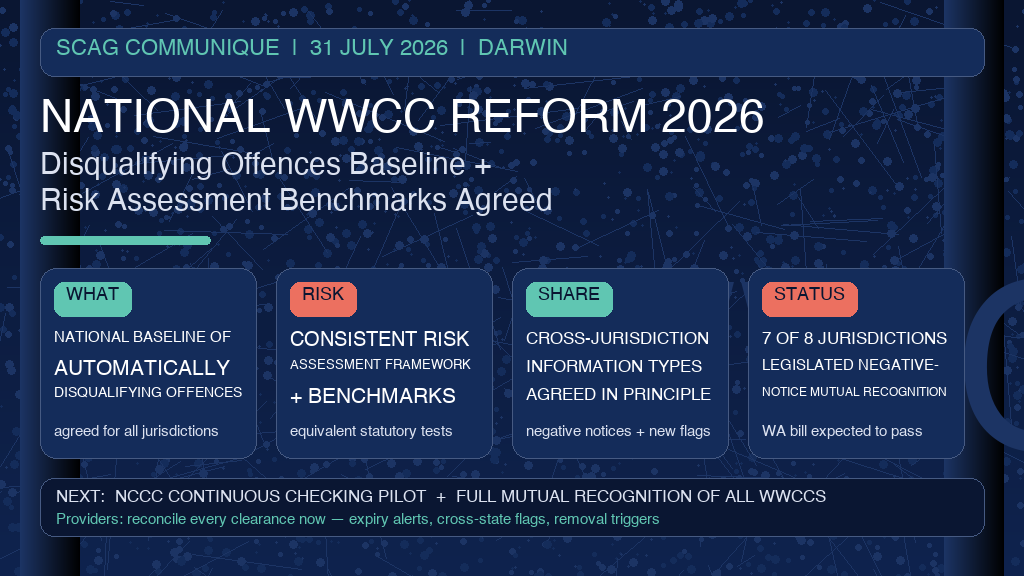
On 31 July 2026, the Standing Council of Attorneys-General (SCAG) met in Darwin and delivered the biggest single step yet in the national harmonisation of Australia's eight separate working with children check (WWCC) schemes. Ministers agreed a meaningfully consistent approach to disqualifying offences — a national baseline of serious criminal offences that will automatically bar a person from holding a WWCC — plus a framework and benchmarks for risk assessments and the information types to be shared across jurisdictions. Seven of eight jurisdictions have already legislated mutual recognition of negative notices; Western Australia has a Bill expected to pass shortly. Here is what the SCAG communiqué means for every childcare and aged care provider that screens staff, and the 30-day workflow to run before the national baseline changes how your workforce is assessed.
Background — how Australia's eight WWCC schemes got here
Every Australian jurisdiction operates its own working with children screening scheme. New South Wales issues WWCC clearances through the Office of the Children's Guardian, Queensland runs the blue card system through Blue Card Services, Victoria has the Working with Children Check via the Department of Justice and Community Safety, Western Australia has its own check through the Department of Communities, South Australia screens through the Department of Human Services, Tasmania issues Registered Working with Vulnerable People cards, the ACT runs the Working with Vulnerable People registration, and the Northern Territory issues ochre cards. Each scheme has its own disqualifying-offence list, its own risk assessment process, and its own renewal cycle.
The differences are not cosmetic. An offence that automatically disqualifies a person in one state may only trigger a risk assessment in another, and a negative notice in one jurisdiction has not historically stopped the same person from obtaining a check elsewhere. The Royal Commission into Institutional Responses to Child Sexual Abuse identified this patchwork as a national risk, and successive federal governments have worked toward consistency. The first concrete milestone was the 'banned in one, banned in all' reform, which all jurisdictions legislated — a person banned from working with children in one state is now banned everywhere. The second milestone was the Agreement to Deliver National Working with Children Check Reform, endorsed by SCAG on 14 November 2025, which set out six priority actions on a defined pathway to full national mutual recognition.
What changed and when — the six priority actions and the 31 July 2026 agreements
The WWCC SCAG Agreement commits all governments to six priority actions: (1) mutual recognition of negative notices, (2) meaningful consistency in automatic exclusion criteria, (3) meaningful consistency in risk assessment frameworks, (4) clear information sharing pathways, (5) an operational National Continuous Checking Capability (NCCC), and (6) mutual recognition of working with children checks. The 31 July 2026 SCAG communiqué reports where each action stands and records the new agreements:
- Priority Action 1 — mutual recognition of negative notices: substantially complete. Seven jurisdictions have legislated to enable mutual recognition of negative notices. The remaining jurisdiction, Western Australia, has introduced a Bill expected to pass shortly. The Northern Territory is developing an interim solution to share and receive negative-notice information through the National Reference System, supported by the Commonwealth. For providers, this is the legal foundation for 'banned in one, banned in all' operating automatically across every border.
- Priority Action 2 — automatic exclusion criteria: national baseline agreed. Ministers agreed a meaningfully consistent approach to disqualifying offences. The Attorney-General's media release confirms this means a national baseline of serious criminal offences that will automatically bar a person from being granted, or continuing to hold, a WWCC if they have been convicted of those offences. This is the single most consequential change for providers: the same offence will now disqualify in every state, and an existing clearance can be revoked when a conviction matches the baseline.
- Priority Action 3 — risk assessment frameworks: framework and benchmarks agreed. Ministers agreed a framework and benchmarks to support meaningful consistency in risk assessments across jurisdictions. Screening units will consider comparable information and apply equivalent statutory tests to decide whether a person poses an unacceptable risk to children. Providers should expect more consistent outcomes when a staff member's application is assessed, regardless of which state they work in.
- Priority Action 4 — information sharing: types agreed. Ministers agreed the information types that must be shared within jurisdictions and agreed in principle the information types that must be shared across jurisdictions to support mutual recognition. They also agreed the Principles and Objectives that will govern sharing of child safety and wellbeing information for WWCC purposes. Cross-border data sharing is the mechanism that makes mutual recognition safe: a negative notice or a new conviction in one state will be visible to screening units in every other state.
- Priority Action 5 — National Continuous Checking Capability: pilot onboarding continues. The Australian Criminal Intelligence Commission continues to support state and territory worker screening units to onboard to the NCCC pilot. Continuous checking means a person's criminal history is monitored after clearance is granted, not just at the point of application — the end of the 'check once, assume nothing changes' era.
- Priority Action 6 — mutual recognition of all WWCCs: the end goal, still ahead. The communiqué notes the agreement remains on track for delivery of priority actions 2, 3 and 4, with continued legislative, policy and operational work required to meet agreed timeframes. Full mutual recognition of every WWCC — where a clearance in one state is automatically recognised in another — is the final action and depends on the earlier actions being operational.
The National Children's Commissioner, Deb Tsorbaris, joined the 31 July meeting and highlighted the importance of a coordinated national approach in improving child safety outcomes. The Attorney-General's media release frames the agreements as closing regulatory gaps between jurisdictions and supporting future mutual recognition of WWCC decisions.
Operational impact for providers — six things the SCAG agreements change
The SCAG agreements do not change a single WWCC card today. But they change the trajectory of every screening decision your provider will make over the next 12 to 24 months, and some of the groundwork is due now. Six operational consequences every childcare and aged care provider should prepare for:
- Your disqualifying-offence list is about to change to a national baseline. When the national baseline is legislated, an offence that currently triggers only a risk assessment in your state may become an automatic disqualification. Re-verify every staff member's clearance against the coming baseline — not just the list your state uses today — so no one is left holding a clearance that the national rules would have barred.
- Existing clearances can be revoked, not just refused. The agreed approach covers both granting and continuing to hold a WWCC. A staff member convicted of a baseline offence will lose their clearance in every jurisdiction, and your service must be able to react within days — not at the next renewal cycle. This is a live removal-from-duty trigger, not a paperwork event.
- Cross-jurisdiction information sharing changes the multi-state staffing picture. If you operate services in more than one state, or recruit staff who hold out-of-state clearances, the information sharing agreements mean a negative notice or conviction in one state will reach screening units in every other state. The 'register in a different state' workaround disappears.
- Continuous checking is coming through the NCCC pilot. The NCCC pilot means criminal history changes can be flagged after clearance is granted. Providers that only check clearances at hire will need a system for acting on mid-employment flags — the regulator expectation is that you demonstrate ongoing oversight, not just an initial check.
- Risk assessment outcomes will become more consistent — and more defensible. The agreed framework and benchmarks mean screening units apply equivalent statutory tests. Consistent national decisions make your own 'fit and proper' judgement calls easier to benchmark, because the state screening outcome is a stronger signal than it is today.
- Renewal tracking becomes a compliance obligation, not an HR convenience. With automatic disqualification, continuous checking and cross-border data sharing, the cost of a lapsed or unverified clearance is much higher. Providers need a reliable way to track every check type — WWCC, blue card, WWVP, ochre card — across every state, with expiry alerts that fire early enough to act.
Step-by-step workflow — the 30-day national WWCC reform readiness plan
The reforms land in stages, and providers do not need to wait for legislation to run the readiness work. The 30-day plan below builds the evidence trail and the operational capability that will matter when the baseline and continuous checking go live in your state.
- Day 1 to Day 3 — Build the complete staff screening register. List every employee, volunteer and contractor who works with or around children. For each person record: check type (WWCC, blue card, WWVP, ochre card or equivalent), issuing state, card number, date of issue, and date of expiry. Include everyone — not just educators — because the national reforms cover all roles that require a check.
- Day 4 to Day 7 — Reconcile the register against actual clearances. For each person, confirm the recorded clearance matches the live status in the issuing state's screening unit. Flag expired, lapsed, or unverifiable clearances immediately and remove affected staff from direct contact duties until the clearance is confirmed current. A register built from memory is not a compliance artefact.
- Day 8 to Day 12 — Map the disqualifying-offence baseline against your workforce. When your state publishes its aligned disqualifying-offence list (or the national baseline is published), run a review of any staff member whose history touched a baseline-adjacent offence. For anyone flagged, obtain the risk assessment or clearance review documentation and store it in the personnel file. This is the evidence you will produce in an audit.
- Day 13 to Day 18 — Document the mid-employment flag response. Write a one-page procedure for acting on a continuous-checking flag or a negative notice from another jurisdiction: who is notified, who is removed from duties, how the decision is recorded, and how the family or regulator communication happens if required. Test the procedure with a tabletop scenario.
- Day 19 to Day 24 — Set renewal alerts at 60 and 30 days. Configure expiry alerts for every clearance type at 60 days and again at 30 days before expiry. Assign an owner to each alert and confirm the renewal application can be lodged in time for the state's processing window. In states with longer processing times, set the first alert at 90 days.
- Day 25 to Day 30 — Run the multi-state audit and produce the evidence pack. If you operate in more than one state, audit every out-of-state clearance against the issuing state's screening unit and confirm mutual-recognition status where applicable. Produce a screening evidence pack — register, verification dates, risk assessment records, flag-response procedure — dated and ready for regulator review. The pack is the artefact that turns 'we check our staff' into 'here is the evidence'.
How NovoCove supports this
NovoCove centralises the staff screening evidence layer that the national WWCC reforms are making progressively more important. The platform tracks working with children checks, blue cards, WWVPs, ochre cards and the full range of Australian credential types — 40+ credential categories across all eight jurisdictions for ECEC, plus AHPRA and NDIS Worker Screening for aged care — with automatic expiry alerts, per-service compliance status, and a daily compliance snapshot that shows how the register is trending over time. That screening workflow sits inside the childcare compliance software and aged care compliance software product pages.
The screening register, verification dates, risk assessment records and renewal alerts all live in one system, so the evidence pack an auditor asks for under the national reform trajectory is an export rather than a paper chase. NovoCove does not replace a provider's screening decisions or the state screening units — it is the data and evidence layer that keeps every clearance current, every expiry visible, and every mid-employment change traceable. As continuous checking and mutual recognition go live, the same workforce data NovoCove holds today is the data regulators will expect to see reconciled tomorrow.
Sources / further reading
- Significant progress on national Working with Children Check reforms — Attorney-General's portfolio media release, 31 July 2026 (T1)
- Standing Council of Attorneys-General (SCAG) Communiqué — 31 July 2026 — Attorney-General's Department (T1, PDF)
- Working with Children Check Reform — National Office for Child Safety (T1)
- Agreement to Deliver National Working with Children Check Reform — SCAG, 14 November 2025 (T1, PDF)
- National Strategy to Prevent and Respond to Child Sexual Abuse — Second Action Plan — National Office for Child Safety (T1)
This guide is general information and is not legal advice.