Childcare compliance
ACECQA 24-Hour Notification Rule: The Reg 176B / 176C WWCC Status-Change Clock That Every ECEC Service Is Now Bound To
On 27 February 2026 the ACECQA child safety reforms went live. New regulations 176B and 176C give every Australian ECEC service a hard 24-hour notification clock for WWCC, WWVP and teacher registration status changes. The new 'localised issue' NQA IT category captures inappropriate conduct (section 166A). Here is what changed, who in your team owns the clock, the four-step workflow that keeps you compliant, and the five concrete checks every approved provider should run in the next 30 days.
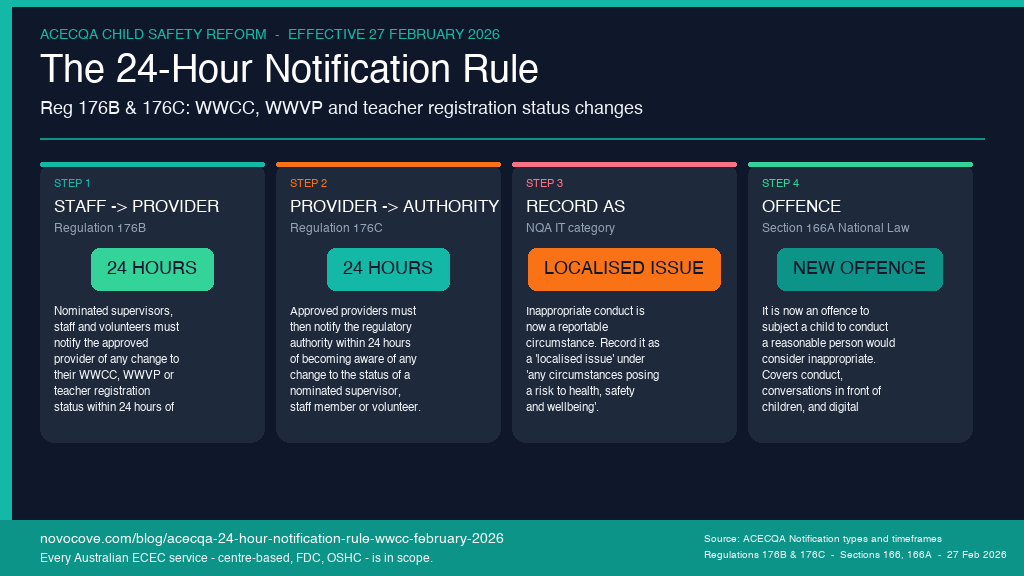
On 27 February 2026 the ACECQA child safety reforms went live across every Australian education and care service. Two new regulations — 176B and 176C — give every approved provider a hard 24-hour notification clock for any change to a nominated supervisor, staff member or volunteer's Working with Children Check (WWCC), Working with Vulnerable People (WWVP) registration or teacher registration status. The same reform package created a new notification category — "localised issue" — in the NQA IT system for any circumstance posing a risk to children, and made inappropriate conduct a stand-alone offence under section 166A of the National Law. This is the operational rule book that the regulator will look at when it next walks through your door.
What actually changed on 27 February 2026 — the four operative pieces
The 27 February 2026 reform package is dense, but the four operative pieces are discrete and individually enforceable. Each piece creates a new obligation that every approved provider — centre-based, FDC, OSHC, vacation care — must build into the daily operating rhythm.
- Reg 176B — a 24-hour clock for the individual. Where checks are conducted in a participating jurisdiction, nominated supervisors, staff members and volunteers must notify their approved provider of any changes to their WWCC, WWVP or teacher registration status. This must occur within 24 hours of becoming aware of the change, unless already required to notify under a law in a participating jurisdiction.
- Reg 176C — a 24-hour clock for the provider to the regulatory authority. Unless already required under a law of a participating jurisdiction, approved providers must then notify the regulatory authority of any relevant change to the status of a nominated supervisor, staff member or volunteer within 24 hours of becoming aware of it.
- The "localised issue" NQA IT category — inappropriate conduct is now a reportable circumstance. The National Decision Tree now includes inappropriate conduct as an example of a circumstance that poses a risk to children's health, safety or wellbeing and must be notified under the incident category. In the NQA IT system, it should be recorded as a "localised issue" under "any circumstances posing a risk to health, safety and wellbeing".
- Section 166A — inappropriate conduct is now a separate offence. From 27 February 2026, a new offence under section 166A of the National Law makes it an offence for an approved provider, nominated supervisor, staff member or volunteer to subject a child to conduct a reasonable person would consider inappropriate in an education and care service. The offence is broader than section 166 (inappropriate discipline) — it covers conduct, conversations between adults in front of children, and digital contact.
Each piece is independently enforceable, but the operational reality is that the four pieces run on the same workflow. The provider who fixes the 24-hour clock on Reg 176B / 176C already has the evidence trail to record the "localised issue" — and the governance posture to defend against a section 166A allegation.
Why this matters now — the regulator is refreshing the playbook
ACECQA refreshed its child safety information hub in July 2026 specifically to support the sector in implementing the 27 February 2026 changes. The refresh updated the Notification types and timeframes web page and the National Decision Tree with a new notification tab for the WWCC / WWVP / teacher registration change under the approved service section, and a new notification tab for acquisition of provider (50% or more ownership change, 7 days). The refresh also added a notification tab for the inappropriate conduct example under the incident category.
ACECQA's National Decision Tree is the live reference the regulator uses when it reviews a provider's incident log. The Decision Tree now treats a missed WWCC status change as a Quality Area 7 — Governance and Leadership failure, and a missed inappropriate-conduct notification as a Quality Area 5 — Relationships with children and Quality Area 7 failure. The combined effect is that the 24-hour clock is now a hard operational test that the regulator will use as part of the next Assessment and Rating visit.
The Q1 2026 NQF Snapshot (published 12 July 2026) shows 933 compliance actions against approved providers in the quarter — up 63% year-on-year. Quality Area 7 is the third-most-failed Quality Area nationally. The 24-hour notification rule is exactly the kind of operational detail that will drive the next wave of compliance actions.
The two 24-hour clocks — who owns each one
The two clocks bind different people. Conflating them is the single most common compliance gap. The provider's policy must name the person who owns each clock, document the system that records the awareness time, and produce the evidence trail on demand.
- Reg 176B clock — owned by the individual. The nominated supervisor, staff member or volunteer must notify the approved provider within 24 hours of becoming aware of the change. The clock starts when the individual becomes aware — not when the WWCC issuer records the change, not when the provider next sees the staff member. The individual owns the clock; the provider owns the receipt.
- Reg 176C clock — owned by the approved provider. The provider must notify the regulatory authority within 24 hours of becoming aware of the change. The clock starts when the provider becomes aware — typically the moment the individual notifies the provider under Reg 176B. The provider owns the clock; the regulatory authority owns the receipt.
The two clocks are independent. If the individual is late on Reg 176B, the provider's Reg 176C clock is unaffected. If the provider is late on Reg 176C, the individual's Reg 176B compliance is unaffected. Both clocks, however, must be evidenced. A provider who can produce a perfect Reg 176C trail but cannot evidence the upstream Reg 176B notification has a gap.
What counts as a "change to status" under Reg 176B / 176C
The reforms do not define "change to status" exhaustively, but ACECQA's refreshed resources treat the following as in-scope events. Providers should adopt the same scope in their policies and procedures.
- WWCC or WWVP registration expires, is suspended, is cancelled, or is made subject to an interim order. Any state- or territory-issued check that expires, is suspended or is cancelled is a status change. The individual becomes aware of the change at the moment the issuer records it; the provider becomes aware at the moment the individual notifies the provider.
- A new condition is imposed on an existing check. If a jurisdiction adds a condition (for example, a supervision order or a working-condition restriction) to an existing WWCC, this is a status change. The individual must notify the provider within 24 hours; the provider must notify the authority within 24 hours of becoming aware.
- Teacher registration is suspended, cancelled or made subject to a non-practising or equivalent order. Teacher registration changes in every participating jurisdiction follow the same 24-hour logic as WWCC. Approved providers in jurisdictions where teacher registration is the primary check should treat the two regimes as operationally identical.
- A new disqualifying offence is recorded against the individual. Where a new offence triggers a downstream change to a WWCC, WWVP or teacher registration, the change is a status change. Providers should not wait for the formal change to be recorded — if the individual is aware of the new offence and reasonably expects the check to be impacted, the 24-hour clock has started.
The scope is intentionally broad. The provider's policy should err on the side of notifying — a notification that turns out not to be required is not a compliance breach. A missed notification is.
The "localised issue" NQA IT category — how to record inappropriate conduct
ACECQA's July 2026 resource refresh added the "localised issue" category specifically to capture inappropriate conduct. The category sits under the incident notification pathway, not the complaint pathway. This matters operationally: an inappropriate-conduct event triggers the 24-hour incident notification clock, not the longer complaint investigation clock.
The NQA IT system records "localised issue" under "any circumstances posing a risk to health, safety and wellbeing" — the broad catch-all category that ACECQA uses for events that fall outside the named serious-incident categories. The provider's notification should include the same information as any other incident notification: who was involved, when the provider became aware, what the conduct was, what action the provider has taken in response, and what steps the provider is taking to prevent recurrence.
The section 166A offence is the legal frame that makes the notification load-bearing. The inappropriate conduct itself may not meet the threshold for a serious-incident notification, but it is now a stand-alone offence — and a failure to record it as a "localised issue" is itself a notification failure under the incident category. The provider's incident log is the evidence trail; the "localised issue" category is the legal handle.
Operational impact for providers — six things to do in the next 30 days
The reforms are live now. Every approved provider should treat the next 30 days as a working compliance sprint. Six concrete actions, in priority order, will put every service in the strongest possible position when ACECQA next reviews incident notifications.
- Map the two 24-hour clocks to named owners in your policy. Update the staffing policy and the governance policy to name the person who receives the Reg 176B notification from the individual, the person who records the awareness time, the person who lodges the Reg 176C notification to the regulatory authority, and the backup owner for each clock when the primary owner is on leave.
- Stand up the Reg 176B receipt workflow. Every WWCC, WWVP and teacher registration status change must be recorded within 24 hours of the individual becoming aware. Build a single receipt form (paper, email, or platform) that captures the individual's name, the type of check, the change, the date and time the individual became aware, the date and time the provider received the notification, and the signature of the receiving staff member.
- Stand up the Reg 176C notification workflow. Every Reg 176B receipt must trigger a Reg 176C notification within 24 hours. Build a single notification template that names the regulatory authority, captures the same information as the Reg 176B receipt, records the date and time the provider became aware, and records the date and time the notification was lodged.
- Add the "localised issue" category to the NQA IT workflow. Train the nominated supervisor and the person in day-to-day charge on the new "localised issue" NQA IT category. Build a single decision-tree-style guide that walks through the four steps: (1) is the event a serious incident? (2) is the event inappropriate conduct under section 166A? (3) if yes, record as "localised issue" under "any circumstances posing a risk to health, safety and wellbeing"; (4) notify the regulatory authority within 24 hours.
- Refresh the section 166A inappropriate-conduct guidance. Update the code of conduct policy and the staff handbook to include the section 166A inappropriate-conduct test. The test is the "reasonable person" test — would a reasonable person consider the conduct inappropriate in an education and care service? The provider's policy should give concrete examples drawn from the ACECQA information sheet (humiliating or threatening children, sexualised or intrusive physical contact, one-to-one online messaging, photographing children in a state of undress, hostile conversations between adults in front of children).
- Run a one-hour notification drill with the leadership team. Pick a recent (real or simulated) staff WWCC status change and walk the leadership team through the Reg 176B receipt, the Reg 176C notification, the "localised issue" NQA IT record (if applicable), and the section 166A guidance (if applicable). Time each step. Identify the bottleneck. Update the workflow.
Step-by-step workflow — the 30-day 24-hour notification plan
The 30-day plan below is the minimum viable workflow for any approved provider that wants to be confident the next ACECQA review finds the 24-hour clock evidenced end-to-end. The plan assumes a single service with a small leadership team; larger providers should run the same workflow across every service in parallel.
- Day 1 to Day 3 — Map the two clocks to named owners. Update the staffing policy and the governance policy to name the primary and backup owner for each 24-hour clock. Confirm the receipt channel (email, form, platform) and the escalation channel (when the individual has not notified within 24 hours, who follows up). Confirm the backup owner is trained.
- Day 4 to Day 7 — Build the Reg 176B receipt workflow. Create a single receipt form that captures the individual's name, the check type, the change, the awareness date and time, the receipt date and time, and the receiving staff member's signature. Distribute the form to every nominated supervisor, staff member and volunteer. Add the form to the staff induction pack.
- Day 8 to Day 12 — Build the Reg 176C notification workflow. Create a single notification template that names the regulatory authority, captures the same information as the Reg 176B receipt, and records the date and time the provider became aware and the date and time the notification was lodged. Confirm the notification is lodged through the NQA IT system and (where the jurisdiction requires) through the regulator's preferred secondary channel (email, portal, phone for urgent cases).
- Day 13 to Day 16 — Add the "localised issue" category to the NQA IT workflow. Build a one-page decision guide for the nominated supervisor and the person in day-to-day charge. The guide walks through the four steps (serious incident? inappropriate conduct? record as "localised issue"? notify within 24 hours?). Confirm every leadership team member has completed the NQA IT system training for the new category.
- Day 17 to Day 21 — Refresh the section 166A inappropriate-conduct guidance. Update the code of conduct policy and the staff handbook. Add the "reasonable person" test. Add the ACECQA examples as concrete illustrations. Add a one-page summary to the staff room wall and the team huddle agenda.
- Day 22 to Day 26 — Run the one-hour notification drill. Pick a real or simulated WWCC status change. Walk the leadership team through the Reg 176B receipt, the Reg 176C notification, the "localised issue" NQA IT record (if applicable), and the section 166A guidance (if applicable). Time each step. Update the workflow for the bottleneck.
- Day 27 to Day 30 — Audit the evidence trail. Pull every Reg 176B receipt from the last 12 months. Confirm every receipt has a matching Reg 176C notification within 24 hours. Pull every "localised issue" record from the NQA IT system. Confirm every record has a section 166A review and a documented response. Identify any gap and remediate.
What ACECQA will look at during the next assessment visit
The 27 February 2026 reforms are now the live reference the regulator uses when it reviews a provider's incident log. ACECQA will look for evidence that the provider has built the two 24-hour clocks and the "localised issue" workflow into the daily operating rhythm. In particular, ACECQA will look at:
- Staffing policy and governance policy. ACECQA will look for the named owner of each 24-hour clock, the receipt channel, and the escalation channel. The provider who cannot name the owner of the Reg 176C clock is exposed to a Quality Area 7 finding on the spot.
- Reg 176B receipt workflow and evidence trail. ACECQA will look for the single receipt form, the distribution to every staff member and volunteer, and the historical record of every receipt over the last 12 months. The receipt is the upstream evidence trail — without it, the Reg 176C notification has no provenance.
- Reg 176C notification workflow and NQA IT record. ACECQA will look for the NQA IT notification record for every Reg 176B receipt, the date and time the provider became aware, and the date and time the notification was lodged. The provider who can produce the NQA IT record but cannot evidence the receipt that triggered it has a gap.
- "Localised issue" category use in the incident log. ACECQA will look for evidence that the "localised issue" category has been used wherever an inappropriate-conduct event has occurred. The provider who has recorded an inappropriate-conduct event under a different category (or not at all) is exposed to a Quality Area 5 finding.
- Section 166A inappropriate-conduct review. ACECQA will look for evidence that every "localised issue" record has been reviewed under section 166A, that the "reasonable person" test has been applied, and that the response has been documented. The provider who has recorded the incident but has not applied the section 166A test has a compliance gap.
- Staff training and code of conduct refresh. ACECQA will look for evidence that every staff member and volunteer has been trained on the 27 February 2026 reforms, that the code of conduct has been updated, and that the staff handbook reflects the new "reasonable person" test. Training records, induction packs, and team-meeting minutes are the evidence trail.
How NovoCove handles this
NovoCove gives ECEC providers a single source of truth for the artefacts ACECQA will request under the 27 February 2026 child safety reforms. The platform centralises the staff WWCC, WWVP and teacher registration status register, the Reg 176B receipt workflow, the Reg 176C notification workflow, the NQA IT "localised issue" record, the section 166A inappropriate-conduct review, and the staff training evidence trail in one workflow.
The Reg 176B receipt workflow captures every status change the moment it is recorded, with the awareness date and time, the receipt date and time, and the receiving staff member's signature. The Reg 176C notification workflow is triggered automatically from the receipt record, with a hard 24-hour deadline, an escalation to the backup owner at the 12-hour mark, and a NQA IT system export that is one click rather than a paper chase. The "localised issue" record is generated from the same workflow, with the section 166A review template pre-loaded and the "reasonable person" test embedded.
The same platform covers every other ECEC compliance obligation your service is operating under — the National Quality Framework, the 7-tier expiry alert cadence for staff certifications and training, the WWCC renewal workflow, the Quality Area evidence pack, the Assessment and Rating visit preparation, and the National Early Childhood Worker Register 14-day update rule. If your service is in scope of the 27 February 2026 reforms, NovoCove is built to evidence the two 24-hour clocks on demand.
Official sources
- Child safety reforms and resource updates — ACECQA (T1, July 2026)
- Child safety changes: National Quality Framework strengthening safety in education and care — ACECQA (T1)
- Notification types and timeframes — ACECQA (T1)
- National Decision Tree — ACECQA (T1)
- Information sheet — Inappropriate conduct (section 166A) — ACECQA (T1)
- Information sheet — Understanding paramount consideration — ACECQA (T1)
- NQF Child Safe Culture Guide — ACECQA (T1)
- Providing a child safe environment — Policy and procedure guidelines — ACECQA (T1)
- NQF Snapshot Q1 2026: 933 compliance actions — ACECQA (T1, 12 July 2026)
- Education and Care Services National Law Act 2010 — Victorian Legislation (T1, section 166A)
This guide is general information and is not legal advice.