ECEC compliance & CCS integrity
National CCS Spot Checks: 1,300+ Services Visited Since November 2025 — the Unannounced Visit Powers, What Officers Check and the 30-Day Readiness Workflow for ECEC Providers
On 20 August 2026 the Australian Government Department of Education confirmed that more than 1,300 early childhood education and care services have received unannounced spot checks since the national program began in November 2025. Authorised Commonwealth officers have visited Centre-Based Day Care, Outside School Hours Care and Family Day Care services in metropolitan, regional and remote communities, checking enrolment and attendance records, record-keeping practices and Child Care Subsidy administration under new powers of entry introduced by the 2025 strengthening-regulation legislation. Any CCS-approved service can be next — and a visit that starts as a subsidy check can end with a referral to your state or territory regulator. Here is what the milestone means for every provider, the six actions to take now, and the 30-day workflow that makes your records demonstrable on an ordinary day.
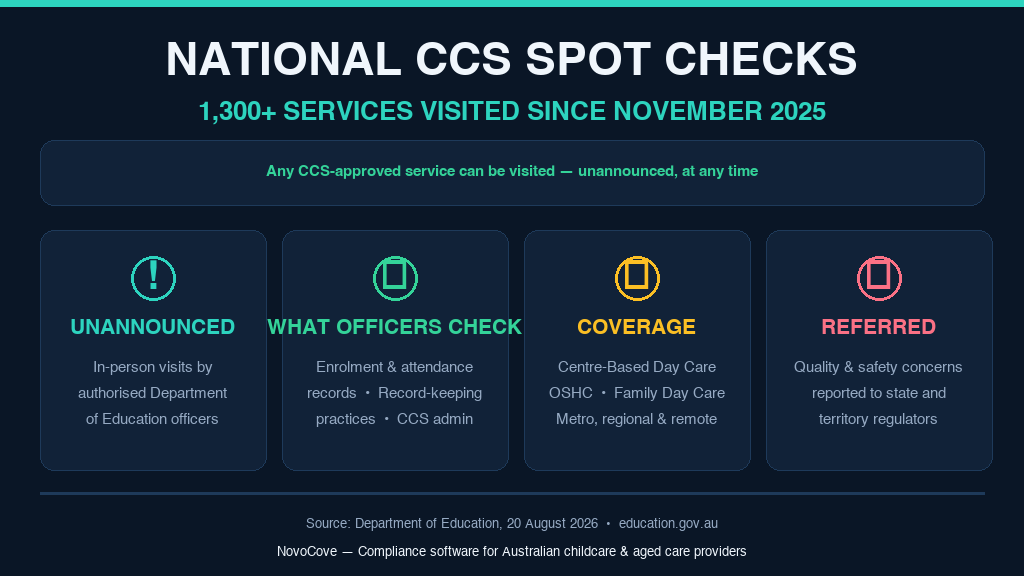
On 20 August 2026, the Australian Government Department of Education confirmed that more than 1,300 early childhood education and care (ECEC) services have received unannounced spot checks since the national program began in November 2025. Authorised Commonwealth officers can now appear at your door without notice, under new powers of entry, to verify that the Child Care Subsidy (CCS) is being administered correctly — and anything they observe about quality or safety goes straight to your state or territory regulator.
Background: how CCS integrity was enforced before the spot check program
CCS has always been a conditional payment. Approved providers administer the subsidy under the Family Assistance Law (FAL), which sets obligations on how enrolment is confirmed, attendance is reported, fees are managed and records are kept. For years, Commonwealth enforcement was largely reactive and desk-based: the Department investigated tip-offs, data mismatches and complaint patterns, and its most visible tools were published on the enforcement action register — suspensions, cancellations and, from 2025, an expanding list of publicised actions.
The compliance architecture changed in July 2025. On 23 July 2025 the Government introduced legislation to strengthen ECEC regulation, making quality and safety a paramount consideration for gaining and maintaining CCS provider and service approval. The package expanded the enforcement register to include infringements, conditions placed on approvals and refusals of new service applications, and — critically for this story — introduced new powers of entry for authorised Commonwealth officers to conduct unannounced service visits and spot checks.
The Department then ran a pilot between October and November 2025, visiting approximately 45 services across regional and urban areas of New South Wales, Queensland, Victoria and Western Australia. The findings were used to shape a nationally consistent and scalable framework — and in November 2025 the program went national. From that point, any registered service in Australia could receive an unannounced visit.
What changed and when: the 1,300-service milestone and what a spot check looks like
Three elements define the new position:
- 20 August 2026 — the milestone announcement. The Department of Education confirmed that more than 1,300 ECEC services have been visited since the program began in November 2025. Visits have covered Centre-Based Day Care, Outside School Hours Care (OSHC) and Family Day Care (FDC) services in metropolitan, regional and remote communities across Australia. Less than a year after the pilot, the unannounced spot check is an established part of the national compliance landscape.
- What officers actually do. Spot checks are unannounced, in-person visits by authorised officers of the Department of Education. During a visit, officers work with service staff to check enrolment and attendance records, review record-keeping practices and ensure CCS is being administered correctly. The Department's guidance adds that officers verify services are meeting their legislative obligations under the FAL, assess whether enrolments and attendance are reported accurately, confirm accurate record-keeping, and ensure services have procedures in place to manage payments and fees.
- The identity and process protocol. Authorised officers must introduce themselves, show their authorised person identity cards, and provide documentation including a consent to enter premises form. The visits also have an educative component: officers share information to help services understand their obligations and highlight examples of effective practice.
The program operates alongside — not instead of — state and territory regulation. The Commonwealth focus is CCS administration and FAL compliance; state and territory regulators retain their NQF monitoring and enforcement roles. But the two systems are connected: if Commonwealth officers observe quality or safety concerns during a spot check, those concerns are referred to the relevant state or territory regulator. A visit that begins as a subsidy check can therefore trigger regulatory attention on the NQF side.
Operational impact: six things every approved provider should do now
The milestone turns an abstract possibility into a statistical reality — more than 1,300 visits in under a year, across every service type and every kind of community. Six actions follow for every CCS-approved provider:
- Assume a visit can happen tomorrow. The program is unannounced by design and the Department has confirmed any registered service can be visited. Readiness is a standing state of the business, not a response to a scheduled event. Put the spot check procedure on your service's radar now — before the officer arrives.
- Reconcile enrolment and attendance records against reality. The core of every check is whether enrolment and attendance reporting is accurate. Run a live reconciliation of what the CCS system says versus what is actually on the floor — children enrolled but not attending, attendance marked at the wrong times, enrolments not updated when families change arrangements. Errors here are both a subsidy integrity issue and the most common thing an officer will test.
- Verify your record-keeping practices. Records must be accurate, current and readily accessible: enrolment records and agreements, attendance records, fee and payment records, and the procedures behind them. An officer will ask to see records on the day — there is no 'send it later'. If your records live across spreadsheets, paper files and multiple inboxes, that is a risk with a known remedy.
- Confirm your CCS administration and payment procedures. Check the mechanics: gap fees collected correctly (including the direct gap fee collection requirement that has applied to Family Day Care and In Home Care providers since 1 January 2026), fee increases handled within FAL rules, and procedures documented for how payments and fees are managed. The Department's guidance explicitly tests whether procedures exist — not just whether the outcome was right.
- Know what happens when the officer arrives. Staff should know how to verify an authorised officer's identity (identity card, consent to enter premises form), who within the organisation must be notified immediately, where records are maintained, and what can and cannot be refused. An awkward first five minutes — a staff member unsure whether to let someone in, or unable to find the register — is the failure mode to design out.
- Treat the referral risk seriously. The spot check is a CCS integrity tool, but it is also a fresh pair of eyes on your service. Anything observed about quality or safety is referred to your state or territory regulator — which can mean an NQF follow-up, assessment or compliance visit you did not ask for. The workforce evidence regulators look for — current qualifications, WWCCs, first aid and child safety training, supervision documentation — should be as demonstrable as your enrolment records.
A 30-day workflow to make your service spot-check ready
Preparing for an unannounced visit is not a special project — it is a deliberate, documented routine. This 30-day workflow gives a centre director, nominated supervisor or approved provider a complete CCS-readiness position:
- Days 1-5 — Map your records and your process. Inventory every record a spot check can test: enrolment agreements, attendance records, fee and payment records, gap fee procedures (including direct gap fee collection for FDC and In Home Care), and the staff records behind them. Write down where each record lives, who owns it, and how quickly it can be produced.
- Days 6-10 — Run the enrolment and attendance reconciliation. Compare CCS-reported enrolments and attendance against the service's actual operations for the last full month. Reconcile every discrepancy, correct the reporting, and fix the underlying process — this is the record officers check first.
- Days 11-15 — Audit the workforce evidence file. Reconcile every staff member's qualifications, current WWCC, first aid/anaphylaxis/asthma certifications and child safety training status, and flag every expiry in the next 12 months. This is the file that answers both a spot check and any quality or safety referral that follows one.
- Days 16-20 — Document your payment and fee procedures. Make sure the service has written procedures for how payments and fees are managed under FAL: how gap fees are collected, how fee changes are decided and communicated, and who is accountable. An officer checks that procedures exist and are followed — documentation is the deliverable.
- Days 21-25 — Brief the team and rehearse the visit. Train staff on the protocol: verify identity, notify the designated leader, escort the officer, retrieve records promptly. Rehearse a mock visit with the enrolment and attendance records and the workforce file — the point is to find the records that take too long to find.
- Days 26-30 — Governance sign-off and a quarterly cadence. Have the approved provider formally review and sign the readiness position. Schedule quarterly re-runs of the reconciliation and the workforce audit so records never drift — accuracy becomes the standing state, not a pre-visit scramble.
How NovoCove supports this
A spot check tests records that must be accurate and current on an ordinary day — and the workforce side of that file is exactly what NovoCove centralises. NovoCove is the data and evidence layer for the staff records behind your service: staff certifications and training expiry for 40+ Australian ECEC credential types across all states, WWCC and clearance expiries, and compliance tasks with owners and due dates, with a 7-tier alert cadence that surfaces a first aid certificate, child safety training or working with children check expiry weeks before an officer — or an assessor — asks to see it. Policy review dates and versions, incident and notification records, and evidence packs all live in the one dashboard, so the file behind your service's compliance position is assembled in minutes rather than reconstructed from spreadsheets.
NovoCove does not administer CCS, and it does not replace your enrolment or attendance system. Enrolment reporting and subsidy administration stay in the systems that run them. What NovoCove provides is the underlying evidence layer: the RAG compliance score and daily ComplianceSnapshot trend show your overall position moving as actions are completed, and the workforce evidence an officer may cross-check — current qualifications, clearances and training — is demonstrable at any moment, not just after a month of preparation. The data the regulator sees today is the same data any future expansion of the National Early Childhood Worker Register will look for.
When the unannounced visit comes, the services that notice it least are the ones whose records were already right. Book a 20-minute demo and we will show you what your service's evidence position looks like through an officer's eyes.
Sources / further reading
- More than 1,300 child care services visited through spot check program — Department of Education, 20 August 2026 (T1)
- Spot checks — what they are, the procedure and the pilot — Department of Education guidance (T1)
- Strengthening early childhood education and care regulation — legislation introduced — Department of Education, 23 July 2025 (T1)
- Enforcement action register — Department of Education (T1)
- More than 1,300 ECEC services visited as national spot-check program expands — The Sector, 25 August 2026 (T3)
This guide is general information and is not legal advice.