Regulatory update
First CCS Cancellation of 2026: What Laugh & Learn Means for Every FDC Provider
Australia cut Child Care Subsidy funding for the first time on 2 July 2026 - and a major loophole lets the worst offenders re-register the next day. Here is what every FDC and approved provider must do this week.
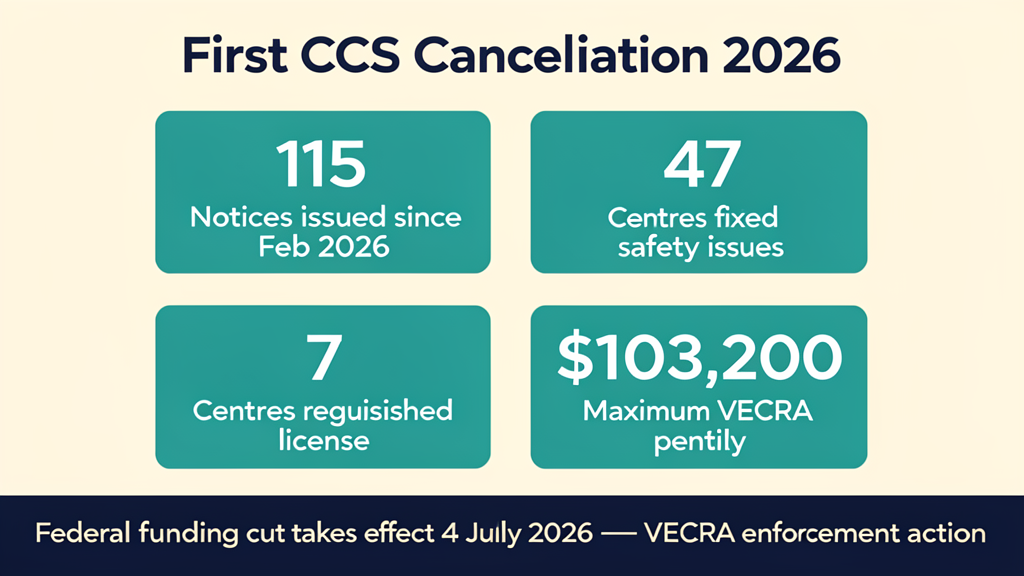
On 2 July 2026, the Australian Government cut Child Care Subsidy (CCS) funding to a family day care provider for the first time since the new safety laws came into effect. From Saturday 4 July, every service linked to Laugh & Learn Family Day Care Education & Training is ineligible to receive further Commonwealth funding. The decision follows a Victorian Early Childhood Regulatory Authority (VECRA) Emergency Action Notice in April that found children at two Craigieburn residences were exposed to rat poison, unsecured bleach, an unanchored bookshelf, a child-accessible chest freezer, dog faeces on the lawn, and an unsecured water feature.
The decision matters far beyond the one provider. It is the first concrete demonstration of the Commonwealth's new power to defund services over quality and safety concerns - a power that only came online in February 2026. Federal Education Minister Jason Clare told Parliament this week that the government has issued 115 notices to centres in the five months since, with 47 fixing the safety issues raised, seven relinquishing their licence, and nine more now facing a formal show-cause process. Every family day care approved provider, every long day care director, and every out-of-school-hours service is now in scope of the same investigation process.
What actually happened at Laugh & Learn
VECRA's own media release, published 15 April 2026 and updated 28 May, describes what its authorised officers found during unannounced visits to nine family day care educator residences operated by the one approved provider. At two of those residences, in Craigieburn in Melbourne's north, officers identified serious breaches of Section 167 of the Education and Care Services National Law - the protection-from-harm provision that every approved provider accepts as a condition of registration.
The specific hazards listed in the VECRA notice are the kind of items that should never reach a child's hands in any education and care setting:
- Unsecured furniture, including a large and heavy bookshelf
- Hazardous materials - bleach, paint and rat sack bait - accessible to children in various rooms
- A free-standing chest freezer on a verandah with no child safety lock
- Trampolines without safety matting
- Dog faeces in grassed areas accessible to children
- Obstructed emergency egress routes
- Unsecured and accessible water features
The Emergency Action Notice required the approved provider to ensure those two educators ceased providing education and care at their residences until the Section 167 requirements were met, and to submit evidence within 14 days that the breaches had been rectified and an updated residence risk assessment had been completed. Two of the educators were also issued with warning notices in their own right.
On 30 June, the federal Department of Education confirmed the outcome of its own parallel investigation: cancellation of the provider's CCS approval. A Department spokesperson told ABC News that "the department's decision relates to the CCS approval of the provider, not individual educators" - a distinction that became the centre of the political story the next day.
The loophole nobody is talking about
Here is the part that should worry every approved provider in Australia. The ABC's exclusive on 2 July reported that Laugh & Learn told the broadcaster that all of its educators - including the two who breached the safety standards - remain operational and have begun re-registering with other providers. Government sources confirmed to the ABC that the new legislation does not prevent an educator found to have breached safety regulations from switching to another approved provider and continuing to receive Commonwealth funding in the process.
The Commonwealth's power, in other words, is provider-level: it can defund an approved provider over the conduct of its educators, but it cannot - on its own - prevent an individual educator from walking next door and joining a different scheme the following Monday. The decision to accept that educator into the new scheme is at the discretion of the new approved provider, who would be subject to closer scrutiny as a result. That is the loophole Greens early childhood spokesperson Steph Hodgins-May has demanded the government close immediately, and that Shadow Minister Matt O'Sullivan has confirmed the Opposition also wants tightened.
What the 115 notices actually cover
The 115 figure Minister Clare reported to Parliament covers every notice issued under the strengthened Child Care Subsidy compliance framework since 27 February 2026, when the new Family Assistance Law powers came online. The breakdown matters:
- 115 notices issued - the total compliance-action correspondence the Department has sent to approved providers whose services breached safety, record-keeping, or educator-to-child ratio requirements
- 47 services fixed the issues - providers who responded to the notice, addressed the breaches, and had their CCS eligibility preserved
- 7 services relinquished their licence - providers who decided that the cost of coming back into compliance exceeded the value of operating, and exited the sector voluntarily
- 9 services moved to show cause - providers who did not satisfy the Department on the 28-day response window and now face formal suspension or cancellation proceedings
- 1 service had its CCS cancelled outright - Laugh & Learn, with effect from Saturday 4 July 2026
The 28-day show-cause window comes from the Early Childhood Education and Care (Strengthening Regulation of Early Education) Bill 2025, which amended the Family Assistance Law to let the Commonwealth suspend or cancel a provider's CCS approval where safety or quality concerns are established. MinterEllison's 25 July 2025 technical update on the Bill describes the mechanism in full: a formal notice triggers a 28-day response window, after which the Department can move directly to suspension, condition, or cancellation without further negotiation.
Why this is different from the VECRA infringement notices we covered in June
If you read our piece on the VECRA infringement regime that took effect on 11 June 2026, you will recognise the pattern - a state regulator with new penalty powers, a visible compliance artefact operators must produce, and a paired enforcement mechanism. What is new on 2 July is the federal arm of the same machinery reaching its first live test. The Victorian Emergency Action Notice gave VECRA the immediate-stop power at residence level; the federal CCS cancellation is what happens when the Department of Education decides the provider as a whole no longer meets the standard for Commonwealth funding.
There is also a financial dimension. The Laugh & Learn funding cut affects more than 30 family day care educators operating out of residential homes - which means 30+ families will receive notices this week that their CCS eligibility is ending on 4 July and they need to find an alternative registered scheme. Sector analyst commentary in The Sector's 15 April 2026 coverage of the VECRA notice flagged that family day care providers in particular must prepare for sudden educator turnover when a coordinator's CCS approval is cancelled: every educator linked to that provider has 14 days to find a new scheme or close.
The five operational moves every approved provider should make this week
The Laugh & Learn case is not a freak event. It is the first verified example of a mechanism the Department of Education has now used publicly and in writing. Every approved provider - whether family day care, long day care, kindergarten, or outside-school-hours care - should treat the following five items as urgent this week.
1. Audit every educator residence against the Section 167 hazards list. The VECRA notice itemises exactly what fails: unsecured furniture, accessible chemicals, unanchored appliances, trampolines, dog faeces, blocked exits, water features without child-resistant barriers. Treat the list as a checklist and walk every residence you operate against it this week. Photograph each item, timestamp the photo, store it where you can retrieve it under pressure.
2. Pre-stage your 14-day evidence pack. VECRA's Emergency Action Notice gives an approved provider 14 days to submit evidence that breaches have been rectified and the residence risk assessment is current. The Commonwealth show-cause process gives 28 days. Build the response pack now, while there is no notice sitting on your desk - every residence risk assessment, every chemical-storage audit, every educator screening record, every maintenance log, in a single folder with a one-page index at the front.
3. Lock down your educator re-registration process before the loophole is closed. Until the loophole is closed, every new educator joining your scheme from another provider should arrive with a documented compliance history: the previous scheme's name, the reason for the move, a written declaration from the prior approved provider that no safety breach was substantiated, and a baseline residence risk assessment on day one. If you cannot obtain that history, decline the onboarding and document the decline. The Department of Education has demonstrated it will ask later what you did at the front door.
4. Reconcile your CCS eligibility workflow against the 28-day show-cause window. The Family Assistance Law now lets the Department issue a formal notice that triggers a 28-day response clock. Have a named owner for every CCS approval reference, a named backup, and a calendar entry that fires 21 days after every correspondence from the Department - giving you a week to gather evidence before the deadline lapses. Do not rely on email alerts from the Provider Entry Point as your only reminder.
5. File your own proactive notification if you have a Section 167 risk. Section 167 is the same provision VECRA used at Laugh & Learn. If you identify a hazard at one of your own residences or services, the lowest-risk path is to notify the relevant state or territory regulator in writing, document the rectification plan, and submit the evidence yourself. A regulator who receives a self-notification with a rectification timeline behaves very differently from a regulator who turns up unannounced.
How NovoCove handles this
NovoCove is built around the exact failure mode that took out Laugh & Learn. The Residence Risk Assessment module captures a timestamped, photo-evidenced check against the Section 167 hazard list for every family day care educator and every LDC room. Hazards escalate automatically into the regulator-ready evidence pack so a VECRA authorised officer, a Department of Education investigator, or an ACECQA assessor sees a clean audit trail in seconds rather than a stack of paper.
The Educator Compliance Record carries every screening, qualification, and WWCC clearance against the approved provider's master file - so when a new educator joins your scheme from another provider, the compliance history is the first thing you see, not an afterthought you discover at audit time. And the CCS Calendar watches every Family Assistance Law deadline - including the new 28-day show-cause window - and pings the named owner 21 days out, with a one-click jump to the evidence pack you need to respond.
The first Child Care Subsidy cancellation of 2026 is not the last. It is the first of a wave that the Department of Education has now demonstrated it is willing to use in public. Approved providers who treat 4 July 2026 as the deadline to get their evidence right - rather than the deadline they got caught - will be the ones still operating this time next year.
This guide is general information and is not legal advice.