Regulatory update
Childcare Funding Cut Loophole: How Breaching Educators Can Re-Register Under a New Provider, and What Every ECEC Operator Must Do
On 2 July 2026 the ABC revealed that the two Victorian educators who triggered the first federal childcare funding cut are already re-registering with other approved providers. The funding cut cancels the provider's Child Care Subsidy approval, not the individual educators, and the new National Early Childhood Worker Register is the only mechanism that gives a receiving provider early warning. Here is what the loophole means, the 115 notice count that put your service in scope, and the 30-day plan every approved ECEC provider should be running before 4 July 2026.
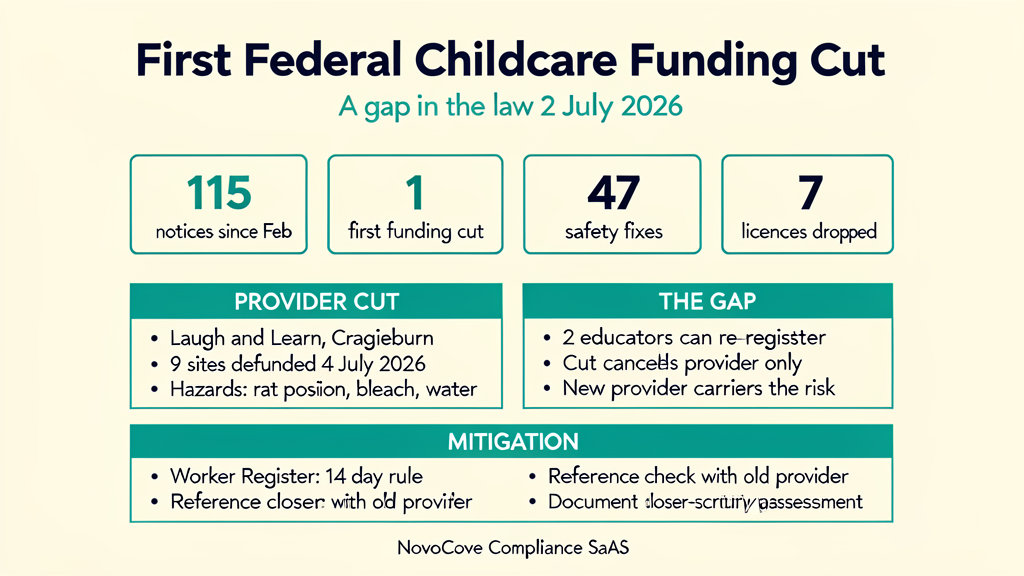
On 2 July 2026, the ABC revealed a loophole in the federal government's new childcare safety laws: the two Victorian educators whose safety breaches triggered Australia's first federal childcare funding cut are already in the process of re-registering with other approved providers. The funding cancellation, announced on 30 June 2026 by Education Minister Jason Clare against Laugh & Learn Family Day Care Education and Training, was the first use of the new Family Assistance Law cancellation powers. But the cancellation cancels the provider's Child Care Subsidy approval, not the individual educators. A breaching educator can move to a new approved provider and continue to receive Commonwealth funding, with the new provider carrying the obligation to assess regulatory compliance as part of standard onboarding.
The Department of Education has confirmed to the ABC that the two educators are not prohibited from re-registering under a different approved provider. The decision is at the discretion of the receiving provider, who is expected to "feel confident that the educators comply with regulatory requirements" and to subject them to "closer scrutiny as a result of ongoing investigations". In practice, the loophole puts the compliance burden on every approved provider that might unknowingly onboard one of the affected educators, and the only mechanism that gives a receiving provider advance warning is the new National Early Childhood Worker Register that has been mandatory since 27 February 2026.
This guide walks through the exact scope of the funding cut, the loophole the cancellation exposed, the 115 enforcement notices the Department has issued since the safety legislation took effect on 27 February 2026, the role of the Worker Register as the only available mitigation, and the 30 day plan every approved ECEC provider should be running before 4 July 2026, when the cancellation of Laugh & Learn's provider approval takes effect.
What happened: the first federal childcare funding cut
On 30 June 2026, Education Minister Jason Clare announced that the federal government had used its power to cut off Commonwealth funding to a child care service for the first time, against Melbourne-based family day care provider Laugh & Learn Family Day Care Education and Training. The decision followed an investigation by the Victorian Early Childhood Regulatory Authority (VECRA) that found serious safety breaches at two of the provider's family day care residences, both in Craigieburn in Melbourne's north. The breaches included exposing children to rat poison and bleach, leaving a water feature unsecured, an unsecured heavy bookshelf, obstructed emergency exits, and trampolines without safety matting.
The federal Department of Education's investigation concluded with the cancellation of the provider's Child Care Subsidy approval. The cancellation takes effect on 4 July 2026 and applies to all nine of the provider's family day care locations. According to the Department, "The department's decision relates to the CCS approval of the provider, not individual educators." This phrasing is the entire loophole. The funding cut cancels the entity, not the people. Parents of children enrolled in the affected services were notified on 1 July 2026, and the provider has publicly stated it will appeal the decision with the Victorian regulator.
The seriousness of the breaches is not in dispute. VECRA had previously ordered both Craigieburn centres to close in April 2026, after the regulator found the breaches represented an "immediate risk" to children. Documents uploaded to the Department of Education enforcement register show that the provider failed to fix the safety issues identified by the regulator, and the cancellation followed the Department's standard escalation pathway. Minister Clare's office declined to comment on the loophole, but the Minister's earlier statement that the safety laws passed last year were "not an idle threat" has now been demonstrated in practice.
The loophole the cancellation exposed
The ABC's reporting on 2 July 2026 confirmed that the two educators whose breaches triggered the cancellation are not personally prohibited from continuing to work in the sector. They can re-register with another approved provider and continue to receive Commonwealth funding, with the new provider carrying the obligation to assess the educator's regulatory compliance as part of onboarding. The Laugh & Learn provider told the ABC that all of its educators, including the two who breached the safety standards, "remain operational and have begun re-registering with other providers".
The mechanics of the loophole are structural. The federal Family Assistance Law framework operates at the provider level. The Department's powers to cancel, suspend, or impose conditions on Child Care Subsidy approval apply to the approved provider entity, not to individual educators. The state regulators (VECRA in Victoria, the NSW Early Learning Commission, the Queensland ECEC Regulatory Authority, and their equivalents in the other six jurisdictions) hold the power to prohibit an individual person from working in the sector, but the threshold for a state-level prohibition is higher than the threshold for a federal funding cut. The two educators at Laugh & Learn have not been subject to a state-level prohibition, and until they are, they remain free to seek employment with another approved provider.
The loophole has two operational consequences. First, the receiving approved provider is now the gatekeeper. A new approved provider that onboards one of the two Laugh & Learn educators without proper due diligence inherits the compliance risk. The Department has confirmed that the new provider would be subject to "closer scrutiny as a result of ongoing investigations", which is a polite way of saying that the receiving provider's next compliance visit is more likely to result in a finding. Second, the families using the receiving service are exposed to the same hazard profile that triggered the original cancellation. The compliance gap that allowed the breaches to occur at Laugh & Learn can recur at the receiving provider, with the receiving provider carrying the liability.
Greens early childhood spokesperson Steph Hodgins-May has called on the federal government to immediately close the loophole, stating that "if there's loopholes that can be exploited by bad-faith actors, Labor's reforms simply aren't good enough". Shadow childcare minister Matt O'Sullivan has agreed that "there must be consequences when serious safety breaches occur in any form of child care", but has argued that "educators who have done the right thing should have a pathway to move to another approved scheme". The political pressure on the loophole is building, but until the Family Assistance Law framework is amended to allow individual educator-level enforcement action, the receiving provider carries the risk.
The 115 notice count: the scale of the federal enforcement blitz
The first-use precedent at Laugh & Learn is one data point in a much larger enforcement pattern. Since the safety legislation took effect on 27 February 2026, the Department of Education has issued enforcement notices to 115 ECEC services across Australia. Of those 115, 47 have fixed the safety issues raised in the notice, and 7 have voluntarily relinquished their licence to operate. The remaining 61 services are at some point in the Department's escalation pathway, and a subset of those will face the same cancellation decision that Laugh & Learn received.
The 115 notice count is the visible output of the federal enforcement machinery that was legislated in 2025. The Department has the power to issue notices, impose conditions, suspend Child Care Subsidy approval, and cancel provider approval entirely. The graduated response is designed to give providers an opportunity to remediate before cancellation, but the Laugh & Learn precedent shows that the Department is willing to use the cancellation power when remediation does not occur. The 7 services that have voluntarily relinquished their licence to operate have effectively pre-empted the cancellation decision by accepting the loss of CCS revenue as inevitable.
The sector-wide distribution of the 115 notices is not published, but the safety breach categories that have triggered notices align broadly with the categories that VECRA has identified in its 2025-26 regulatory activity: hazardous substances accessible to children (the Laugh & Learn bleach and rat poison pattern), unsecured furniture and fittings (the bookshelf and water feature pattern), inadequate supervision evidence, and staff screening failures. Each of these categories is a high-frequency operational failure mode in ECEC services, and each is a category that the Laugh & Learn cancellation has now publicly associated with the cancellation outcome. The reputational cost of a notice is now much higher than it was in February 2026.
The National Early Childhood Worker Register as the only available mitigation
The mitigation for the re-registration loophole is the National Early Childhood Worker Register that has been mandatory for all NQF-regulated approved providers since 27 February 2026. The Register, hosted by ACECQA, captures personal details, contact details, role, employment details (including the family day care residence or venue location), employment arrangement (direct or labour hire), qualifications, training, and safety check information (including the Working With Children Check or Working With Vulnerable People registration number) for every educator, nominated supervisor, coordinator, regular volunteer, student or trainee, and non-educator staff member at an approved service.
The Register is the only mechanism that gives a receiving provider advance warning that a prospective educator has an enforcement history at a previous approved provider. Approved providers are required to enter or update a worker's details within 14 days of any change, including starting or finishing their role at the service. The system automatically checks new entries against the Prohibited Persons and Suspended Educators Register, and if a potential match is identified, the approved provider is prompted to contact the relevant regulatory authority for further information. The check does not replace the approved provider's existing obligation to check the Register of Prohibited Persons before engaging anyone.
The mitigation is partial. The Worker Register flags prohibited persons and suspended educators, but it does not currently flag an educator whose previous provider has had its funding cancelled due to a safety breach. The Department has signalled that the Worker Register will evolve over time, with future enhancements potentially including stronger identity verification, links with Working With Children and Working With Vulnerable People registration agencies, and exploration of a full national educator registration scheme. None of these enhancements is currently live, and the receiving provider is currently reliant on the 14 day update rule, the Prohibited Persons check, and the standard onboarding due diligence.
What can go wrong: receiving-provider failure modes
The failure modes for a receiving approved provider that onboards one of the two Laugh & Learn educators without proper due diligence are concrete and foreseeable. The Department has confirmed that the receiving provider would be subject to closer scrutiny, and the Department's escalation pathway from "closer scrutiny" to "notice" to "condition" to "suspension" to "cancellation" is well established. The Laugh & Learn case demonstrates that the Department will reach the cancellation step when remediation does not occur. A receiving provider that onboards a breaching educator and then fails to remediate the underlying risk is on the same pathway as Laugh & Learn itself.
Common receiving-provider failure modes that the Worker Register and standard onboarding due diligence are designed to catch include:
- No reference check with the previous approved provider. The single most common onboarding failure. Most ECEC onboarding workflows accept the Working With Children Check, the qualifications, and a CV as sufficient evidence, and do not contact the previous approved provider to ask whether the educator has any history of enforcement action. The Worker Register captures current role and employment dates, but does not include a free-text "history" field. A reference check with the previous provider is the only way to surface the Laugh & Learn context.
- Late Worker Register entry. The 14 day rule is the operational floor. A provider that takes 30 days to enter a new educator's details has a 16 day window during which the Worker Register is unaware of the new employment. For an educator moving from a defunded provider, those 16 days are the highest-risk window. The Department's automated check against the Prohibited Persons Register does not run until the entry is made.
- No central record of enforcement history at the provider level. Most approved providers track individual educator compliance (WWCC, qualifications, training) but do not maintain a record of the service's own enforcement history with the Department. The Laugh & Learn educator's previous provider had its funding cut, but the receiving provider's onboarding workflow is not designed to check the previous provider's enforcement status. The federal Enforcement Action Register, which lists 216 services sanctioned under Family Assistance Law in 11 months, is the only public source for this check.
- Family day care residence change without regulator notification. In a family day care context, the educator's residence is the service venue. A receiving provider that onboards an educator who is changing residence as part of the move from Laugh & Learn needs to ensure the new residence is assessed by the state regulator (VECRA in Victoria) before the educator commences. The standard 14 day Worker Register entry does not capture the residence change.
- Continuing professional development (CPD) and refresher cycle gaps. An educator who is moving between providers may have lapsed on mandatory training cycles (child safety training, first aid, anaphylaxis management, asthma management) during the transition period. The receiving provider's onboarding workflow should include a CPD status check against the educator's previous completion dates, not just the WWCC and qualifications.
What the loophole means for the broader sector
The re-registration loophole is the first structural gap in the federal childcare safety framework to be exposed by an actual enforcement action. The Family Assistance Law cancellation powers, the 14 day Worker Register rule, the Prohibited Persons check, and the federal Enforcement Action Register are all designed to create a layered compliance system, but the layering does not currently extend to the receiving-provider onboarding step. A breaching educator can move between providers, and the receiving provider is the layer that has to close the gap manually.
The Greens have called for the loophole to be closed. The political pressure is likely to result in a future amendment to the Family Assistance Law framework, potentially extending the Department's cancellation power to allow individual educator-level enforcement, or adding a Worker Register flag for educators whose previous provider has had its funding cancelled. Neither of these changes is currently in place, and approved providers cannot wait for the legislative fix. The compliance workflow that closes the gap manually is the only available option for the 2026-27 financial year.
For approved providers, the operational takeaway is that the standard onboarding workflow needs three additional steps that were not necessary before 30 June 2026. First, a reference check with the previous approved provider as a mandatory step, with the reference check outcome recorded in the educator's personnel file. Second, a check of the federal Enforcement Action Register for the previous provider's status. Third, a documented "closer scrutiny" assessment for any educator whose previous provider has an active enforcement action, with the assessment outcome signed off by the approved provider's nominated supervisor. None of these steps is currently mandated by the National Law or the Family Assistance Law, but all three are now part of the prudent compliance baseline.
The first-use enforcement precedent at Laugh & Learn is the moment when the federal childcare safety framework stopped being a forward-looking policy document and started being a working compliance system. The 115 notices, the 47 remediations, the 7 relinquishments, and the 1 cancellation are the first four months of the system's operational life. The loophole exposed by the cancellation is the first structural gap to be identified through actual use rather than policy review. The next 12 months will show whether the gap is closed by legislation, by Worker Register enhancement, or by receiving-provider manual diligence. The safest assumption for any approved provider is that the third option is the only one available in 2026.
How NovoCove handles this
NovoCove's compliance dashboard surfaces enforcement history from the National Early Childhood Worker Register and the federal Enforcement Action Register the moment a new educator is added to an approved provider's roster. The platform's onboarding workflow includes a mandatory reference check step that records the outcome of the contact with the educator's previous approved provider, a federal register check that flags any previous provider on the Enforcement Action Register, and a documented closer-scrutiny assessment for any educator whose previous provider has an active enforcement action. The assessment is signed off by the approved provider's nominated supervisor and stored as part of the educator's compliance record.
For the 14 day Worker Register rule, NovoCove's onboarding workflow generates an automatic alert on the day the educator commences, with a 7 day reminder and a day 13 escalation to the approved provider's compliance lead. The platform tracks the Worker Register entry status for every educator across the approved provider's services, and the compliance evidence pack for any Department of Education compliance visit includes the per-educator Worker Register entry date as a standard line item. The platform also tracks the educator's previous approved provider, previous commencement and end dates, and the reason for the role change, all of which feed into the closer-scrutiny assessment.
For family day care providers, NovoCove's compliance dashboard tracks the educator's residence status separately from the Worker Register entry. The residence change workflow triggers a state regulator notification step (VECRA in Victoria, the equivalent in the other seven jurisdictions) and a residence assessment date is recorded as part of the compliance record. The platform generates a per-educator compliance view that shows the WWCC status, the qualifications, the mandatory training cycles (child safety training, first aid, anaphylaxis management, asthma management), the Worker Register entry status, the previous approved provider reference check outcome, and the residence assessment status. The view is the single pane of glass that an approved provider's nominated supervisor needs to make the onboarding decision.
The 30 June 2026 cancellation is the first test of the federal framework, and the loophole it exposed is the first structural gap. NovoCove's compliance dashboard is built to close the gap at the receiving provider, where the framework currently places the burden. For approved providers that want to be on the right side of the closer-scrutiny standard from 4 July 2026 forward, the platform converts the loophole into a working line item in the onboarding workflow, with the reference check, the federal register check, and the documented closer-scrutiny assessment as the three operational steps that catch the risk before the educator is approved.
This guide is general information and is not legal advice.