Childcare compliance
NQF Snapshot Q2 2026: 6,000+ Regulator Visits, the 4:1 Monitoring Shift and What It Means for Your Service
Regulators made more than 6,000 visits to Australian ECEC services in one quarter — and four times as many were monitoring checks as assessment visits. Compliance actions doubled to 1,538 and 589 approvals were cancelled. Here is what the Q2 2026 data means for your service, and the workflow that keeps you ready for a visit at any time.
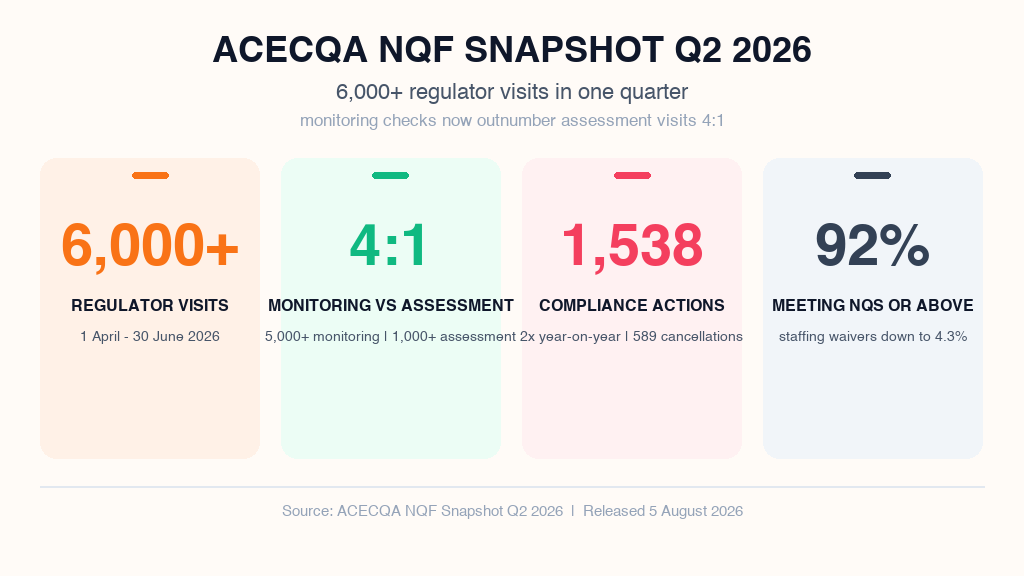
On 5 August 2026, ACECQA released the Q2 2026 edition of its quarterly NQF Snapshot, and the headline is not the quality ratings — it is the visits. State and territory regulatory authorities made more than 6,000 visits to approved services between 1 April and 30 June 2026, and more than 5,000 of those visits were for monitoring, compliance checking and investigation, not assessment and rating.
Background: how the NQF regulates services
The National Quality Framework has regulated approved education and care services since 2012. Under the framework, each state and territory regulatory authority is responsible for approving providers and services, monitoring compliance with the Education and Care Services National Law and National Regulations, and assessing services against the National Quality Standard. ACECQA's quarterly NQF Snapshot reports on how that system is operating nationally: how many services hold ratings, how many visits regulators undertake, how many compliance actions they take, and how the sector's quality profile is trending.
The assessment and rating process is the part most operators know: an authorised officer visits the service, gathers evidence across the seven Quality Areas, and assigns an overall rating from Significant Improvement Required through to Exceeding NQS, with a small number of services achieving the Excellent rating. But the Q2 2026 Snapshot makes explicit something the sector has suspected for years: assessment visits are only a small slice of regulator activity. Monitoring visits, compliance checks, complaint investigations and targeted follow-ups now dominate the regulatory workload — and each one carries the same evidentiary weight as an assessment.
For context, the Q1 2026 Snapshot (released 24 May 2026) showed 933 statutory compliance actions — a 63 per cent year-on-year increase — and the first full quarter of the federal government's new Child Care Subsidy (CCS) cancellation powers. The Q2 report shows that trend did not plateau. It accelerated.
What changed and when: the Q2 2026 Snapshot numbers
The Q2 2026 NQF Snapshot covers the period 1 January to 31 March 2026's successor quarter — 1 April to 30 June 2026 — and was released by ACECQA on 5 August 2026 alongside a ministerial statement from Education Minister Jason Clare. Four numbers define the quarter:
- 6,000+ regulator visits were made to services between 1 April and 30 June 2026. More than 1,000 were assessment and rating visits; more than 5,000 were for monitoring policies and practices, checking compliance and investigating issues.
- 1,538 compliance actions were taken in the quarter — more than double the 735 taken in the same quarter last year.
- 589 provider approvals were cancelled under the National Law — 20 times the number in the same quarter a year earlier.
- 92 per cent of services are rated Meeting the National Quality Standard or above — the highest proportion since the framework was introduced, up from 88 per cent when the Albanese Government came to office. Staffing waivers fell to 4.3 per cent of services, down from 7.9 per cent a year earlier.
ACECQA CEO Gabrielle Sinclair put the visit data in perspective: while the quality assessment and rating system is a key part of the NQF, the Snapshot makes clear that around four times as many other types of visits are undertaken to ensure the health, safety and wellbeing of children attending education and care services.
The 4:1 monitoring shift: why it changes your compliance posture
Until recently, a service could treat compliance as episodic: prepare for the assessment every few years, keep the evidence pack current in the months beforehand, and relax in between. The Q2 2026 Snapshot data makes that strategy obsolete. With more than 5,000 monitoring, compliance and investigation visits per quarter nationally, any service can be visited at any time — and the visit can be triggered by a complaint, a notification, a referral from another agency, or a targeted monitoring campaign, not just the assessment schedule.
Education Ministers agreed last year to more regular assessment and rating visits: states and territories committed to ensuring all services are assessed on average every three years, with more frequent visits for services rated Working Towards the NQS. On top of that, the Australian Government's child safety reform agenda — backed by almost half a billion dollars — introduced targeted monitoring of Working Towards services and new Commonwealth funding conditions that link eligibility for the extended 15 per cent early childhood workforce wage increase to meeting quality requirements.
The result is a regulatory environment where the distinction between "assessment" and "monitoring" is collapsing. A monitoring visit can be as probing as an assessment: officers review policies, observe practice, interview staff, and inspect records. If they find evidence of non-compliance, the action can range from a compliance notice through emergency action to cancellation of the service approval or the provider's CCS approval. The Q2 2026 data shows the system is using the full range.
What the doubling of enforcement means in practice
The 1,538 compliance actions in Q2 2026 — more than double the 735 recorded a year earlier — are distributed across the levers regulators hold. The Q1 2026 Snapshot showed the fastest-growing categories were emergency action notices (up 188 per cent year-on-year) and approval cancellations (up 1,800 per cent). Q2 continues that trajectory at scale: 589 cancellations in a single quarter is a step-change in regulatory posture, not a blip.
Minister Clare framed the numbers as proof the reform agenda is working: enforcement action at record highs alongside the highest-ever proportion of services meeting the national standards. He also flagged legislation that would allow the Commonwealth to withdraw CCS funding from providers that fail to meet required quality and safety standards — extending the funding lever beyond the current cancellation powers. For providers, the message is unambiguous: the compliance action is the new normal, and the cost of falling behind is not a fine or a notice — it is the loss of the approval itself.
The quality side of the ledger matters too. The 92 per cent Meeting NQS or above figure is the sector's best-ever result, and the fall in staffing waivers from 7.9 per cent to 4.3 per cent shows the workforce pressure easing at the margins. But those averages obscure the risk concentration: services rated Working Towards the NQS are now assessed more frequently, monitored more often, and subject to funding conditions that tie wage subsidies to quality performance. For that group, the Q2 2026 Snapshot is not background reading — it is the operating environment.
Operational impact: six things to do now
If the Q2 2026 data is the weather report, this is the response plan. Six actions every approved provider should take:
- Assume your service can be visited at any time. The 4:1 monitoring-to-assessment ratio means the next visit is unlikely to be an announced assessment. Your policies, rosters, incident records and qualification evidence must be current every day, not just before an assessment.
- Know your Quality Area risk profile. Quality Area 7 (Governance and Leadership) has been the weakest area nationally for consecutive snapshots, with Element 7.1.2 Management systems the most commonly "not met" element. If your management systems are not demonstrable on demand, that is your first remediation target.
- Close the supervision and health-practice gaps. Element 2.2.1 Supervision and Element 2.1.2 Health practices and procedures are among the most frequently unmet elements nationally. Both are also the elements most likely to be probed during an unannounced monitoring visit.
- Treat every compliance notice as a cancellation risk. With 589 cancellations in one quarter, a second or third compliance action is no longer a warning trajectory — it can be a terminal one. Respond to notices within the regulator's timeframe, document the corrective action, and evidence it.
- Reconcile your staffing waiver position. Waivers fell to 4.3 per cent nationally, and the expectation is clear: waivers are a temporary bridge, not a strategy. If your service holds a waiver, map the recruitment and qualification path off it now.
- Check your funding-eligibility conditions. The extended 15 per cent workforce wage increase is now conditional on meeting the NQS. A Working Towards rating can have a direct wage-bill consequence, so quality performance and payroll planning are now the same conversation.
A 30-day workflow to be monitoring-ready
Getting ready for a visit that can happen any day is different from preparing for a scheduled assessment. This 30-day workflow builds the standing evidence base:
- Days 1-5 — Evidence inventory. List every document a monitoring officer could request: service policies, supervision records, incident and injury reports, medication records, staff qualification registers, WWCC clearances, training records and QIP. Identify anything missing, unsigned, or out of date.
- Days 6-10 — Qualification and clearance audit. Verify every educator's qualification, WWCC (or blue card, WWVP, ochre card), first aid, anaphylaxis and asthma-management certifications, and child safety training records against the rosters for all rooms and shifts. Flag expiries inside 90 days.
- Days 11-15 — Supervision and health-practice spot check. Review the last month of supervision observations, excursion risk assessments and health-practice logs against Element 2.2.1 and Element 2.1.2 expectations. Fix anything that would not survive an officer's review.
- Days 16-20 — Management systems documentation. Ensure Element 7.1.2 evidence is current: governance documents, staff handbooks, policy review dates, complaint registers and committee minutes, all version-controlled and dated.
- Days 21-25 — Dry-run visit. Conduct an internal monitoring visit using the regulator's own lens: walk the service, interview a staff member, and request your own evidence pack as an officer would. Note every gap.
- Days 26-30 — Remediate and standardise. Fix the gaps, update the QIP, and put the monthly evidence refresh on the calendar so the pack is never more than 30 days stale again.
How NovoCove supports this
The Q2 2026 Snapshot is a national dataset, but the monitoring shift lands on individual services. NovoCove centralises staff certifications and training expiry with automatic alerts and RAG status per service, so the qualification register an officer asks for on a monitoring visit is current, searchable and exportable in minutes — not assembled overnight from spreadsheets and filing cabinets.
NovoCove tracks the elements regulators probe most: staff certification and training expiry (40+ Australian ECEC credential types across all states), WWCC and clearance expiries, incident and evidence records, policy review dates and compliance tasks, all attached to the relevant NQS element and Quality Area. The 7-tier alert cadence means a first-aid cert or a blue card expiry surfaces weeks before it becomes a monitoring-visit finding. The dashboard's RAG compliance score and daily ComplianceSnapshot trend capture give leaders the same continuous picture the regulator is building — you see your risk profile move before the regulator does.
It does not replace a provider's supervision plan, risk assessments or quality improvement process. It gives leaders the underlying evidence layer: workforce data the regulator sees today — roster qualification mix, training expiry, clearance status — is the same data any monitoring visit or future expansion of the National Early Childhood Worker Register will look for. When the officer arrives unannounced, the evidence is already timestamped, organised and exportable as a Quality Area pack.
The 6,000+ visits in Q2 2026 are not a forecast of regulator behaviour — they are a record of it. Services that keep their evidence continuously current are the services that answer a monitoring visit calmly and stay off the cancellation list. Book a 20-minute demo and we will run your service name through the same Q2 2026 Snapshot lens the regulators use.
Sources / further reading
- More than 6,000 service visits undertaken by state and territory regulators in the most recent quarter — ACECQA news release, 5 August 2026 (T1)
- Enforcement action in child care sector doubles, lifts standards — Minister for Education Jason Clare, August 2026 (T1)
- NQF Snapshot reports and interactive data — ACECQA (T1)
- Enforcement action doubles as quality standards reach record highs across ECEC — The Sector, 6 August 2026 (T2)
This guide is general information and is not legal advice.