ECEC provider resilience
Childcare Centre Closure 2026: The Avondale Heights Liquidation and the Provider Resilience Checklist
On Tuesday 25 August 2026, Avondale Heights Childcare and Early Learning Centre in Melbourne's north-west closed at the end of the day and never reopened. Families were told by text message at 6:40 pm that the centre would not open the next morning. The operator, Belotte Pty Ltd, had entered liquidation after a proposed sale fell through and the directors could no longer personally fund the business. Around 70 children and 25 employees were affected. The detail that should worry every provider is this: the service was rated Meeting National Quality Standard, had no conditions on its approval and no enforcement actions in the previous two years — and it still collapsed with almost no notice. This article walks through what happened, the ASIC mechanics of the closure, the six operational actions every provider should take, and a 30-day resilience workflow that separates the evidence layer of a service from the financial risk that can sink it.
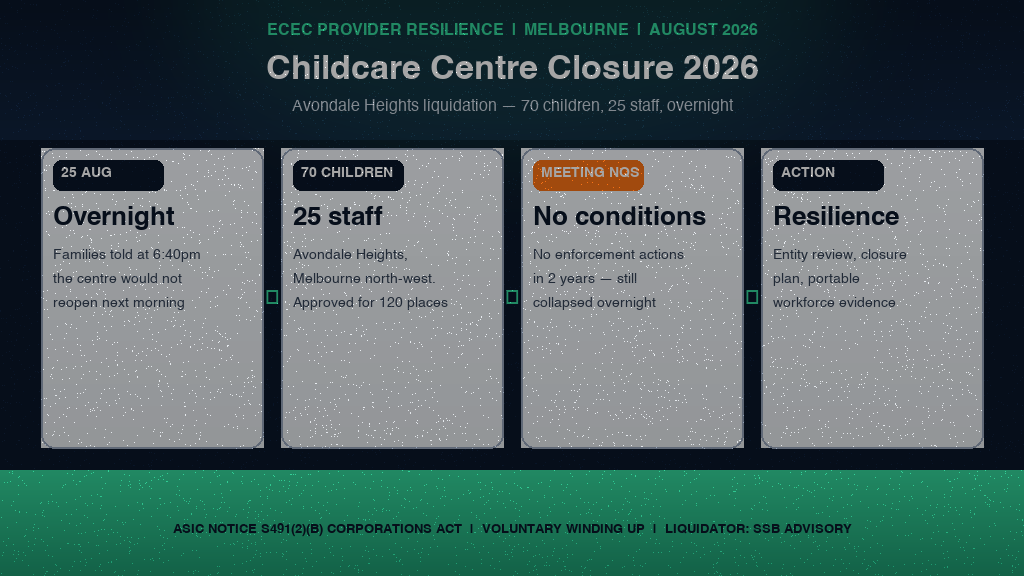
On the evening of Tuesday 25 August 2026, parents collecting their children from Avondale Heights Childcare and Early Learning Centre in Melbourne's north-west had no reason to think it was their last pick-up. At 6:40 pm, a text message and email from the liquidator told them the centre would not reopen the following morning. The operator, Belotte Pty Ltd, had entered liquidation; a proposed sale of the business had fallen through when the intended purchaser could not settle; and the directors, who had been personally funding the operation for an extended period, could no longer continue. Around 70 children and 25 employees were affected, and the centre — approved for up to 120 children and rated Meeting National Quality Standard — was locked with families' belongings still inside.
Background: how a "Meeting NQS" service can still collapse
The Avondale Heights closure is a useful stress test of how the sector thinks about provider risk. The service's StartingBlocks record showed an overall rating of Meeting National Quality Standard, most recently confirmed in February 2026 following a regulatory visit in January. It recorded no conditions on the service approval and no enforcement actions against the service during the previous two years. On the compliance evidence that families, regulators and the market can see, this was not a service in visible trouble.
What the public record did not show was the financial position of the operator. Belotte Pty Ltd (ACN 064 669 754) operated the centre as trustee for the Williams Family Trust. According to the liquidator, SSB Advisory, the directors had been personally funding the centre's operations for an extended period and could no longer continue to do so. A contract had been entered into for the sale of the childcare business, but the intended purchaser was unable to settle the transaction. Recent staff resignations meant the directors were not confident that appropriate staffing levels and continuity of care could be maintained. The decision to close was made on the basis of the centre's financial position and concerns about care.
The lesson is uncomfortable but important: regulatory quality and financial viability are different systems. A service can be excellent on the National Quality Standard and still be insolvent. The NQF assesses the quality of education and care, not the solvency of the approved provider. Nothing in the public compliance record — no conditions, no enforcement actions, a current Meeting NQS rating — is a signal about whether the business behind the service can pay its bills. Providers, families and the sector more broadly have been treating the two as if they move together. They do not.
This is also not an isolated event in the sector's recent history. The federal government's enforcement action register and the CCS cancellation pipeline have documented services losing approval or funding for safety and quality failures. The Avondale Heights case is different in kind: it is a financial failure of an operator that was, on the visible record, compliant. That is the scenario most providers have not planned for, because it is the one the compliance system was never designed to surface.
What happened and when: the closure timeline and the ASIC mechanics
The closure followed a specific legal path, and providers should understand it because it determines what families and staff are entitled to and what the operator's obligations are. The ASIC notice was published under paragraph 491(2)(b) of the Corporations Act 2001 and regulation 5.5.01 of the Corporations Regulations 2001. Those provisions relate to a voluntary winding up following a resolution by the company's members — not a creditor-initiated court application or a court winding-up order. In plain terms, the members of Belotte Pty Ltd resolved to wind the company up and appointed a liquidator, who took control of the company's affairs from the directors.
The timeline, reconstructed from the ASIC notice, the liquidator's correspondence and media reporting:
- Before August 2026. The centre, operating since February 2012 at 63-67 Canning Street, had been for sale. A contract for the sale of the childcare business was entered into, but the intended purchaser was unable to settle. The directors had been personally funding operations for an extended period.
- August 2026. A number of recent staff resignations left the directors unable to maintain appropriate staffing levels and continuity of care. The decision was made that the centre could not continue operating.
- Tuesday 25 August 2026, close of business. The service ceased operating. Families were notified by text message and email at approximately 6:40 pm that the centre would not reopen the following morning. The liquidator apologised for the distress and inconvenience of arranging alternative care at short notice.
- Wednesday 26 August 2026. The centre remained locked with children's belongings inside. Parents reported difficulty retrieving property and stopping scheduled direct debit payments. ABC News reported families scrambling to secure alternative care before the next working day.
- Ongoing. The liquidator is responsible for identifying and realising assets, reviewing the company's financial affairs, notifying creditors and distributing any available funds in accordance with the law. The total amount owed to creditors has not been publicly disclosed.
Two details in the reporting deserve emphasis. First, the liquidator's correspondence said the centre "had to be closed immediately due to its financial position and concerns about care" — the staffing resignations meant the directors were not confident that appropriate staffing levels and continuity of care could be maintained. Second, the service's StartingBlocks record showed no conditions and no enforcement actions in the previous two years, and its Meeting NQS rating had been confirmed as recently as February 2026. The public compliance record gave families no warning.
Operational impact: six things every provider should do now
The Avondale Heights closure is a warning for every approved provider, not just small independents. The mechanisms that produced it — a sale that falls over, directors funding the business personally, staff resignations that tip staffing below viable levels — exist in every part of the sector. Six actions follow:
- Separate your compliance evidence from your financial position — on paper. The single most important lesson is that a Meeting NQS rating, no conditions and a clean enforcement history say nothing about solvency. Write down, in your governance documentation, who monitors the financial viability of the approved provider entity (not just the service), how often, and what triggers escalation. If the answer is "the directors just know", that is the risk.
- Know your entity structure and your personal exposure. Belotte operated as trustee for the Williams Family Trust, and the directors were personally funding the operation. If your approved provider entity is a trust with a corporate trustee, or a company where directors are advancing funds, understand what happens to the service if that support stops. Review your entity structure, any guarantees, and the difference between the service's cash position and the operator's.
- Stress-test the "sale falls through" scenario. The immediate trigger for the closure was a purchaser unable to settle. If your service is for sale, or could be, model what happens if settlement fails: how long can the business run, what is the contingency for families, and what is the communication plan? A sale that falls over should not be the first time the closure plan is written.
- Build a family and staff communication plan for sudden closure. Families were told at 6:40 pm by text message. Staff were reportedly unaware when families collected children that afternoon. Every service should have a written plan for what happens if the service cannot open tomorrow: who is notified, in what order, through what channels, and how families retrieve belongings and stop payments. The plan should be reviewed annually and held somewhere more than one person can access.
- Know your obligations when a service closes. When a service ceases to operate, there are notification and record obligations to the regulatory authority, obligations to families about fees and enrolments, and obligations to staff under employment law. The liquidator handles the company's affairs, but the approved provider's regulatory obligations do not simply evaporate. Confirm with your state or territory regulatory authority what must be notified and when, before you need to know.
- Keep the workforce evidence layer current and portable. When a service is sold, wound up or transferred, the first thing a purchaser's due diligence, a regulator's review or a liquidator's records request asks for is the workforce compliance picture: who holds what certifications, what is current, what is expiring, what training records exist. If that data lives in spreadsheets and one person's head, it is not portable. If it lives in a system with exportable records, it is an asset rather than a liability in a transition.
A 30-day provider resilience workflow
The Avondale Heights case is a reminder that resilience planning is a compliance activity, not a finance-only one. This workflow assumes a provider starting from today and takes 30 days to complete. It is designed to be run by the approved provider with the nominated supervisor and, where one exists, the service's accountant or business adviser:
- Days 1-5 — Entity and exposure review. Map the approved provider entity, the service entity and any trusts, and identify who is personally exposed (directors, guarantors, family members funding operations). Document the current funding position: how the service is capitalised, whether directors are advancing funds, and what the cash runway is if revenue stopped. Record the review date and owner in your compliance register.
- Days 6-10 — Financial viability monitoring. Define the financial indicators the provider will monitor monthly — not just occupancy and fee collection, but debt levels, director advances, creditor terms and any reliance on personal funding. Assign an owner and a review cadence. If the service has an accountant or business adviser, agree who escalates and at what threshold.
- Days 11-15 — Closure and communication plan. Write the sudden-closure plan: notification order (families, staff, regulatory authority, landlord, insurers), channels, the belongings-and-payments process for families, and the staff communication protocol. Include the regulatory notification obligations for your state or territory. Review it with the leadership team and store it where more than one person can access it.
- Days 16-20 — Workforce evidence audit. Run a full audit of the workforce compliance data: every educator and staff member's certifications, training expiry dates, first aid, anaphylaxis and asthma management currency, and WWCC status across all relevant jurisdictions. Flag anything expiring in the next 90 days. Confirm the data is exportable and portable — this is the evidence layer a transition will need.
- Days 21-25 — Sale and transition scenario. If the service is for sale or could be, model the failed-settlement scenario: how long the business can run without the sale, what the contingency is, and what the communication plan looks like. If the service is not for sale, document the succession plan — who can operate the service if the current approved provider cannot.
- Days 26-30 — Sign-off and evidence pack. Have the approved provider formally adopt the resilience plan, with a record of adoption date and version. Assemble the evidence pack: the entity map, the financial monitoring framework, the closure and communication plan, the workforce evidence audit and the succession or sale scenario. This pack is what you show a regulator, a purchaser or a lender — and it is the difference between a managed transition and an overnight closure.
How NovoCove supports this
The Avondale Heights closure separates two things that are easy to conflate: the quality of care a service delivers and the financial viability of the operator behind it. NovoCove is the data and evidence layer for ECEC and aged care providers — it does not replace the approved provider's financial management, the accountant's advice or the liquidator's role. What it does is make the compliance evidence layer portable, current and demonstrable. NovoCove centralises staff certifications and training expiry — 40+ Australian ECEC credential types across all states, plus first aid, anaphylaxis and asthma management — with a 7-tier alert cadence, so the workforce picture a purchaser's due diligence or a regulator's review will ask for is a dated, exportable record rather than a spreadsheet in one person's drawer. Compliance tasks get owners and due dates, which is how a resilience review, a closure-plan update or a financial-monitoring check becomes a tracked action with a completion trail instead of a good intention. Incident registers, policy review history and service-level records sit in one dashboard with a RAG compliance score and a daily ComplianceSnapshot trend, so the evidence position of the service is visible on an ordinary day — not reconstructed under pressure. The same workflow is covered on the policy compliance software page.
NovoCove does not claim to predict insolvency, and no software can. It gives leaders the underlying evidence layer: when a service is sold, transferred or wound up, the workforce and compliance data the regulator sees today is the same data any future operator, purchaser or liquidator will ask for — and it exports in minutes. That is the difference between a service whose evidence is an asset in a transition and one whose evidence is a liability discovered at the worst possible moment.
Book a 20-minute demo and we will show you what your service's evidence position looks like through that lens.
Sources / further reading
- ASIC published notice: Belotte Pty Ltd in liquidation (ACN 064 669 754) — Australian Securities and Investments Commission, 25 August 2026 (T1)
- Snap closure of Avondale Heights childcare centre leaves families in the lurch — ABC News, 25-26 August 2026 (T1)
- Avondale Heights childcare centre closes abruptly — The Sector, 27 August 2026 (T2)
- Avondale Heights Childcare and Early Learning Centre — StartingBlocks record — Australian Government (T1)
- Wind up an insolvent company — ASIC guidance (T1)
- Enforcement action register — Australian Government Department of Education (T1)
This guide is general information and is not legal advice.