Childcare compliance
CCS Funding Cut Pipeline 2026: The 62 Services at Risk and the 5-Step Playbook to Survive the Notice
115 Australian ECEC services are on notice for safety breaches. 46-47 have fixed the problem. 7 have surrendered their approval. And 62 services remain at risk of losing their Child Care Subsidy funding. Here is the national pipeline, the 5-step remediation playbook, and what every approved provider should be running this fortnight.
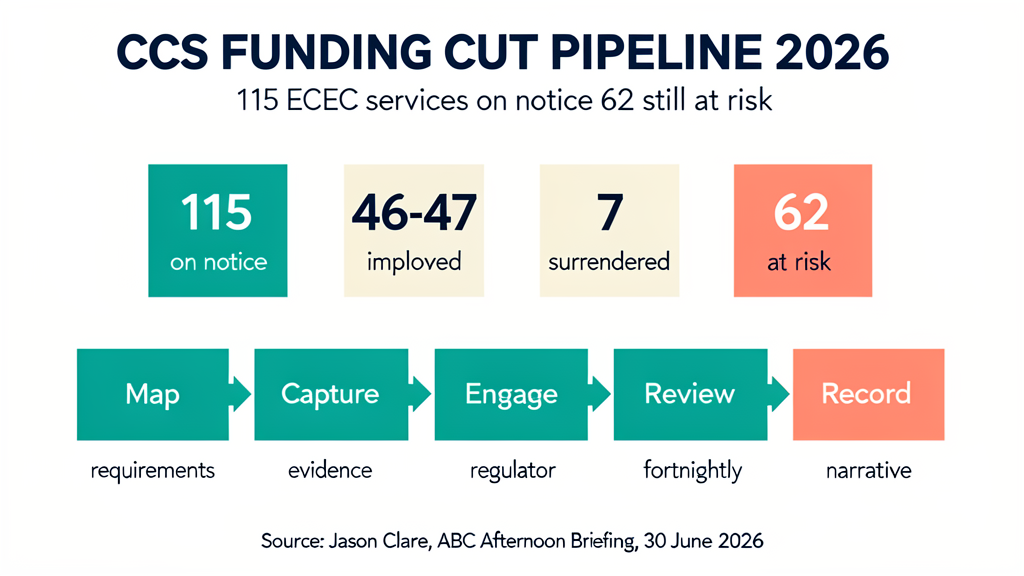
On 30 June 2026, Minister for Education Jason Clare used new federal powers to cut Child Care Subsidy funding from a Victorian family day care service for the first time. In the same interview, on ABC Afternoon Briefing, he confirmed a number that matters more to most approved providers than the named case: 115 ECEC services are currently on notice for safety breaches, 46 to 47 have improved sufficiently to retain funding, 7 have voluntarily surrendered their approval, and the remainder - roughly 62 services - remain at risk of losing their CCS funding in the months ahead.
Commonwealth funding accounts for around 70 per cent of a typical service's revenue. The pipeline is no longer hypothetical. It is the live operating environment for every approved provider in Australia. This guide walks through what the Minister actually said, how the pipeline numbers break down, and the 5-step remediation playbook that keeps your service off the list.
The 115-service pipeline: what Jason Clare confirmed on 30 June 2026
The data points below come directly from Jason Clare's interview with Patricia Karvelas on ABC Afternoon Briefing, transcribed and published on the Ministers' Media Centre site. They are the most current federal-government pipeline figures publicly available for the ECEC sector in 2026.
- 115 ECEC services have been placed on notice under Family Assistance Law since the federal safety reforms took effect, mostly for environmental safety hazards, child protection gaps, or persistent National Quality Framework non-compliance.
- 46 to 47 of those services - close to 41 per cent - have improved sufficiently under state-regulator reassessment to retain their CCS funding. Most did so only after the funding-cut notice was served, which is the strongest signal yet that the threat of cancellation is moving the sector.
- 7 services voluntarily surrendered their approval rather than face continued enforcement. For an approved provider, surrender is the cleanest exit: it avoids a recorded cancellation, preserves the option to reapply later, and protects the principals from a barring review.
- The remaining roughly 62 services are still on remediation timeframes of 6, 9 or 12 months. Some have already missed their deadline. The Minister was explicit: where providers miss agreed remediation dates, expect the funding to be cut.
Why most services improved only after the notice landed
Close to 41 per cent of on-notice services fixed the problem once funding loss became a real risk. That tells you something specific: most of the breaches were not capital or staffing issues. They were governance and documentation gaps that a noticed service can remediate in weeks. Inspections in the cancelled Laugh & Learn case turned up hazardous chemicals, a chest freezer without a child safety lock, obstructed emergency exits and other environmental risks - all categorised as everyday safety failures, not predator cases.
The Minister was deliberate about drawing that distinction. The reform programme is about everyday safety and NQF compliance, not only criminal offending. In other words, the on-notice pipeline is built around the same quality-area framework your service is already rated against. The remediation workflow is one you can start tomorrow morning.
The 5-step playbook to keep your service off the list
The pipeline data points to a single conclusion: the gap between the 41 per cent that fixed it and the 62 services still at risk is operational discipline. Here is the 5-step workflow that the 46 to 47 improved services will have run, in some form, between the notice and the state-regulator reassessment.
Step 1 - Map every notice requirement to a named owner and a deadline
When a notice lands, the response fails if it is run as a team inbox. Map each requirement to one named owner - usually the Nominated Supervisor for operational items, the Responsible Person for governance items, and the Approved Provider principal for funding items. Every mapped item gets a remediation deadline inside the 6, 9 or 12-month window, with a 30-day buffer to allow for evidence assembly.
- Owner column tied to a single individual, not a role
- Source clause (regulation, NQS element, or environmental hazard category)
- Evidence type required (photo, policy version, training record, third-party certification)
- Deadline date that sits 30 days before the regulator visit
- Re-assessment gate date that triggers a sign-off from the Approved Provider
Without those five columns, the notice will not be defensible. The state reassessment officer will be looking for evidence, not intent.
Step 2 - Capture remediation evidence as you go, not at the end
The 46-to-47 services that improved sufficiently to retain funding will have assembled evidence continuously - photos of remediation work, dated policy versions, screenshots of training completion, certificates of disposal for hazardous chemicals. Evidence captured at the point of work is timestamped, complete, and harder to dispute. Evidence assembled in the last two weeks before the reassessment visit looks like a scramble, and state regulators are calibrated to spot that.
Step 3 - Treat the state regulator as the customer, not the adversary
The 6, 9 and 12-month remediation timeframes are set by the state or territory ECEC regulator in consultation with the federal Department of Education. The reassessment visit is scheduled on the same track. Treat the regulator as a customer whose acceptance criteria you are working to. The regulator's acceptance criteria are precisely the items on the notice plus any related National Regulations or NQS elements they saw during the original inspection. Walk the notice, line by line, and confirm you have addressed each item plus every adjacent gap the assessor is likely to flag.
Step 4 - Run a fortnightly rehearsal against the deadline
Every two weeks, the Approved Provider or Responsible Person should run a 30-minute rehearsal against the notice. Open the file. Walk through each requirement. Read the evidence aloud. If the evidence is not there, the item is not yet remediated - regardless of what the team believes has been done. The services on the 46-to-47 improved list will have rehearsed at least four times between notice and reassessment. The 62 services still at risk are the ones that did not rehearse.
Step 5 - Keep a written narrative that defends every decision
If a re-inspection finds the service still not meeting the standard, the next step is cancellation. At that point a written narrative that explains what was done, when, why, and by whom becomes the primary evidence in any review or appeal. Approved providers that lose funding and then seek reversal on review lose 9 times out of 10 when the narrative is missing. Approved providers with a dated, signed narrative that walks the auditor through each requirement win more often than they should. Build the narrative as you go. Add a paragraph per item per fortnight. By the time you reach the reassessment visit, you have a defensible record whether or not the regulator agrees with the result.
The Commonwealth funding economics that make the pipeline unforgiving
The Minister was blunt: child care centres cannot operate without government funding, and Commonwealth funding is roughly 70 per cent of a typical service's revenue. That funding is now explicitly linked to NQF compliance through the 15 per cent pay rise extension - the $3.5 billion Worker Retention Payment flows only to services that hold their national safety standard. The funding mechanism has three stages: subsidy, conditional subsidy, and withdrawn subsidy. Each stage has fewer dollars attached and fewer days to remediate.
- Baseline CCS approval - all approved providers in good standing
- Conditional CCS approval - on-notice services with a remediation timeframe
- Withdrawn CCS approval - cancellation under Family Assistance Law, effective on service of the instrument
This is why the 7 voluntarily surrendered services represent the rational exit. Continuing on a path to cancellation damages the principal's reapplication prospects, and CCS withdrawal is now the dominant sector-wide enforcement lever. The 62 services still at risk face a hard choice: remediate on schedule, or exit cleanly.
How NovoCove handles this
The 5-step playbook maps directly to a workflow we have built into the NovoCove platform specifically for this pipeline. Each notice requirement becomes a tracked task with an assigned owner and a deadline buffer. Evidence capture is structured at the point of work - photos, document versions, training records and regulator correspondence are all attached to the requirement, not assembled in a panic a week before the visit. The fortnightly rehearsal is automated: a dashboard view that walks you through every open requirement and flags any missing evidence 30 days before the reassessment date. The written narrative is generated from the activity log. If a service reaches the regulator's desk with a complete record, the result is overwhelmingly likely to be retained funding.
We use this same workflow internally to keep NovoCove's own customers on the right side of the pipeline. If you are operating a portfolio of approved services and want to walk through your top three at-risk requirements live, book a 20-minute demo and we will show you the exact workflow we run.
This guide is general information and is not legal advice.