Aged care reporting & funding
Care Minutes Performance Statement Audit 2026: The 31 October Deadline for Residential Aged Care Providers
On 25 August 2026 the Aged Care Quality and Safety Commission confirmed in its September Quality Bulletin that the Department of Health, Disability and Ageing is changing how it monitors care minutes — and the change lands this reporting season. From the 2025-26 Aged Care Financial Report (ACFR), every residential aged care provider must prepare a Care Minutes Performance Statement (CMPS) and have it externally audited under ASAE 3000 by a registered company auditor, at the provider's own cost. The ACFR is due 31 October 2026. For the 2025-26 ACFR only, the CMPS covers January to June 2026 care minutes plus registered nurse (RN) coverage data from November 2025. The department has also signalled it may recalculate care minutes supplements already paid if the audited statement does not match what you reported in past Quarterly Financial Reports. Here is the background, what changed and when, the six operational actions, and the 30-day workflow that gets your first audited statement over the line.
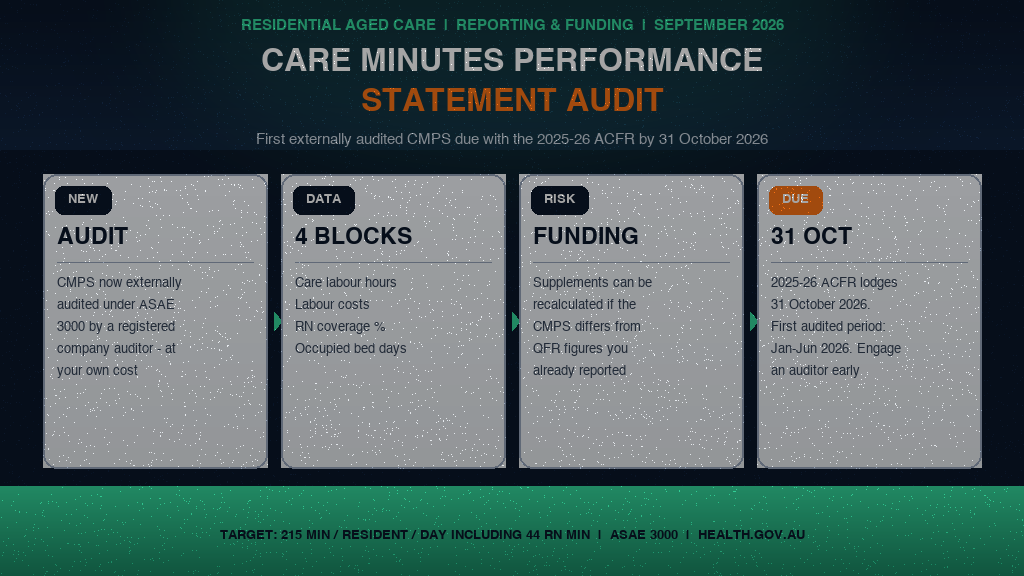
Your service's care minutes have always been self-reported — rosters, payroll and the figures you submitted through the Quarterly Financial Report were the only window the funding system had on the care actually delivered. That window is closing. From the 2025-26 Aged Care Financial Report (ACFR), every residential aged care provider must prepare a Care Minutes Performance Statement (CMPS) and have it externally audited under ASAE 3000 by a registered company auditor, at the provider's own cost — and the first audited statement is due in under eight weeks. The ACFR lodges on 31 October 2026, and the Department of Health, Disability and Ageing has already said it may recalculate care minutes supplements already paid if your audited statement does not match what you reported earlier.
Background: the care minutes regime that ran on trust
Care minutes became a legislated obligation in residential aged care under the Aged Care Act 1997 reforms, and the numbers have been part of the sector's operating language since: a sector-wide average of 215 minutes of care per resident per day, including 44 minutes of direct registered nurse care, alongside the 24/7 registered nurse on-site requirement. Under the Aged Care Act 2024 (commenced 1 November 2025) and the Aged Care Rules 2025, those obligations continue — reinforced by the strengthened Aged Care Quality Standards, by the staffing component of the Star Ratings system, and by funding mechanics: the care minutes supplement pays providers that meet their targets, while providers that miss them face reduced funding. In April to June 2025, 43 per cent of metropolitan (MMM1) non-specialised providers did not meet their required targets, facing funding reductions of up to $33.41 per resident per day; as of June 2025, around 40 per cent of all residential providers were below target on both total care and RN care minutes.
The regulatory teeth were always there — the Aged Care Quality and Safety Commission began regulatory action against persistently non-compliant providers as far back as January 2025 — but the evidence base underneath all of it was provider-declared. Care minutes were reported through the Quarterly Financial Report (QFR) and checked against the department's own modelling, not verified against source records. There was no independent assurance layer testing whether the hours in the report actually matched rosters, timesheets, payroll and agency invoices. That is the gap the CMPS audit closes.
What changed and when: the first audited statement, due 31 October 2026
The Commission's September Quality Bulletin (#8-2026, published the first week of September 2026) made the new arrangements explicit: the Department of Health, Disability and Ageing is updating the way it monitors care minutes, and as part of the Aged Care Financial Report, residential aged care providers must now submit a Care Minutes Performance Statement plus an external audit of that statement. The dates and mechanics that matter:
- 31 October 2026 — the first CMPS lodges with the 2025-26 ACFR. Registered providers reporting on a standard financial year cycle submit the ACFR — and the first Care Minutes Performance Statement forms part of it — by 31 October 2026. The Commission's guidance is blunt: engage an auditor early and keep records up to date.
- The first audited statement covers Q3 and Q4 of 2025-26 care minutes, plus RN coverage from November 2025. For the 2025-26 ACFR only, the department requires care minutes for the January to June 2026 half-year and registered nurse (RN) coverage data from November 2025. If your reporting cycle is not the standard financial year, confirm your due date and coverage period with the department directly.
- Four data blocks, one statement. The CMPS reports direct care labour worked hours, direct care labour costs, the monthly 24/7 RN coverage percentage, and quarterly occupied bed days. Every figure must trace to source records.
- Independent assurance is mandatory. The audit is performed under the ASAE 3000 assurance standard by a registered company auditor, or otherwise approved by the department under the Rules, at the provider's own cost. The department has published auditor-facing guidance to support the assurance engagement — this is a real audit, not a compliance checkbox.
- Supplements can be recalculated. The department may recalculate care minutes supplements paid to your home if the CMPS submission differs from information you reported in past Quarterly Financial Reports. A low QFR number that was never checked becomes an audited discrepancy with a funding adjustment attached.
The shift is from self-reporting to a verification model: every reported care minute must now be supported by evidence an independent auditor can test. Inaccuracies or shortfalls can affect your Star Ratings, produce funding penalties, or trigger compliance action under the Aged Care Quality Standards.
Operational impact: six things every residential provider should do now
Eight weeks is workable — but only if the work starts now, because the scarce resource is auditor capacity and the slow part is reconciling systems that were never built to talk to each other. Six actions follow for every residential aged care provider:
- Confirm your reporting cycle and scope. Verify with the Department of Health, Disability and Ageing that you report on the standard financial year cycle (ACFR and CMPS due 31 October 2026) and that, for 2025-26, your audited statement covers January to June 2026 care minutes plus RN coverage data from November 2025. Non-standard cycles, new registrations and services that changed hands need explicit confirmation, not assumptions.
- Engage your auditor now. The audit must be signed by a registered company auditor (or otherwise approved by the department under the Rules) with ASAE 3000 assurance capability — and, practically, with enough aged care understanding to test care minutes sensibly. Auditor calendars fill in September; a provider that starts looking in mid-October will be paying rush rates or waiting for capacity that no longer exists.
- Fix the direct-care classification across every system. Rostering, time and attendance, payroll and agency invoicing must all distinguish direct care from non-direct care on the same definitions, with job titles and role codes consistent end to end. Hybrid and managerial roles are the classic fault line: the same person doing a direct care shift and an admin shift must be coded correctly in both systems, or the hours will not reconcile.
- Make the RN register auditable. RN minutes only count when the minutes were delivered by a registered nurse whose AHPRA registration was current at the time. Pull your credential register against every rostered RN shift for the January-June 2026 half-year now — a lapse that was invisible in the QFR era is exactly the kind of finding an auditor tests.
- Reconcile to your QFR history before the auditor does. Build the four CMPS blocks from source records and compare them with the care minutes figures you reported through the QFR for the same period. Every material difference is a potential supplement recalculation — finding them yourself, with a defensible explanation, is far better than handing the auditor the discrepancy.
- Stand up the evidence file and the sign-off chain. The statement needs a named owner and a cross-team review involving clinical, finance, rostering and payroll — plus a documented approval trail. The auditor will ask for policies, position descriptions, roster and leave records, agency invoices and the 24/7 RN reporting trail. That file should be assemble-able in an afternoon, not a fortnight.
A 30-day workflow to audit-ready by early October
Working backwards from 31 October, this workflow has you audit-ready by early October with three weeks of buffer for auditor queries, amendments and final sign-off:
- Days 1-5 — Scope and classify. Confirm the reporting cycle and coverage period with the department. Map every role that performs direct care, and audit how rosters, time and attendance, payroll and agency systems code those hours today. Produce the role-to-code map and flag every hybrid role that needs reclassification.
- Days 6-12 — Build the four blocks from source. Extract direct care labour hours, labour costs, monthly 24/7 RN coverage percentage and quarterly occupied bed days for the 2025-26 CMPS period (January to June 2026 care minutes, plus RN coverage from November 2025) from source records — not from last year's QFR template. Reconcile agency invoices and leave adjustments; resolve anomalies while the people who know them are still around.
- Days 13-19 — Verify the workforce register. Match every RN on every rostered shift against current AHPRA registration for the covered period (including November 2025 RN coverage data for the 2025-26 CMPS), and every care worker against your credential and training records. Fix classification errors in the systems themselves so the evidence trail is clean, not patched in a spreadsheet.
- Days 20-26 — Compare with QFR history and brief the auditor. Reconcile the CMPS blocks against the care minutes figures previously reported through the QFR. Document material differences with explanations before the auditor asks. Confirm the auditor's engagement, evidence list and timeline in writing.
- Days 27-31 — Dry run and evidence pack. Run the audit internally as a rehearsal: an independent person in your team (or your accountant) tests a sample of shifts from roster to timesheet to payroll to the statement. Assemble the auditor's evidence file — policies, position descriptions, rosters, leave and agency records, 24/7 RN reports — and confirm the sign-off chain and the named statement owner.
- Days 32-38 — Audit fieldwork and lodgement plan. Support the auditor's fieldwork, resolve findings as they land, and lock the lodgement plan for the ACFR and CMPS through the Forms Administration online portal well before 31 October — including who submits, who checks the submission receipt, and what happens if a query arrives in the final week.
How NovoCove supports this
A first-time audited care minutes statement is, underneath the finance work, an evidence and task-management exercise: one workforce register that proves who was eligible to deliver care, one trail of classified and reconciled data, and a hard lodgement date. NovoCove is the data and evidence layer behind that exercise. Compliance tasks with owners and due dates turn the six actions and the workflow above into a tracked program — each classification review, each reconciliation, each auditor milestone gets an owner, a due date and a status, so the question "where are we against the 31 October lodgement?" answers itself from the task board rather than from memory. Task progress and the daily ComplianceSnapshot trend show records on file improving as work completes, and the audit log keeps the record of who did what, when.
NovoCove's core surface is the one the auditor's eligibility testing leans on: staff certifications and training expiry for aged care — AHPRA registration for registered and enrolled nurses, NDIS Worker Screening and more — centralised with a 7-tier alert cadence, so an RN whose registration is due to lapse is flagged weeks ahead, not discovered by the auditor. The workforce data the CMPS depends on — who was a current, eligible nurse on each shift — is the same data NovoCove keeps current and exportable. It does not replace your payroll or rostering systems, and it is not your auditor: the ASAE 3000 assurance engagement must be performed by a registered company auditor (or otherwise approved by the department under the Rules), and minute-by-minute classification is your finance and clinical teams' call. You remain responsible for classification, source records and lodgement outcomes. But when the auditor asks for the register behind the RN minutes, the answer is one current, exportable file, not a folder of PDFs. The coverage is detailed on the aged care compliance software page.
Book a 20-minute demo and we will show you what a CMPS readiness program looks like as a tracked task list with a due date on 31 October — before the first audited statement lands.
Sources / further reading
- Care Minutes Performance Statement — Department of Health, Disability and Ageing (T1)
- Care minutes in residential aged care — Department of Health, Disability and Ageing (T1)
- Aged Care Financial Report — Department of Health, Disability and Ageing (T1)
- Aged Care Quality Bulletin #8-2026 (September 2026) — Aged Care Quality and Safety Commission (T1)
- Provider financial reporting requirements — Aged Care Quality and Safety Commission (T1)
- Aged Care Rules 2025 — Federal Register of Legislation (T1)
- Care minutes audits are coming: are you ready? — Ageing Australia, Aged Care Today (T2)
This guide is general information and is not legal advice.