Aged care compliance
Aged Care Star Ratings: What the May 2026 Update Means for Your Facility Rating
Two rule changes landed eight months ago. The May 2026 quarterly update is the first time consumers saw them on the Find a provider tool. Here is what shifted, what the data shows, and the workflow that keeps your overall rating safe.
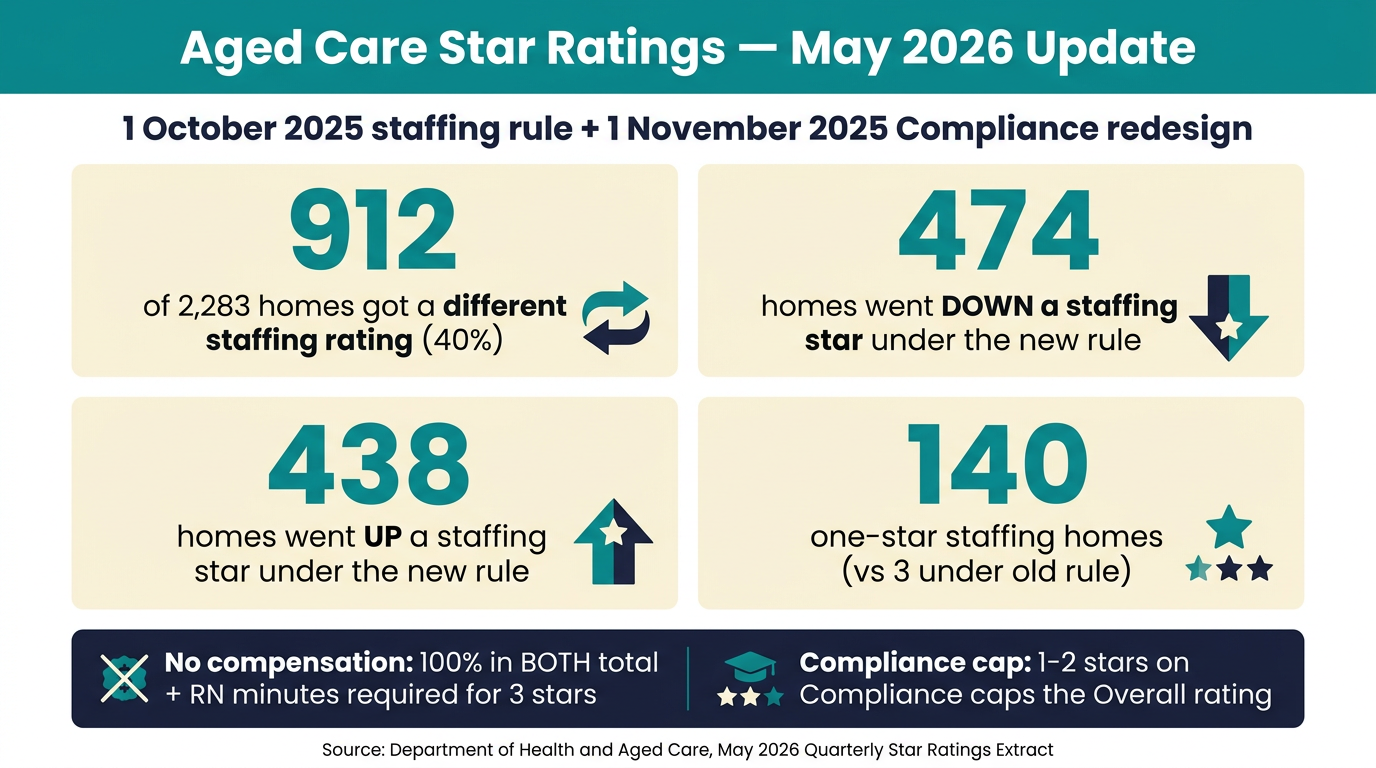
On 26 May 2026, the Department of Health and Aged Care released the quarterly Star Ratings data extract. For most providers it looked like any other quarterly update. It was not. It was the first time the public-facing Star Ratings on the My Aged Care Find a provider tool reflected two rule changes that had landed eight months earlier, on 1 October 2025 and 1 November 2025, and which had been sitting on the rule book waiting for the next quarterly cycle to expose them to consumers.
The data extract itself is blunt about the impact. Among 2,283 homes with a staffing sub-rating, 912 ended up with a different staffing star rating than they would have received under the old rule. Of those, 438 went up and 474 went down. The mean staffing rating barely moved, but the distribution did. Homes that had been quietly compensating for a weak area with a strong one stopped being able to hide. And 140 homes ended up on a one-star staffing rating under the new rule, against just three under the old rule.
Two rule changes, one quarterly update
Star Ratings has four sub-ratings — Residents' Experience, Compliance, Staffing, and Quality Measures — rolled into one Overall Star Rating displayed on My Aged Care. Two of those four sub-ratings changed between July and November 2025:
- 1 October 2025 — Staffing rating rule change. The Department of Health and Aged Care retired the compensation matrix that let providers offset a low score in one care minute area with a high score in the other. Under the new rule, homes must meet 100 per cent of the target in both total care minutes and registered nurse care minutes to land on three or more stars.
- 1 November 2025 — Compliance rating redesign. The Compliance sub-rating was rebuilt to reflect graded assessments against the strengthened Aged Care Quality Standards and any regulatory decisions handed down by the Aged Care Quality and Safety Commission (ACQSC). Compliance ratings now refresh daily after a regulatory decision and fortnightly after a graded assessment. The full transition will take up to three years as every home is audited under the strengthened Standards.
The rule change was published on 13 March 2025 in version 2.8 of the Star Ratings Provider Manual. The data started flowing in the Quarter 2 FY25-26 Quarterly Financial Report. But consumers only saw the impact on 26 May 2026, the first quarterly extract after both rules took effect.
How the staffing matrix actually changed
The old matrix rewarded providers who could push one care minute area well above target. If you were hitting 125 per cent of the registered nurse target but only 90 per cent of the total care minute target, the old rule gave you four stars. Under the new rule that same home drops to two stars, because you must hit 100 per cent in both to clear three.
The thresholds for the top and bottom of the rating also moved:
- Five stars (old): at least 125 per cent of RN target and at least 105 per cent of total care minute target. Five stars (new): 105 per cent in one and 110 per cent in the other. The bar is meaningfully lower if you are already clearing the targets.
- One star (old): below 75 per cent of the RN target and below the total care minute target. One star (new): below both targets, full stop. The floor tightened: the old "one below the target" loophole closed.
- RN minutes definition unchanged: up to 10 per cent of the registered nurse care minute target can be delivered by enrolled nurses. The 10 per cent EN allowance is the same as it was under the old matrix.
The single biggest shift is the elimination of compensation. The Australian Ageing Agenda analysis of the May 2026 data extract put it plainly: "Nearly 40 per cent of homes received a different staffing rating under the new methodology, despite the underlying care minute data remaining exactly the same. It highlights how changes in measurement can be just as influential as changes in performance."
What the May 2026 data extract tells us
Filip Reierson's analysis for Australian Ageing Agenda applied the old rule and the new rule to the same May 2026 Quarterly Financial Report data, isolating the effect of the rule change alone. The headline numbers:
- 912 of 2,283 homes (40 per cent) ended up on a different staffing star rating.
- 438 homes went up, 474 homes went down. The negative tail outweighed the positive tail by 36 homes.
- 233 homes received a different overall star rating.
- 138 homes went down overall; 95 went up overall.
- 140 homes landed on a one-star staffing rating under the new rule. The old rule would have produced three one-star homes.
- The mean staffing rating moved by less than 0.01 of a star. The median stayed at three stars. The change was in the distribution: homes are more spread out across all five staffing star ratings.
Translation: the average home's rating did not change. The 40 per cent of homes that were compensating under the old rule are now visible to families comparing providers on My Aged Care. And the floor — the one-star tail — moved from a handful of homes to 140.
The Compliance rating cap is the bigger risk
The Compliance sub-rating redesign is, in our view, the bigger operational risk for 2026 because of one specific mechanic. From 1 November 2025, any home with a Compliance rating of one or two stars has its Overall Star Rating capped at that level. Compliance ratings update daily after an ACQSC regulatory decision and fortnightly after a graded assessment. The cap is automatic. There is no internal review pathway that lifts it before the next quarterly cycle.
The three-year transition matters here too. ACQSC has signalled that full compliance with the strengthened Aged Care Quality Standards will take up to three years as every home is audited. In the meantime, a graded assessment that lands a home on two Compliance stars will drag the Overall rating down on the next refresh — within a fortnight of the decision being published, not at the next quarterly cycle.
The five-step workflow to protect your rating
The two rule changes pull the operational cadence in opposite directions. The staffing matrix rewards steady, predictable delivery against both care minute targets every day. The Compliance rating redesign punishes any single graded assessment or regulatory decision. The five-step workflow below is the operational playbook we walk every NovoCove residential customer through after a quarterly Star Ratings extract.
- Step 1 — Run a fortnightly Staffing matrix dry-run. Using your QFR data, project both care minute and RN care minute delivery for the next quarter against the new matrix. Flag any week where either metric is forecast to drop below 100 per cent. The new matrix punishes dips the old matrix absorbed. Quarterly reviews miss weekly dips entirely.
- Step 2 — Hold the 24/7 RN rule as a hard constraint. From 1 July 2023 every government-funded residential aged care home must have a registered nurse on site, on every shift, 24 hours a day. Build the staffing roster around the 24/7 RN rule first, then layer the care minute and RN care minute targets on top. A roster that meets care minutes but misses the 24/7 RN rule creates a different compliance failure.
- Step 3 — Reconcile the QFR before submission, not after. The May 2026 extract ran on Quarter 2 FY25-26 QFR data. The QFR is the input to the Staffing matrix, so a misclassified shift or an unreconciled roster gap flows straight into your rating. Run a weekly reconciliation between your roster system, payroll, and QFR line items. Find the gaps before the extract finds them for you.
- Step 4 — Treat ACQSC correspondence as a rating event. From 1 November 2025 every Notice of Decision, Direction to Revise, or Non-Compliance Notice updates the Compliance sub-rating within a fortnight. The responsible person and the clinical lead should review ACQSC correspondence within 24 hours of receipt and feed it into a compliance log that maps the action to the relevant Quality Standard requirement. The fortnightly Compliance rating update will reflect the action regardless of whether your internal log has caught up.
- Step 5 — Run a monthly Star Ratings simulation. Combine your roster forecast (Step 1) and your ACQSC log (Step 4) into a single Star Ratings simulation before each quarterly extract. The next extract will refresh on or around 26 August 2026 (Q1 FY26-27) — every home should know their projected sub-ratings and Overall rating at least 14 days before publication. The simulation is what gives you time to adjust roster, escalate an open ACQSC action, or communicate with families before the number changes on My Aged Care.
What NovoCove tracks so you do not have to run the matrix by hand
The Staffing matrix in version 2.8 of the Star Ratings Provider Manual has 25 cells, each combining a total care minute band with an RN care minute band. Running a fortnightly dry-run against 25 cells, then folding in the Compliance rating cap, then simulating the next quarterly extract is a meaningful amount of arithmetic for a single residential home. For a group with 10 or 20 homes it is unmanageable in spreadsheets.
NovoCove ingests your roster, payroll and QFR data, projects both care minute and RN care minute delivery against the new matrix on a daily basis, and surfaces the cells where either metric is forecast to drop below 100 per cent before they land in the quarterly extract. The same compliance log that captures ACQSC correspondence and graded assessments feeds a live Compliance sub-rating projection, so you see the Overall Star Rating impact of a single Notice of Decision within a day, not within a fortnight.
When the next extract lands on 26 August 2026, you will already know what your rating will be. The families using My Aged Care to compare homes in your catchment will see the same number you saw in your simulation. That is the standard we hold ourselves to, and it is the workflow we have built into every residential aged care plan.
This guide is general information and is not legal advice.