Aged care clinical compliance
ACQSC Clinical Alert on Medication Administration Errors 2026: What the Commission Expects, the Six Rights and the eNRMC Transition
On 9 September 2026 the Aged Care Quality and Safety Commission (ACQSC) published a clinical alert on preventable medication administration errors. It responds to recently released Victorian Coroner's Court findings into the deaths of 3 aged care residents who, at different services between August 2024 and September 2025, were given medicine intended for another person. The coroner concluded the errors could have been prevented. This guide summarises the five contributing factors the alert names, what the Commission expects providers to do, how the alert relates to the eNRMC transition deadline of 31 March 2027, and a paced 30-day review plan.
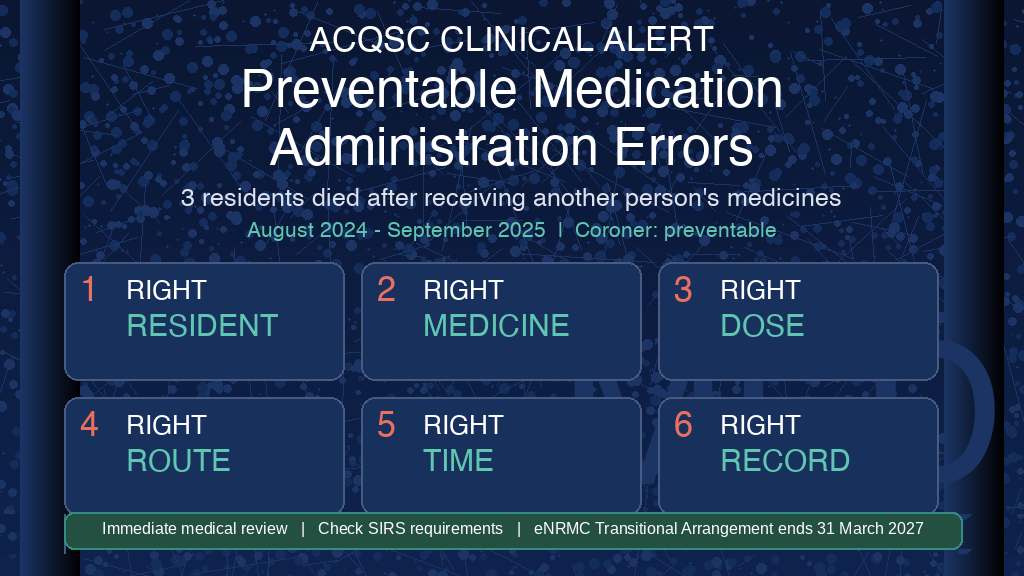
On 9 September 2026 the Aged Care Quality and Safety Commission (ACQSC) published a clinical alert titled The tragic consequences of preventable medication administration errors. The Commission published it in response to recently released findings from the Victorian Coroner's Court about the deaths of 3 aged care residents. The deaths happened at different services between August 2024 and September 2025, after the residents were given medicine intended for another person. The coroner concluded that the medication errors could have been prevented.
The alert does not change the Aged Care Act 2024 or the strengthened Aged Care Quality Standards. It restates existing obligations and sets out what the Commission expects providers to do: respond immediately to concerns about medicine administration, report incidents, understand the risks for frail older people, train and support workers, have processes and systems in place to prevent harm, and use the electronic National Residential Medication Chart (eNRMC) securely.
This article is general information only. It is not legal or clinical advice. Medication decisions for individual residents belong with prescribers, pharmacists and your clinical governance arrangements, and the Commission's alert is the authoritative source.
Background
The national Guiding Principles for Medication Management in Residential Aged Care Facilities set out system-level guidance for managing medicines in residential care. Under the Aged Care Act 2024, the strengthened Aged Care Quality Standards require providers to make sure medicines are managed safely, effectively and in partnership with the older person.
The alert sits alongside a separate change to medication charting. On 22 September 2026 the Department of Health, Disability and Ageing extended the deadline for residential aged care homes to adopt electronic prescribing conformant eNRMC systems by three months, from 31 December 2026 to 31 March 2027. The department said the extension reflects feedback from the sector and software vendors about the complexity of migrating every resident's medication chart. Homes using a Transitional eNRMC system can keep operating under the Transitional Arrangement until 31 March 2027. The department's fact sheet sets out what happens to new medication orders from 1 April 2027.
The coroner's findings and the five contributing factors
The Commission also highlighted the alert in its Aged Care Quality Bulletin #9-2026, published in early October 2026. According to the alert, the 3 incidents had similar contributing factors. Staff:
- did not follow the 6 rights of safe medication administration checks. WA Health's six rights resource lists right patient, right medication, right dose, right time, right route and right documentation.
- were unfamiliar with the service.
- were distracted during medicine administration.
- did not recognise psychotropic medicines as high-risk. The alert describes psychotropic medicines as medicines that affect the mind, emotions and behaviour, and notes that giving high-risk medicines to an older person who has not previously taken them can very quickly become catastrophic.
- did not escalate the incident urgently once the error had been detected. The alert also notes that in one incident, delays in communication from the provider with the family added to their distress.
The alert points to the provider's duties under the Aged Care Act 2024: to provide care that does not harm the older person's health and safety, to understand potential harms, and to have processes in place to prevent harm. It also cites Standard 5: Clinical care, Outcome 5.3 (Safe and quality use of medicines), which requires providers to confirm a medicine has been prescribed for the older person before giving it, and to give, monitor and review medicines safely and appropriately. Two actions are quoted in the alert: 5.3.4, on identifying, monitoring and mitigating risks from high-risk medicines, including reducing the inappropriate use of psychotropic medicines, and 5.3.6, on regularly reviewing and improving the effectiveness of the medicines system.
What the Commission expects providers to do
The points below summarise the alert. Read the full alert for the Commission's exact wording.
- Respond immediately. When you think a worker could have made an error in administering medication, the alert says to make sure the older person is safe, confirm who is or could be affected, confirm which medicines were given and when and in what doses, check whether they are high-risk medicines, check for allergy or intolerance risk, and activate your incident management system. When medicines have been given to the wrong person or taken by mistake, the alert says providers must seek immediate medical review in all circumstances. The Poisons Information Centre (131 126) is available 24 hours a day, 7 days a week from anywhere in Australia to help guide the initial response while awaiting medical review.
- Report incidents. The alert says to report an incident to the Commission when it caused, or could have caused, harm to an older person and it meets the reporting requirements for reportable incidents, through the Serious Incident Response Scheme (SIRS) portal. Not every medication error will be a reportable incident, so check each one against the SIRS requirements. The alert also says providers should consider notifying Ahpra, and the coroner if the error has resulted in an unexpected or preventable death, and should practise open disclosure, record the incident and respond in line with incident management obligations.
- Train and support all workers, including agency staff. The alert says to provide appropriate training, support, systems and processes to all workers (including agency staff) who administer medicines, and to make sure they follow the 6 rights and know when and how to escalate concerns. Providers also need to make sure workers have the right skills, qualifications and experience, with the training and supervision they need.
- Manage high-risk medicines. The alert suggests working with your medication advisory committee, pharmacists and prescribers to identify high-risk medicines (including psychotropic medicines), supervise them carefully, keep a psychotropic register and regularly review psychotropic medicines. It also asks providers to review systems for Schedule 8 medicines such as opioids and benzodiazepines, including making sure only staff qualified to administer Schedule 8 medicines in your jurisdiction can do so, and notes that the Guiding Principles recommend packing Schedule 8 medicines separately in dose administration aids.
- Support safe medicine rounds. Before giving medicines, the alert suggests supporting workers to identify each medicine and confirm the resident's identity (for example, with a recent photograph), thinking about assigning workers who are familiar with the residents and service, and giving older people the chance to confirm their medicines. During rounds, it suggests treating medicine administration as a protected task, clearly identifying who can give medicines, having enough workers to give medicines one resident at a time, avoiding busy, crowded areas, and giving medicines in private in the older person's room.
- Use the eNRMC securely. The alert says only workers qualified to administer medicines should have authorised access to the medication administration function, workers should close that function at the end of each round, and providers should work with their eNRMC provider on ways the system can help prevent errors, such as alerts for high-risk medicines like Schedule 8 medicines. Separately, homes using a Transitional eNRMC system have until 31 March 2027 to move to a conformant electronic prescribing system.
A paced 30-day review plan
There is no deadline attached to the alert itself. The plan below is one way a service could work through it over a month. Adapt it to your own clinical governance arrangements and involve your pharmacist, prescribers and clinical leaders.
- Days 1 to 3: leadership read-through. Read the clinical alert, Quality Bulletin #9-2026 and the Guiding Principles with your clinical leaders. Agree a short summary of the five contributing factors and the Commission's expectations to share with staff who administer medicines.
- Days 4 to 7: observe medicine rounds. Observe a sample of rounds across shift patterns and note how the six rights checks, resident identification and documentation are carried out in practice.
- Days 8 to 12: review workforce records. For everyone who administers medicines, including agency and casual staff, check that registration, qualifications and any jurisdiction-specific authorisations are current, and record the expiry dates.
- Days 13 to 17: review high-risk medicine processes. With your pharmacist and prescribers, review the psychotropic register, Schedule 8 handling and any eNRMC alerts for high-risk medicines.
- Days 18 to 22: walk through the escalation process. Talk the team through the alert's immediate response steps, including medical review, the Poisons Information Centre number, open disclosure with the family and checking the SIRS requirements, and update your procedures where needed.
- Days 23 to 26: review past medication incidents. Look at recent medication-related incident records and check the response, medical review, any SIRS notification, open disclosure and follow-up review were recorded.
- Days 27 to 30: check your eNRMC position. If you use a Transitional eNRMC system, confirm your plan with your vendor to move to a conformant system before 31 March 2027, and review who has access to the medication administration function.
How NovoCove can help
NovoCove is not a medication management, clinical or incident reporting system. It helps with one part of the workforce picture: keeping track of credential expiry dates. You record the expiry dates for each worker's registration, qualifications and other credentials, including agency and casual staff, and NovoCove sends reminders at 90, 60, 30 and 7 days before each date so renewals can be followed up in good time.
NovoCove does not check the Ahpra register or any other register, and it does not replace your medication chart, your pharmacist or your clinical governance committee.
Official sources
- The tragic consequences of preventable medication administration errors, Aged Care Quality and Safety Commission, clinical alert (9 September 2026)
- Aged Care Quality Bulletin #9-2026, Aged Care Quality and Safety Commission (October 2026)
- Electronic National Residential Medication Charts (eNRMC): implementation timeframes extended to 31 March 2027, Department of Health, Disability and Ageing (22 September 2026)
- eNRMC Transitional Arrangement extended to 31 March 2027 (fact sheet), Department of Health, Disability and Ageing (22 September 2026)
- Six rights of medication administration, WA Health
- Standard 5: Clinical care, Aged Care Quality and Safety Commission
- SIRS reportable incidents, Aged Care Quality and Safety Commission
- Guiding Principles for Medication Management in Residential Aged Care Facilities, Department of Health, Disability and Ageing
- Poisons Information Centre (131 126), Department of Health, Disability and Ageing
- Best Practice Guidance for Medicines Use by Nurses in Aged Care, Australian Nursing and Midwifery Federation (2025)
This guide is general information and is not legal advice.