Aged care clinical compliance
ACQSC Clinical Alert Dehydration in Residential Aged Care 2026: The 1,500 ml/Day Rule, the Coroner's Finding Every Provider Should Read, and the 30-Day Care-Plan Workflow
On 31 July 2026 the Aged Care Quality and Safety Commission (ACQSC) published a formal Clinical Alert on preventing and responding to dehydration in older people receiving aged care services, issued by Chief Clinical Advisor Dr Mandy Callary in response to a South Australian coronial inquest finding (Adelina D'Angelo) of a preventable death in residential aged care from acute renal failure caused by severe dehydration. The Alert names a 1,500 ml/day fluid-intake target, lists five common risk factors, and requires every registered provider to document a fluid-monitoring strategy in every care plan. Here is what changed, what every residential and home care provider must audit this month, and the 30-day workflow to evidence the new standard.
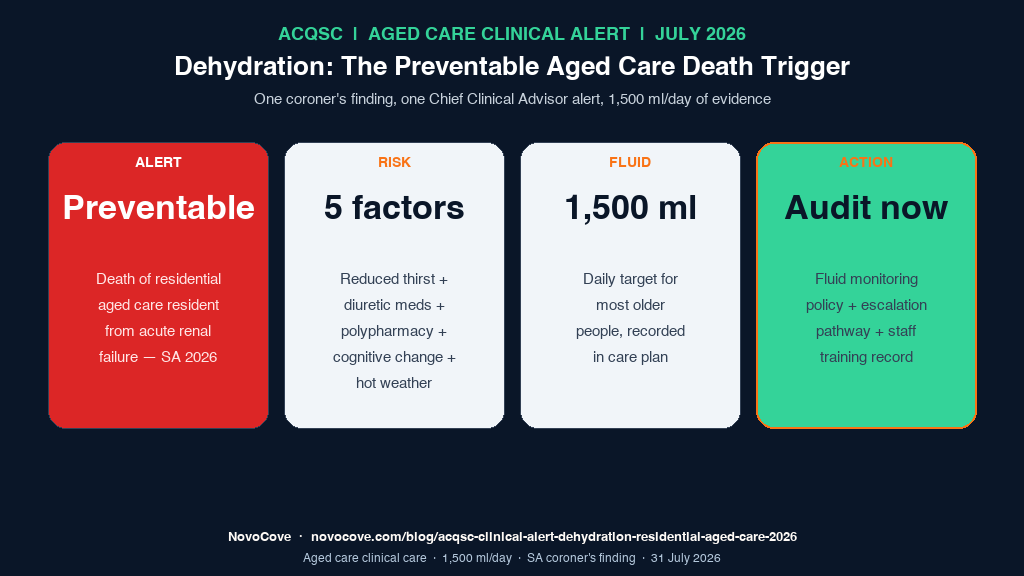
On 31 July 2026 the Aged Care Quality and Safety Commission (ACQSC) published a formal Clinical Alert on preventing and responding to dehydration in older people receiving aged care services. The Alert was issued by ACQSC's Chief Clinical Advisor Dr Mandy Callary and is the regulator's response to a recent South Australian coronial inquest into the death of a residential aged care resident from acute renal failure caused by severe dehydration. The coroner found the death was preventable, and named the absence of a systemic mechanism to monitor fluid intake and to recognise the seriousness of dehydration in aged care residents as the cause.
The Alert is short and operational. It does not amend the Aged Care Quality Standards, the Aged Care Act 2024 or the Statement of Rights. What it does is force every registered provider to document a fluid-monitoring strategy in every care plan, identify higher-risk residents on admission and at every clinical-status change, escalate to the GP early when dehydration is suspected, and review the system-level causes when an incident has occurred. Read together with the SA coroner's findings, the Alert is the regulator giving the sector its clearest signal yet that the absence of a documented fluid strategy is now a recognised gap.
The South Australian coronial finding — what the inquest actually decided
The Alert is anchored to a specific coronial case. The published finding (courts.sa.gov.au, "D'Angelo, Adelina") records that an older woman living in a South Australian residential aged care service was admitted with dementia and died of multiple organ failure caused by acute renal failure arising from severe dehydration. The coroner found:
- The death was preventable.
- The service had no systemic mechanism to monitor fluid intake.
- Staff did not recognise or escalate the seriousness of dehydration in a resident with cognitive impairment.
- The clinical signs of dehydration (confusion, low urine output, fatigue, dizziness, falls) are unreliable in older people and appear too late to trigger a clinical response that is early enough to prevent acute renal failure.
The coroner's published recommendations, reflected in the ACQSC Clinical Alert, are that every residential aged care service should:
- Identify every older person at higher risk of dehydration on admission and document the risk in the care plan.
- Reassess dehydration risk whenever there is a change in clinical status, food or fluid intake, behaviour, cognition, function or environmental exposure.
- Set an individualised fluid-intake target — the Alert names 1,500 ml/day as the default in the absence of a specific medical instruction or documented preference.
- Document the fluid-monitoring strategy in the care plan, including the strategy, the recording approach, the escalation pathway and the review date.
- Train direct-care workers to know the fluid needs of each older person in their care, the standard volume held in glassware, mugs and bowls, and the high-fluid-content foods that count toward the daily target.
- Escalate to the GP promptly with a discussion of the benefit of blood testing for accurate hydration assessment when dehydration is suspected.
The Alert closes with the regulator's expectation that providers will "evaluate the systems and processes within their services" when harm or repeated concerns are identified. Open disclosure is named in the Alert as an explicit obligation whenever something has caused, or could have caused, harm.
The five risk factors the regulator named
The Alert lists the five most common contributors to dehydration in older people living in residential care homes. Each is independently common, and the regulator's framing is that they rarely appear in isolation — they stack on top of each other in the same resident. Every care plan should now name, for each resident, which of these factors apply, and what the service is doing to mitigate them.
- Ageing-related physiological changes. Reduced thirst, reduced body fluid reserves, and reduced ability of the kidneys to conserve fluids. These are universal in older people — every care plan needs a fluid strategy simply because of the age profile of the resident.
- Diuretic medication and certain medical conditions. Diuretic medicines flush extra salt and water out of the body as urine, accelerating fluid loss. Any resident on a diuretic regimen should have a higher-target fluid intake than 1,500 ml/day and should be flagged in the care plan as higher risk.
- Barriers to adequate fluid intake. Functional or cognitive capacity, acute illness, increased fluid losses, polypharmacy (multiple medications regularly), and access to fluids all sit in this category. The Alert is explicit: fluids must be within easy reach across the day, and assistive equipment (specialised cups, straws) must be provided where an occupational therapist has recommended it.
- Environmental factors. Hot weather and indoor heat exposure. Australia is heading into spring and summer from October — the Alert lands at the point where this risk becomes operationally binding. The Alert links to the regulator's own Summer Clinical Alert 2025–26 on preventing heat stress in older people.
- Cognitive changes that mask thirst. A resident with dementia may not recognise thirst, may not be able to ask for fluids, and may resist prompting. The Alert names this risk explicitly and the operational answer is a documented fluid-monitoring strategy with named caregiver responsibility and review date.
Why this Alert is different from the sector's existing clinical guidance
Dehydration as a clinical risk has been in aged care guidance for decades — the Alert references the Victorian Department of Health's Dehydration standardised care process as a more detailed clinical reference. What makes this Alert different is the regulatory framing. It is the ACQSC formally requiring the sector to evidence a fluid-monitoring strategy for every older person in their care, with named review dates, named escalation pathways and a documented review after every change in condition. The Alert is, in effect, the regulator's answer to the question: "Where in the care plan do you evidence that you are systematically managing each resident's hydration risk?"
The Alert also aligns the regulator's vocabulary with what coroners have been writing in aged care findings for the past five years. The D'Angelo finding is the first major published SA coronial case to explicitly tie a residential aged care death to the absence of a fluid-monitoring system, but the same finding shape has been appearing in NSW and Victorian coroners' reports since at least 2021. The 2024–25 NSW Special Commission of Inquiry into Aged Care heard repeated evidence of "thirst, dehydration and inadequate assistance with eating and drinking." The Alert is the regulator absorbing that body of evidence into a single, enforceable artefact — the care plan.
What the regulator will look at during your next ACQSC visit
Residential and home care providers should expect the next ACQSC visit — whether it is an assessment contact for the strengthened Quality Standards, a SIRS review, an unannounced monitoring visit under the new Monitoring Policy, or an audit under the Financial and Prudential Standards — to test the Alert's expectations on at least four dimensions. None of these is new in law; all of them are newly enforceable from the date of this Alert.
- Care plan fluid strategy. The provider must be able to produce, on demand, an up-to-date care plan for every older person in their care, with a named fluid-monitoring strategy, a daily fluid target, the strategy for achieving it, the recording approach, the escalation pathway, and a named review date. The care plan that names "encourage fluids" as the only hydration strategy is the care plan that fails this test.
- Daily fluid intake record. Direct-care workers need to be able to record fluid intake by container volume, and the service needs to be able to produce the daily record against the 1,500 ml/day target (or the individually set target). The Alert is specific: workers should know the typical volume of fluid held in standard glassware, mugs and bowls, and the high-fluid-content foods that count. The provider that cannot produce a four-week run of daily fluid intake records does not have a fluid-monitoring system.
- Dehydration incident register and review. If a resident has had a dehydration episode — whether escalated to a GP, recorded as a SIRS reportable incident, or simply identified in a clinical review — the provider must be able to produce the incident record, the system-level review and the open-disclosure record. The Alert names "immediately investigating and understanding any contributing systemic factors across all aspects of care" as a required step.
- Staff training and competency record. Direct-care workers must be able to demonstrate competency in identifying higher-risk residents, recognising the late signs of dehydration (confusion, dizziness, fatigue, falls, low urine output), and escalating to the GP. The provider that trains new starters on induction and never refreshes that training does not meet the Alert's expectations.
The 30-day plan to evidence the new standard before your next visit
The provider that wants to convert the Alert into a defensible evidence pack has 30 working days to build it. The plan is paced, evidence-led, and aligned to what the coroner's finding actually recommended.
- Day 1 to Day 3 — Read the Alert and the D'Angelo coronial finding as a leadership team. Print the ACQSC Clinical Alert, the SA coroner's published finding for Adelina D'Angelo, and the Victorian Department of Health's Dehydration standardised care process. Hold a 90-minute clinical-leadership read-through. The output is a one-page summary of the six coroner's recommendations and the regulator's five named risk factors, distributed to every clinical manager, registered nurse, and care worker in the service.
- Day 4 to Day 7 — Audit every care plan on the books for a documented fluid strategy. Pull the care plan for every older person in your service. For each one, test it against the Alert: is there a named fluid target? Is the strategy named? Is the recording approach named? Is the escalation pathway named? Is there a review date? If any care plan fails the test, schedule the rewrite before the next clinical handover.
- Day 8 to Day 12 — Build the daily fluid intake record template. Build or update the daily fluid intake record to record intake by container volume, with a daily total against the resident's individual target. Train direct-care workers on standard glassware, mugs and bowl volumes and on the high-fluid-content foods that count. Document the competency assessment for each worker.
- Day 13 to Day 17 — Identify the higher-risk residents. Pull the medication chart for every resident. Flag every resident on a diuretic, every resident with a diagnosis that increases dehydration risk (dementia, delirium history, renal impairment, congestive heart failure on fluid restriction, recent gastroenteritis), every resident whose care plan has documented weight loss or fluid-intake decline. Update each care plan's risk section. Notify the GP of every flagged resident.
- Day 18 to Day 22 — Run the dehydration escalation drill. Pick three real residents at different risk levels. Walk the direct-care team through the escalation pathway — when to encourage fluids, when to call the GP, when to call an ambulance, when to escalate to SIRS. Time the drill. Document the drill. Use the bottleneck to update the policy.
- Day 23 to Day 26 — Review the SIRS register for dehydration events. Pull every SIRS reportable incident record for the past 12 months that involved hydration, fluid intake, renal failure, urinary tract infection in a dehydrated resident, falls with dehydration as a contributing factor, or hospital admissions from dehydration. For each one, confirm the system-level review is documented and the open-disclosure record is on file.
- Day 27 to Day 30 — Audit the evidence pack. Pull the updated care plans, the daily fluid intake records, the risk flag list, the drill records, the SIRS register reviews, and the training records. Confirm every artefact is dated, signed, and current. Store the evidence pack in a single folder the clinical leadership team can produce on demand. The D'Angelo finding will be the comparator the regulator uses — the provider that produces an evidence pack aligned to the Alert's recommendations is the provider that does not become the next finding.
How NovoCove handles this
NovoCove centralises the clinical-governance artefacts the ACQSC Clinical Alert expects every residential and home care provider to produce on demand. The platform stores the care plan with a named fluid-monitoring strategy and review date for every older person, the daily fluid-intake record against the 1,500 ml/day default (or the individually set target), the medication review that flags diuretic use, the dehydration incident register linked to the SIRS reporting workflow, the escalation pathway with named clinician responsibilities, and the training competency record for every direct-care worker.
The care plan carries automatic review-date alerts whenever a resident's clinical status changes — a new diuretic prescription, a weight-loss flag, a cognitive assessment change, a hospital discharge, a heat-event environmental flag. The daily fluid intake record is captured at the point of care against container-volume defaults, with an automated shortfall alert if intake drops below the resident's target for two consecutive shifts. The dehydration escalation pathway is role-based: encourage fluids under a set threshold, escalate to the registered nurse at a higher threshold, refer to the GP at a higher threshold still, with SIRS-reportable triggers visible to the clinical leadership team.
The same platform covers the rest of your residential and home care compliance obligations — the Aged Care Quality Standards evidence pack for the next assessment visit, the SIRS register and reporting workflow, the National Aged Care Mandatory Quality Indicator Program quarterly submission, the new Financial and Prudential Liquidity Standard evidence file, the Higher Everyday Living Fee (HELF) refund register following the ACQSC's 2026 regulatory action, the strengthened Quality Standards strengthened Clinical Governance Standard evidence, the training records register against every AHPRA-registered clinician, and the Statement of Rights acknowledgement record for every older person. If the next ACQSC visit is the test, NovoCove is built to make sure your fluid-monitoring evidence pack is the artefact the regulator sees first.
Official sources
- Preventing and responding to dehydration in older people receiving aged care services — Aged Care Quality and Safety Commission, Clinical Alert issued by Chief Clinical Advisor Dr Mandy Callary (T1, July 2026)
- Coroner's Finding — D'Angelo, Adelina — South Australian Coroners Court (T1, 2026)
- Aged Care Quality Bulletin #6-2026 — Aged Care Quality and Safety Commission (T1, July 2026)
- Dehydration standardised care process — Victorian Department of Health (T1)
- Summer clinical alert 2025-26 — Preventing heat stress in older people — Aged Care Quality and Safety Commission (T1)
- Keep your fluids up! — Aged Care Quality and Safety Commission (T1)
- Why meals matter — Aged Care Quality and Safety Commission (T1)
- Serious Incident Response Scheme (SIRS) — Aged Care Quality and Safety Commission (T1)
- Voluntary assisted dying fact sheet — Aged Care Quality and Safety Commission (T1)
- D'Angelo, Adelina — Coroner's Finding index — Coronial (T1)
This guide is general information and is not legal advice.