Regulatory update
Worker Retention Payment Extended to 30 June 2028: What the $3.6 Billion Means for Your Long Day Care Service
On 17 June 2026, Education Ministers confirmed a $3.6 billion extension of the ECEC Worker Retention Payment (WRP) to 30 June 2028, locking in the historic 15 per cent pay rise won through the 2024 multi-employer agreement and opening eligibility to Family Day Care and In Home Care services that employ educators. The same announcement reset the fee growth cap to 5.8 per cent from 8 August 2026. Here is what the extension means for your service, what breaches the cap cost you, and the 90-day compliance workflow that keeps your funding intact.
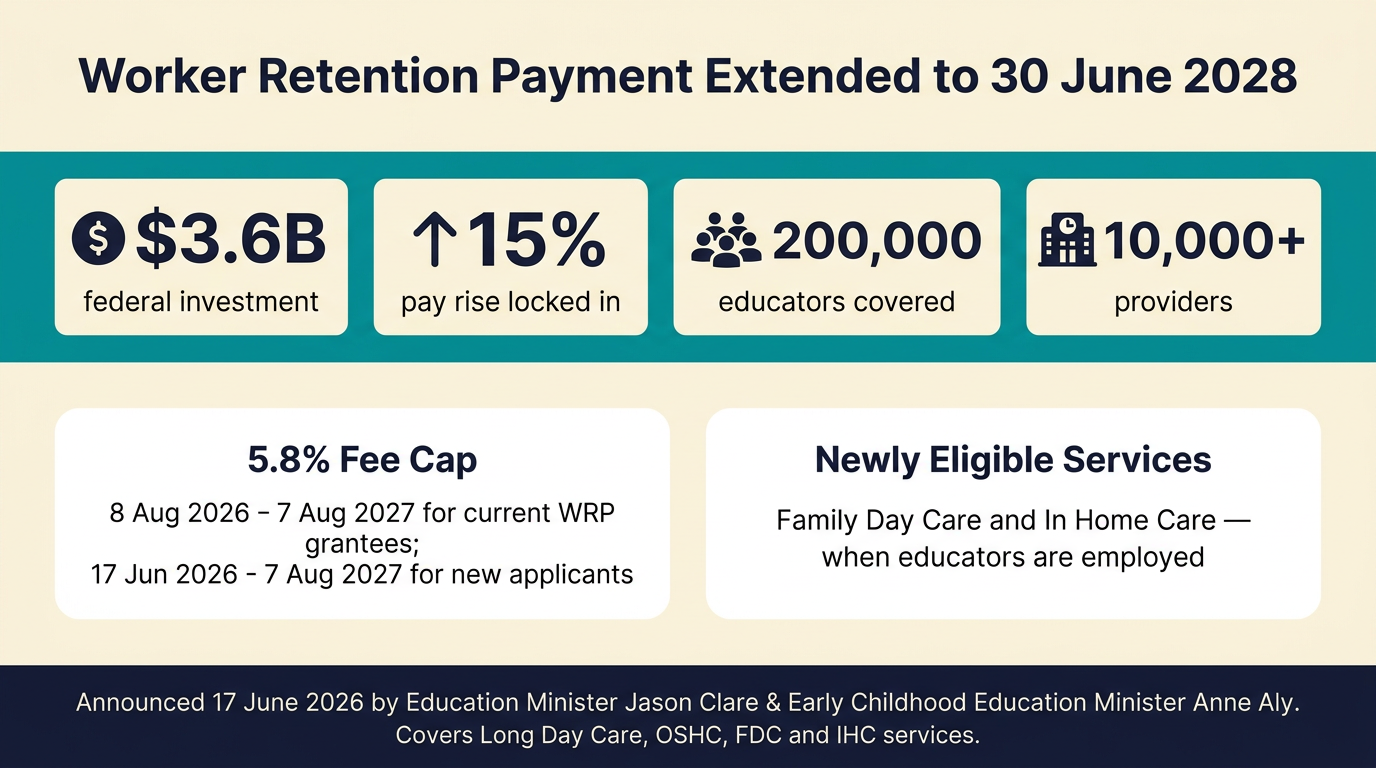
On 17 June 2026, Education Minister Jason Clare and Early Childhood Education Minister Anne Aly confirmed a $3.6 billion extension of the ECEC Worker Retention Payment (WRP) to 30 June 2028. The extension locks in the historic 15 per cent pay rise that the sector won through the 2024 multi-employer agreement and covers more than 200,000 educators across 10,000-plus approved providers. The same announcement reset the fee growth cap to 5.8 per cent from 8 August 2026 and quietly opened eligibility to Family Day Care and In Home Care services that engage educators as employees. For every Long Day Care, OSHC, FDC and IHC service in Australia, this is the most consequential workforce funding announcement since the WRP was first introduced, and it changes the compliance perimeter of the next two financial years.
What the WRP actually is, and why the extension matters
The Worker Retention Payment is the federal grant that funds the historic 15 per cent wage increase the sector fought for through the first multi-employer agreement in 2024. Before the WRP, a Certificate III-qualified educator at the bottom of the Children's Services Award earned around $27 an hour — a wage the sector's own multi-employer agreement, supported by the Fair Work Commission's gender undervaluation findings, judged structurally too low. The WRP pays the difference between the award and the 15 per cent higher rate, directly to the approved provider, on the condition that the increase is passed through to staff and that the service holds fees within a defined growth cap.
Without the extension, the 15 per cent rise was due to expire in late 2026. With the extension confirmed to 30 June 2028, services have certainty that the wage subsidy will continue across the next two financial years. That certainty matters operationally: the multi-employer agreement now covers roughly 200,000 educators across more than 10,000 approved providers, and a sudden expiry would have triggered contract renegotiations, payroll resets and likely a wave of resignations from a workforce that is already short by industry estimates of more than 10,000 educators nationally.
The 5.8 per cent fee growth cap, explained
The trade for receiving the WRP is that an approved provider cannot pass the wage cost through to parents as a fee increase above the cap. The Department of Education has reset that cap at 5.8 per cent for the next fee year. The cap works on a per-day-care-hour basis and is measured against a baseline of fees charged before the cap period commenced.
For services that are already WRP grantees, the 5.8 per cent cap applies to hourly fee increases between 8 August 2026 and 7 August 2027. For services applying for the WRP for the first time, the cap applies between 17 June 2026 and 7 August 2027 — that earlier start date matters because the cap window begins on the day the announcement took legal effect, not on the day your service applies. A first-time applicant that raised fees by more than 5.8 per cent between 17 June 2026 and the application date is already non-compliant for the coming fee year.
The Department has also introduced a new two-year cumulative fee growth cap of 8.6 per cent from 1 December 2025, designed to bring more services into WRP eligibility. Under the cumulative cap, total fee increases across the two-year window 8 August 2024 to 7 August 2026 must stay under 8.6 per cent, even if Year 2 alone runs slightly above 4.2 per cent. Services that breached the original 4.2 per cent Year 2 cap may now be eligible for WRP funding from 1 December 2025 if their cumulative growth is inside 8.6 per cent — but only if they have not otherwise breached the cap rules.
What breaches the cap, and what it costs your service
Breaching the fee growth cap is not a soft failure. The WRP grant guidelines treat a breach as a failure to meet the eligibility conditions for the entire fee year. The consequence is that the approved provider loses WRP funding for that year — and because the WRP is the funding mechanism for the 15 per cent wage increase, losing the WRP means staff pay drops back to the award rate. The IEU's Branch Secretary Carol Matthews framed the extension in exactly those terms: without it, “many [educators] would have seen a pay cut later this year and left the sector.” A breach-driven WRP loss lands the same way, only on the service that breached.
- Hourly fee increases above 5.8 per cent in the cap window, whether through a scheduled increase, a new levy, a late-payment surcharge or a change to the published fee schedule.
- Acquiring an existing service with a recent fee increase. The acquisition date carries the seller's breach history forward. If the seller raised fees above the cap before settlement, the buyer inherits the breach and is ineligible for WRP in the year of acquisition.
- Operating more than one service with combined fee structures. Each service is measured separately against its own baseline. A 4 per cent increase across two related services is fine; a 4 per cent increase that combines a 5 per cent rise at one service with a 3 per cent cut at another can trip the cap on the rising service.
- Late-notified fee increases. The cap window measures the date the increase took effect, not the date it was notified to parents. A fee letter sent in July but effective in September is still inside the August-to-August window.
Family Day Care and In Home Care now eligible
The single most under-reported change in the 17 June announcement is that Family Day Care and In Home Care services become eligible for the WRP for the first time — but only if they engage their educators as employees. Historically, FDC and IHC educators have operated as independent contractors or sole traders, and the WRP's pass-through-to-staff model was incompatible with that structure.
The extension creates a clear incentive for FDC and IHC coordinators to convert their educator engagement model to direct employment. Services that do will unlock the 15 per cent wage subsidy for their educator workforce, but they will also take on employer obligations — payroll tax, workers' compensation, superannuation, leave entitlements, and a workplace instrument that meets the WRP's compliance requirements (the Children's Services Award, an enterprise agreement, or the multi-employer agreement itself).
For FDC and IHC operators, the next 90 days are a strategic decision window. The WRP funding does not flow until the conversion is complete, the workplace instrument is in place and the service has demonstrated that the 5.8 per cent fee cap is being met. Operators who start the conversion now will be inside the 8 August 2026 fee year and inside the multi-employer agreement coverage. Operators who wait risk losing the Year 1 funding window entirely.
The workplace instrument compliance requirement
Every WRP-funded service must operate under an eligible workplace instrument. The Department accepts three structures:
- The Children's Services Award 2010. The simplest pathway, but the award does not itself deliver the 15 per cent increase — the WRP funds the gap between the award rate and the higher rate the educator is paid.
- An enterprise agreement approved by the Fair Work Commission. Suitable for larger services with a stable workforce. The agreement must incorporate, at minimum, the 15 per cent wage increase, and the WRP funds the difference between the EA rate and the higher rate.
- The multi-employer agreement (MEA). The sector-wide agreement that covers approximately 200,000 educators and 10,000-plus providers. Most new WRP applicants enter through the MEA pathway because the agreement itself delivers the 15 per cent wage increase, with the WRP funding applied directly to the wage bill.
The WRP also requires that services pass the increase through to staff. A common compliance failure is retaining the WRP-funded uplift as operating margin. The Department's compliance reviews reconcile WRP payments against payroll records, and a mismatch is treated as a misuse of grant funds.
The 90-day operational checklist
Most services can land the new WRP rules cleanly inside a single planning cycle. The following 90-day workflow covers the compliance perimeter a Long Day Care, OSHC, FDC or IHC service should run between now and 7 August 2027, when the current cap window closes.
- Days 1–10: Lock your fee schedule against the 5.8 per cent cap. Pull every fee increase in the last 24 months, calculate the cumulative growth from your baseline, and confirm the next scheduled increase is inside the 8.6 per cent two-year cap. If you are a new WRP applicant, recalculate from 17 June 2026.
- Days 11–25: Reconcile the workplace instrument. Confirm the instrument under which each educator is engaged is the award, an EA or the MEA, and that the rate on the payroll matches the rate the WRP will fund. Reconcile every WRP payment against payroll for the last 12 months.
- Days 26–40: Document the pass-through. For every educator, evidence the wage uplift was applied to base pay, not absorbed as a one-off payment. The Department's compliance reviews look for permanent rate increases, not bonus-style top-ups.
- Days 41–60: For FDC and IHC operators: model the employment conversion. If you are converting educator engagement to direct employment, model the cost of payroll tax, superannuation, workers' compensation and leave entitlements against the WRP funding uplift. Confirm the 5.8 per cent fee cap can absorb the residual net cost without breaching.
- Days 61–75: Update parent communications. Where the WRP-funded wage uplift is reflected in fee stability, communicate that explicitly to families. Where a fee increase is unavoidable, ensure the published hourly fee matches the underlying schedule to the basis point.
- Days 76–90: Build the evidence pack. Bundle the fee schedule, the workplace instrument, the payroll reconciliation, the pass-through evidence and the parent communications into a single evidence pack with a timestamp and a sign-off from the approved provider.
How NovoCove tracks the WRP for your service
NovoCove treats the WRP as a compliance artefact, not just a grant payment. Every fee schedule is version-controlled against the applicable cap window. Every payroll entry reconciles to a workplace instrument line. Every WRP payment is timestamped and cross-referenced to the educator whose wage it funded. When the Department asks for evidence, NovoCove produces the evidence pack in a single export — with the same artefact structure the WRP Provider Guidance recommends.
For FDC and IHC operators modelling the employment conversion, NovoCove provides a built-in workplace instrument module that tracks award, EA and MEA coverage per educator, flags any service whose instrument coverage is incomplete, and surfaces the per-educator payroll reconciliation required for WRP audit. The platform also generates the parent communication templates that keep fee notifications aligned with the underlying schedule.
The 17 June 2026 extension is good news for the sector — it locks in wage funding for two more years and opens a clear pathway for FDC and IHC to participate. The trade is a tighter fee cap, a more visible compliance perimeter, and a sharper audit trail. The services that benefit most are the ones that treat the WRP as part of their compliance system, not as a separate payroll line. NovoCove is built to run that system.
This guide is general information and is not legal advice.