Regulatory update
Child Care Subsidy Changes from 6 July 2026: What Every ECEC Provider Needs to Update
From 6 July 2026, indexed increases lift Child Care Subsidy hourly rate caps and family income thresholds. Long Day Care rises to $15.19 below school age, OSHC rises to $13.30, Family Day Care to $14.08, and the 90 percent subsidy threshold lifts to $88,520. Here is the new cap table, the second-and-younger-child thresholds, and the 17-day operational checklist for every Australian ECEC provider.
On 6 July 2026 the Child Care Subsidy (CCS) system rolls over to its 2026-27 financial year settings. The Department of Education has indexed the hourly rate caps and the family income thresholds upward, in line with the Consumer Price Index, and the new numbers take effect for every Australian ECEC service in 17 days. If your centre charges above the new cap, the gap fee shifts; if your fee sits at or below the cap, the government's contribution rises by a few dollars per family per week. Either way, the change is not optional — it is the regulator's annual reset, and it runs through your billing system, your parent communications, your enrolment agreements and your gap-fee reconciliation on day one. This post gives you the new rate table, the new income thresholds, and the operational checklist to land the change cleanly before the first session on Monday 6 July.
The new hourly rate caps from 6 July 2026
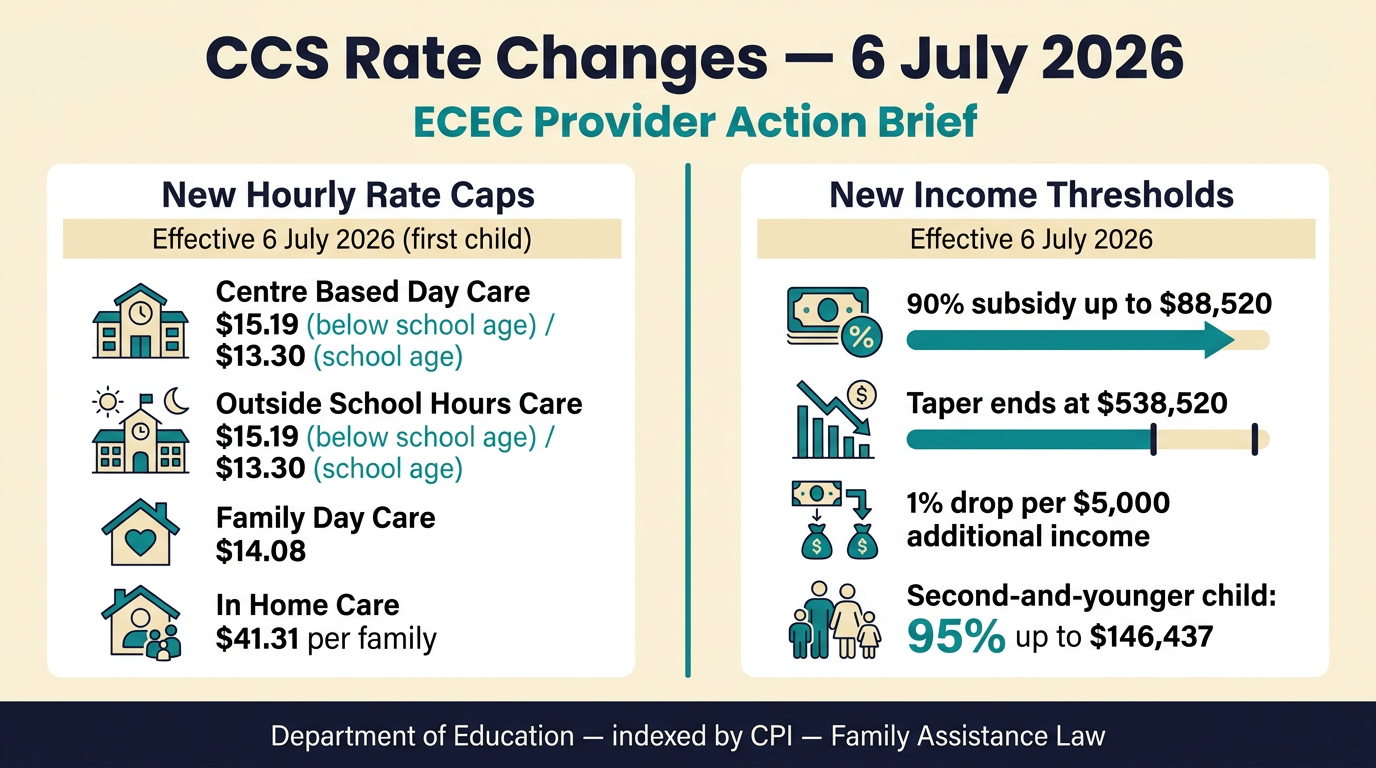
The hourly rate cap is the maximum hourly fee the government uses to calculate a family's CCS entitlement. Where your service charges above the cap, the family pays the full difference — and that gap fee is the single most common source of complaints to ECEC services. The updated caps from 6 July 2026, for the first child in care, are:
- Centre Based Day Care (CBDC): $15.19 per hour below school age (up from $14.63), $13.30 per hour school age (up from $12.81).
- Outside School Hours Care (OSHC): $15.19 per hour below school age, $13.30 per hour school age.
- Family Day Care (FDC): $14.08 per hour (up from $13.56) — applies to both below school age and school age.
- In Home Care (IHC): $41.31 per family per hour (up from $39.80) — applies to both below school age and school age.
The dollar step is small on its own — typically between $0.52 and $1.56 per hour per child — but it compounds across a fortnight of full-time care. A family using 100 hours of Long Day Care per fortnight below school age moves from a $1,463 fortnight cap to a $1,519 cap. That $56 a fortnight difference is the difference between a parent staying in the workforce and a parent dropping a day because the math no longer works.
The new family income thresholds from 6 July 2026
CCS eligibility and the subsidy percentage are driven by a family's adjusted taxable income. The thresholds lift in line with the caps, so families whose income has crept up over the past year stay eligible at the same percentage, and families whose income stays flat see a small percentage increase. From 6 July 2026:
- Full 90% subsidy: family income up to $88,520 (up from $85,279).
- Taper band: family income above $88,520 and below $538,520. The subsidy rate decreases by 1 percentage point for every $5,000 of additional family income, sliding from 90% down to 0%.
- No CCS eligibility: family income of $538,520 or more (up from $535,279).
The taper structure is unchanged — same 1% per $5,000 step, same 90% maximum, same 0% floor. The Department of Education has only lifted the band endpoints by CPI. For most families the change is modest (a 1-3 percentage point bump depending on income bracket), but it is enough to shift the per-session gap fee calculation enough that any quote issued before 6 July will be wrong after 6 July.
Second and younger child thresholds (6 July 2026)
Where a family has more than one CCS-eligible child aged 5 or under, a higher rate applies for the second and younger children. The Services Australia thresholds for the higher rate from 6 July 2026 are:
- $0 to $146,437: 95% subsidy rate for second and younger children.
- $146,437 to $191,437: subsidy decreases from 95% to 80%.
- $191,437 to $270,727: 80% subsidy.
- $270,727 to $360,727: subsidy decreases from 80% to 50%.
- $360,727 to $370,727: 50% subsidy.
- $370,727 or more: higher rate no longer applies (reverts to the first-child schedule).
These higher-rate thresholds are confirmed by Services Australia and are also effective from 6 July 2026. If your centre has a significant share of multi-child under-5 families, the second-child step is the most consequential number in the indexation — it is where the largest subsidy percentages sit, and a missed recalculation leaves the largest dollar amounts on the table.
The 3 Day Guarantee continues unchanged
One number that does not change on 6 July 2026 is the 3 Day Guarantee. Introduced on 5 January 2026, the Guarantee provides every eligible CCS family with a minimum of 72 subsidised hours per fortnight regardless of activity test participation. The Guarantee is legislated and funded for 2026-27, and remains in force at the same 72-hour floor through the new financial year. If you built your billing and attendance system around the pre-January 2026 activity-test rules, make sure the 3 Day Guarantee is being applied automatically — not as a manual override — before the new indexation lands.
The 17-day provider action checklist
With effect from 6 July 2026, here is the operational sequence every Australian ECEC provider should walk through. None of these steps are regulatory filings — they are the internal actions that determine whether the rate change is invisible to families or becomes a complaint spike on the first Monday back.
- Update your billing system rate tables for the four care types (CBDC, OSHC, FDC, IHC) with the 2026-27 hourly caps. Test with at least one family in each subsidy band before 6 July to confirm the new gap fee matches what your fee schedule predicts.
- Re-quote every enrolled family using the new caps and the new income thresholds. Send the new quote to the primary contact parent before 30 June so they can adjust their Family Tax Benefit estimates and Centrelink income reporting ahead of the change.
- Update parent handbooks and enrolment agreements to reference the 2026-27 cap table. Most services put the cap table in the fee schedule appendix — replace the 2025-26 numbers with the 2026-27 numbers, and reissue the appendix as a standalone update to avoid re-printing the entire handbook.
- Brief your front-of-house team on the cap changes. Front desk staff typically field the gap-fee questions when a parent sees the first CCS-adjusted statement after 6 July. They need a one-page cheat sheet showing old vs new caps per care type so they can explain the difference without referring the parent to head office.
- Reconcile July week 1 against July week 2. The first week of the new financial year (6-12 July) is the reconciliation window where any rate-table misconfiguration surfaces as overcharging or undercharging against the new caps. Run a daily gap-fee report for the first fortnight and investigate any variance over $5 per session.
- Document the change for your ACECQA evidence pack. While the CCS caps sit under Family Assistance Law (Department of Education) rather than the National Law (ACECQA), the evidence that your service correctly applied the new caps from 6 July 2026 is part of your Quality Area 7 governance and financial records. Keep the announcement, your system change log, and the reconciliation report.
What the rate change means for your fee-setting decisions
The Department of Education announcement is explicit on one point: the new caps do not require providers to raise fees. They reset the maximum the government will count against a family's CCS entitlement. Where your fee is below the new cap, the family pays the same dollar fee and the government pays a few cents more. Where your fee is above the new cap, the family pays the full difference — including any gap between your fee and the new cap.
Services that have held fees flat through the 2024-25 and 2025-26 indexation rounds have already absorbed the impact of two below-CPI annual adjustments. If you are one of them, the 2026-27 cap is the natural moment to consider a modest fee increase aligned with the new cap — not because the regulator is pushing you to, but because two years of held fees alongside rising wage costs has compressed your operating margin. The Sector's coverage of the announcement noted that the annual indexation "may influence fee-setting decisions and discussions with families about affordability and out-of-pocket costs" — a regulator-neutral framing that puts the decision squarely with you.
Services that raise fees faster than the cap rises create a compounding gap-fee problem. If you raised fees 6% last year and the cap rose 3%, you absorbed the gap and the family's out-of-pocket went up. If you raise fees another 6% this year against a 3-4% cap rise, the family's gap is now 9 percentage points wider than it was two years ago — and that is the trend that drives families to reduce days, switch providers, or leave the workforce entirely. Modelling the per-family impact before you set your 2026-27 fee schedule is the single most consequential pricing decision your service makes this year.
How NovoCove handles the 2026-27 CCS change
NovoCove treats the annual CCS indexation as a calendar event, not a project. When the Department of Education confirms the new caps and income thresholds — typically in late May or early June each year — the rate table in the platform updates overnight. Every enrolled family's gap-fee calculation, every parent statement template, and every billing export picks up the new numbers the moment they take effect. There is no manual re-keying, no spreadsheet recalculation, and no risk of a centre running on last year's caps into the second week of July.
For services operating across multiple states or across mixed CBDC / OSHC / FDC offerings, NovoCove also tracks the cap difference per care type in the same record — so a single family with a preschooler in Long Day Care and a school-age child in OSHC gets the right cap applied to each child's session automatically, and the parent statement shows the breakdown rather than a single blended number. The 2026-27 indexation is the third annual adjustment NovoCove has rolled into customer billing systems automatically; for services that have been on the platform across all three, the gap-fee accuracy has held within $1 per family per fortnight against the Department of Education reference calculator at every annual reset.
On 6 July 2026, you do not need to do anything for the rate change to flow through NovoCove. You do need to do everything in the 17-day checklist above to make sure your service is ready for the change — but the rate-table update, the per-family recalculation, and the parent statement regeneration happen in the background, exactly as they did on 5 January 2026 (3 Day Guarantee), 1 January 2026 (NQS refinements), and 1 September 2025 (NQF child safety regulations). The annual indexation is the regulator's calendar, and NovoCove treats it that way.
This guide is general information and is not legal advice.