ECEC workforce compliance
NT ECT Registration Mandatory 1 September 2026: The 28-Day Cliff, the National Rollout, and the 30-Day Provider Workflow
From 1 September 2026 every early childhood teacher in the Northern Territory must hold current registration to teach in any NQF-approved service. Tasmania and Queensland follow in 2026-27. Here is the 28-day NT checklist and the 30-day workflow every multi-jurisdiction provider must run, with a national picture of where each state and territory sits under Shaping Our Future action FA1-2.
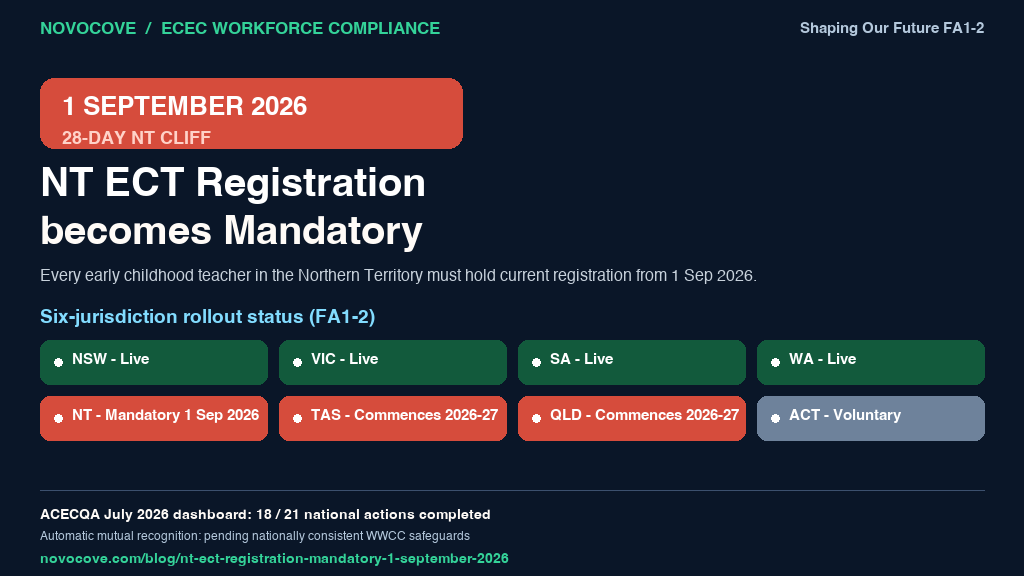
From 1 September 2026 every early childhood teacher in the Northern Territory must hold current registration with the NT Teacher Registration Board to teach in any service approved under the National Quality Framework. The mandatory commencement is the first hard deadline in a national rollout that will see Tasmania and Queensland join the registration regime during 2026-27, leaving the ACT and Victoria as the two remaining holdouts in a six-by-six state and territory map. There are 28 calendar days between today and the NT commencement — and 28 working days for any NT provider that has not yet audited every educator on the roster.
Background: why ECT registration matters and where the national rollout sits today
Early childhood teacher registration sits inside action FA1-2 of the ten-year Shaping Our Future national children's education and care workforce strategy (2022-2031). The strategy commits every Australian government to mandatory registration of early childhood teachers, including those working in non-school settings, in every state and territory. ACECQA's July 2026 update of the implementation tracker shows that the action is now on track: New South Wales, Victoria, South Australia and Western Australia already require registration; the ACT commenced voluntary registration in 2024; the Northern Territory has passed legislation with a mandatory commencement of 1 September 2026; and Tasmania and Queensland have jurisdictional roadmaps and are expected to commence in 2026-27.
The workforce strategy frames registration as one of several reinforcing interventions. The same dashboard update reports that ACECQA's six National Quality Framework eLearning modules had been accessed more than 19,000 times by April 2026 with an average helpfulness rating of at least 4.4 on a 5-point scale, that ACECQA became the assessing authority for early childhood teacher skilled migration in December 2024, and that the National Early Childhood Worker Register — which sits underneath registration for the purpose of regulatory and workforce-integrity information sharing — is operational across the country. Registration, migration assessment and the Worker Register are three layers of the same workforce evidence stack.
The NT commencement matters most immediately because it is the first of the remaining jurisdictions to convert a roadmap into a hard date. The Education and Care Services National Law already requires providers to keep a current Working With Children Check and (where applicable) teacher registration or accreditation on file before any educator begins work, and from 27 February 2026 the National Regulations require providers to be notified of any change to a staff member's WWCC status. Registration is the next layer: it is the credential, not the check, and it is the layer that makes a workforce record portable across the country.
What changed: the 1 September 2026 NT commencement and the 2026-27 national rollout
The NT Government passed legislation that mandates early childhood teacher registration across all settings, with the requirement taking effect from 1 September 2026. From that date, an ECT may not teach in a Northern Territory NQF-approved service unless their registration with the NT Teacher Registration Board is current. The commencement does not require an NT ECT to be currently working in the jurisdiction on the day; it applies to anyone who is teaching on or after 1 September 2026.
Three downstream consequences follow from the NT commencement:
- Providers must verify status before commencement. An NT provider cannot continue to roster an unregistered ECT in a teaching role from 1 September 2026. If an educator is not registered on commencement day the provider must either withdraw them from a teaching role, move them to a non-teaching role within their qualification, or arrange registration through the NT Teacher Registration Board in the available 28 calendar days.
- Cross-border mobility narrows until AMR lands. An ECT who holds current registration in another jurisdiction is not automatically registered in the NT. ACECQA's dashboard notes that automatic mutual recognition of teacher registration is on the horizon, but it remains contingent on the nationally consistent Working With Children Check safeguards being in place. Until AMR lands, an ECT relocating to Darwin, Alice Springs or any NT regional service must lodge a fresh NT application.
- The Tasmanian and Queensland waves follow in 2026-27. Tasmania and Queensland have developed jurisdictional roadmaps and consultation processes and are expected to commence registration during 2026-27. The remaining jurisdictions without a commencement date are the ACT (voluntary) and Victoria (a registration regime that already exists but is being aligned to the national framework during 2026-27). Every multi-state provider should expect to operate across four to six registration regimes by the end of 2027.
The Australian Government separately announced additional funding for the National Early Childhood Worker Register in the 2026-27 Budget. The Register is the national infrastructure that records ECTs and other educators for regulatory and workforce-integrity purposes and is one of the data sources the regulator looks at during a serious-incident investigation, a roster audit or a fit-and-proper assessment of a nominated supervisor.
Operational impact for ECEC providers
The operational risk is straightforward: an ECT who was compliant on 31 August 2026 may be non-compliant on 1 September 2026, and the provider that continues to roster them in a teaching role is the entity on the hook. The safe approach is to treat 1 September as a roster rebuild, not a single HR ticket. Six concrete steps reduce the chance of an undetected gap.
1. Build a single source of truth for every ECT on the roster. Pull the current teaching roster across every NT site. Include casual and agency educators, not only permanent staff. For each name, capture the qualification (Bachelor or higher in early childhood education, or an approved equivalent under the National Law), the jurisdiction where registration currently sits, the expiry date, and any conditions on the registration. The same record will become the source for the Worker Register evidence and for any future multi-jurisdiction change.
2. Identify the ECTs who will need an NT application in the next 28 days. The largest exposure sits with ECTs currently registered in NSW, Victoria, SA or WA — jurisdictions that already require registration — because their existing registration does not extend to NT. The next largest exposure is ECTs who hold qualifications but have never been registered in any jurisdiction, because they face a first-time application through the NT Teacher Registration Board.
3. Open the NT Teacher Registration Board application before 15 August 2026. The Board's published processing times are longer than the 28 calendar days remaining. A provider that waits until the final week will discover the hard way that "commencement" does not mean "grace period". Treat 15 August as the internal cut-off for lodging applications, so any back-and-forth on qualifications or identity evidence has time to resolve before 1 September.
4. Re-write the roster with a registration column from 1 September 2026. Where the provider's roster system does not yet include a registration column, add one. The column should store the registration number, the registering authority, the expiry date, the conditions, and a link to a scanned copy of the certificate. The roster is the document the regulator sees first if anything goes wrong, and a roster that names an unregistered ECT in a teaching role is the document the regulator uses to demonstrate non-compliance.
5. Move ECTs without NT registration off teaching roles from 1 September 2026. The National Law does not allow an unregistered ECT to be in a teaching role once mandatory registration is in force in the jurisdiction. For ECTs whose NT application is still in progress on 1 September, redeploy them to educator (rather than teacher) duties, to non-teaching roles consistent with their qualifications, or to a different jurisdiction where their existing registration remains valid. This is a workforce decision, not a paperwork decision.
6. Plan for the Tasmanian and Queensland waves during 2026-27. A multi-state provider should not treat the NT commencement as a one-off. Tasmania and Queensland are expected to commence during 2026-27, and each commencement will introduce another registration boundary that an ECT must cross to teach in that jurisdiction. Stand up a small registration matrix now — a table with one row per ECT and one column per state or territory — and keep it current. The matrix becomes the planning document for the next two commencements.
A 30-day provider workflow for the NT commencement
The objective is to land on 1 September 2026 with a roster in which every NT-based teaching role is held by an ECT with current NT registration, and a documented evidence trail showing how the provider got there. The 30-day window deliberately finishes a week before commencement so any unresolved applications or document gaps have time to escalate.
Days 1-5 — inventory and gap analysis. Export the current NT teaching roster, the central staff record, and the WWCC register. Reconcile them into a single table with one row per ECT. For each row, record qualification, current registration (jurisdiction and expiry), NT WWCC status, and any conditions or suspensions. Highlight rows where NT registration is absent, expired or held in a non-NT jurisdiction. Highlight rows where the WWCC is current but the registration has lapsed.
Days 6-12 — open NT applications for the gap group. For every ECT in the gap group, lodge an NT Teacher Registration Board application. Keep a copy of the application, the receipt and any assessor correspondence in the central evidence folder. Where the ECT holds current registration in another jurisdiction, the application may be expedited, but "may" is not "will" — track each application against a published processing-time expectation.
Days 13-20 — resolve conditions and document gaps. Most NT applications in this cohort will not be approved unconditionally on day 13. Identity evidence, qualification transcripts, English-language proficiency, WWCC clearance and prior-employment statements are common sources of follow-up requests. Set a 48-hour internal service standard for responding to assessor queries. Where an application cannot be approved before 1 September, escalate to the ECT, the registered teacher and the centre director with a redeployment plan.
Days 21-26 — write the new roster and rehearse it. Take the gap-closure status as of day 20 and write the 1 September roster. Every teaching role must be held by an ECT with confirmed NT registration or by an ECT whose NT application has been approved in principle with a documented start date. Run a rehearsal: pretend 1 September is today, and check whether the roster would pass a regulator audit. Resolve the remaining gaps.
Days 27-30 — submit, evidence and brief. On or before 28 August, finalise the roster, the registration matrix and the evidence pack. Brief the nominated supervisor, the educational leader and each centre director on which educators are teaching in NT roles from 1 September, which are not, and why. Update the Worker Register record for each NT-registered ECT. Save the evidence pack under the provider's regulatory-record retention policy — the NT commencement date is the date that future audits will compare against.
Common errors to avoid before 1 September 2026
- Treating voluntary registration in the ACT as equivalent to mandatory registration in the NT. The ACT regime remains voluntary. An ACT-registered ECT who moves to the NT still needs NT registration.
- Assuming an ECT with current registration in NSW, Victoria, SA or WA can teach in the NT without further action. Cross-jurisdiction recognition depends on automatic mutual recognition, which is not yet in force for early childhood teachers.
- Rostering an ECT in a teaching role pending the NT application outcome. Pending is not current. The legal requirement is registration, not application.
- Ignoring the Worker Register evidence trail. The Register is the data layer the regulator consults during an investigation; missing entries will be flagged even if the on-roster registration is in order.
- Forgetting casuals and agency educators. An agency-supplied ECT teaching in an NT service on 1 September is still subject to the registration requirement, and the provider remains the entity on the regulatory hook.
- Treating 1 September as a one-off rather than the start of a multi-year cycle. Tasmania and Queensland follow during 2026-27; each will introduce its own commencement and its own evidence pack.
How NovoCove supports this
NovoCove is the data and evidence layer for ECEC and aged-care provider compliance. It does not lodge NT Teacher Registration Board applications, issue registration certificates or replace the Worker Register. It centralises the workforce evidence a provider needs to demonstrate compliance from 1 September 2026 and to manage the Tasmania and Queensland waves during 2026-27.
In practice, NovoCove lets a multi-site provider record each ECT's qualification, current registration (jurisdiction, number, expiry and conditions), WWCC status, child safety training status and Worker Register entry in one record per educator. Automatic alerts surface when a registration is approaching expiry, when a WWCC needs renewal, or when a Tasmanian or Queensland commencement is imminent. RAG status per service shows which sites have full registration coverage and which still have a gap. Daily ComplianceSnapshot trend capture and audit logging give a regulator-ready evidence trail showing what the workforce record looked like on 31 August 2026 and on each subsequent commencement day.
For this transition, the safe pattern is to use NovoCove as the central evidence layer while the responsible person and the educational leader drive the NT, Tasmanian and Queensland applications outside the platform. That separation keeps NovoCove honest about what it does — the data and evidence layer — while making sure the regulatory actions themselves run through the Teacher Registration Boards and the Worker Register.
Sources and further reading
- ACECQA: Shaping Our Future workforce dashboard update (31 July 2026) (T1) — confirmation that 18 of 21 national actions are completed, two on track, one not on track; NT commencement confirmed for 1 September 2026; Tasmania and Queensland to follow in 2026-27.
- ACECQA: Shaping Our Future implementation tracker (T1) — full text of action FA1-2 (early childhood teacher registration in every state and territory), including jurisdictional status as at July 2026.
- ACECQA: National Workforce Strategy — Shaping Our Future (T1) — the ten-year strategy framework, six focus areas and 21 national actions.
- ACECQA: Early childhood teacher registration and accreditation (jurisdiction-by-jurisdiction) (T1) — the registering authority in each state and territory, plus the National Law context.
- NT Department of Education: National Early Childhood Worker Register guidance for NT providers (T1) — the NT-specific workforce register guidance that runs alongside the registration commencement.
- Northern Territory Teacher Registration Board (T1) — application portal, processing-time expectations and conditions register for the NT commencement.
This guide is general information and is not legal advice.