Regulatory update
Disability Standards for Education 2026 Amendment: What Every ECEC Service Must Do Before 1 August 2026
From 1 August 2026, every approved ECEC service in Australia will be explicitly bound by the Disability Standards for Education 2005. Here is what the 6 Standards require of centre directors, the reasonable adjustments workflow you need on file, and the 90-day plan to be ready before the commencement date.
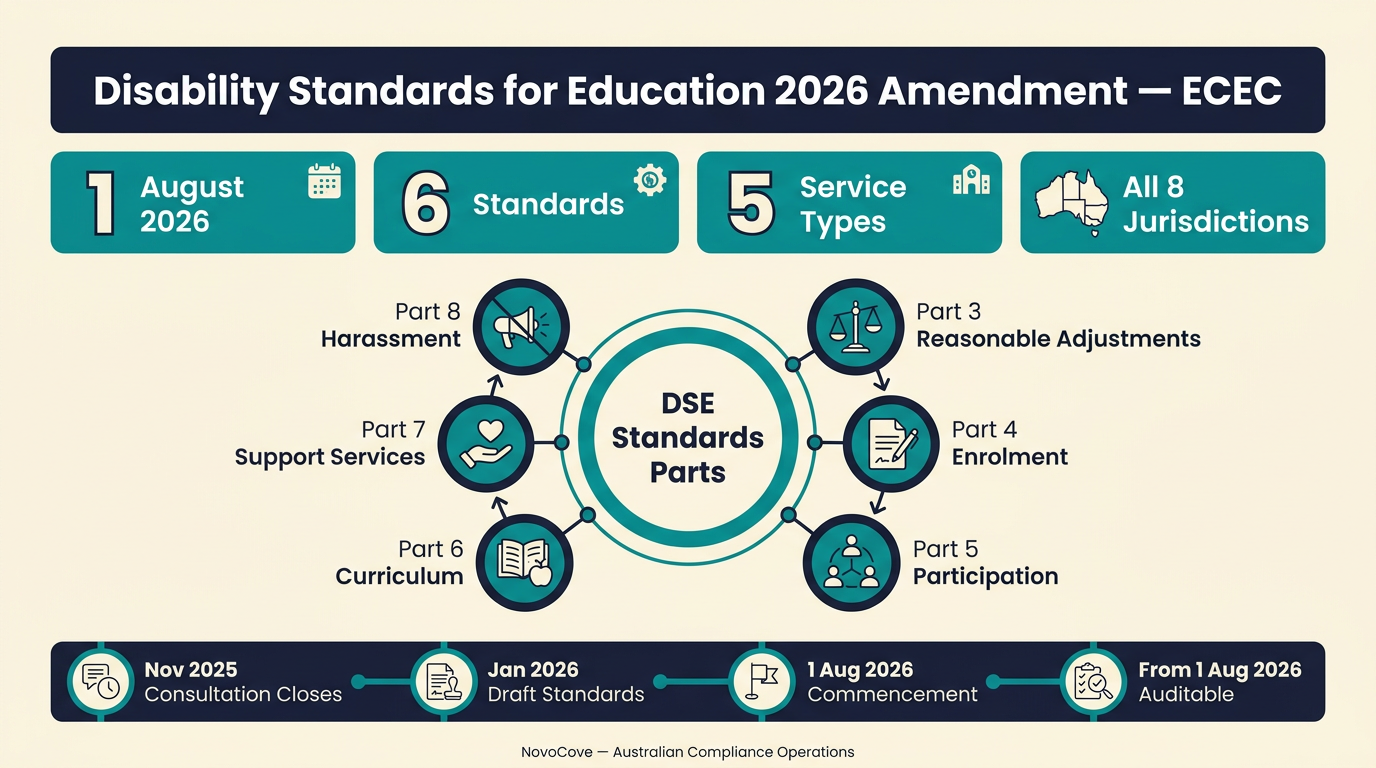
From 1 August 2026, every approved early childhood education and care service in Australia will be explicitly bound by the Disability Standards for Education 2005. That is the date the federal government has set for the Disability Standards for Education Amendment Standards 2025 to commence, and the date ACECQA confirmed in its June 2026 newsletter to the sector. The amendment does not invent new obligations for centre directors. It lifts obligations that already existed under the Disability Discrimination Act 1992 into a specific, auditable framework that applies to most long day care, kindergarten, family day care, outside school hours care, and vacation care services.
The change matters because, until now, ECEC services were covered by the DDA's general anti-discrimination duty but had to argue by analogy that the 2005 Standards applied to them. After 1 August 2026, no service in scope can rely on that argument. The Standards spell out six substantive obligations — reasonable adjustments, enrolment, participation, curriculum, support services, and harassment — and they make it clear what a regulator, a complainant, or a family can demand to see when they ask whether your service has done the right thing by a child with disability.
What is changing on 1 August 2026
The original Disability Standards for Education 2005 were made under section 31 of the Disability Discrimination Act 1992. They have always technically bound education providers, but the term "education provider" was not defined in a way that clearly captured the full ECEC sector. The 2025 amendment, expected to commence on 1 August 2026 following a 2025 review and consultation period, defines the sector explicitly and applies the Standards to most approved ECEC service types operating under the National Law and Regulations.
In practice, this means three things for every approved provider:
- The six substantive Standards in Parts 3 to 8 of the instrument will apply to your service directly, not as an analogy from the DDA's general duty.
- The reasonable adjustments obligation in clause 3.4 will sit alongside, not replace, your existing NQS Quality Area 1 (Educational program and practice) and Quality Area 6 (Collaborative partnerships with families and communities) obligations.
- A complaint to the Australian Human Rights Commission, or a compliance notice from a state or territory ECEC regulator, will be assessed against the specific Standards, not against the broader DDA alone.
The 6 Standards that apply to your service
The Disability Standards for Education 2005 set out six substantive obligations across Parts 3 to 8 of the instrument. Each one maps to an artefact your service needs to be able to produce on demand.
Standard 1 — Reasonable adjustments (Part 3). Clause 3.4 requires providers to make reasonable adjustments to enable a student to participate in education on the same basis as other students. For ECEC, "student" means the child in your care. The decision must be made in consultation with the family (clause 3.5), documented (clause 3.6), and implemented in reasonable time (clause 3.7). The bar is "reasonable" — adjustments that would impose unjustifiable hardship on the provider are not required — but every decision needs a written record of the factors considered.
Standard 2 — Enrolment (Part 4). Clause 4.2 prohibits discrimination in enrolment on the basis of disability. For ECEC, this means your enrolment policy cannot contain a blanket exclusion clause for children with disability, and your waiting list management cannot deprioritise a child because of additional support needs. The Standard does not require you to enrol every child who applies — it requires that the decision is made on the same basis as for any other child and that adjustments to the enrolment process are made where reasonable.
Standard 3 — Participation (Part 5). Clause 5.2 requires providers to consult with the child (where age-appropriate) and the family and to make reasonable adjustments so the child can participate in the education and care service. For ECEC, this is the obligation that maps most directly to your educational program, your daily routine, your excursions, and your rest and meals practices. A child who cannot participate in the standard program because of a disability is entitled to an adjusted program, and the adjustment must be documented.
Standard 4 — Curriculum development, accreditation and delivery (Part 6). Clause 6.2 requires providers to consult and take reasonable steps to ensure the curriculum is designed to enable a child with disability to participate. For services delivering the Early Years Learning Framework or a state-approved kindergarten program, this means your curriculum plan must show how it is reviewed for accessibility, not just whether it covers the framework outcomes.
Standard 5 — Support services (Part 7). Clause 7.2 requires providers to consult and take reasonable steps to ensure support services are designed to enable a child with disability to participate. "Support services" in the ECEC context includes additional staffing, specialised equipment, modified meals, transport assistance, and any allied health or therapist visit conducted on the service premises. The obligation is to facilitate access, not to fund it.
Standard 6 — Harassment and victimisation (Part 8). Clause 8.3 requires providers to take reasonable steps to prevent harassment and victimisation of a child with disability by staff, other children, or visitors. The Standard has been in force since 2005 for schools and is now being made explicit for ECEC. Your behaviour guidance policy, your staff code of conduct, and your bullying prevention practices must be capable of addressing disability-based harassment specifically.
What service types are in scope
The amendment applies to "most" ECEC service types operating under the National Law and Regulations. Based on the ACECQA notice and the Department of Education consultation paper, the scope is expected to include:
- Long day care — centre-based care for children from birth to school age, including preschool programs.
- Kindergarten — state and territory funded preschool programs delivered in standalone or attached settings.
- Family day care — services provided in a residence by an approved educator.
- Outside school hours care — before-school, after-school, and vacation care for primary school-aged children.
The amendment is not expected to extend to occasional care, mobile services, or short-term holiday programs that fall outside the standard service type definitions. If your service operates across multiple service types, the Standards apply to every service type you are approved for, not just your largest program.
The 90-day preparation plan
You have 65 days between today and the 1 August 2026 commencement date. The following five-step plan is what we walk every NovoCove customer through when a regulator-level framework change lands on this short a runway. The order matters: each step produces an artefact the next step depends on.
Step 1 — Audit your current inclusion documentation. Pull every policy, enrolment form, family handbook, behaviour guidance plan, and reasonable adjustment record you have produced in the last 12 months. Tag each document against the six Standards. The first artefact you need is a gap analysis: which of the six Standards can you evidence today, and which are gaps?
Step 2 — Write or update your reasonable adjustments policy. The policy needs to define the trigger (a request, an observed need, a family disclosure), the consultation step (who, when, how recorded), the decision framework (what factors you weigh), the implementation timeline, and the review schedule. A one-page policy is not enough — the regulator will look for evidence that the policy is operated, not just published.
Step 3 — Build the consultation record template. Every reasonable adjustments decision under clause 3.5 needs a written record of the consultation. The template should capture the date, the participants, the adjustment discussed, the family's contribution, the decision made, the implementation date, and the next review point. If you cannot show this for every active adjustment, the gap analysis in step 1 will surface it.
Step 4 — Review your curriculum and participation plans. Pull three recent educational programs and check that they show how a child with disability would participate on the same basis as their peers. If your plans describe what the children do but not how a child with mobility, sensory, communication, or behavioural needs would access each activity, the plans are not yet aligned with Standard 3 (participation) or Standard 4 (curriculum).
Step 5 — Train your educators and document the training. The Standards bind the provider, but the operational obligation sits with the educators who deliver the program. A 60-minute staff training session on the six Standards, the consultation workflow, and the harassment obligation is the minimum. Document the training date, the attendees, and the assessment of understanding. Repeat annually.
What this means for your NQF assessment and rating visit
From 1 August 2026, an authorised assessor will be able to cite the Disability Standards for Education 2005 directly when assessing your service against the National Quality Standard. Quality Areas 1, 6, and 7 all touch on inclusion, and the amended Standards give the assessor a measurable benchmark for what "inclusion" looks like in practice.
If you are due for an assessment and rating visit before the end of 2026, treat the 90-day plan as a priority. If your visit is in early 2027, you will be assessed against the amended Standards regardless of whether your service has prepared, because the Standards will have been in force for six months by then.
How NovoCove handles this
The six Standards produce six artefacts — a reasonable adjustments policy, a consultation record, an enrolment review, a participation review, a curriculum review, and a harassment prevention record. NovoCove gives every approved provider a single compliance workspace where each of these artefacts lives alongside the related NQS, Child Safe Standards, and WWCC evidence. When a regulator, a family, or an assessor asks, the operator pulls one record and shows the policy, the consultation, the decision, and the implementation timeline in the same view.
For reasonable adjustments specifically, NovoCove captures the request, the family consultation, the factors weighed, the decision, and the review date in a single adjustment record that maps directly to clauses 3.4, 3.5, 3.6, and 3.7. For participation and curriculum, the platform flags any educational program that does not record how a child with disability would access each planned experience, so the gap is visible before the assessor or the family finds it. For harassment, the behaviour guidance module requires a disability-specific prevention clause as part of the standard policy template.
The result is that the 1 August 2026 commencement date becomes a workflow change rather than a policy rewrite. Your service has been operating under the DDA's general duty for decades. NovoCove simply makes that duty measurable, documentable, and audit-ready in the same format the regulator expects to see.
This guide is general information and is not legal advice.