Aged care compliance
First Nations Aged Care Commissioner Bill 2026: Provider Refund Obligations, Regulator Price-Setting Powers and the Cultural-Safety Compliance Shift
On 1 July 2026 the Government introduced the Aged Care Legislation Amendment (Aboriginal and Torres Strait Islander Aged Care Commissioner and Other Measures) Bill 2026, establishing a permanent First Nations Aged Care Commissioner and clarifying the obligation on providers to refund overcharged fees. Referred to a Senate inquiry on 2 July 2026. Here is what the bill changes, what the regulator can now do, and the 30-day compliance workflow every residential and home care provider should be running.
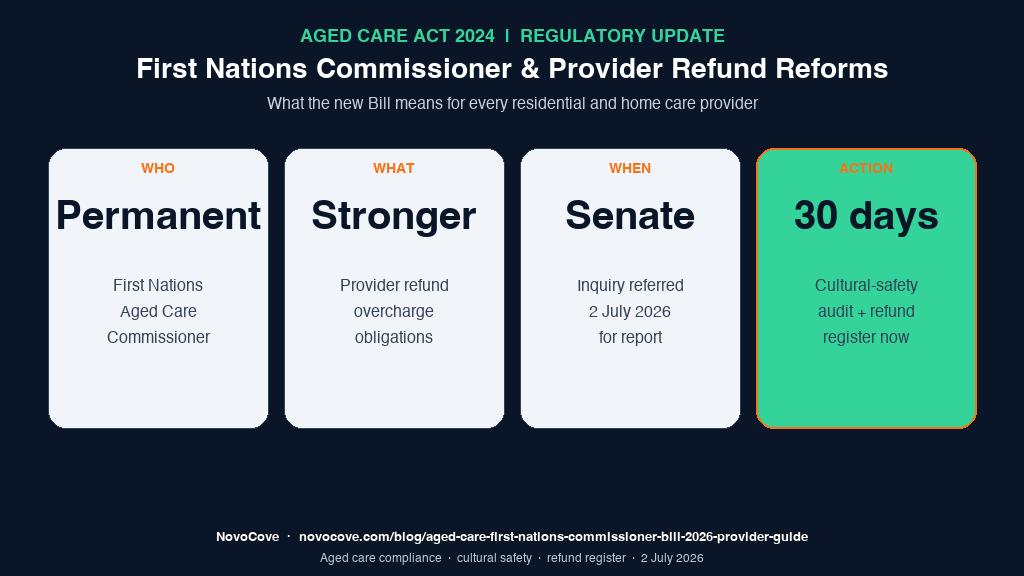
On 1 July 2026 the Government introduced the Aged Care Legislation Amendment (Aboriginal and Torres Strait Islander Aged Care Commissioner and Other Measures) Bill 2026 into the House of Representatives. The bill does two things that matter to every Australian aged care provider: it creates Australia's first permanent Aboriginal and Torres Strait Islander Aged Care Commissioner inside the Aged Care Quality and Safety Commission, and it rewrites the provider obligation to refund overcharged fees and contributions, with stronger regulator powers to determine when a price is unreasonable and set a fair one. The bill was referred to the Senate Community Affairs Legislation Committee on 2 July 2026, with reporting expected before the spring sittings. Here is what the bill actually changes, what the regulator can now do, and the 30-day workflow every residential and home care provider should be running.
What the bill actually does — the four operative changes
The bill's long title is dense, but the operative provisions sit in four distinct places. Each one is a discrete change to the Aged Care Act 2024, and each one creates a compliance obligation that providers can prepare for in advance, regardless of when the bill receives Royal Assent.
- Establishes a permanent Aboriginal and Torres Strait Islander Aged Care Commissioner. The new Commissioner will be a statutory office-holder within the Aged Care Quality and Safety Commission, reporting to the Minister for Aged Care. The Commissioner's functions include promoting the rights of Aboriginal and Torres Strait Islander older people, advising the Commission and the Department on culturally safe, trauma-aware and healing-informed care, and engaging with Aboriginal community-controlled organisations, providers and older people directly.
- Clarifies the obligation on providers to refund contributions and fees that have been overcharged or overpaid. The bill rewrites the refund obligation to make it clear, simple, and enforceable. The previous framework required the Commission to prove that a charge was unreasonable before requiring a refund. The new framework reverses the test: where a resident or former resident has been charged an amount that is unreasonable, the obligation to refund sits on the provider, and the regulator has a clear power to compel the refund.
- Gives the regulator stronger powers to determine when a price is unreasonable and set a fair one. Where the regulator forms the view that a price is unreasonable, it can now determine a fair price, require the provider to charge no more than the determined price, and compel refunds of any amount charged above the determined price. This power sits alongside the existing information-gathering, notice and enforceable undertaking powers.
- Adjusts the definition of "responsible person" so elected local councillors are no longer automatically captured. The change resolves a long-running concern from council-auspiced and community-controlled providers about whether an elected local councillor who is also a board member of an Aboriginal community-controlled aged care service falls inside the "responsible person" definition. The new definition tightens the test so the default capture of elected councillors is removed.
Each of these four changes is independently significant. The Commissioner role strengthens the cultural-safety lens on every Commission decision. The refund and price-setting powers rewrite the economic relationship between providers and the regulator. The responsible-person change unwinds a technicality that has blocked good governance in council-auspiced services. The combined effect is the most significant package of changes to the Aged Care Act 2024 since the Act commenced on 1 November 2025.
Why the bill matters now — the timing pressure on providers
The Senate inquiry timetable matters. The bill was referred to the Senate Community Affairs Legislation Committee on 2 July 2026, with submissions open in the first two weeks of July and a reporting date before the spring sittings. If the bill passes both houses in the spring sittings, Royal Assent could follow within weeks, and the operative provisions could commence on Royal Assent, 1 November 2026, or a later date specified in the Aged Care Rules 2025. Providers that have prepared their refund register, their cultural-safety evidence trail, and their responsible-person register before the bill commences will be in a much stronger position than those that have not.
The Commission has signalled in Quality Bulletin #6-2026 (July 2026) that refund enforcement is already a live workstream. The bulletin confirms the Commission is investigating several residential aged care providers over the way they are charging Higher Everyday Living Fees (HELF), and that formal notices compelling information have already been issued. The bill is the legislative companion to that enforcement posture. Providers that are already refunding residents who were overcharged are well placed; providers that have not reviewed their pricing since 1 November 2025 are exposed.
The new refund obligation — what the bill actually says
The bill rewrites the refund framework in plain language. The previous framework required the Commission to identify an unreasonable charge and then take enforcement action; the new framework is built around three concepts: an overcharge is an amount that is unreasonable, the provider is obliged to refund the overcharged amount, and the regulator has the power to determine what is reasonable and compel the refund. The practical effect is that the burden of demonstrating that a charge is reasonable shifts to the provider at the point of charge, not at the point of regulator investigation.
The categories of overcharge the bill is designed to address are the categories the Commission has already named publicly in the HELF investigation: services that are required under the Aged Care Quality Standards and the Statement of Rights being charged for as if they were additional services; services that have been removed from the standard offering so that they can be re-introduced as a paid extra; services that are not in fact being delivered to the resident; and fees that have been agreed before a resident has entered care, or that are presented as a condition of entry.
The new price-setting power — what the regulator can now do
The price-setting power is the most significant new regulator tool in the bill. Where the regulator forms the view that a price is unreasonable, it can now determine a fair price and require the provider to charge no more than that price. The determined price is binding on the provider from the date of the determination, and any amount charged above the determined price after that date is an overcharge that triggers the refund obligation.
The price-setting power sits inside a wider package of regulator tools that have been progressively expanded since the Aged Care Act 2024 commenced on 1 November 2025. The Commission already has the power to gather information, issue notices, accept enforceable undertakings, and pursue civil penalty proceedings for non-compliance. The new power to determine a fair price adds a direct price-control tool to that package, and the existence of that tool changes the regulator's negotiating position with every provider, even where the regulator has not yet exercised the power.
Operational impact for providers — six things to do in the next 30 days
The bill's operative provisions are not yet in force, but the compliance groundwork can be laid now. Six concrete actions, in priority order, will put every residential and home care provider in the strongest possible position when the bill commences.
- Build or refresh the refund register. The refund register is the single most important compliance artefact under the new framework. The register should record every refund issued to a resident or former resident, the reason for the refund, the date the refund was issued, and the underlying pricing decision that the refund corrects. The register should be exportable in a single file so the Commission can review it on request.
- Re-map every HELF line item to the residential care service list and the Aged Care Quality Standards. Any HELF line item that maps to a service that is required to be delivered as part of standard care is non-compliant under the existing framework and will be an overcharge under the new framework. The service list mapping is the evidence the Commission will look at first.
- Audit cultural-safety training and engagement records. The new Commissioner's functions include advising on culturally safe, trauma-aware and healing-informed care. The cultural-safety evidence trail — training records, engagement logs with Aboriginal community-controlled organisations, language and communication plans for Aboriginal and Torres Strait Islander residents — will become a routine part of Commission inspections.
- Review the responsible-person register against the new definition. The bill adjusts the responsible-person definition so elected local councillors are no longer automatically captured. Providers should review the responsible-person register, identify any elected councillors who are currently registered only by virtue of the old definition, and document the basis on which each remaining responsible person falls inside the new definition.
- Update the Statement of Rights evidence pack. The Aged Care Act 2024 and the Statement of Rights already require providers to deliver care that is culturally safe, culturally appropriate, trauma aware and healing informed. The evidence pack should map every resident's care plan to the Statement of Rights and identify the cultural-safety considerations that have been taken into account.
- Document the pricing decision trail. Every price that a provider charges for a HELF, a Support at Home service, or a residential accommodation payment should be traceable to a documented decision that records what the price is for, why the price is reasonable, and how the price compares to the cost of delivery. The pricing decision trail is the evidence the provider will rely on if the regulator forms the view that a price is unreasonable.
Step-by-step workflow — the 30-day First Nations Commissioner Bill compliance plan
The 30-day plan below is the minimum viable workflow for any residential or home care provider that wants to be in the strongest possible position when the bill commences. The plan assumes a single provider with a small compliance team; larger providers can run the same workflow across multiple services in parallel.
- Day 1 to Day 3 — Stand up the refund register. Open a single refund register that will record every refund issued under the new framework. Identify the system of record (a spreadsheet, a compliance platform, or a finance system export) and confirm the export format the Commission can read.
- Day 4 to Day 7 — Run the HELF service list mapping. Pull every current HELF agreement, list every HELF line item, and map it to the residential care service list and the Aged Care Quality Standards. Flag every line item that maps to a service that is required to be delivered as part of standard care.
- Day 8 to Day 12 — Issue refunds for any HELF line item that maps to standard care. For every flagged line item, identify the residents who have been charged that item, calculate the overcharged amount, issue the refund, and record the refund in the refund register.
- Day 13 to Day 16 — Audit cultural-safety training and engagement. Pull the cultural-safety training records for every staff member, the engagement log with local Aboriginal community-controlled organisations, and the language and communication plans for Aboriginal and Torres Strait Islander residents. Identify the gaps and book the training or engagement that is missing.
- Day 17 to Day 21 — Refresh the responsible-person register. Review the current responsible-person register against the new definition. Document the basis on which each responsible person falls inside the new definition, and remove any person who is captured only by virtue of the old default for elected councillors.
- Day 22 to Day 26 — Update the Statement of Rights evidence pack. Map every resident's care plan to the Statement of Rights, identify the cultural-safety considerations that have been taken into account, and document the evidence that supports each consideration.
- Day 27 to Day 30 — Document the pricing decision trail. For every current price, document the pricing decision, the basis for the price, and the cost-of-delivery comparison. The pricing decision trail becomes the first line of defence if the regulator forms the view that a price is unreasonable.
What the Commission will look at during a First Nations Commissioner-era review
The new Commissioner's functions include advising the Commission on culturally safe care and engaging directly with Aboriginal and Torres Strait Islander older people. In practice, this means the Commission will start to ask questions during routine inspections that it has not previously asked, and the answers to those questions will be looked at alongside the existing evidence on quality and safety.
- Refund register and refund decision trail. The Commission will look for a current refund register, the pricing decisions that have triggered refunds, and the process the provider has used to identify and correct overcharges.
- Cultural-safety training and engagement records. The Commission will look for evidence that staff have completed cultural-safety training, that the provider has engaged with Aboriginal community-controlled organisations, and that the provider has a documented cultural-safety plan for Aboriginal and Torres Strait Islander residents.
- Statement of Rights evidence pack. The Commission will look for evidence that the provider has delivered care that is consistent with the Statement of Rights, including the rights of Aboriginal and Torres Strait Islander older people to access aged care that is culturally safe, culturally appropriate, trauma aware and healing informed.
- Responsible-person register. The Commission will look for a current responsible-person register, the basis on which each responsible person is registered, and the governance arrangements that support the responsible person in performing their functions.
- Pricing decision trail. The Commission will look for evidence that every price the provider charges has been subject to a documented pricing decision, that the price is reasonable, and that the price has been benchmarked against the cost of delivery.
How NovoCove handles this
NovoCove gives aged care providers a single source of truth for the artefacts the Commission will request under the new framework. The platform centralises the refund register, the HELF service list mapping, the cultural-safety training and engagement records, the responsible-person register, the Statement of Rights evidence pack, and the pricing decision trail in one workflow. The refund register is generated from the same workflow that records the original charge, so the refund trail and the charge trail reconcile on the same screen and the export is one click rather than a paper chase.
The cultural-safety evidence trail is built from the staff training and engagement records already in the platform, with each cultural-safety consideration linked back to the resident's care plan and the Statement of Rights. The responsible-person register tracks the basis on which each responsible person is registered, the date of the last review, and the documentation that supports the registration. The pricing decision trail is generated from the HELF agreement register and the service list mapping, so the Commission's question about whether a particular price is reasonable can be answered by exporting a single file.
The same platform covers every other aged care compliance obligation your service is operating under — the HELF framework, the Care Minutes Supplement quarterly reporting, the 24/7 RN rule, the SIRS incident reporting workflow, the Quality Standards evidence pack, and the registered provider reporting obligations under the new Aged Care Act. If your service is in scope of the First Nations Aged Care Commissioner Bill, NovoCove is built to answer it.
Sources / further reading
- Aged Care Quality Bulletin #6-2026 — Aged Care Quality and Safety Commission (T1, July 2026)
- New Commissioner to improve culturally safe aged care — Minister for Aged Care, the Hon Sam Rae MP (T1, July 2026)
- Aged Care Legislation Amendment (Aboriginal and Torres Strait Islander Aged Care Commissioner and Other Measures) Bill 2026 — Parliament of Australia (T1, 1 July 2026)
- Senate Community Affairs Legislation Committee — inquiry into the Bill — Parliament of Australia (T1, 2 July 2026)
- Landmark bill to establish permanent First Nations Commissioner — Australian Ageing Agenda (T2, July 2026)
- NATSIAACC submission on the Bill — National Aboriginal and Torres Strait Islander Aged Care Association (T2, July 2026)
- Regulatory Bulletin RB 2026/1 — Support at Home pricing — Aged Care Quality and Safety Commission (T1, July 2026)
- Strengthened Aged Care Quality Standards — Aged Care Quality and Safety Commission (T1)
This guide is general information and is not legal advice.