Aged care compliance
ACQSC Monitoring Policy and Inspections Fact Sheet: What Every Aged Care Provider Must Prepare For Under the Aged Care Act 2024
The Aged Care Quality and Safety Commission has now published the four documents that turn the Aged Care Act 2024 into day-to-day operational reality for every Australian Government-funded aged care provider: the Monitoring Policy on 22 April 2026, the Inspections fact sheet on 24 April 2026, the Statement of Rights fact sheet, and the Choice, dignity, respect public information program. Together they explain how the Commission monitors, what an inspection looks like, what evidence is collected on-site, what the provider has to show, and what enforcement tools apply when an inspection finds unmanaged risk. For any provider running residential aged care, home care, respite, or CHSP transition services, this is the regulatory layer that sits underneath every Strengthened Quality Standard assessment, every SIRS notification, and every Statement of Rights claim. This guide walks through the announced vs unannounced rule, the entry, search, copy, photograph and ask powers that Chapter 6 of the Aged Care Act and the Regulatory Powers (Standard Provisions) Act 2014 give to authorised officers, the six enforcement outcomes the Commission can apply when non-compliance is identified, the Statement of Rights link to every inspection finding, and the 90-day operational plan every registered provider should be running from today.
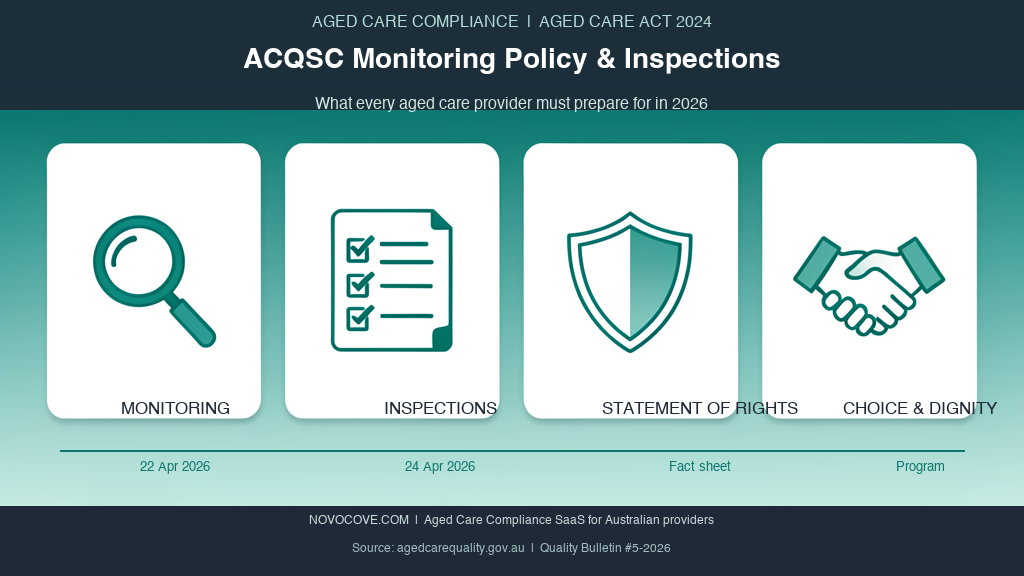
On 22 April 2026, the Aged Care Quality and Safety Commission published its Monitoring Policy, the Commission-wide document that explains how it identifies and assesses risk, responds in proportion to risk, focuses on prevention and early intervention, and addresses the highest risks first. Two days later, on 24 April 2026, the Commission published the Inspections fact sheet, the operational companion to the Monitoring Policy that tells providers exactly what an inspection looks like, when it happens with notice and when it does not, what powers authorised officers have, and what evidence they collect on-site. The two documents were reinforced in Quality Bulletin #5-2026 (released in mid-July 2026) alongside the Statement of Rights fact sheet and the Choice, dignity, respect public information program. Taken together, they are the regulatory layer that turns the Aged Care Act 2024 from legislation into day-to-day operational reality for every Australian Government-funded aged care provider, and they sit underneath every Strengthened Quality Standard assessment, every SIRS notification, and every Statement of Rights claim that the regulator or the older person may raise.
The Commission's framing is explicit in Quality Bulletin #5-2026: "we continue to work with and support providers to meet new responsibilities, uphold people's rights and provide quality care." The Monitoring Policy and Inspections fact sheet are the operational expression of that commitment. For providers, the operational question is no longer whether they have a Strengthened Quality Standards evidence pack — they have to, under the Aged Care Act 2024 that commenced on 1 November 2025 — but whether their evidence pack is built around the four documents the Commission actually uses during an inspection. That is the audit-trail question this guide answers.
This guide walks through what the Monitoring Policy does and does not cover, what the Inspections fact sheet tells a provider to expect during an on-site visit, when an inspection is announced and when it is not, what powers authorised officers have under Chapter 6 of the Aged Care Act and Part 2 of the Regulatory Powers (Standard Provisions) Act 2014, the six enforcement tools the Commission can apply when non-compliance is identified, the Statement of Rights link between an inspection finding and the older person's recourse, and the 90-day operational plan every residential aged care, home care, respite, and CHSP transition provider should be running from today.
What the Monitoring Policy does
The Monitoring Policy is the Commission-wide document that explains how the regulator uses its powers under the Aged Care Act 2024 and the Regulatory Powers (Standard Provisions) Act 2014 to identify, assess, and respond to risks to older people. The policy is in line with the Commission's Regulatory Strategy and guides the way it uses its powers to identify and assess risks, respond in proportion to risk, focus on prevention and early intervention, address the highest risks first, do targeted enquiries, reviews, inspections and investigations, and take action depending on the situation. The action options range from a recommendation to improve, to compliance and enforcement powers, to taking no further action.
The Monitoring Policy applies to four categories of regulated entity: providers, workers, responsible persons, and digital platform operators. Each category has its own evidence obligations under the Aged Care Act 2024, and the Monitoring Policy sets out how the Commission collects information and investigates when those obligations are at risk of non-compliance. The information-gathering powers in Chapter 6 of the Aged Care Act and Part 2 of the Regulatory Powers Act allow authorised Commission officers to enter premises, request information, examine records, observe activity, and take copies of documents. The Monitoring Policy is the document that tells providers what to expect when those powers are exercised against their service.
For a registered provider, the most important sentence in the Monitoring Policy is the one that says the Commission will "focus on prevention and early intervention" and "address the highest risks first." The practical consequence is that providers in sectors with the highest residual risk — residential aged care, dementia-specific care, psychotropic medicine use, restrictive practices, and home care delivery — are the most likely to be subject to the most intense monitoring activities. The Monitoring Policy is not a one-size-fits-all document; it is a risk-stratified document that allocates regulatory attention according to where the risk to older people is highest.
What the Inspections fact sheet actually says
The Inspections fact sheet is the operational companion to the Monitoring Policy. Where the Monitoring Policy is the Commission-wide document that explains why and how, the Inspections fact sheet is the document that tells providers what an inspection looks like in practice. The fact sheet describes when the Commission does an inspection, whether the provider will be notified in advance, who performs the inspection, what happens during the inspection, how long the inspection takes, what happens at the end, and what outcomes the Commission can apply.
The fact sheet states that the Commission may do an inspection when it is concerned there are high levels of risk to older people (for example, after receiving a serious incident response notification, complaint, or feedback), when a provider or worker is not complying (or the Commission thinks they might not be complying) with their obligations and there is a risk to the safety and wellbeing of older people, when the Commission is checking whether progress has been made in fixing non-compliance found in the past, and when doing an inspection is the right way to seek assurance of risk controls.
The fact sheet also makes clear that the Commission may or may not notify the provider before an inspection happens. The Commission may announce inspections (call or write to the provider before inspecting the premises) or arrive without prior notice. The Commission can do unannounced inspections when there is a high risk of harm to an older person, or when the type of evidence the Commission needs is best collected without warning. For providers, the operational implication is that every site must be in a continuous state of inspection-readiness, not a one-off scramble before a scheduled visit.
Authorised Commission officers perform the inspections. The Commissioner appoints them under the Aged Care Act and the Regulatory Powers Act. An officer may have people helping them, known as persons assisting. During an inspection, the officer will hold an entry meeting to give the provider an opportunity to ask questions and explain what to expect, collect information and evidence on-site to assess compliance (which may include asking questions, asking for documents, searching the premises and anything on the premises, examining or observing any on-site activity, inspecting, testing or taking measurements of anything on the premises, taking photos, videos, and any other recordings of anything at the premises, inspecting any document on the premises, and taking information from or making copies of any of these documents), work with the provider to make sure risks to older people are being managed in a timely way and that systems are in place to reduce ongoing risks, assess areas the Commission has found to be non-compliant in the past, and evaluate how effective the provider's actions have been at addressing the risks identified.
If the Commission finds issues or concerns during the inspection, it will raise them with the provider, give the provider an opportunity to respond, and may ask the provider to explain how and when appropriate risk controls will be set up. The Commission may take action to reduce the risk while on-site. For example, the Commission may require specific actions to address a complaint or serious incident, or issue a compliance notice. At the end of the inspection, the officer will hold an exit meeting with the provider, talk through findings, and follow up with a written report that sets out what was found and what will happen next. The provider will have time to consider and respond to the report, and the Commission will consider the response before deciding what to do next.
Announced vs unannounced inspections: the operational rule
The announced vs unannounced rule is the operational pivot of the new regulatory layer. Under the Aged Care Act 2024 and the Inspections fact sheet, the Commission can choose to do either, depending on the risk profile of the provider and the type of evidence the Commission is seeking. The Commission will typically announce an inspection when the issue under investigation is a documented non-compliance that the provider has had a chance to fix and the Commission wants to verify the fix. The Commission will typically do an unannounced inspection when there is a high risk of harm to an older person, when the type of evidence the Commission needs is best collected without warning, or when the Commission wants to observe the service under normal operating conditions.
The practical consequence for providers is that the announcement status of an inspection is no longer predictable. The Commission can announce one inspection and arrive without notice for the next. The provider cannot rely on a lead-time to prepare evidence, fix documentation gaps, or coach staff on answers. Every site has to be in a state of continuous inspection-readiness, with the Strengthened Quality Standards evidence pack, the SIRS notification trail, the Statement of Rights documentation, and the staff training records all current and accessible on the day an authorised officer walks in.
The announced vs unannounced rule also creates a new internal governance test. The Commission's expectation, set out in the Monitoring Policy, is that the provider's monitoring of its own compliance is at least as rigorous as the Commission's monitoring of the provider's compliance. If a provider's self-monitoring catches and fixes an issue before an inspection, the Commission will look more favourably on the provider than if the Commission catches the issue first. If the Commission catches the issue first, the provider's self-monitoring record becomes evidence in the inspection report and the subsequent enforcement decision.
What authorised officers can actually do on-site
The powers that authorised Commission officers can exercise during an inspection are set out in Chapter 6 of the Aged Care Act 2024 and Part 2 of the Regulatory Powers (Standard Provisions) Act 2014. The Monitoring Policy and the Inspections fact sheet operationalise those powers. The powers allow an officer to enter a provider's premises such as a residential care home or provider office. The Commission does not inspect private homes where home care services or specialist aged care programs are delivered. Officers may enter with the provider's consent, or under a warrant or certificate from the Commissioner.
Once on-site, the officer can hold an entry meeting, collect information and evidence, ask questions, ask for documents, search the premises and anything on the premises, examine or observe any on-site activity, inspect, test or take measurements of anything on the premises, take photos, videos and any other recordings of anything at the premises, inspect any document on the premises, take information from or make copies of any documents, bring equipment and materials on-site, and work with the provider to make sure risks to older people are being managed in a timely way. The officer will also assess areas the Commission has found to be non-compliant in the past and evaluate how effective the provider's actions have been at addressing the risks identified.
For a registered provider, the most operationally consequential of these powers are the document inspection and copy power, the photograph and video power, and the on-site observation power. The document inspection and copy power means the officer can take copies of any document on the premises, including staff rosters, training records, care plans, medication charts, incident reports, complaints records, and the evidence pack for the Strengthened Quality Standards. The photograph and video power means the officer can photograph or video any part of the premises, including residents' rooms (with appropriate consent and privacy controls), common areas, kitchens, medication storage, and outdoor areas. The on-site observation power means the officer can observe staff interactions with residents, medication administration, meal service, and any other on-site activity.
The combination of these powers means that an inspection is not a paper exercise. It is an on-site, real-time assessment of the provider's compliance with the Aged Care Act 2024, the Strengthened Quality Standards, the Statement of Rights, and the SIRS notification obligations. The provider's evidence pack has to match what an authorised officer sees, hears, photographs, and copies on the day.
The six enforcement outcomes the Commission can apply
When the Commission decides that a provider is not complying with its obligations under the Aged Care Act 2024, the Commission can apply one or more of six enforcement outcomes. The Inspections fact sheet lists them in escalating order:
- Support the provider to manage risks or harms and address concerns. The Commission may work with the provider to identify the issues, develop a remediation plan, and provide guidance on how to address the concerns. This is the lowest-level outcome and is typically used when the non-compliance is identified early, the provider is cooperative, and the risk to older people is low.
- Do more monitoring. The Commission may increase the frequency or intensity of monitoring activities for the provider. This can include more frequent inspections, more frequent audits, more frequent SIRS notification reviews, and more frequent reporting requirements. The "more monitoring" outcome is typically used when the non-compliance is identified but the provider needs ongoing oversight to confirm the fix.
- Issue a compliance notice or enter into an enforceable undertaking with the provider. A compliance notice is a formal direction from the Commission to the provider to take specific actions to address the non-compliance. An enforceable undertaking is a formal agreement between the Commission and the provider in which the provider commits to take specific actions to address the non-compliance. Both are formal regulatory tools and both are recorded on the provider's regulatory record.
- Take enforcement action if the provider is not willing or able to deliver long-lasting solutions, or if there is unacceptable or system-wide non-compliance. The Commission may take one or more of four enforcement actions: issuing banning orders or infringement notices; applying for fines or injunctions (legal orders) through the courts; referring a matter for criminal prosecution; or varying (changing), revoking (cancelling) or suspending the provider's registration.
The six enforcement outcomes are the operational ceiling on the Commission's regulatory response. The provider's evidence pack, self-monitoring record, response to identified issues, and demonstrated capacity to fix non-compliance are the inputs that determine which outcome the Commission applies. A provider that catches and fixes an issue before the Commission catches it, and that can demonstrate the fix with documented evidence, will typically receive the lowest-level outcome. A provider that fails to respond to identified non-compliance, or that has a pattern of non-compliance, will typically receive the highest-level outcome, including the possibility of registration being varied, revoked or suspended.
The Statement of Rights link between inspection and older person
The Statement of Rights is the document the Aged Care Act 2024 gives to every older person receiving Australian Government-funded aged care. The Statement of Rights outlines the rights that older people have when accessing aged care services and promotes quality and safety. Providers have to ensure that their actions are consistent with the Statement of Rights, which includes ensuring that their aged care services are delivered by workers who also comply with the Statement of Rights.
The Statement of Rights fact sheet (released alongside the Monitoring Policy and Inspections fact sheet) is the operational companion that providers use to demonstrate Statement of Rights compliance. The Statement of Rights fact sheet sets out the obligations on the provider to give the older person information on their rights, a copy of the Statement of Rights, and assistance to understand and exercise those rights. Under section 155 of the Aged Care Rules, the rules prescribe that a provider must provide an older person with information on their rights, a copy of the Statement of Rights, and assist the older person to understand and exercise those rights.
The link between the Statement of Rights and an inspection is that every inspection finding is now assessed against the Statement of Rights, not just against the Strengthened Quality Standards or the SIRS notification obligations. If an inspection finds that the provider has not given an older person a copy of the Statement of Rights, or has not assisted the older person to understand and exercise their rights, the finding is a Statement of Rights non-compliance, not just a Strengthened Quality Standards non-compliance. The Statement of Rights non-compliance can attract any of the six enforcement outcomes on its own, without an accompanying Strengthened Quality Standards or SIRS finding.
The Choice, dignity, respect public information program
The Choice, dignity, respect public information program is the companion program to the Statement of Rights fact sheet. The program is aimed at helping older people, their families and supporters understand their rights and protections in aged care, and at providing a safe and supportive pathway for raising concerns. The program was launched earlier in mid-2026 by the Commission and is being reinforced in Quality Bulletin #5-2026 with new stakeholder kits for providers and peaks.
The research underpinning the program, conducted by WhereTo Research, found that most older people would first raise concerns with their provider, which is encouraging. But for many, a fear of reprisal, of not being listened to or not being taken seriously prevents them from speaking up. The Commission has committed to providing clear information on how to give feedback or make a complaint, and to working with providers to support older people to feel safe and confident in raising concerns. The Choice, dignity, respect program is the consumer-facing expression of that commitment.
For providers, the Choice, dignity, respect program creates a new documentation obligation. Providers are encouraged to promote the program, distribute the stakeholder kits, and use the program materials to support older people to understand their rights. The Statement of Rights documentation, the complaints process, and the feedback pathway are all part of the operational evidence that an authorised Commission officer will look for during an inspection. A provider that has the Strengthened Quality Standards evidence pack but not the Choice, dignity, respect program materials is exposed to a documentation finding under the Inspections fact sheet.
Operational impact for registered providers: the 90-day plan
For a registered aged care provider, the combined regulatory workload of the Monitoring Policy, Inspections fact sheet, Statement of Rights fact sheet, and Choice, dignity, respect program is heavier than the workload under the previous assessment-and-rating regime. The 90-day plan below is the minimum viable response; providers that are further behind on the Aged Care Act 2024 evidence pack should treat it as the recovery plan, not the standard plan.
- Days 1-14: roster the four Commission documents. For every registered service, create a working line item for each of the four Commission documents: Monitoring Policy, Inspections fact sheet, Statement of Rights fact sheet, and Choice, dignity, respect program. Assign a responsible person, a next review date, and an evidence artefact that proves alignment to each. The four documents become a single working line on the compliance dashboard.
- Days 15-30: align the Strengthened Quality Standards evidence pack. Map every Strengthened Quality Standard evidence artefact to one or more of the four Commission documents. The mapping makes it clear which evidence artefacts support which Commission documents, and which evidence artefacts are missing. The Statement of Rights documentation, the complaints process, and the feedback pathway should all appear in the mapping.
- Days 31-60: simulate an unannounced inspection. Walk through the Inspections fact sheet as if an authorised officer is on-site. Hold an entry meeting, collect information and evidence, ask questions, ask for documents, search the premises, examine or observe any on-site activity, inspect, test or take measurements of anything on the premises, take photos, videos, and any other recordings, inspect any document, take information from or make copies of any documents. The simulation should be done by someone other than the responsible person for the evidence pack.
- Days 61-90: lock the Statement of Rights documentation. For every older person on the service's roster, confirm that a copy of the Statement of Rights has been given, that the older person has been assisted to understand and exercise their rights, and that the documentation has been recorded. The documentation should be per-individual, not service-level, and should be accessible on the day an authorised officer walks in.
- Days 91-180: refresh the SIRS notification trail. The SIRS notification obligations under the Aged Care Act 2024 sit alongside the four Commission documents. Refresh the SIRS notification trail so every notifiable incident has a documented notification, investigation, and resolution. The SIRS notification trail is one of the evidence artefacts the Commission will ask for during an inspection.
- Days 181-365: governance and responsible person review. The responsible person obligations under the Aged Care Act 2024 sit alongside the four Commission documents. Run a quarterly responsible person review to confirm that every responsible person is current, that the Statement of Responsibilities is up to date, and that the evidence pack for the responsible person obligations is accessible. The responsible person review is the second-most important governance test after the Statement of Rights documentation.
Failure modes the Commission has flagged in the Inspections fact sheet
The compliance failure modes that the Commission has flagged in the Inspections fact sheet and the Monitoring Policy are useful as a checklist for the 90-day plan. The most common patterns are:
- Missing per-individual records. The most common finding in inspections is incomplete per-individual records: the provider has a service-level summary of "compliant" but no per-individual Statement of Rights documentation, no per-individual SIRS notification, no per-individual care plan review, and no per-individual training record. The Commission treats missing records as missing compliance, regardless of what the service-level summary says.
- Late or absent Statement of Rights distribution. An older person is admitted on 1 June 2026 and the Statement of Rights is given on 15 July 2026, after the admission process is largely complete. The Statement of Rights documentation is non-compliant from 2 June 2026 to 14 July 2026, a 44-day gap. Providers that onboard in bulk need a workflow that triggers Statement of Rights distribution on day 1 of every admission.
- Strengthened Quality Standards evidence pack out of date. The Strengthened Quality Standards evidence pack is current as at 1 January 2026 but has not been refreshed since. The Inspections fact sheet requires the Commission to assess progress against past non-compliance, and a stale evidence pack is treated as evidence of ineffective remediation.
- Complaints process not aligned with Statement of Rights. The complaints process is documented but does not align with the Statement of Rights fact sheet's requirement to assist the older person to understand and exercise their rights. The Commission may issue a compliance notice on this finding alone, without an accompanying Strengthened Quality Standards or SIRS finding.
- Choice, dignity, respect program not promoted. The Choice, dignity, respect program materials are not displayed, not distributed, and not integrated into the admission process. The Commission may issue a finding on this documentation gap, particularly if the inspection is unannounced and the materials are not visible on-site.
- Self-monitoring record absent or out of date. The provider's self-monitoring record is absent or has not been refreshed since the Aged Care Act 2024 commenced on 1 November 2025. The Monitoring Policy explicitly expects provider self-monitoring to be at least as rigorous as Commission monitoring, and an absent or out-of-date self-monitoring record is treated as evidence of ineffective self-monitoring.
How NovoCove supports this
NovoCove's compliance dashboard operationalises the evidence trail that authorised ACQSC officers will look for during an inspection under the Monitoring Policy and Inspections fact sheet. The dashboard aligns every Strengthened Quality Standard evidence artefact with one or more of the four Commission documents — Monitoring Policy, Inspections fact sheet, Statement of Rights fact sheet, and Choice, dignity, respect program — and gives every registered service a single working line on the dashboard with the responsible person, the next review date, and the evidence artefact that proves alignment to each.
The Statement of Rights documentation is maintained per-individual, with the date the Statement was given, the date the older person was assisted to understand and exercise their rights, and the documentation record. The SIRS notification trail is documented per-incident, with the notification, investigation, and resolution recorded against the relevant Strengthened Quality Standard. The complaints process is aligned with the Statement of Rights fact sheet's requirement to assist the older person to understand and exercise their rights, and the feedback pathway is integrated into the admission process so that older people are aware of their rights from day 1.
NovoCove's compliance evidence pack, generated for any ACQSC inspection or Strengthened Quality Standards assessment, includes the per-service monitoring data points aligned to the four published Commission documents, role-based evidence chains for the Statement of Rights fact sheet, automatic refresh of the Inspections fact sheet trigger categories, and a documented audit trail that proves ongoing compliance to authorised Commission officers during both announced and unannounced visits. The platform keeps the Monitoring Policy, Inspections, Statement of Rights and Choice dignity respect documents as a single working line for every registered service, not a one-off compliance scramble.
For registered providers running a quarterly review across the Aged Care Act 2024 evidence pack, the Statement of Rights documentation, the SIRS notification trail, the Strengthened Quality Standards assessment, and the responsible person obligations, NovoCove's calendar view puts the four workstreams in a single working line. The 90-day plan is the minimum viable response, the responsible person review is the governance backstop, and the dashboard is the operational spine of the regulatory workload.
Official sources and further reading
- ACQSC — Monitoring Policy (published 22 April 2026, the Commission-wide document that explains how the regulator identifies, assesses, and responds to risks under the Aged Care Act 2024)
- ACQSC — Inspections fact sheet: what to expect (published 24 April 2026, the operational companion to the Monitoring Policy that tells providers what an inspection looks like and what evidence is collected on-site)
- ACQSC — Aged Care Quality Bulletin #5-2026 (the Commissioner's message and the four-document roll-out that frames Monitoring Policy, Inspections, Statement of Rights fact sheet and Choice, dignity, respect)
- ACQSC — Statement of Rights (the document the Aged Care Act 2024 gives to every older person receiving Australian Government-funded aged care, and the documentation obligation on every provider)
- ACQSC — Choice, dignity, respect: your rights in aged care (the public information program that helps older people, their families and supporters understand and exercise their rights)
- ACQSC — Compliance and enforcement (the operational overview of how the Commission uses its powers under the Aged Care Act 2024 and the Regulatory Powers (Standard Provisions) Act 2014)
- Department of Health, Disability and Ageing — About the new rights-based Aged Care Act (the rights-based framing of the Act, the Statement of Rights, and the Statement of Principles)
This guide is general information and is not legal advice.