Regulatory update
Advanced Child Safety Training for ECEC: The July 2026 Geccko Release, the 3-Month Rule, and the 6-Month Window for Existing Staff
ACECQA has confirmed the Advanced child safety training module is being released on the Geccko platform in July 2026, completing the two-tier national training package that began on 27 February 2026. It is mandatory for persons with management or control, nominated supervisors, persons in day-to-day charge, and staff members who work directly with children. Existing staff have a 6-month transition; new starters have 3 months from commencement. With National Law penalties tripled from 1 January 2026, this guide covers the role-by-role scope, the dual-window rule, the per-educator Geccko mechanics, and the 90-day plan every approved provider needs before the new module goes live.
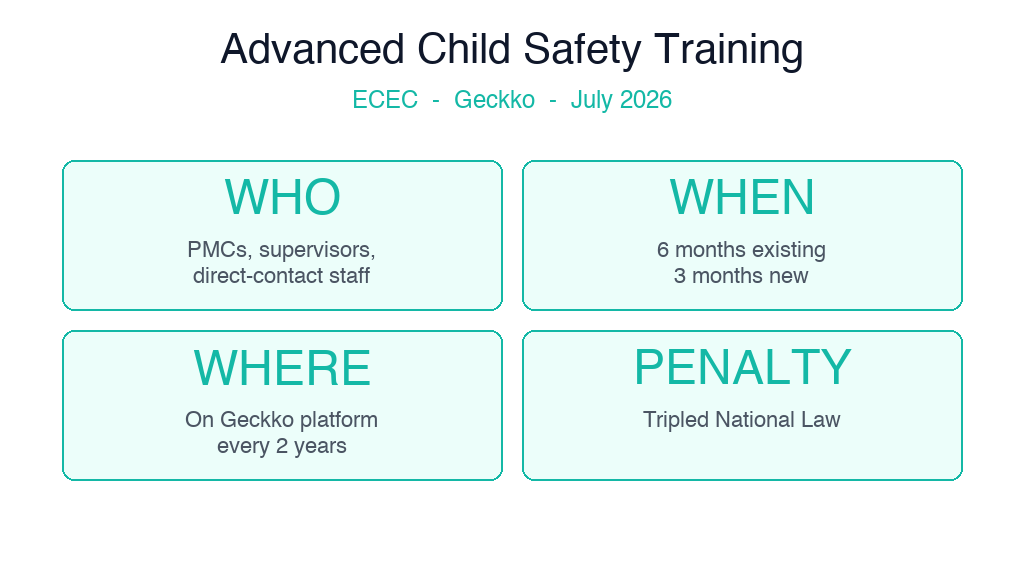
ACECQA has confirmed that the Advanced child safety training module is being released on the Geccko platform in July 2026, completing the two-tier national training package that the Department of Education, the Australian Centre for Child Protection at the University of South Australia, and the Queensland Government began rolling out on 27 February 2026. The Advanced module is the second half of a single national training framework: Foundation is the floor that every relevant worker has to clear, and Advanced is the higher bar that leadership and direct-contact staff have to clear on top of it. The Foundation transition window closes on 27 August 2026; the Advanced module's six-month transition window opens the day it goes live.
The audience for the Advanced module is narrower than the Foundation audience but materially larger than many providers are planning for. Foundation applies to persons with management or control (PMC), nominated supervisors, persons in day-to-day charge, staff members (including Family Day Care coordinators, educators and educator assistants), and regular or semi-regular volunteers (including students on placement studying an approved ECEC qualification). Advanced applies to PMCs, nominated supervisors, persons in day-to-day charge, and staff members who work directly with children. The Foundation audience is the entire in-scope workforce; the Advanced audience is the leadership cohort plus every direct-contact educator. In a 60-educator long day care service, the Foundation cohort is around 70-80 people, and the Advanced cohort is around 60-65.
The release date has been visible on ACECQA's homepage and confirmed in sector reporting from The Sector on 16 July 2026. The Department of Education has indicated it will provide more information ahead of the formal release. The framework has been in flight since Education Ministers agreed the national child safety package in 2025, the same package that delivered the 27 February 2026 Foundation rollout, the 1 July 2026 expansion of the training mandate to IHC and CCCFR services as a condition of approval, and the tripled National Law penalties from 1 January 2026. The Advanced module is the final piece of the package, and the compliance arithmetic is now concrete.
This guide walks through the role-by-role scope, the dual-window rule (six months for existing staff, three months for new starters), the Geccko mechanics for completion tracking, the 90-day operational plan that every approved provider should be running from today, and the audit trail that ACECQA and the Department of Education will expect to see when assessors or compliance officers come knocking in the second half of 2026.
What ACECQA confirmed in July 2026
ACECQA's homepage as of 21 July 2026 carries a single-line confirmation: "Advanced child safety training is coming in July 2026." The relevant sector guidance, dated to the same period and reinforced by The Sector on 16 July 2026, sets out the headline facts:
- Release platform. The Advanced module is published on Geccko, the Australian Government Department of Education's online learning platform for the ECEC sector. There is no alternative delivery channel. Every learner uses a personal Geccko account so completions are recorded against the individual's name, role, employer, and date.
- Mandatory for four role categories. Persons with management or control of a service, nominated supervisors of a service, persons in day-to-day charge of a service, and staff members of the service who work directly with children (including Family Day Care coordinators, educators, and educator assistants). Volunteers, including students on placement, are not in the Advanced cohort; Foundation is sufficient for them.
- 6-month transition for existing staff. Anyone who was employed, engaged or appointed immediately before the date the Advanced module is published must complete it within 6 months of the publication date. If the module is published on, say, 25 July 2026, the existing-staff deadline is around 25 January 2027.
- 3-month rule for new starters. Anyone employed, engaged or appointed after the publication date must complete the Advanced module within 3 months of commencing at the service, or before they start working directly with children, whichever is earlier. This is a strict 3-month clock starting on day 1 of employment.
- Refresher cycle every 2 years. Both Foundation and Advanced have a 2-year currency. The Geccko platform sends reminders at 90, 30, and 7 days before the refresher due date. Missing the refresher cycle puts the staff member out of compliance from the day after the due date.
- Authoring. The package was developed by the Australian Centre for Child Protection (ACCP) at the University of South Australia in partnership with the Queensland Government, on behalf of all Australian governments. The same ACCP authorship covers both modules.
For approved providers, the immediate consequences are operational rather than conceptual. The Foundation cohort (due by 27 August 2026) still has to be closed out, the Advanced cohort (due within 6 months of release) has to be scheduled, and the two-yearly refresher cycle has to be put on a forward-looking tracker. None of these are aspirational tasks; all of them are on the ACECQA and Department of Education assessment radar in the second half of 2026.
Who exactly is in scope for the Advanced module
The role-by-role scope is more granular than the Foundation scope. The four Advanced categories, and the typical number of in-scope individuals per service type, are:
- Persons with management or control (PMC). Every individual who holds a PMC role for the approved provider entity, including directors, the CEO, the operations manager, the responsible person, and any board member or governance committee member with management or control of the service. For a single-site LDC operator, the PMC cohort is typically 1-3. For a multi-site approved provider, the PMC cohort is typically 4-12, often the C-suite and one or two board directors. The PMC requirement is the same as the Foundation requirement, so every PMC has both completions to manage.
- Nominated supervisors. Every nominated supervisor of an NQF-regulated service. A single-site LDC service typically has 1 nominated supervisor; a multi-site operator can have one per service plus an "across services" nominated supervisor. Each nominated supervisor carries both the Foundation completion and the Advanced completion.
- Persons in day-to-day charge. Every person placed in day-to-day charge of a service during periods when the approved provider and the nominated supervisor are not physically present. This is often the most overlooked category. A service that operates across an early-morning shift, a regular shift, and a late-afternoon shift may have 3-4 persons in day-to-day charge per service. All of them need both Foundation and Advanced.
- Staff members who work directly with children. The largest cohort by far: every educator, educator assistant, and Family Day Care coordinator who works directly with children. This is the operational core of the workforce. Family Day Care educators are in scope. FDC coordinator staff are in scope. FDC educator assistants are in scope. OSHC, vacation care, long day care, kindergarten, and preschool educators are all in scope. The typical service has between 60% and 90% of its total workforce in this category.
Roles that are NOT in the Advanced cohort, but are still in the Foundation cohort, are volunteers (including students on placement), one-off visitors, parents, family members, and carers of a child at the service. High school students on work experience who are not studying an approved ECEC qualification are also out of Foundation scope. Approved providers should keep a clear record of which Foundation staff are out of Advanced scope, both for the audit trail and to avoid flagging non-completion on dashboards where the staff member is correctly out of scope.
For a 60-educator long day care service with 1 PMC, 2 nominated supervisors, 4 persons in day-to-day charge, and 60 direct-contact educators, the Advanced cohort is around 67. The Foundation cohort is the same 67 plus 5-10 regular volunteers or placement students, so around 75. The Advanced workload is therefore 90% of the Foundation workload, and the planning and tracking effort is similar for both.
The dual-window rule: 6 months for existing, 3 months for new starters
The most operationally important feature of the Advanced module rollout is the dual-window rule. The two windows are:
- 6 months from publication date, for existing staff. Anyone who was employed, engaged, or appointed immediately before the date the Advanced module is published must complete the module within 6 months of the publication date. The "immediately before" framing is the ACECQA wording and is intended to capture anyone already on the books at the time the module goes live.
- 3 months from commencement, for new starters. Anyone employed, engaged, or appointed on or after the publication date must complete the Advanced module within 3 months of being employed, engaged, or appointed at the service, or before they start working directly with children, whichever is earlier. The "or before they start working directly with children" wording gives providers an effective tightening lever: a new starter can be required to complete the module before their first day with children, even if the 3-month clock has not expired.
The dual-window rule is what makes the Advanced rollout different from the Foundation rollout. Foundation had a single 6-month transition window for the existing workforce (27 February to 27 August 2026) and a 30-day new-starter rule from 14 August 2026. Advanced has a 6-month transition for the existing workforce and a 3-month new-starter rule, with the new-starter clock starting on day 1 of employment rather than from a fixed transition deadline.
The practical consequence is that the Advanced module is a continuous obligation, not a one-off deadline. Once the 6-month transition expires, every new hire in the four in-scope role categories starts a 3-month clock on day 1. The workforce tracker therefore has to be forward-looking and continuous, with automatic 3-month alerts on every new-starter commencement date, not a single countdown to a fixed deadline.
The Geccko mechanics: who, what, when, how it gets recorded
Geccko is the Australian Government Department of Education's online learning platform for the ECEC sector. It is the only approved delivery channel for both the Foundation and Advanced modules. The mechanics for the Advanced module are the same as for Foundation, with the same per-learner record, the same completion date, the same 2-yearly refresher, and the same provider-level reporting dashboard.
The per-learner record holds the learner's name, role, employer (the approved provider), the module completed, the completion date, and the next refresher due date. Each approved provider has access to a reporting dashboard that shows completion status across the whole workforce, the count of unstarted and partially completed modules, the count of overdue refresher cycles, and the count of staff in the 3-month or 6-month transition window. The provider is responsible for ensuring the dashboard is current and for acting on any flagged non-completion before the relevant deadline.
The Advanced module is delivered as an online learning package similar in structure to Foundation. ACECQA has not published the exact time required to complete the Advanced module, but the Foundation module is approximately 2 hours, and the Advanced module is expected to take 1.5-2.5 hours based on sector guidance. The 5-hour per-educator service closure allowance introduced on 27 February 2026 for the Foundation completion carries forward and can be used for the Advanced completion, on the same per-educator basis (for IHC) or per-service basis (for centre-based LDC, kindergarten, OSHC, and vacation care).
For Western Australian providers, ACECQA has flagged that Western Australia is currently moving to Applied Law and the proposed changes relating to child safety will not apply in Western Australia until sometime after February 2026. WA providers should refer to the WA regulatory authority for current commencement dates and not assume the 3-month and 6-month windows apply on the same dates as the rest of the country. All other states and territories are in scope from the publication date.
What the tripled National Law penalties mean for the Advanced rollout
From 1 January 2026, maximum penalties under the Education and Care Services National Law and National Regulations were tripled. The change is the most material compliance consequence in the framework since the 2018 amendments and was confirmed by the Department of Education in its "A year of action to strengthen child safety in early childhood education and care" announcement. The same penalty regime applies to the Advanced module rollout, because the Advanced module is a condition of approval for the workforce, not a discretionary improvement program.
Under the tripled regime, the maximum penalties for a Category 1 breach of the National Law are now three times the previous amount. The current Category 1 penalty units are set at 60 penalty units for individuals and 300 penalty units for bodies corporate, after the tripling. The previous figures were 20 and 100 respectively. For approved providers, the financial exposure on a single breach finding is now in the tens of thousands of dollars at the individual level and the hundreds of thousands of dollars at the corporate level, before any enforceable undertaking, suspension, or cancellation of approval is added on top.
The penalty regime is the enforcement layer that gives the Advanced module rollout its teeth. The Foundation rollout is a condition of approval, the Advanced rollout is a condition of approval, and the penalty for a finding of non-completion under the National Law now starts at 60 penalty units. The combination of mandatory training, tripled penalties, and ACECQA's published priority on child safety in the 2026 NQS refinements (which renamed Element 2.2.3 as Child Safety and Protection) means the Advanced module is being introduced into a compliance environment that is materially stricter than the one that has applied at any earlier point in the NQF.
Operational impact for approved providers: the 90-day plan
For an approved provider, the Advanced module release in July 2026 lands on top of the Foundation deadline of 27 August 2026, the 1 July 2026 NQF licence fee increase in NSW and Victoria, and the 1 July 2026 expansion of the training mandate to IHC and CCCFR services. The combined compliance workload for the 2026-27 financial year is heavier than any prior year. The 90-day plan below is the minimum viable response; providers that are further behind on Foundation should treat it as the recovery plan, not the standard plan.
- Days 1-14: roster the Advanced cohort. Pull the Foundation completion roster from Geccko and the Foundation non-completion roster, classify every in-scope staff member into the four Advanced categories (PMC, nominated supervisor, person in day-to-day charge, direct-contact staff), and produce a per-individual completion target date. Existing staff get a 6-month deadline. New starters from the publication date forward get a 3-month clock per individual hire.
- Days 15-30: schedule the Advanced closures. Map each individual's 5-hour closure allowance to a date that does not collide with the Foundation closure window still in flight for any staff member who has not yet completed Foundation. For IHC and FDC operators, the closure runs per educator; for centre-based services, the closure runs per service between 5 pm and midnight. Multiple shorter blocks are permitted within the annual cap.
- Days 31-60: close out Foundation, start Advanced. For services that have not yet closed out Foundation, the priority is the 27 August 2026 deadline. Advanced is layered on top. The two rollouts use the same 5-hour closure allowance, so a service that has used 3 of its 5 hours on Foundation can use the remaining 2 hours for Advanced, with an additional block scheduled before the 6-month Advanced transition ends.
- Days 61-90: lock the new-starter 3-month rule. Update the onboarding workflow so every new hire in the four Advanced categories triggers a 3-month Advanced completion clock on day 1 of employment, with a 90-day, 30-day, and 7-day reminder cadence, and a documented record of the per-individual completion target. For Family Day Care operators, the 3-month clock applies to new FDC educators from the publication date forward.
- Days 91-180: refresher cycle and audit trail. Once the Advanced module is live and Foundation is closed out, the next step is the 2-yearly refresher cycle. Every Foundation and Advanced completion is now subject to a 2-year refresher due date, with reminders at 90, 30, and 7 days. The audit trail for the ACECQA assessment and the Department of Education compliance visit is built from the per-individual Geccko records, not from a service-level completion summary.
- Days 181-365: PMC and governance. The PMC cohort is the highest-risk group because they are the most likely to be missed on a service-level dashboard. Run a quarterly PMC roster review against the approved provider's governance records, and re-roster new PMCs into the Geccko system within 14 days of appointment. The same review applies to nominated supervisors and persons in day-to-day charge.
Failure modes the Department has flagged in similar compliance activity
The compliance failure modes that have appeared in Department of Education activity on the Foundation rollout and the IHC/CCCFR expansion are useful as a checklist for the Advanced rollout. The most common patterns are:
- Missing per-individual records. The most common finding in compliance visits is incomplete per-individual records: the provider has a service-level summary of "completed" but no per-individual Geccko certificate, no per-individual completion date, and no per-individual refresher due date. The Department treats missing records as missing completions, regardless of what the summary says.
- Late new-starter completions. A new educator commences on 15 August 2026 and the 3-month Advanced window expires on 14 November 2026. If the Advanced completion is not recorded on Geccko by 14 November, the educator is non-compliant from day 91. Providers that onboard in bulk need a workflow that triggers the 3-month clock on day 1 of every new hire in the four categories.
- PMC roster drift. A board director leaves in March 2026 and is replaced in May 2026; the Geccko PMC roster is not updated until August 2026. The new PMC is non-compliant for the period between appointment and roster update. A quarterly PMC roster review against the approved provider's governance records is the simplest mitigation.
- Person in day-to-day charge overlooked. The person in day-to-day charge category is the most commonly missed in the Foundation rollout and is likely to be the most commonly missed in the Advanced rollout as well. Every approved provider should maintain a per-service roster of persons in day-to-day charge, with start and end dates, and ensure every individual on the roster has both completions on Geccko.
- Closure hours used for non-training purposes. The 5-hour closure allowance is specifically for the completion of the Geccko Foundation or Advanced module. Using the closure for staff meetings, planning days, or professional development unrelated to the mandatory training is a misuse of the allowance and can be reclaimed.
- Refresher cycle drift. A staff member who completed Foundation on 1 September 2026 is due for Foundation refresher by 1 September 2028, and Advanced refresher by 1 September 2028 if the Advanced completion is also on 1 September 2026. If the refresher is missed, the staff member is non-compliant from 2 September 2028. The two-yearly cadence requires a forward-looking tracker that alerts at 90, 30, and 7 days, not a backward-looking one that flags non-completion after the fact.
How NovoCove supports this
NovoCove's compliance dashboard tracks Geccko child safety training completion for every approved provider, with separate Foundation and Advanced completion records, role-based scope (PMC, nominated supervisor, person in day-to-day charge, direct-contact staff, and volunteers / students), automatic 3-month new-starter and 6-month existing-staff countdown alerts, and a documented audit trail that proves compliance to ACECQA and the Department of Education.
The platform integrates the Geccko completion records and the ACECQA roster updates into a single workforce compliance view, with RAG status per individual and per service. The PMC roster is maintained as a separate compliance artefact with its own alert cadence, the person in day-to-day charge roster is maintained per service, and the direct-contact staff cohort is the largest grouping on the dashboard. Volunteers and students on placement appear in the Foundation cohort only, not in the Advanced cohort, and the platform flags the role classification automatically based on the Geccko record.
NovoCove's compliance evidence pack, generated for any ACECQA assessment and rating visit or Department of Education compliance visit, includes the per-individual Geccko certificate, the per-individual completion date, the per-individual refresher due date, the Foundation and Advanced classification, the role category, the 5-hour closure record for every closure used in the period, and the new-starter onboarding timestamp with the 3-month or 6-month transition target. The platform also tracks the 5-hour per-educator or per-service closure allowance as a calendar-year budget, with the unused hours resetting on 1 January each year.
For approved providers running a single quarterly review across the Foundation deadline, the Advanced rollout, the IHC and CCCFR expansion, the CCS rate changes from 6 July 2026, and the 2026 NQS refinements, NovoCove's calendar view puts the four milestones in a single working line. The window between today and 27 August 2026 is finite, the Advanced window is 6 months from publication, the new-starter 3-month rule is continuous, and the refresher cycle is 2 years. The dashboard is the operational spine of that compliance workload.
Official sources and further reading
- ACECQA — Child Safety and Child Protection Training (the two-tier Foundation and Advanced framework, role-by-role scope, and timeframes)
- Department of Education — A year of action to strengthen child safety in early childhood education and care (the tripled National Law penalties from 1 January 2026)
- Department of Education — Changes to legislation to strengthen child safety in early education (the 1 July 2026 IHC and CCCFR condition-of-approval expansion)
- Australian Centre for Child Protection (UniSA) — National Child Safety Training for the ECEC Sector (the ACCP-authored Foundation and Advanced modules)
- Geccko — Australian Government Department of Education online learning platform (the only approved delivery channel)
- The Sector — Advanced child safety training to be released for ECEC workforce (16 July 2026 sector coverage of the July 2026 release and dual-window rule)
This guide is general information and is not legal advice.