Aged care financial compliance
ACQSC Late QFR Infringement Notices and Name Publication 2026: The 4 August 2026 Deadline, Section 166-340 of the Aged Care Rules 2025 and the 14-Day Compliance Workflow Every Residential Provider Must Run
On 1 August 2026 the Aged Care Quality and Safety Commission published Aged Care Quality Bulletin #7-2026, confirming that it is taking regulatory action against providers who repeatedly submit their Quarterly Financial Report late. The Commission confirmed in writing that it can issue infringement notices and publish the names of non-compliant providers. The Q4 2025-26 QFR was due 35 days after 30 June 2026 — on 4 August 2026. Every residential aged care and Multi-Purpose Service provider must now evidence governance, calendar and approval workflows behind every QFR submission. Here is the operational reading of the bulletin, the action menu the regulator has confirmed, and the 14-day compliance workflow that closes the gap before the next QFR deadline.
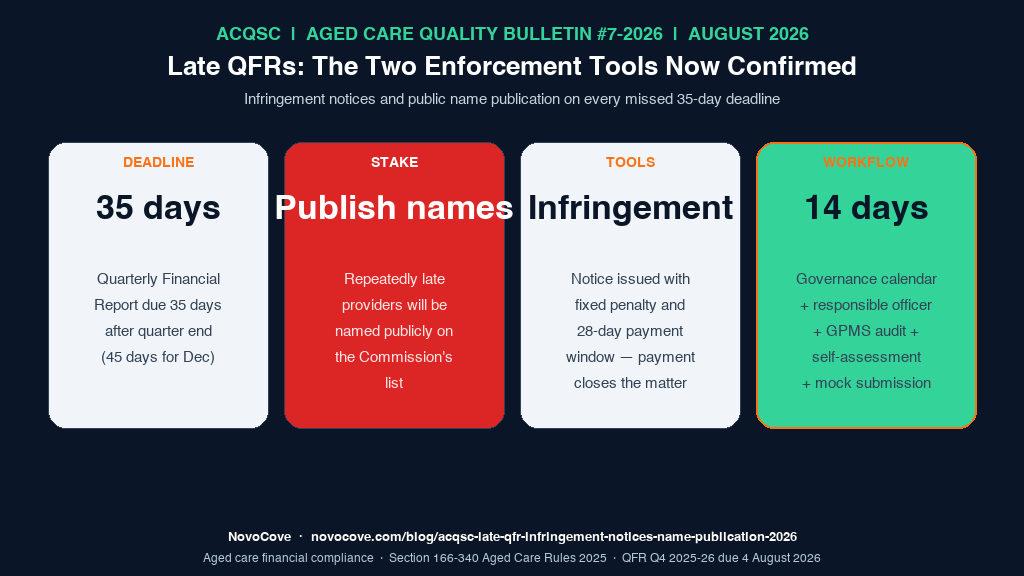
On 1 August 2026 the Aged Care Quality and Safety Commission published Aged Care Quality Bulletin #7-2026, and the bulletin includes a single short paragraph that every residential aged care and Multi-Purpose Service provider should read as a stand-alone enforcement signal. The Commission confirmed in writing that it is taking regulatory action against providers who repeatedly submit their Quarterly Financial Report (QFR) late — and that the action menu now includes both infringement notices and publishing the names of non-compliant providers. The Q4 2025-26 QFR was due 35 days after the end of the quarter — on 4 August 2026. Here is the operational reading of the bulletin, the action menu the regulator has confirmed, and the 14-day compliance workflow every provider should run before the next QFR deadline.
Why Bulletin #7-2026 changes the QFR risk profile
The QFR has been a mandatory financial report since 1 July 2022. Section 166-340 of the Aged Care Rules 2025 prescribes the form, the content, and the deadline. The Department's reporting calendar is published annually and copied into the Commission's provider reporting requirements page. The deadline is hard: 35 days after the end of each quarter (45 days for the December quarter). The Commission's own provider financial reporting page is unambiguous: there are no provisions under the Aged Care Act to grant an extension for submitting reports, and providers who submit reports late are considered non-compliant.
Bulletin #7-2026 changes the risk profile for a single, concrete reason. The bulletin is the first time the Commission has named the two specific enforcement tools it is prepared to use for late QFR submissions. The bulletin also confirms that the Commission is monitoring reporting data and looking into providers who continue to submit late, and that the regulator views late QFRs as a failure of internal financial supervision — not as an administrative inconvenience. The operational consequence is that a single missed QFR is no longer a quiet event; it is a measurable compliance breach on the Commission's published tracking dashboard, and a second missed QFR is sufficient for the Commission to start the infringement notice and name publication process.
What changed and when — the four operative changes from Bulletin #7-2026
Bulletin #7-2026 is the 28-page mid-year sector update from Commissioner Liz Hefren-Webb. Most of the bulletin is operational guidance on existing obligations. The four operative changes for QFR compliance sit inside a single short section titled "Late financial reporting" and are reinforced by the bulletin's cover note from the Commissioner. Each one is a discrete update to the Commission's enforcement posture, and each one creates a compliance obligation that providers can prepare for in advance.
- Confirmed enforcement action against late QFR submissions. The bulletin states the Commission "is taking action against providers who repeatedly submit their Quarterly Financial Report (QFR) late." The action is described as a regulatory action in line with the Commission's existing powers under the Aged Care Act 2024 and the Aged Care Rules 2025.
- Infringement notices are confirmed as a live enforcement tool. The bulletin explicitly lists "issuing infringement notices" as one of the two consequences the Commission can apply. Infringement notices carry a fixed penalty that the provider can either pay (as an alternative to court proceedings) or contest. The Commission does not need to prove fault — the late QFR is the breach.
- Publishing the names of non-compliant providers is confirmed as a live enforcement tool. The bulletin lists "publishing the names of non-compliant providers" as the second consequence. This is the most consequential of the two tools: a published name is a public compliance signal to residents, families, referrers, the Department, and the home care transition pathway. Recovery from a published name is much slower than payment of an infringement notice.
- Governance — not paperwork — is the Commission's stated remedy. The bulletin tells providers they need "robust financial supervision" and a "strong financial and prudential management system" to meet the reporting deadline. The bulletin directs providers to the Commission's Financial and Prudential Management Standard checklist and the Aged Care Financial and Prudential Standards. The operational message is that the Commission will not accept a missed QFR as a one-off administrative failure — it will ask the provider to show the governance framework that was supposed to prevent the breach.
The QFR deadline calendar — the four reporting dates every provider must pre-book
The QFR deadline is not a single date. It is a recurring quarterly cycle with a fixed offset from the end of each quarter. The cycle for the 2025-26 financial year is set out in the Commission's Aged Care Financial Reports calendar 2025-26, and the pattern repeats every year. Section 166-340 of the Aged Care Rules 2025 and the Multi-Purpose Service Program Manual both confirm that the deadline is 35 days after the end of the quarter, with one specific exception: 45 days for the quarter ending 31 December. The four-quarter calendar for a standard 30 June financial year is therefore:
- Q1 2025-26 (1 July to 30 September 2025) — QFR due 4 November 2025.
- Q2 2025-26 (1 October to 31 December 2025) — QFR due 14 February 2026 (45-day rule).
- Q3 2025-26 (1 January to 31 March 2026) — QFR due 5 May 2026.
- Q4 2025-26 (1 April to 30 June 2026) — QFR due 4 August 2026 (this is the deadline the bulletin was published against).
The 2026-27 financial year follows the same pattern. The Q1 2026-27 QFR will be due on or around 4 November 2026, depending on the calendar. The Q2 2026-27 QFR will be due on or around 14 February 2027 (45-day rule). Providers who cannot show that the cycle is pre-booked in their governance calendar — not in a finance-team spreadsheet — are the providers Bulletin #7-2026 is targeting.
The enforcement action menu — what the Commission can now compel
The action menu the Commission has confirmed in Bulletin #7-2026 is the practical core of the bulletin. Each tool is a distinct regulatory instrument, and each one has its own operational pattern. Providers that understand the menu are in a position to negotiate; providers that do not understand the menu are in a position to absorb the cost of the first action.
- Infringement notices (fixed penalty). Infringement notices are issued under the regulatory powers in the Aged Care Act 2024. The notice sets out the alleged breach, the fixed penalty, and the 28-day payment window. Payment closes the matter without admission. Contesting the notice opens a court process. The Commission's published approach is to issue infringement notices where the breach is clear on the facts and the provider has not engaged.
- Publishing the names of non-compliant providers. Name publication is a published-compliance signal the Commission has used for other late-reporting regimes (for example, the Annual Prudential Compliance Statement). The published list records the provider name, the type of report, and the period of the breach. Once a name is published it is available to residents, families, journalists, and the Department. The signal is reputational, not financial, and the recovery time is long.
- Targeted and prudential reviews. The Commission can open a targeted review into a provider's financial supervision and governance if the late QFR pattern is consistent. The review asks the provider to demonstrate the governance framework behind the QFR: the calendar, the responsible officer, the approval workflow, the reconciliation evidence, and the audit trail. A targeted review is more resource-intensive than an infringement notice and is a clear escalation signal.
- Regulatory action under the Aged Care Act 2024. The Commission can take regulatory action if the foundation period of the breach is repeated. The action menu under the Act includes notices, enforceable undertakings, sanctions, and revocation or variation of registration. The bulletin signals that the Commission views repeated late QFRs as a foundation for this kind of escalation.
Operational impact for providers — six things to do in the next 14 days
Bulletin #7-2026 is live now. The Q4 2025-26 QFR was due on 4 August 2026, and the Q1 2026-27 QFR will be due approximately 92 days later. Providers should treat the next 14 days as a working compliance sprint, not a planning exercise. Six concrete actions, in priority order, will put every provider in the strongest possible position when the Commission next reviews QFR compliance.
- Confirm the QFR was submitted on time and the receipt is stored. Open the GPMS provider portal and confirm the Q4 2025-26 QFR was submitted on or before 4 August 2026. Download the submission receipt and the system-generated acknowledgement. Store both in a QFR evidence folder named by quarter. The receipt is the first document the Commission will ask for if the provider's submission comes onto the Commission's monitoring dashboard.
- Pre-book the QFR deadline for every quarter of the 2026-27 financial year. Open the governance calendar. Add the four 2026-27 QFR deadlines as recurring events with an internal lead-time of 7 days. The QFR is not a single date — it is a calendar object the governing body should approve at the next board meeting. The repeat pattern is the safeguard against a single missed deadline.
- Document the responsible-officer workflow for declarations. The QFR declaration must be signed by a director of the body corporate or a member of the provider's governing body for unincorporated providers. The provider must be able to evidence the workflow that produces a signed declaration: the responsible officer, the data sources, the reconciliation, the approval, the submission. The audit trail is the only defence against a name-publication decision.
- Confirm GPMS access and digital readiness. The QFR is submitted through the Government Provider Management System (GPMS). Every reasonable officer who may need to submit the QFR must have a working GPMS account, two-factor authentication, and a fallback signer. A GPMS account that expired five days before the deadline is no defence against a late submission.
- Audit the financial and prudential management framework. The Commission is asking providers to use the Financial and Prudential Management Standard checklist to assess their current practices. The checklist is the Commission's stated baseline. Providers who have not done a documented self-assessment against the checklist in the last 12 months are the providers the Commission will ask the hardest questions of.
- Run the 14-day compliance workflow (below) before the next QFR deadline. The 14-day workflow below is the minimum viable governance cadence for an on-time QFR submission. The workflow is designed to be repeatable, so the same cadence runs every quarter with no calendar drift.
Step-by-step workflow — the 14-day QFR compliance plan
The 14-day plan below is the minimum viable workflow for any registered residential aged care or Multi-Purpose Service provider that wants to be in the strongest possible position when the Commission next reviews QFR compliance. The plan assumes a single provider with a small finance team; larger providers can run the same workflow across multiple services in parallel with a single responsible officer for each submission.
- Day 1 to Day 2 — Confirm the Q4 submission and store the evidence. Open GPMS. Confirm the Q4 2025-26 QFR was submitted on or before 4 August 2026. Download the submission receipt and the system-generated acknowledgement. Store both in a QFR evidence folder with the responsible officer's name and the date of the approval. If the QFR has not been submitted, escalate to the responsible officer today and document the escalation.
- Day 3 to Day 5 — Pre-book the 2026-27 QFR deadlines in the governance calendar. Add the four 2026-27 QFR deadlines as recurring events. Set an internal lead-time of 7 days so the responsible officer and the finance team have a working week before the deadline. Add the responsible officer as the owner of each event. Add a backup officer as a co-owner. Confirm the calendar is reviewed at the next board meeting and the review is minuted.
- Day 6 to Day 8 — Document the responsible-officer workflow. Write a one-page QFR workflow that records the responsible officer, the data sources, the reconciliation step, the resolution step, the approval workflow, the submission step, and the evidence storage step. The workflow is the document the Commission will ask for if the provider's submission pattern is reviewed. The workflow must be dated and signed by the responsible officer.
- Day 9 to Day 10 — Confirm GPMS access and digital readiness. Audit every GPMS account for the responsible officer, the backup officer, and the finance team. Confirm the accounts are active, the two-factor authentication is in place, and there is a documented fallback for a forgotten password or an unavailable device. Re-issue credentials if necessary. The audit trail is the evidence that the provider can submit on time.
- Day 11 to Day 12 — Run the Financial and Prudential Management Standard self-assessment. Use the Commission's Financial and Prudential Management Standard checklist to assess the provider's current practices. Document the assessment, the gaps, and the remediation plan. The remediation plan is the evidence the provider is taking the obligation seriously. The self-assessment is the first thing the Commission will ask for in a targeted review.
- Day 13 to Day 14 — Run a mock QFR submission and confirm the cadence. Run a mock QFR submission under the new cadence. Confirm the responsible officer, the data sources, the reconciliation, the approval and the submission all work to the published deadline. Document the mock submission, the time it took, and the evidence that the cadence is repeatable. The mock submission is the operational evidence the cadence works.
What the Commission will look at during a QFR compliance review
Bulletin #7-2026 is silent on the exact evidence list the Commission will request, but the bulletin's cover note and the Commission's existing compliance review patterns give a clear direction. The review will focus on the governance framework behind the QFR, not on the QFR content itself. The Commission will look at:
- Submission pattern. The Commission will look at the last four QFR submissions and the submission dates against the statutory deadlines. A single missed QFR is a measurable breach; two missed QFRs in a 12-month period is the pattern that triggers the enforcement tools.
- Submission evidence. The Commission will look for the GPMS submission receipt, the system-generated acknowledgement, the responsible officer's signed declaration, and the evidence folder. The combined evidence is the first line of defence against a name-publication decision.
- Governance framework. The Commission will look for the governance calendar, the responsible-officer workflow, the GPMS access audit, the Financial and Prudential Management Standard self-assessment, and the remediation plan. The governance framework is the second line of defence if the submission pattern is reviewed.
- Internal financial supervision. The Commission will look for evidence of robust financial supervision: the cadence of internal finance reporting, the responsible officer's review of the QFR data, the reconciliation of the QFR data to the general ledger, and the approval workflow. The internal financial supervision is the evidence the provider can submit on time.
- Engagement history. The Commission will look at the provider's engagement with the Commission's prudential mailbox ([email protected]) and the financial viability mailbox ([email protected]). A provider that has engaged proactively is in a different position to a provider that has not engaged at all.
How NovoCove handles this
NovoCove gives aged care providers a single source of truth for the artefacts the Commission will request under Bulletin #7-2026. The platform centralises the QFR deadline calendar, the responsible-officer workflow, the GPMS access audit, the Financial and Prudential Management Standard self-assessment, and the QFR evidence folder in one workflow. The QFR deadline calendar is generated from the same platform that records the responsible officer, the data sources, the reconciliation, the approval, the submission, and the evidence storage, so the calendar and the audit trail reconcile on the same screen and the export is one click rather than a paper chase.
The same platform covers every other aged care compliance obligation your service is operating under — the Support at Home pricing framework, the Liquidity Standard, the Care Minutes Supplement quarterly reporting, the 24/7 RN rule, the SIRS incident reporting workflow, the Quality Standards evidence pack, the registered provider reporting obligations under the new Aged Care Act, and the ACQSC RB 2026/1 v2.0 pricing bulletin. If your service is in scope of Bulletin #7-2026, NovoCove is built to answer it.
Sources / further reading
- Aged Care Quality Bulletin #7-2026 — Aged Care Quality and Safety Commission (T1, 1 August 2026)
- Provider financial reporting requirements — Aged Care Quality and Safety Commission (T1)
- Aged Care Financial Reports calendar 2025-26 — Aged Care Quality and Safety Commission (T1, PDF)
- Financial and Prudential Management Standard checklist — Aged Care Quality and Safety Commission (T1, PDF)
- Financial and Prudential Standards — Aged Care Quality and Safety Commission (T1)
- Aged Care Rules 2025 — Federal Register of Legislation (T1, includes section 166-340 QFR provisions)
- Multi-Purpose Service Program Manual — Department of Health, Disability and Ageing (T1, January 2026)
- Quarterly Financial Report Q2 2025-26 Guidance and FAQs — Department of Health, Disability and Ageing (T1, September 2025)
- Targeted reviews and audits — Aged Care Quality and Safety Commission (T1)
This guide is general information and is not legal advice.