Working with children compliance
Victoria WWC Connect: The 19 October 2026 Employer Deadline for Every Child-Related Service
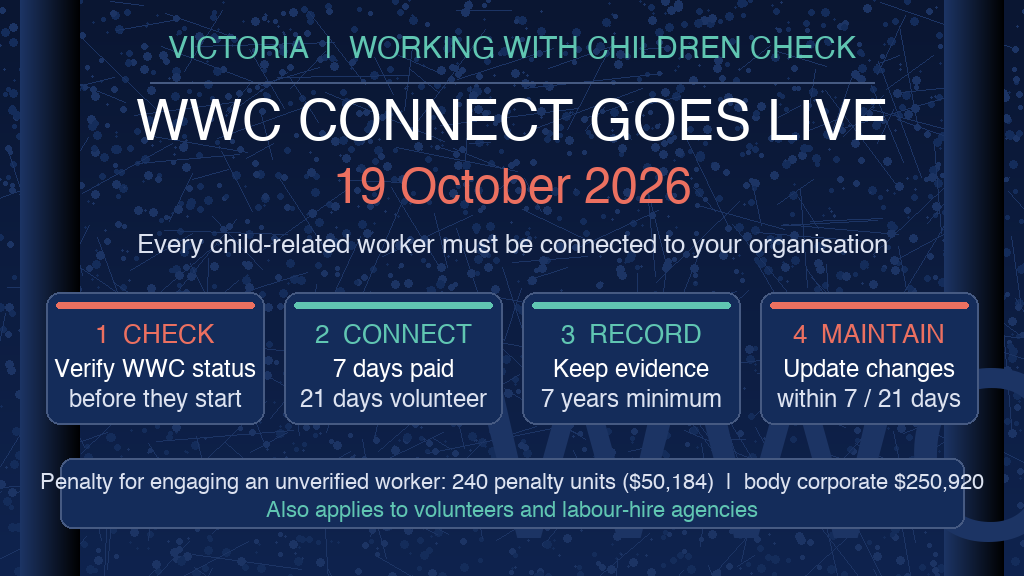
From 19 October 2026, the Victorian Working with Children Check changes from a document you file to a live relationship you record. Every organisation and sole trader that engages anyone in child-related work must verify that person's clearance before they start, connect them to the organisation in the new WWC Connect online system within 7 days (paid workers) or 21 days (volunteers), keep verification records for at least seven years, and report any changes to the Social Services Regulator. At the same time, mandatory online child safety training becomes part of every WWC Check application and renewal. For childcare services, schools, tutoring, sport and any organisation running activities for children, this is a process change that lands with hard deadlines and real penalties, up to two years imprisonment or $250,920 for a body corporate.
From 19 October 2026, Victoria's Working with Children (WWC) Check scheme stops being a paper credential and becomes a live, regulator-visible record of who works with children where. The trigger is the introduction of WWC Connect, a new online service run through Service Victoria that records the connection between your organisation and every person you engage in child-related work. It is the direct implementation of recommendation 6.1(c) of the 2025 Rapid Child Safety Review, which called for the regulatory framework to require organisations to verify and report when they engage someone in child-related work, so the regulator can track worker movements across organisations over time.
Background: how the WWC Check worked before 19 October
Victoria's Working with Children Check is established under the Worker Screening Act 2020 (Vic). Until now, the scheme's machinery sat almost entirely on the individual: a person applies for a clearance, holds it for five years, and adds the organisations they work for to their own WWC profile as part of the application process. Employers were expected to sight or verify a card, but the regulator had no live, structured record of who was working with children at which organisation at any point in time.
The July 2026 reforms began tightening this: the Social Services Regulator (SSR) gained stronger information-sharing powers, more risk-based assessment, and greater ability to act on suitability concerns. The October changes complete the loop. Instead of the worker volunteering their workplaces, the organisation now has a legal duty to verify eligibility before work starts, to connect the person to the organisation in WWC Connect within a set window, and to keep the record current. The regulator gets an accurate, up-to-date map of where cleared workers are actually working and volunteering, and can notify every organisation connected to a worker the moment a clearance is suspended or revoked.
What changes on 19 October 2026
Four obligations land on organisations and sole traders that engage anyone in child-related work. The Victorian Government summarises them as Check, Connect, Record, Maintain:
- Check, before a person starts child-related work, verify their eligibility using the WWC status checker (family name plus WWC application or card number). You must verify before whichever happens first: the day they first perform child-related work, or the day you enter an arrangement (written or verbal) to engage them.
- Connect, once engaged, connect the person to your organisation in WWC Connect: within 7 days for paid workers and within 21 days for volunteers. Labour-hire agencies must connect workers they list for child-related work within 7 days.
- Record, keep evidence of every verification for at least seven years after the person stops doing child-related work for you. This includes name, address, email and phone; how you verified eligibility; and start and stop dates.
- Maintain, update the record when the worker starts, stops, changes roles or changes contact details: within 7 days for paid workers, within 21 days for volunteers, and within 7 days for your own organisation's details.
Alongside WWC Connect, mandatory online child safety training becomes part of the WWC Check itself from 19 October 2026. Every person applying for a new clearance, and every existing clearance holder renewing on or after that date, must complete the training before their clearance is assessed. That means a renewal now takes longer and involves a training step, plan renewals accordingly, because a clearance that lapses on the regulator's side cannot be worked around.
Who is affected
The obligations apply to any organisation or sole trader that engages a worker or volunteer in child-related work, that is, work at or for a service, body or place that usually involves direct contact with children, regardless of whether the contact is supervised. It does not include occasional direct contact that is incidental to the work. Child-related work covers childcare and education and care services, schools, tutoring and coaching, sports clubs, cultural and recreational groups, religious organisations, babysitting and party services, and photography services for children.
Two points are easy to miss. First, volunteers count: if a volunteer does child-related work for you, you must connect them within 21 days, and for ongoing volunteers with no fixed end date, the SSR expects you to confirm annually whether they wish to continue, and to update WWC Connect if they no longer do. Second, ECEC services that already use the National Early Childhood Worker Register are still affected: the National Register records workers in specific education and care roles under the NQF, while WWC Connect records everyone doing child-related work. Both registers run in parallel, and a Victorian ECEC service must maintain both. The only significant carve-out is that teachers and early childhood teachers currently registered with the Victorian Institute of Teaching (VIT) are exempt from holding a WWC Clearance for their teaching role, but if a VIT-registered teacher does child-related work outside teaching (for example, tutoring or coaching), they must be connected in WWC Connect.
Operational impact for providers
- Re-verify everyone, including people who show you a card. The Victorian Government is explicit: even if a worker shows you their WWC Clearance, you must still verify their current status through the status checker before engaging them, a card can be suspended or revoked and the worker may not know or say so.
- Treat engagement as the clock-start, not the first shift. You engage a person on the day they first perform child-related work, or the day you enter a written or verbal arrangement, whichever is earlier. A verbal offer made two weeks before orientation starts the 7-day connection window, not the first day of work.
- Re-engagement means re-connect. If you stop engaging someone (end of term, season, project) and re-engage them later, you must verify and connect them again each time. There is no standing connection that survives a break.
- Existing workers are strongly encouraged but updates are mandatory. Connecting workers engaged before 19 October is not required, but if an existing worker changes their name or contact details, or stops doing child-related work for you after 19 October, you must update that in WWC Connect within the applicable window.
- Records are a seven-year liability. Failing to keep the required verification records is itself an offence, 5 penalty units ($1,045.50) for a person and 10 penalty units ($2,091) for a body corporate from 19 October 2026.
- You will be told about clearance status changes. Once connected, you will be automatically notified if a worker's clearance is suspended, revoked or expires. If a clearance is suspended, it is an offence to keep the person engaged in child-related work, so act on these notifications promptly.
A 5-step transition plan
WWC Connect access opens on 19 October, and the SSR has said it will take a reasonable and proportionate approach to enforcement while organisations establish new systems. It still helps to get your processes in place early. Here is a simple plan you can start now and finish in the first weeks after 19 October:
- Step 1 (now): review your engagement records. Pull the current list of every paid worker and volunteer who does child-related work for you. For each person, confirm you hold their correct name, WWC card or application number, address, email and phone, the exact fields WWC Connect will ask for. Flag anyone where the card number is missing or the details look stale.
- Step 2 (now, continuing after 19 October): verify the current workforce. Start running the list through the WWC status checker now, and finish in the first weeks after 19 October if needed. This is a good way to find any expired card or suspended clearance early.
- Step 3 (first weeks after 19 October): assign ownership. Name one person (or role) as the WWC Connect administrator. Decide who connects new workers at onboarding, who is responsible for the 7-day window, and who handles volunteers' 21-day window. Document the process so it survives staff holidays and turnover.
- Step 4 (first weeks after 19 October): add it to onboarding. Add the verify-then-connect steps to your recruitment and onboarding checklist: verification happens before the first shift, connection happens within 7 days of engagement (which may be earlier than the first shift), and the seven-year record is filed with the worker's file. For volunteers, set a 21-day reminder at the point of offer.
- Step 5 (first month after 19 October): check notifications and tell staff about renewals. Confirm how your organisation will receive and action WWC Connect notifications. Then tell every clearance holder whose renewal falls due after 19 October that renewal now includes mandatory child safety training and takes longer, so they can start early and avoid a lapse.
Penalties
- Engaging a person without a current clearance (knowingly or recklessly): level 7 imprisonment (two years maximum), or 240 penalty units ($50,184 for FY26-27), or both, and 1,200 penalty units ($250,920) for a body corporate.
- Engaging a person whose clearance is suspended or excluded: same offence tier as above, you must not allow a person with an interim WWC Exclusion, Exclusion, Interim Bar or suspension to do child-related work.
- Failing to keep required records: 5 penalty units ($1,045.50) for a person, 10 penalty units ($2,091) for a body corporate, from 19 October 2026.
- Failing to notify the SSR of required changes or engagements: an offence under the Worker Screening Act 2020.
The whole point of WWC Connect is that the regulator now has the structured data to know, without an inspection, which organisation is connected to which worker, and can see when a connection should have been made but was not.
How NovoCove supports this
NovoCove centralises staff certifications and training expiry with automatic alerts and RAG status per service, and the 19 October 2026 change is exactly the kind of deadline it was built to make visible. The platform tracks every WWC Clearance, Blue Card, WWVP and equivalent credential across the workforce with reminders at 90, 60, 30 and 7 days before expiry, so the verification step of the new regime starts from a list that is already current, rather than from a spreadsheet last updated when someone remembered.
For the new WWC Connect obligations specifically, NovoCove can help leaders with a single view of every worker's clearance status and expiry across services, automatic reminders at 90, 60, 30 and 7 days before expiry, and records of credential expiry dates and reminders that you can keep alongside your own WWC Connect records. NovoCove does not record status checker verifications or WWC Connect connections. It does not replace your onboarding process or your HR system, it helps you see which clearance is about to lapse and which renewal now carries a mandatory training step.
Sources / further reading
- Working with Children (WWC) Connect, official guide (Victorian Government, updated 14 October 2026): https://www.vic.gov.au/working-children-connect
- Changes to the Working with Children Check (Victorian Government, updated 12 October 2026): https://www.vic.gov.au/changes-working-children-check
- Changes to the Working with Children Check (Department of Families, Fairness and Housing, Victoria): https://www.dffh.vic.gov.au/news/changes-working-children-check
- Working with Children Check, Organisations' legal obligations (Victorian Government): https://www.vic.gov.au/legal-obligations-organisations
- Offences and penalties, Working with Children Check (Victorian Government): https://www.vic.gov.au/offences-and-penalties
- Mandatory child safety training for WWC Clearance holders (Victorian Government): https://www.vic.gov.au/mandatory-child-safety-training-working-children-clearance-holders
- Rapid Child Safety Review (Victorian Government): https://www.vic.gov.au/rapid-child-safety-review
This guide is general information and is not legal advice.