Aged care end-of-life compliance
Voluntary Assisted Dying in Residential Aged Care 2026: The 10% Compliance Number, the ACQSC Fact Sheet Every Provider Should Publish, and the 30-Day VAD-Policy Workflow
A national report card published in April 2026 found that only 10% of Australia's largest residential aged care providers meet their VAD obligations under the Aged Care Act 2024, the Statement of Rights, state VAD laws and the Strengthened Quality Standards. The Aged Care Quality and Safety Commission spotlighted the gap again in Quality Bulletin #6-2026 and has now published a dedicated VAD fact sheet. Here is what every provider must do — including the 90% that do not currently participate in VAD — and the 30-day workflow to publish a policy, train frontline staff, and evidence the new standard.
On 2 August 2026 the Aged Care Quality Bulletin #6-2026 is still the regulator's working month. Buried in the bulletin, between the HELF overcharging investigation and the new Liquidity Standard targeted review, the Aged Care Quality and Safety Commission (ACQSC) re-published a dedicated Voluntary Assisted Dying fact sheet for registered residential aged care providers. The fact sheet was first published on 10 February 2026. The bulletin is the second time in 2026 that the Commission has used its standing channel to flag that the way residential aged care providers handle VAD is a compliance issue under the new Aged Care Act — not an optional end-of-life discussion.
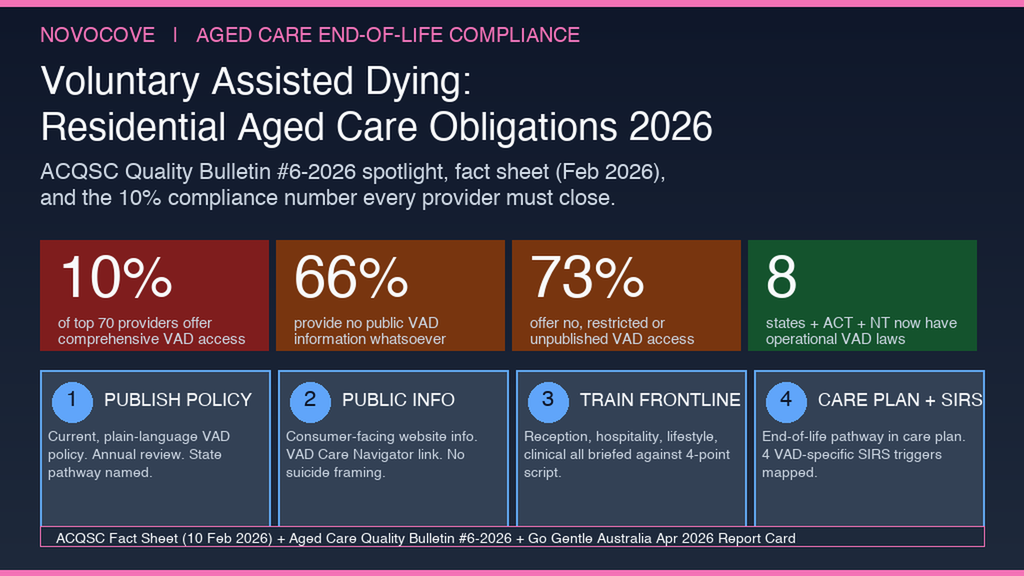
The timing is not accidental. In April 2026 Go Gentle Australia published its second national VAD report card on residential aged care homes, covering 70 providers that operate roughly 130,000 beds — about 66 per cent of all residential aged care beds in Australia. The numbers were worse than the first report, published in September 2025. Only 10 per cent of those 70 providers offer comprehensive VAD information and full access to VAD. 66 per cent provide no public information about VAD whatsoever. 73 per cent offer no, restricted, or unpublished VAD access to the older people in their care. The remaining providers sit somewhere in the middle. The report for the first time named residential aged care providers publicly.
What the regulator actually said in Quality Bulletin #6-2026
The bulletin's VAD section is short. It does not introduce a new rule. What it does is tell the sector that the ACQSC has now read the Go Gentle Australia report card, the Australian Medical Association Position Statement on VAD (2025), and the National Palliative Care Week 2026 framing, and is treating the 10 per cent figure as the benchmark the Commission will test residential providers against. The bulletin links to the dedicated fact sheet, Voluntary Assisted Dying — the role of registered aged care providers delivering residential care, which was published in February 2026 and which the Commission now expects every registered residential provider to have read.
Three operational signals matter for providers:
- The fact sheet is now the test. The ACQSC's dedicated VAD fact sheet sets out provider obligations under the Aged Care Act 2024 (Cth), the Statement of Rights, the Strengthened Aged Care Quality Standards (in particular outcomes 1.3 Person-centred care, 1.4 Choice and independence, and 5.6 Palliative and end-of-life care), and the Serious Incident Response Scheme. The fact sheet is the artefact a Commission assessment contact will now ask the responsible person to walk through. If the policy or practice cannot be reconciled to the fact sheet, the practice fails.
- "Not participating" is not a defence. The fact sheet is explicit: a provider that decides not to participate in VAD still has an obligation to support consumers' access to medical services, including VAD, and still has an obligation under the Statement of Rights to ensure the older person is not asked to leave the facility because they have asked about VAD. The conscientious-objection pathway is real, but the access-facilitation pathway is non-negotiable.
- SIRS triggers are in scope. The fact sheet names VAD-specific SIRS reportable incidents: a consumer being asked to leave the facility because of a VAD decision, a provider's failure to facilitate access to a VAD clinician, a restrictive VAD policy that delays access, or an incident involving the storage or administration of VAD medication. These are now under the same SIRS notification regime as any other reportable clinical or care incident.
The four obligations every residential provider already has
Whether or not your service delivers VAD on site, the obligations below are not new in law. What is new is that the ACQSC is now testing them.
- Obligation 1 — Publish a current, plain-language VAD policy. The policy must be written for the consumer, not the lawyer. It must explain what a resident can expect if they ask about VAD, whether VAD assessments can take place on site, whether VAD clinicians can visit the facility, how VAD medication will be stored and administered, and what will happen if your service does not support VAD on site. The policy must be reviewed annually and must be made publicly available on request. Providers that have not reviewed the policy since the new Aged Care Act commenced on 1 November 2025 are running a pre-Act artefact.
- Obligation 2 — Publish VAD information in plain language on your website.The information must be easy to find, written from the consumer's perspective, and displayed alongside other end-of-life care information — not buried in the governance or policy section of the site. The information must include the contact details of the state VAD Care Navigator Service (every state and the ACT operates one). It must not conflate VAD with suicide, must not characterise VAD as anything other than a legal medical treatment, and must not require the consumer to opt in to additional religious or pastoral care.
- Obligation 3 — Train and brief every frontline worker. Reception staff, lifestyle coordinators, clinical staff, registered nurses, personal care workers, and hospitality staff all need to know the same four things: that VAD is legal in every state and the ACT, that the older person has a right to ask about it, that the service has a documented pathway, and where to find the VAD Care Navigator contact. The "we don't do that here" answer from the front desk is the failure mode the regulator is looking for.
- Obligation 4 — Document a VAD pathway in the care plan. For every resident for whom end-of-life choices have been discussed, the care plan must record the discussion, the resident's expressed preference, the pathway your service will follow, and the date the pathway was last reviewed. Where the resident has expressed a preference for VAD and your service does not participate on site, the care plan must record the off-site pathway and the clinician contact.
The state VAD matrix — different rules, same Commonwealth overlay
VAD legislation in Australia is state-based. Every state and the ACT has a VAD Act. The Northern Territory's Voluntary Assisted Dying Act 2024 commenced on 1 July 2025, making it the last jurisdiction to bring VAD into force. The Commonwealth layer — the Aged Care Act 2024, the Statement of Rights, the Strengthened Quality Standards, and the ACQSC's role — applies to every registered provider regardless of which state the service operates in. The practical effect is that a provider in any state must meet the Commonwealth obligations, and must then add the state-specific pathway on top.
- NSW — Voluntary Assisted Dying Act 2022 (NSW). VAD has been available since 28 November 2023. NSW Health operates the NSW Voluntary Assisted Dying Care Navigator Service. The NSW pathway permits both self-administration and practitioner administration, with a coordinating practitioner and a consulting practitioner.
- VIC — Voluntary Assisted Dying Act 2017 (Vic). VAD has been available since 19 June 2019. The Victorian Voluntary Assisted Dying Care Navigator is operated by the Victorian Department of Health. The Victorian framework is the most-mature operational model in the country.
- QLD — Voluntary Assisted Dying Act 2021 (Qld). VAD has been available since 1 January 2023. Queensland Health operates the QLD Voluntary Assisted Dying Care Navigator Service. The Queensland framework explicitly distinguishes VAD from suicide and from palliative care.
- WA — Voluntary Assisted Dying Act 2019 (WA). VAD has been available since 1 July 2021. The WA VAD Care Navigator is operated by the WA Department of Health. The WA framework requires a coordinating medical practitioner and a consulting medical practitioner.
- SA — Voluntary Assisted Dying Act 2021 (SA). VAD has been available since 31 January 2023. The SA VAD Care Navigator is operated by SA Health. The SA framework requires a 9-day cooling-off period between the first request and the final request for self-administration.
- TAS — End-of-Life Choices (Voluntary Assisted Dying) Act 2021 (Tas).VAD has been available since 23 October 2022. The Tasmanian VAD Care Navigator is operated by the Tasmanian Department of Health.
- ACT — Voluntary Assisted Dying Act 2024 (ACT). VAD has been available since 1 November 2025 — the most recent commencement before the Northern Territory. The ACT framework is administered by ACT Health.
- NT — Voluntary Assisted Dying Act 2024 (NT). VAD has been available since 1 July 2025. The Northern Territory framework is administered by the NT Department of Health and is the newest operational model in the country.
Every state and territory VAD framework expressly states that VAD is not suicide, and that a person accessing VAD retains the right to receive palliative care and other support services. The 2023 joint statement from Lifeline, Beyond Blue and the suicide prevention peaks is explicit that conflating VAD with suicide causes real harm and is inconsistent with the law. Providers that publish material that links VAD to suicide are publishing material that is inconsistent with the legal framework the regulator is testing against.
What the regulator will look at during your next ACQSC visit
Residential and home care providers should expect the next ACQSC visit — whether it is an assessment contact for the strengthened Quality Standards, a SIRS review, an unannounced monitoring visit under the new Monitoring Policy, or a financial prudential audit — to test VAD on at least five dimensions.
- Published VAD policy currency. The provider must produce a current VAD policy, dated within the last 12 months, that names the state-specific pathway, the conscientious-objection scope (if any), the storage and administration rules for VAD medication, the access-facilitation pathway for non-participating services, and the named responsible person. A pre-2025 policy is out of date; a policy with placeholder text is not a policy at all.
- Public-facing VAD information. The provider's website must surface VAD information in plain language, in a consumer-facing location, with a link to the state VAD Care Navigator Service. A provider whose VAD information is buried in a PDF in the corporate governance section fails this test.
- Frontline staff briefing record. Reception staff, lifestyle coordinators, hospitality staff, and clinical staff must each have a documented briefing record against the four-point script (legal in every state, right to ask, service has a pathway, Care Navigator contact). The provider that has trained clinical staff and has not briefed reception fails this test.
- Care plan end-of-life pathway. For every resident for whom end-of-life choices have been discussed, the care plan must record the discussion, the expressed preference, the pathway, and the review date. Where the preference is VAD and the service does not participate on site, the off-site pathway and clinician contact must be in the plan.
- SIRS readiness for VAD-related incidents. The provider must be able to walk an ACQSC reviewer through the SIRS trigger list for VAD-related incidents (consumer asked to leave, access delayed, restrictive policy applied, medication administration issue), the notification timeline, and the open-disclosure record.
The 30-day plan to publish, train and evidence before your next visit
The provider that wants to convert the ACQSC spotlight into a defensible evidence pack has 30 working days to build it. The plan below is paced, evidence-led, and aligned to what the Commission's fact sheet actually requires.
- Day 1 to Day 3 — Read the ACQSC fact sheet and the state Act as a leadership team. Print the Commission's VAD fact sheet, the relevant state VAD Act, and the Go Gentle Australia April 2026 report card. Hold a 90-minute leadership read-through with the responsible person, the clinical lead, the lifestyle manager, and the communications lead. The output is a one-page summary of the four obligations above, the state-specific pathway, and the gap between your current policy and the fact sheet.
- Day 4 to Day 7 — Draft or rewrite the VAD policy. Draft or rewrite the VAD policy against the Commission's fact sheet template: scope, state pathway, conscientious-objection scope (if any), storage and administration, access-facilitation for non-participating services, SIRS linkage, training, review date. Run the draft past the responsible person, the clinical lead, and legal. Date the policy and schedule the annual review.
- Day 8 to Day 12 — Publish plain-language VAD information on the website.Add or update the consumer-facing end-of-life page. Link the state VAD Care Navigator. Remove or rewrite any text that conflates VAD with suicide. Pull the VAD information out of the governance section and put it where families will actually find it. Add the policy PDF as a download.
- Day 13 to Day 17 — Brief every frontline worker. Run four 30-minute briefings — reception, hospitality, lifestyle, clinical — against the four-point script. Record attendance. Test the script on a mystery-shop basis by calling your own reception from a relative's phone. The "we don't do that here" answer is the failure mode you are looking for. Update the script based on the mystery-shop result.
- Day 18 to Day 22 — Audit end-of-life conversations in care plans.Pull the care plan for every resident. Flag every resident for whom end-of-life choices have been discussed. For each, confirm the conversation is documented, the preference is recorded, the pathway is named, and the review date is current. Where the resident has expressed a VAD preference, confirm the off-site pathway and clinician contact are in the plan.
- Day 23 to Day 26 — Map the SIRS triggers and the open-disclosure workflow.Pull the SIRS register and incident workflow. Add the four VAD-specific triggers (consumer asked to leave, access delayed, restrictive policy applied, medication administration issue) to the SIRS trigger list. Confirm the notification timeline, the escalation pathway, and the open-disclosure record template.
- Day 27 to Day 30 — Audit the evidence pack. Pull the updated policy, the website page, the briefing records, the care plan audit, and the SIRS workflow. Confirm every artefact is dated, signed, and current. Store the evidence pack in a single folder the responsible person can produce on demand. The ACQSC fact sheet is the comparator the regulator will use — the provider that produces an evidence pack aligned to the fact sheet is the provider that does not become the next case study.
How NovoCove handles this
NovoCove centralises the end-of-life compliance evidence the ACQSC VAD fact sheet and the Strengthened Quality Standards expect every residential and home care provider to produce on demand. The platform stores the current VAD policy with the annual review date, the state-specific pathway reference, and the conscientious-objection scope; the consumer-facing end-of-life information page with the VAD Care Navigator link; the frontline staff briefing records against the four-point script; the care plan end-of-life pathway with the documented discussion, expressed preference, and review date; and the SIRS trigger list with the four VAD-specific triggers linked to the open-disclosure workflow.
The VAD policy carries automatic annual review-date alerts so the responsible person is prompted before the policy lapses. The care plan pathway is captured at the point of clinical review against the Strengthened Quality Standards outcomes 1.3, 1.4 and 5.6. The frontline briefing record is role-based, so reception, hospitality, lifestyle and clinical staff are each briefed against the same script with a documented completion date. The SIRS trigger list links the four VAD-specific triggers to the open-disclosure workflow so the responsible person can produce the notification record on demand.
The same platform covers the rest of your residential and home care compliance obligations — the Aged Care Quality Standards evidence pack for the next assessment visit, the SIRS register and reporting workflow, the National Aged Care Mandatory Quality Indicator Program quarterly submission, the new Financial and Prudential Liquidity Standard evidence file, the Higher Everyday Living Fee (HELF) refund register following the ACQSC's 2026 regulatory action, the strengthened Clinical Governance Standard evidence, the training records register against every AHPRA-registered clinician, and the Statement of Rights acknowledgement record for every older person. If the next ACQSC visit is the test, NovoCove is built to make sure your VAD evidence pack is the artefact the regulator sees first.
Official sources
- Voluntary Assisted Dying — the role of registered aged care providers delivering residential care — Aged Care Quality and Safety Commission, Fact sheet, 10 February 2026 (T1)
- Aged Care Quality Bulletin #6-2026 — Aged Care Quality and Safety Commission, July 2026 (T1)
- Voluntary assisted dying in residential aged care homes: April 2026 — Go Gentle Australia, 4 May 2026 (T2)
- Voluntary Assisted Dying in Residential Aged Care Homes — National Report Card — Go Gentle Australia, April 2026 (T2)
- Voluntary Assisted Dying (VAD) in residential aged care report card: room for improvement — Aged Care Essentials, 23 June 2026 (T2)
- Aged Care Act 2024 (Cth) — Federal Register of Legislation (T1)
- Statement of Rights — Aged Care Quality and Safety Commission (T1)
- Strengthened Aged Care Quality Standards — Provider Guidance — Aged Care Quality and Safety Commission (T1)
- Position Statement on Voluntary Assisted Dying 2025 — Australian Medical Association (T2)
- End of Life Law — Voluntary Assisted Dying — End of Life Directions for Aged Care (ELDAC) (T2)
- NSW Voluntary Assisted Dying — NSW Health (T1)
- Voluntary Assisted Dying in Victoria — Victorian Department of Health (T1)
- Voluntary Assisted Dying in Queensland — Queensland Health (T1)
- Voluntary Assisted Dying in Western Australia — WA Department of Health (T1)
- Voluntary Assisted Dying in South Australia — SA Health (T1)
- Voluntary Assisted Dying in Tasmania — Tasmanian Department of Health (T1)
- Voluntary Assisted Dying in the ACT — ACT Health (T1)
- Voluntary Assisted Dying in the Northern Territory — NT Department of Health (T1)
- Serious Incident Response Scheme (SIRS) — Aged Care Quality and Safety Commission (T1)
- Voluntary assisted dying in residential aged care homes: September 2025 — Go Gentle Australia, 30 September 2025 (T2)
This guide is general information and is not legal advice.