Regulatory update
Thriving Kids: How Australia's $4 Billion Foundational Supports Reshape the ECEC Role in Child Development and Inclusion
On 1 July 2026 the intergovernmental agreement behind Thriving Kids goes live. Here is the $4B funding model, the ECEC delivery role, and the 92 day plan every Australian centre director should be running before the first state services begin on 1 October 2026.
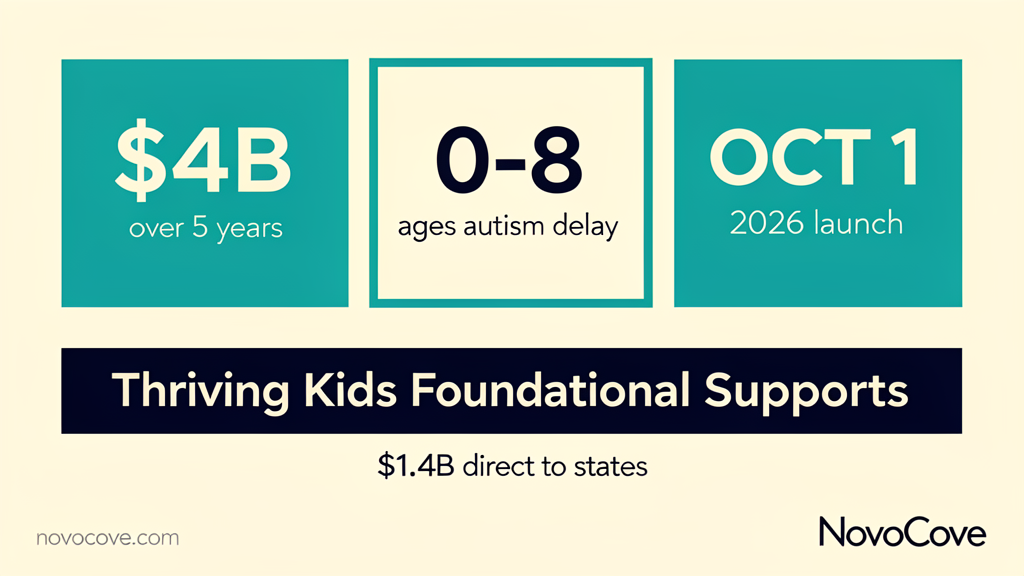
On 1 July 2026, the intergovernmental agreement behind Australia's new Thriving Kids Foundational Supports program goes live. Federal, state and territory governments have committed a combined $4 billion over five years to deliver early intervention supports to children aged 8 and under with developmental delay or autism who have low to moderate support needs, and the model names early childhood education and care services alongside schools and local health networks as one of three delivery settings. The first state services start on 1 October 2026. NDIS access changes for the same cohort follow from 1 January 2028. Every Australian long day care, kindergarten, family day care, outside school hours care, and vacation care service is a potential delivery partner for a state-level Foundational Supports program, and the 92 day window between today and the 1 October 2026 launch is the operational lead time to map the new model into the existing inclusion, capability and referral workflow.
Thriving Kids is the first phase of the National Disability Insurance Scheme Independent Review's Foundational Supports recommendation, and the federal government's signature response to the NDIS sustainability concerns that have dominated the 2025-26 policy debate. The model is not a grant program for ECEC services, and it is not a new regulatory framework. It is a new operating model for the early childhood, school, and health sectors in which the Commonwealth pays state and territory governments for the delivery of evidence-based developmental supports to a defined cohort of children outside the NDIS. The cohort is the same one that the upcoming 1 August 2026 Disability Standards for Education amendment explicitly captures in the ECEC legal obligations, but the funding model is new and the ECEC role is now explicit rather than implied.
This guide walks through the exact funding model, the ECEC delivery role, the intergovernmental agreement that goes live today, the cohort definition that distinguishes Thriving Kids from the NDIS, the timeline from the 1 October 2026 first state services through to the 1 January 2028 full national scale, and the 92 day plan every Australian centre director should be running before the first state services begin. The plan covers what state-level engagement your service should be tracking, what your inclusion workflow needs to look like for the new referral pathways, what the National Early Childhood Worker Register means for the cross-sector delivery model, and what the 1 August 2026 Disability Standards for Education amendment adds to the underlying legal obligations.
What Thriving Kids is: the first phase of Foundational Supports
Thriving Kids is the agreed first phase of Foundational Supports, the new system of supports for people with disability that sits outside the NDIS and was the centrepiece recommendation of the 2023 NDIS Independent Review. The Foundational Supports model is designed to deliver information, advice, capacity building, and targeted early intervention supports to people with disability who are not eligible for the NDIS or whose needs can be met more effectively outside the scheme. The first phase focuses on children aged 8 and under with developmental delay or autism who have low to moderate support needs, a cohort that has historically struggled to access the NDIS and has instead been referred to fragmented state and territory programs, private allied health, or general practice.
The intergovernmental agreement reached on 5 February 2026 commits the Commonwealth to $2 billion over five years and the states and territories to a matching $2 billion, for a combined $4 billion commitment. At least $1.4 billion of the Commonwealth's $2 billion contribution is to be provided as direct funding to states and territories for the delivery of Thriving Kids services. The Department of Health, Disability and Ageing is the Commonwealth lead, working with each state and territory health and disability department on the local service design and delivery arrangements. The Thriving Kids Advisory Group, co-chaired by Professor Frank Oberklaid AM, has published a final report that informed the model design.
For ECEC services, the most important structural element of the model is the explicit naming of early childhood education and care as one of three delivery settings. The model document states that supports will be delivered "in locations they live, learn and play", and the three delivery settings are early childhood education and care services, schools, and local health networks. The Thriving Kids model is not delivered through a new ECEC-specific program. It is delivered through existing service touchpoints, with the funding flowing to the state-level delivery partner (often an allied health provider, a community health service, or a non-government organisation) rather than to the ECEC service directly. The ECEC role is to identify, refer, collaborate, and provide the everyday setting in which the support is delivered.
Who is in scope: the under-9 cohort with low to moderate needs
Thriving Kids is targeted at children aged 8 and under with developmental delay or autism who have low to moderate support needs. The age threshold aligns with the early childhood developmental window that the NDIS Independent Review identified as the highest-leverage intervention point, and the developmental delay and autism focus aligns with the cohort that has historically struggled to access the NDIS. Children with permanent and significant disability, including those with developmental delay or autism with high support needs, will remain eligible for the NDIS, subject to usual arrangements.
The cohort definition matters because it is the line that distinguishes the new model from the NDIS. A child with low to moderate support needs will be supported through Thriving Kids. A child with high support needs will continue to be supported through the NDIS. The threshold between low to moderate and high is not yet a published operational definition, and the Department of Health, Disability and Ageing has indicated that further detail on the assessment pathway will be released as state-level services come online. The implication for ECEC services is that the cohort identification decision will increasingly sit at the intersection of the ECEC observation, the family, and the allied health or paediatric assessment, rather than at the NDIS access request stage.
The size of the cohort is not publicly estimated, but the Parliamentary Inquiry report and the Thriving Kids Advisory Group final report both note that the cohort is substantially larger than the current NDIS-participating population for the same age band. The implication for ECEC services is that the number of children in any given service who will be supported through Thriving Kids rather than the NDIS is likely to be larger than the current number of NDIS participants in the same age band, and the cohort is likely to include children with milder developmental concerns who would not previously have qualified for NDIS access.
What changes on 1 October 2026: the first state services go live
The first state services start on 1 October 2026, exactly 92 days from today. The first state services are not a national launch. They are the state and territory services that each jurisdiction has designed, funded, and contracted in the lead-up to the intergovernmental agreement. Each state and territory is undertaking its own engagement on the specific initiatives it will deliver in its jurisdiction, and the Department of Health, Disability and Ageing has published a Thriving Kids Service Design, Engagement and Consultation overview that outlines the Commonwealth-led national services and the state-level engagement process.
The full national rollout is expected to be at scale from 1 January 2028, which is also the date the NDIS access changes for the under-9 cohort commence. The 15-month gap between the 1 October 2026 first state services and the 1 January 2028 NDIS access change is the operational lead time for the model to build delivery capacity in each state and territory, for families to learn about the new pathway, and for the cross-sector workforce (allied health, ECEC, schools, health networks) to embed the new referral and collaboration workflows. For ECEC services, this 15-month window is the operational lead time to map the new model into the existing inclusion workflow, the educator capability framework, and the family communication workflow.
The Department has indicated that details about specific services and how to access them will be made available closer to services commencing. The implication for centre directors is that the state-level service catalogue is the operational artefact to track, and each state and territory health and disability department will publish its own service catalogue and referral pathway in the lead-up to the 1 October 2026 launch. The Commonwealth has indicated that the national services it will deliver directly include trusted information and advice for families, evidence-based child development supports delivered by allied health professionals, and a navigable service pathway that connects families with the supports they need.
The ECEC delivery role: identification, collaboration, and the everyday setting
The ECEC delivery role in the Thriving Kids model is built on three functions that the early childhood sector already performs, but with a new operating framework and a new funding context. The first function is identification. The early childhood sector has long been the first professional touchpoint for developmental concerns. Educators are often among the first to notice changes or concerns in a child's communication, social development, behaviour, motor skills, or participation. The Thriving Kids model recognises this role and formalises the pathway from educator observation to family conversation to allied health assessment to service delivery. The 2026-27 Federal Budget framing of the 3-year-old Medicare Healthy Kids Check, which is being re-established as part of the broader Foundational Supports investment, complements this identification pathway.
The second function is collaboration. The Thriving Kids model is explicitly cross-sector, and the ECEC role in the model includes collaborating with allied health professionals, paediatricians, general practitioners, and the state-level Foundational Supports coordinators to deliver the support in the everyday setting. The cross-sector collaboration requirement is new for many ECEC services, and the operational artefact that demonstrates the collaboration is a documented inclusion plan for each child in the service whose developmental needs are being supported through a Thriving Kids pathway. The 1 August 2026 Disability Standards for Education amendment, which is covered in detail in the recent NovoCove Disability Standards post, explicitly captures this collaboration obligation in the legal framework.
The third function is the everyday setting. The Thriving Kids model is designed to deliver supports in the locations where children live, learn, and play, and the ECEC service is one of those locations. The everyday setting function is the operational reason why the model is being delivered through ECEC rather than through a separate clinical pathway. For the ECEC service, the everyday setting function means that the inclusion and capability workflow that the service already runs is the operational context in which the Thriving Kids support is delivered, and the service's existing documentation, planning, and review frameworks are the operational artefacts that the state-level delivery partner will look for when assessing whether the service is ready to host the delivery.
How Thriving Kids connects to the existing compliance framework
Thriving Kids is not a new regulatory framework. It does not impose new obligations on ECEC services under the Education and Care Services National Law, the National Quality Framework, or the National Regulations. The compliance obligations that the model triggers are the existing ones, framed in a new operating context. The connections to the existing framework are concrete.
- Disability Standards for Education 2005 (amended 1 August 2026). The 1 August 2026 amendment extends the Standards to most ECEC services for the first time, and explicitly captures the reasonable adjustments, enrolment, participation, curriculum, support services, and harassment obligations that approved providers already owe under the Disability Discrimination Act 1992. The Thriving Kids model is the funding and service delivery context in which the Standards obligations will be operationalised for the under-9 cohort. The two changes are designed to land together.
- National Early Childhood Worker Register (mandatory since 27 February 2026). The Worker Register captures the qualifications, training, working with children check status, and role details for every educator, nominated supervisor, coordinator, and regular volunteer at an approved service. The Thriving Kids model's expectation that the ECEC service will collaborate with allied health professionals and host cross-sector delivery means that the Worker Register entry for every educator who will be involved in the cross-sector delivery is a prerequisite for the service to be a Thriving Kids delivery partner.
- National Quality Standard Element 1.1.3 (program). Element 1.1.3 requires that the educational program enhances each child's learning and development. The Thriving Kids model adds an explicit expectation that the educational program is responsive to the developmental needs of children who are receiving Thriving Kids supports, and that the program planning documentation reflects the cross-sector collaboration.
- National Quality Standard Element 1.1.6 (each child). Element 1.1.6 requires that each child's learning and development is or being supported as connected to their current skills, knowledge and ways of being. The Thriving Kids model adds an explicit expectation that the service's knowledge of each child's developmental profile is current, documented, and shared with the cross-sector delivery team.
- National Quality Standard Element 1.2.2 (responsiveness to children). Element 1.2.2 requires that educators respond to children's ideas, skills and experiences. The Thriving Kids model adds an explicit expectation that the educator response is informed by the cross-sector delivery team's expertise, and that the response is documented in the child's individual learning plan.
- National Quality Standard Quality Area 7 (governance and leadership). Quality Area 7 requires that governance supports the delivery of a quality educational program. The Thriving Kids model adds an explicit expectation that the approved provider's governance arrangements include a documented cross-sector collaboration policy, a documented referral pathway to the state-level Foundational Supports coordinator, and a documented inclusion plan template that supports the Thriving Kids delivery context.
The compliance implication is that Thriving Kids is the first operating context in which multiple NQS elements, the Disability Standards, and the Worker Register converge around a single cohort and a single funding pathway. The convergence is not a new obligation, but it is a new operational pressure on the existing documentation and planning workflows. For approved providers that have not yet mapped their existing inclusion and capability workflows against the 1 August 2026 Disability Standards amendment, the 92 day window before the first state services start is the operational lead time to do so.
The 92 day plan: what every centre director should be running now
The 92 day window between today and the 1 October 2026 first state services is the operational lead time for every Australian ECEC service to map the Thriving Kids model into the existing inclusion, capability, and compliance workflow. The plan has five operational steps that build on the existing framework rather than replacing it, and each step has a measurable deliverable that can be tracked in the lead-up to the launch.
- Days 1 to 14: identify your state's Foundational Supports coordinator and service catalogue. Each state and territory will publish its own service catalogue and referral pathway in the lead-up to the 1 October 2026 launch. Identify your state's lead agency, the published service catalogue, the published referral pathway, and the contact details for the state-level Foundational Supports coordinator. The lead agency is usually the state or territory health and disability department, sometimes shared with the education department. The service catalogue is the operational artefact that defines which services are in scope, who is eligible, and how the referral is made.
- Days 15 to 30: map your existing inclusion workflow against the 1 August 2026 Disability Standards. The 1 August 2026 Disability Standards amendment is the legal framework that captures the ECEC obligations in the Thriving Kids delivery context. The recent NovoCove post on the Disability Standards amendment walks through the five operational artefacts (reasonable adjustments policy, consultation workflow, participation and curriculum review, support services register, staff capability checkpoint) that need to be in place by 1 August 2026. Map each artefact against your existing inclusion workflow and identify the gaps.
- Days 31 to 50: prepare the per-child documentation framework. The Thriving Kids model expects a documented inclusion plan per child, a documented reasonable adjustments workflow per child, and a documented cross-sector collaboration record per child. The per-child documentation framework is the operational artefact that the state-level delivery partner will look for when assessing whether the service is ready to host the delivery. Prepare the template, the review cycle, and the storage arrangement.
- Days 51 to 70: confirm the National Early Childhood Worker Register status for every educator who will be involved in cross-sector delivery. The Worker Register status for every educator who will be involved in the cross-sector delivery is a prerequisite for the service to be a Thriving Kids delivery partner. Confirm that every such educator has a current Worker Register entry, a current Working with Children Check or Working With Vulnerable People registration, and the relevant training (child safety training, first aid, anaphylaxis management, asthma management). The 14 day Worker Register update rule applies to any change in role or employment status.
- Days 71 to 92: communicate with families and build the family-facing pathway. The Thriving Kids model is designed to be family-facing, and the family-facing communication workflow is the operational artefact that the state-level delivery partner will look for. Communicate with families about the new pathway, the eligibility criteria, the referral process, and the role of the ECEC service in the cross-sector delivery. The communication should be written, documented, and stored as part of the service's family communication records.
What this means for the broader sector
Thriving Kids is the first operating context in which the ECEC sector's identification, collaboration, and everyday setting functions are explicitly recognised in a federal funding model. The recognition is the operational outcome of the NDIS Independent Review, the Parliamentary Inquiry into Thriving Kids, the Thriving Kids Advisory Group consultation, and the 2026-27 Federal Budget investment. For the ECEC sector, the recognition is a structural shift in how the early childhood workforce is positioned in the cross-sector delivery of developmental supports, and the shift will be visible in the documentation, planning, and review workflows that the state-level delivery partners will look for.
The structural shift has three operational implications. First, the ECEC workforce is now a named delivery partner for a federal funding program, and the operational expectations that follow are higher than the implicit cross-sector collaboration that has been the norm. Second, the National Early Childhood Worker Register is now an operational prerequisite for cross-sector delivery, and the 14 day update rule is the operational floor that approved providers must meet. Third, the per-child documentation framework is now an audit-ready artefact for the state-level delivery partner, and the documentation must be current, comprehensive, and stored in a way that can be shared with the cross-sector delivery team.
The 92 day window is the operational lead time for the ECEC sector to map the new model into the existing compliance workflow, and the mapping is a five-step plan that builds on the existing framework rather than replacing it. The approved providers that complete the five-step plan before the 1 October 2026 launch will be in a strong position to be named as delivery partners in their state's Foundational Supports rollout. The approved providers that delay the mapping will be responding to the model after the launch, and the operational pressure will be higher. The 1 January 2028 NDIS access change is the second milestone, and the 15-month gap between the first state services and the NDIS access change is the operational runway for the model to build delivery capacity and for the cross-sector collaboration to mature.
How NovoCove handles this
NovoCove's compliance dashboard turns the new Thriving Kids Foundational Supports model into a working line item in your service's inclusion and capability workflow. The platform tracks the National Early Childhood Worker Register status for every educator, including the 14 day update rule and the working with children check status. The platform's per-child documentation framework supports the inclusion plan, the reasonable adjustments workflow, and the cross-sector collaboration record that the state-level delivery partner will look for in the Thriving Kids delivery context. The framework is built to be compatible with the 1 August 2026 Disability Standards amendment and the existing NQS documentation requirements.
For approved providers that want to be named as a delivery partner in their state's Foundational Supports rollout, NovoCove's compliance evidence pack includes the per-educator Worker Register entry dates, the per-educator training and qualifications status, the per-child inclusion plan and reasonable adjustments record, the per-family communication record, and the cross-sector collaboration documentation. The evidence pack is generated on demand and can be shared with the state-level Foundational Supports coordinator as part of the service's readiness assessment. The platform also tracks the 1 October 2026 launch, the 1 January 2028 full national scale, and the 1 January 2028 NDIS access change as key milestones in the operational calendar.
For the 92 day plan, NovoCove's onboarding workflow generates the five operational steps above as a tracked project, with day-level reminders, milestone alerts, and a compliance evidence pack that is current as of the launch date. The platform's family communication module supports the family-facing pathway communication, with templates that are aligned with the National Health and Medical Research Council's Child Health and Development guidance and the state-level service catalogue terminology. The platform's governance module supports the Quality Area 7 cross-sector collaboration policy, the referral pathway documentation, and the inclusion plan template.
Thriving Kids is the first operating context in which the ECEC sector's identification, collaboration, and everyday setting functions are explicitly recognised in a federal funding model. For approved providers that want to be ready for the 1 October 2026 first state services and the 1 January 2028 NDIS access change, NovoCove's compliance dashboard is the operational backbone. The platform converts the new model into a working line item in the existing inclusion, capability, and compliance workflow, and the per-child, per-educator, and per-family documentation is the audit-ready artefact that the state-level delivery partner will look for.
This guide is general information and is not legal advice.