Aged care provider reporting
Residential Aged Care Accommodation Census 2026: The 6 September Deadline and 30-Minute Provider Workflow
The Department of Health, Disability and Ageing opened a national accommodation census on 27 July 2026. Every residential aged care provider must use its individual email link, verify prepopulated data for each home and submit by 6 September.
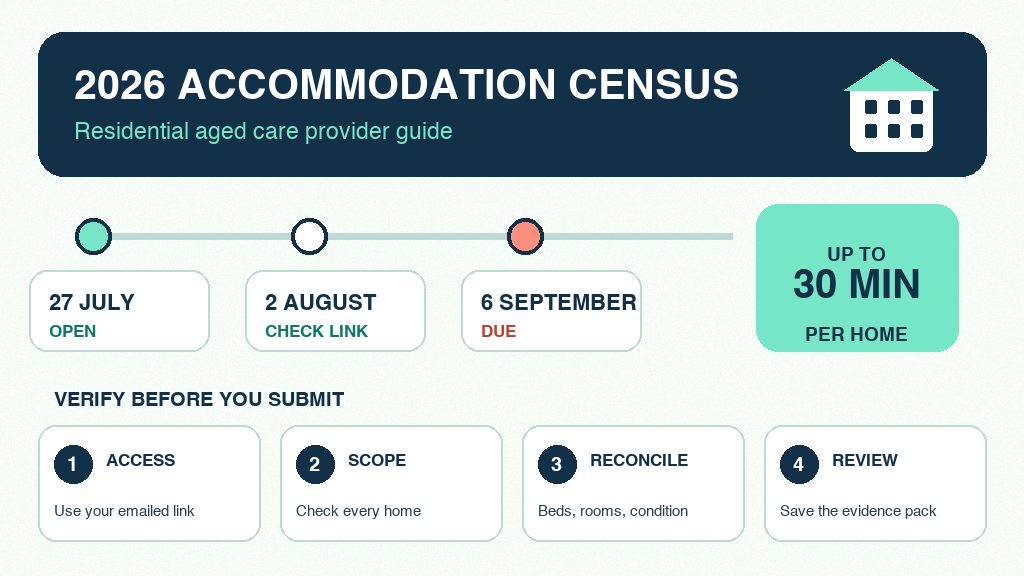
The Australian Government's 2026 Residential Aged Care Accommodation Census is now open. The Department of Health, Disability and Ageing launched the collection on 27 July 2026 to build a national database of aged care bed capacity, home locations and accommodation conditions. Every residential aged care provider must complete the census through the individual link emailed to it, and the submission window closes on 6 September 2026.
This is a short collection—the Department says it should take up to 30 minutes for each residential care home—but it is not a box-ticking survey to hand to one person without preparation. Providers are being asked to check prepopulated information and confirm the physical capacity and condition of their accommodation. A rushed answer can turn a small data discrepancy into an inaccurate national record used for funding, supply and policy decisions.
Background: why the Government needs a national accommodation dataset
Residential aged care planning has historically relied on several administrative datasets that answer related but different questions. Provider registration establishes who may deliver funded care. Operational reporting records care, finance and quality information. Occupancy and places data help describe current use. None of those sources necessarily gives government one verified, home-level picture of the number of physical beds, the location and condition of accommodation, and how rooms are configured.
The policy setting is also changing. The Government is moving from the former allocation-of-places model towards a more person-centred system in which funding follows the older person and provider supply responds to demand. The Department describes this work as “places to people—embedding choice in residential aged care”. A dependable accommodation baseline matters because planning decisions must distinguish an approved place on paper from an available bed in a real building.
The Department says the new database will inform policy and funding decisions, help address care shortages, reduce hospital stays and support Australia's ageing population. Those purposes make data quality consequential. If capacity is overstated in one region, planning may assume supply that is not operationally available. If it is understated, a genuine gap may not be visible. Room configuration and building condition add another layer: a headline bed number alone does not show whether rooms are usable, suitable or aligned with contemporary expectations.
Aged Care Quality Bulletin #7-2026 reinforces the census as a current provider obligation. The Aged Care Quality and Safety Commission says all residential aged care providers need to complete it and notes that aggregated findings will be published later in 2026. Individual provider answers therefore contribute to a public national picture, even though the Department has said it will publish key findings in aggregate.
What changed on 27 July 2026 and what happens by 6 September
The new event is the opening of the dedicated national accommodation census on 27 July 2026. The Department has emailed a unique census link to each provider. Providers must use that link rather than a general public form, which is important for identity, prepopulation and matching responses to the correct organisation and homes.
There are four dates or timing controls to put on the compliance calendar:
- 27 July 2026: the census opened and provider links began operating.
- 2 August 2026: the Department's trigger date for providers that had not received an email. Those providers should contact [email protected].
- 6 September 2026: the census closes. A provider should not plan to use the final day for discovery and reconciliation.
- Up to 30 minutes per home: the Department's completion estimate. Multi-home providers should scale resourcing by home and add time for source checks and internal sign-off.
The Department has also made an example census available. That is useful for preparation because it shows which questions providers will answer and which fields contain prepopulated information that must be checked. The example is a preview, not a substitute for the unique provider link. A provider should use it to identify data owners and source records before opening the live submission.
The Commission's bulletin describes the collection as nation-wide and says the resulting database will cover bed numbers, home locations and conditions. Providers should interpret “check” literally: prepopulation reduces typing, but it does not transfer responsibility for accuracy back to government. The person submitting should be able to explain where each confirmed or amended number came from.
Operational impact for residential aged care providers
The practical risk is not the form itself; it is fragmented ownership of the underlying facts. Property teams may know room configuration, finance may hold asset records, operations may know which rooms are offline, and executive reporting may use a different capacity number again. A safe submission reconciles those views before it converts them into one official response.
1. Confirm the link reached the right person. Search the nominated provider and regulatory mailboxes, not only one executive's inbox. Check spam and email-security quarantine. If the link was not received by 2 August, contact the Department using the published residential places management address. Record the contact and any replacement-link response so the organisation can show that it acted promptly.
2. Establish the reporting perimeter. List every residential care home associated with the provider and compare it with the homes represented in the census link. Confirm legal entity names, service names, locations and identifiers. Escalate a missing, duplicated or unfamiliar home before submitting rather than forcing an answer into the wrong record.
3. Reconcile capacity, not just registration. Agree what the response should report for physical rooms and beds. Check whether rooms are temporarily offline, being refurbished, decommissioned, used for another purpose or configured for couples. Keep a short reconciliation between the source floor plan or asset register and the final number entered.
4. Validate room and accommodation characteristics. The Department's example shows providers which prepopulated fields need checking. Ask the facilities or property owner to validate the physical facts and an operations leader to confirm current use. Avoid treating an old asset schedule as proof of today's configuration.
5. Apply a named review before submission. One person may enter the data, but a second appropriate person should compare the draft response with source evidence. For a multi-home provider, use the same definitions and review method across the group so homes do not answer similar questions differently.
6. Retain a submission evidence pack. Keep the submitted response or confirmation, the capacity reconciliation, the list of source documents, the reviewer sign-off and any correspondence with the Department. The census page does not create a new seven-year retention rule, so providers should apply their own regulatory-record retention policy rather than inventing a statutory period.
A five-day census verification workflow
Day 1 — secure access and scope the portfolio. Confirm receipt of the individual link and nominate the person who will coordinate the response. Build the full home list from the provider's current registration and internal portfolio records. Compare that list with the homes visible in the census. Send any access or scope query to the Department immediately rather than waiting until September.
Day 2 — collect the physical source evidence. For each home, gather the current floor plan, room and bed schedule, property or asset register, recent occupancy/capacity report, and records of rooms that are offline or under works. The aim is not to upload every document. It is to make the number and configuration entered in the form reproducible.
Day 3 — reconcile and resolve exceptions. Put the main capacity figures side by side. Investigate differences between registered, physical, staffed, operational and occupied capacity instead of treating those terms as interchangeable. Ask the appropriate property and operations owners to resolve shared rooms, couple rooms, temporarily unavailable rooms and changed room use. Document the basis for the chosen response.
Day 4 — prepare and independently review the draft. Use the Department's example census as a rehearsal, then enter the verified information in the unique live link. Before final submission, have a second person compare the draft against the reconciliation and source list. Multi-home groups should run a cross-home reasonableness check for inconsistent terminology or unexplained outliers.
Day 5 — submit, preserve and report. Submit the completed census, save the confirmation and archive the evidence pack in the provider's approved records system. Report completion across the portfolio, including any unresolved correspondence with the Department. Do not mark the obligation complete merely because one home has submitted when the provider operates several homes.
This five-day method intentionally finishes well before 6 September. It creates room to replace a missing link, correct a provider-to-home mapping problem or obtain a definitive facilities answer. The 30-minute completion estimate should be the final data-entry window, not the entire project plan.
Common errors to avoid before submitting
- Using the public example as the submission: the real census requires the individual link emailed to the provider.
- Assuming prepopulated means verified: providers are expected to check the supplied information and amend it where necessary.
- Reporting occupied beds as total capacity: current residents, operational beds and physical beds answer different questions.
- Ignoring rooms temporarily out of service: record how the provider interpreted the question and why the final number is supportable.
- Submitting one group-wide estimate: the Department's timing is expressed per residential care home, and the database is intended to capture home locations and conditions.
- Waiting until 6 September: access, scope and capacity exceptions need time for Department or internal resolution.
Providers should also avoid adding certainty that the official guidance does not provide. The Department's published announcement states what the census is for, when it runs, how long each home should take and how providers receive access. For a question whose definition is unclear, use the Department's contact pathway rather than adopting an internal interpretation and presenting it as a government rule.
How NovoCove supports this
NovoCove is the data and evidence layer for care-provider compliance; it does not submit the Department's accommodation census and it is not a dedicated property or bed-inventory system. Providers should complete the live census through the individual government link and keep their authoritative room and capacity records in the appropriate operational or property system.
What NovoCove does support is the surrounding compliance discipline. It centralises staff certifications and training expiry across sites, applies automatic seven-tier expiry alerts, and shows RAG compliance status by service. Daily ComplianceSnapshot trend capture and audit logging help leaders show what the workforce evidence looked like when a provider submission or governance review was completed.
For this census, use NovoCove to keep the relevant workforce credential and compliance evidence current while the property team verifies accommodation data outside the platform. That separation avoids overclaiming what one system can do: the Department receives an accurate home-level accommodation response, while provider leaders retain a regulator-ready evidence layer for the workforce and compliance controls that sit around safe service delivery.
Sources and further reading
- Department of Health, Disability and Ageing: Accommodation census for residential aged care providers (T1, published 27 July 2026) — opening date, 6 September deadline, 30-minute estimate, individual-link rule and national database purpose.
- Department of Health, Disability and Ageing: Places to people—embedding choice in residential aged care (T1) — reform context and current census access information.
- Aged Care Quality and Safety Commission: Aged Care Quality Bulletin #7-2026 (T1) — confirmation that all residential aged care providers need to complete the collection, plus the dates and publication plan.
- Department example of the Residential Aged Care Accommodation Census (T1) — preview of questions and prepopulated fields to check; not the provider's submission link.
- Australian Ageing Agenda: Department launches accommodation census (T3) — industry coverage of the collection and its accommodation-detail focus.
This guide is general information and is not legal advice.