Industry news
National ECEC Walk-Off on 15 July 2026: What 20,000+ Educators Industrial Action Means for Every ECEC Service and the Compliance Workflow Operators Need Now
On 21 May 2026 the United Workers Union endorsed a national walk-off on 15 July 2026 by more than 1,000 centres representing 20,000+ early childhood educators. The action targets the federal government's failure to extend the Worker Retention Payment (WRP) funding beyond 30 November 2026, leaving educators facing a 4 to 15 per cent pay cliff and families facing uncapped fee increases. Here is what every approved ECEC provider needs to know about the action, the 8 days until 15 July, the supervisory and reporting obligations that still apply on walk-off day, and the workflow that keeps your service on the right side of the National Law when half the sector closes its doors.
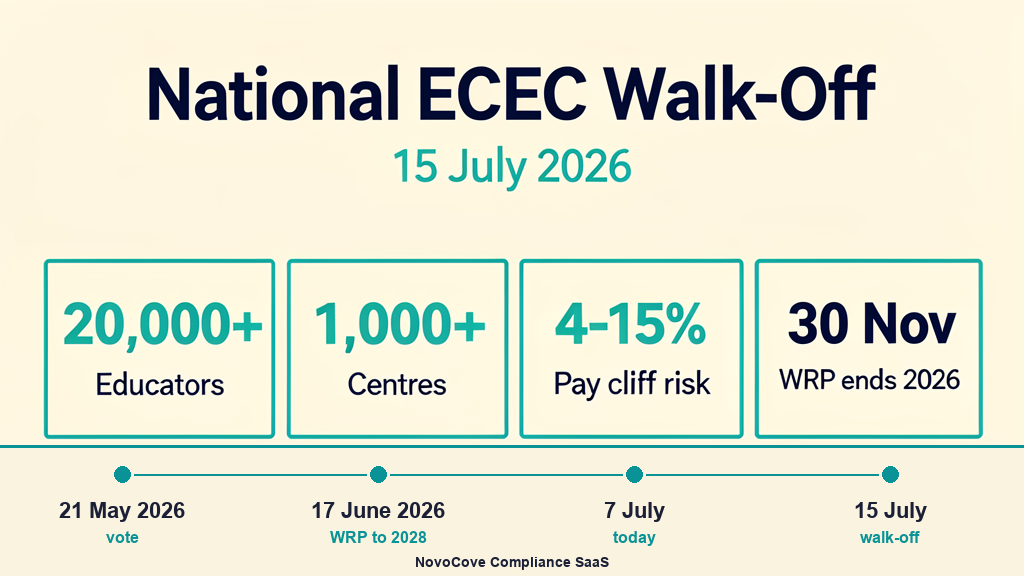
On 21 May 2026, hundreds of early childhood educators meeting in Perth endorsed a national walk-off for 15 July 2026. The action, called by the United Workers Union (UWU), has the support of more than 1,000 centres representing over 20,000 educators across Australia, and is expected to force the closure of a significant proportion of long day care, kindergarten, outside school hours care, and family day care services on the day. The dispute is over the Albanese Government's failure to commit to ongoing funding for the 15 per cent pay rise that was delivered through the Fair Work Commission's multi-employer bargaining process in 2024, and the looming expiry of the Worker Retention Payment (WRP) on 30 November 2026.
The walk-off is not a dispute between educators and providers. It is a dispute between educators and the federal government over the funding mechanism that has been keeping the 15 per cent pay rise alive. Educators who participate in the action are exercising lawful industrial rights. Approved providers that close on the day are not in breach of the National Law, provided they meet the educator-to-child ratio requirements, supervision requirements, and notification obligations that apply on any other day. The compliance challenge for approved providers is operational: how to keep the service open if enough staff are available, how to communicate a closure to families if not, and how to satisfy the state regulator's notification requirements either way.
This guide walks through what the action is, the data behind the 20,000+ educator figure, the WRP expiry timeline that triggered the dispute, the educator-to-child ratio obligations that still apply on walk-off day, the 24 hour serious-incident reporting window that does not pause for industrial action, the 14 day National Early Childhood Worker Register rule that does not pause either, and the operational workflow that approved providers should be running in the 8 days between now and 15 July 2026.
What the action is: a UWU-endorsed national walk-off on 15 July 2026
The walk-off was endorsed on Wednesday 21 May 2026 at a meeting of hundreds of educators in Perth, hosted by UWU Early Education Director Carolyn Smith. The vote followed the federal government's 2026-27 Budget, which the union argued failed to commit to ongoing funding for the 15 per cent pay rise that was delivered through the Fair Work Commission's multi-employer bargaining decision. According to UWU's media release on 21 May 2026, more than 1,000 centres representing over 20,000 educators had signed an open letter urging the government to lock in the pay rise permanently.
The mechanics of the action are familiar to anyone who has tracked Australian industrial history in the early childhood sector. Coordinated strike action and temporary centre closures occurred in 2022 as part of campaigns calling for higher wages and structural reform. Educators also took action on International Women's Day in 2024 to highlight gender-based undervaluation and workforce pressures. The planned July 2026 walk-off sits in the same lineage. UWU last threatened a mass walkout in 2024 but suspended the action after the government promised to commit to funding. The 2026 walk-off reflects the union's view that the funding commitment has not been honoured.
For approved ECEC providers, the action is best understood as a sector-wide one-day stoppage, not a permanent workforce withdrawal. Educators who participate in the walk-off plan to return to work on 16 July 2026. The compliance challenge is therefore concentrated in a single 24 hour window: how to operate the service if enough educators are available, how to safely close if not, and how to satisfy the National Law notification and reporting obligations that apply on either path.
Why the dispute matters: the WRP pay cliff and the 4 to 15 per cent drop
The underlying cause of the dispute is the Worker Retention Payment (WRP) funding mechanism that has been supporting the 15 per cent pay rise since 2024. The WRP was introduced by the Albanese Government in 2024 as part of a broader effort to stabilise the early childhood workforce, and operates as a federal funding pass-through to approved providers to offset the cost of the wage increase. The WRP was originally scheduled to conclude on 30 November 2026, and the federal government's 17 June 2026 announcement of a $3.6 billion extension to 30 June 2028 did not eliminate the underlying dispute.
UWU's position is that the extension was announced without the additional funding that the union says is necessary to permanently lock in the 15 per cent pay rise. According to UWU, almost all educators face a pay cliff of between 4 per cent and 15 per cent in pay cuts when the WRP expires on 30 November 2026, unless additional funding is committed in the 2026-27 Budget. The union argues that the extension simply delays the cliff by 18 months rather than preventing it. The government's position is that the extension provides long-term funding certainty and removes the immediate cliff that was scheduled for December 2026.
The dispute matters for approved ECEC providers because the WRP is the mechanism that has kept the 15 per cent wage uplift on the books since 2024. If the WRP expires without a replacement mechanism on 30 November 2026, providers face the choice of absorbing the wage increase (which most cannot afford) or rolling back the wage increase (which would conflict with the multi-employer bargaining determination). The walk-off is therefore not only about the 15 July 2026 day of action. It is about the long-term sustainability of the workforce funding model.
The 8 days between now and 15 July: what approved providers should be doing
From today, 7 July 2026, there are 8 days until the planned walk-off. Approved providers that intend to operate on 15 July 2026 should be running a workforce confirmation workflow now. The first task is to identify which educators have indicated they will participate in the action. Most approved providers will have a reasonable estimate from UWU member lists, internal surveys, or informal indication. The second task is to confirm whether the remaining roster can satisfy the educator-to-child ratio requirements under Regulation 123 of the Education and Care Services National Regulations.
Approved providers that cannot satisfy the ratio requirements with the available roster on 15 July 2026 should close the service for the day. The closure must be notified to the state regulator under the standard service-closure notification framework (in Victoria, VECRA's service closure notification form; in NSW, the NSW Early Learning Commission's service closure portal; in Queensland, the ECEC Regulatory Authority's notification form; and the equivalent mechanisms in the other five jurisdictions). The notification must be made as early as possible to give families time to make alternative arrangements.
Approved providers that intend to close in solidarity with the action, regardless of whether the roster can satisfy ratio requirements, should also notify the state regulator and the families. The notification should make clear that the closure is a one-day event tied to industrial action and that the service will reopen on 16 July 2026. Providers should also notify the Department of Education if the closure affects the receipt of Child Care Subsidy (CCS) payments for affected families, since absent days that are covered by a service-closure notification are treated differently from absent days that are not covered.
- Day 1 to Day 3 (today through 9 July): confirm educator participation intentions, map the roster against Regulation 123 ratio requirements, and decide whether to operate, partially operate, or close on 15 July 2026.
- Day 4 to Day 6 (10 to 12 July): if operating, prepare the adjusted roster, notify families of any service-level changes, and confirm with the state regulator that the adjusted roster satisfies ratio requirements. If closing, submit the service-closure notification to the state regulator and notify families.
- Day 7 (13 July): finalise all notifications, confirm that the National Early Childhood Worker Register reflects the current roster (the 14 day rule applies regardless of industrial action), and prepare the incident-management protocol for any unexpected absences on 15 July 2026.
- Day 8 (14 July): final communications to families, final check on the incident-management protocol, and confirmation that the approved provider has a clear decision on the 15 July operating status.
Compliance obligations that do not pause for industrial action
The walk-off does not suspend any of the compliance obligations that apply to approved ECEC providers under the Education and Care Services National Law and Regulations. Three obligations in particular are worth flagging for 15 July 2026.
First, the 24 hour serious-incident reporting window. From 1 September 2025, the mandatory reporting window for allegations, complaints or incidents of physical or sexual abuse was reduced from 7 days to 24 hours. The window is calculated from the time the approved provider becomes aware of the allegation, complaint, or incident. Approved providers that operate on 15 July 2026 with a reduced roster must have a clear protocol for identifying, escalating, and reporting serious incidents within the 24 hour window. The reduced roster does not extend the window. Approved providers that close on 15 July 2026 must have an after-hours contact protocol that allows the approved provider to receive and respond to serious-incident notifications within the 24 hour window even when the service is closed.
Second, the National Early Childhood Worker Register 14 day rule. Approved providers are required to enter information about new educators into the Worker Register within 14 days of the educator starting work at the service, and to update existing educator records within 14 days of any change. The 14 day window applies regardless of industrial action, public holidays, or service closures. Approved providers that bring in replacement educators to cover for walk-off participants on 15 July 2026 must enter those educators into the Worker Register within 14 days of their start date.
Third, the educator-to-child ratio requirements under Regulation 123. Approved providers that operate on 15 July 2026 must satisfy the educator-to-child ratio requirements for the relevant age groups at all times during the operating day. The ratios are 1:4 for under 24 months, 1:5 for 24 to 36 months, 1:11 for 36 months to preschool age, and 1:15 for preschool age and above. A reduced roster does not relax the ratio requirements. If the available roster cannot satisfy the ratios, the service must either refuse to accept additional children or close for the day.
Fee-cap obligations under the WRP extension
The WRP extension to 30 June 2028 announced on 17 June 2026 includes a new fee-cap regime that replaces the previous 4.2 per cent cap. The new regime limits hourly fee increases to 5.8 per cent for current WRP grantees between 8 August 2026 and 7 August 2027, and to 5.8 per cent for future WRP applicants between 17 June 2026 and 7 August 2027, with a cumulative cap of 8.6 per cent over the period. The WRP funding evaporates if the service breaches the fee cap.
The fee-cap regime applies to the period 8 August 2026 onwards, which means it will not be triggered by any fee decisions made on or before 15 July 2026. However, approved providers that have not yet reviewed their fee structure in light of the new cap should use the 8 day window to map out the fee trajectory for the period 8 August 2026 to 7 August 2027. A fee increase that exceeds 5.8 per cent in that period will breach the cap, regardless of whether the increase is announced in advance or implemented in stages.
The fee-cap regime is enforced by the Department of Education through the CCS payment system. Approved providers that submit CCS claims for hours charged at a rate that exceeds the cap will have those claims reduced or rejected. The reduction is automatic: there is no internal review, no second chance, and no carve-out for services that were "trying". The fee-cap compliance artefact is now one of the highest-stakes compliance artefacts that an approved ECEC provider produces, and the 8 day window between now and the walk-off is a good time to review the fee structure against the cap.
How NovoCove handles the 15 July workflow
NovoCove's compliance dashboard gives approved ECEC providers a single operational view of every compliance obligation that applies on 15 July 2026, regardless of whether the service is operating, partially operating, or closed for the day. The platform tracks the 24 hour serious-incident reporting window from the moment a notification is received, the 14 day National Early Childhood Worker Register rule for every new educator entered into the service, and the educator-to-child ratio requirements under Regulation 123 for every age group at every point in the operating day.
For approved providers that are operating on 15 July 2026 with a reduced roster, NovoCove's ratio-tracking module flags any roster configuration that does not satisfy the Regulation 123 requirements in real time, and routes the alert to the approved provider's compliance officer and the nominated supervisor. For approved providers that are closing for the day, NovoCove's service-closure module generates the state-regulator notification form with the relevant details pre-populated, and tracks the after-hours contact protocol for serious-incident notifications within the 24 hour window.
For approved providers that want to review their fee structure against the new WRP fee cap, NovoCove's fee-cap compliance module tracks the cumulative hourly fee increase for the 5.8 per cent and 8.6 per cent caps over the relevant periods, and flags any planned fee increase that would breach the cap before the increase is implemented. The module integrates with the CCS claim workflow so that any CCS claim that exceeds the cap is flagged at the time of submission rather than at the time of audit. The fee-cap compliance artefact is now a working line item in the NovoCove platform rather than a spreadsheet that has to be manually updated each time the fee structure changes.
This guide is general information and is not legal advice.