Regulatory update
ASQA Cancels Childcare Qualifications From Unique College of Technology: What Every Provider Must Verify Before August 2026
On 2 July 2026, ASQA began issuing Notices of Intent to cancel ECEC qualifications issued by deregistered RTO 91358 between June 2022 and September 2025. Approved providers now have a 30 day window to verify the qualification status of every educator on the roster. Here is the 3 step verification workflow and the 1 line you should be running this week.
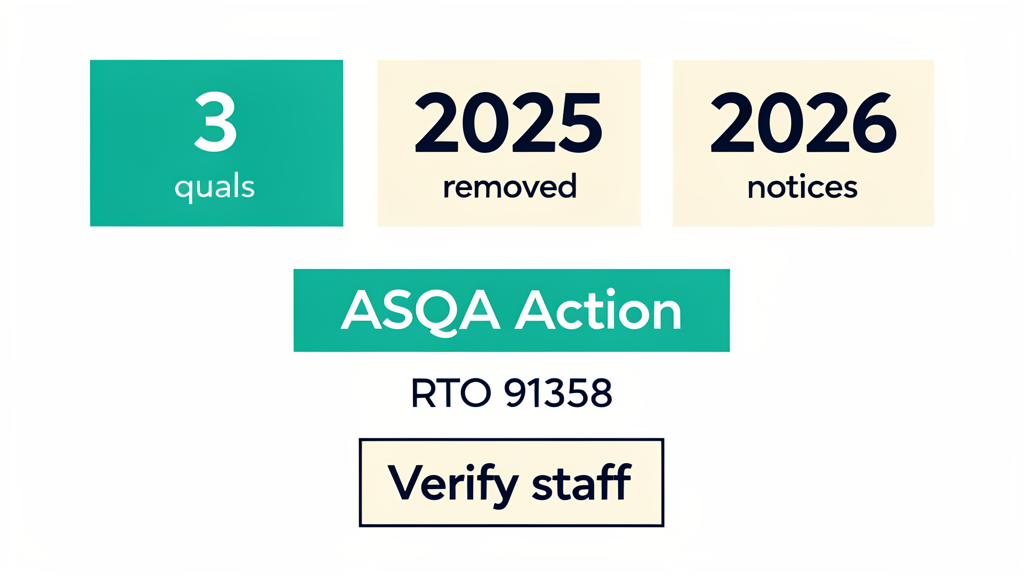
On 2 July 2026, the Australian Skills Quality Authority confirmed that it has begun issuing Notices of Intent to cancel qualifications issued by Unique College of Technology (RTO 91358), including three qualifications that are widely held by educators working in approved early childhood education and care services across Australia. The three qualifications in scope are CHC30113 Certificate III in Early Childhood Education and Care, CHC30121 Certificate III in Early Childhood Education and Care, and CHC50121 Diploma of Early Childhood Education and Care. The qualifications were issued between 1 June 2022 and 2 September 2025, the window during which the RTO was registered before its cancellation took effect on 2 September 2025. The first batch of Notices of Intent was published in June 2026, and the affected educators and their current employers are the audience for the next six to eight weeks of operational work.
This is not a sector-wide qualification cancellation. The action is targeted at the qualifications issued by one deregistered RTO over a defined 39 month window, and the recipients of the Notices of Intent are the former students whose qualifications were on the RTO's student management system. The action is, however, sector-wide in operational impact. Every approved ECEC service that employs an educator whose qualification was issued by Unique College of Technology during the affected window is now on the hook for a qualification verification sweep, and the operational window to do that sweep is shorter than most centre directors will have planned for. The reason is structural. The cancellation of a qualification does not happen the moment ASQA issues a Notice of Intent, but the qualification is in a contested state from the moment the notice is received, and the educator's continued employment in a role that requires the qualification becomes a compliance risk for the approved provider from the same moment.
This guide walks through what happened, what is in scope, what the Notice of Intent process means for educators and approved providers, the three step roster verification workflow every approved provider should be running this week, the 7 day reporting window, the 30 day operational timeline, and how the verification record you build this week becomes the audit ready evidence layer for your next assessment and rating visit. The 1 August 2026 National Early Childhood Worker Register, the 27 August 2026 Geccko Foundation child safety training deadline, and the 1 January 2026 NQS refinements are the adjacent compliance artefacts that the qualification verification workflow needs to be integrated with, and the integration is the operational reason this is a 30 day project rather than a 7 day one.
What happened: the RTO, the cancellation, and the Notice of Intent
Unique College of Technology (RTO 91358) had its registration as a registered training organisation cancelled by ASQA, with the cancellation taking effect from 2 September 2025. The cancellation decision was based on ASQA's findings that the RTO did not meet the conditions of registration, had issued qualifications and statements of attainment without adequate assessment, and did not ensure that impacted individuals had successfully satisfied all requirements before VET certification was issued. The cancellation was published on the National Register and is the regulatory event that started the qualification review process.
The qualification review process itself is the second step. Following the cancellation, ASQA commenced a process to issue Notices of Intent to cancel the qualifications and statements of attainment that the RTO issued between 1 June 2022 and 2 September 2025. The first batch of Notices of Intent was published in June 2026, and the affected educators were contacted directly by ASQA through the RTO's student management system. The notice specifies the qualification, the reason for the proposed cancellation, and the date by which the educator must respond with supporting documentation. The notice is the start of a formal process, and it is not the cancellation itself. ASQA has not made a final decision about the affected qualifications at the point of the notice, and the educator has an opportunity to provide additional information or evidence before a final regulatory decision is made.
The qualification review is targeted at the specific RTO's output, and the action is one of a number of qualification integrity investigations that ASQA has undertaken in recent years. The regulator has indicated that the action is part of its ongoing work to protect the integrity of Australia's vocational education and training system, and that protecting the integrity of nationally recognised qualifications is essential to maintaining confidence in the system and ensuring that graduates possess the skills and knowledge expected of their qualification. The framing is important for the approved provider. The qualification review is not a sector-wide invalidation of ECEC qualifications, and it is not a comment on the quality of the ECEC workforce. It is a targeted regulatory action against a deregistered RTO, and the operational implication for approved providers is a verification sweep, not a wholesale review of every educator on the roster.
What is in scope: the qualification codes and the affected cohort
The three ECEC qualifications in scope are the qualification codes that an approved provider is most likely to encounter on an educator's qualification record. CHC30113 and CHC30121 are the current Certificate III in Early Childhood Education and Care codes (the 13 code was superseded by the 21 code), and CHC50121 is the current Diploma of Early Childhood Education and Care. The three codes together cover the entry level and lead level qualifications for educators working in long day care, kindergarten, family day care, outside school hours care, and vacation care services across Australia. The qualifications are the foundation of the educator to child ratio rules under Regulation 126 of the Education and Care Services National Regulations, and the qualifications are the entry point for the educator progression framework that the National Quality Standard Quality Area 4 (staffing arrangements) and Quality Area 7 (governance and leadership) rely on.
The affected cohort is the educators who hold one or more of the three qualifications and who were issued the qualification by Unique College of Technology between 1 June 2022 and 2 September 2025. The cohort is not large in absolute terms, but it is spread across multiple approved providers in multiple states and territories. The educators who completed their qualification in good faith, did the work, and received a qualification that they have used to build their career in the sector are the recipients of the Notices of Intent, and they are the audience for the next phase of the process. The process is not a finding that the educator did anything wrong, and it is not an accusation of fraud. It is a regulatory action against the RTO, and the operational implication for the educator is a requirement to provide supporting documentation to ASQA before a final decision is made.
The qualification review also has a second scope that approved providers need to be aware of. ASQA's published list of qualifications and statements of attainment in scope from RTO 91358 includes 17 qualifications and 51 statements of attainment across aged care, disability support, community services, leadership and management, real estate, cleaning operations, and other vocational sectors. The ECEC impact is the focus of this guide, but the same approved provider may also employ educators who hold qualifications from RTO 91358 in other sectors, and the verification sweep should include those qualifications as well. The statements of attainment are particularly relevant. ASQA has identified 51 statements of attainment in scope, and several of them are core ECEC units (CHCECE036, CHCECE037, CHCECE054, CHCECE055, CHCPRT001) that are commonly held by educators as standalone units outside a full Certificate III or Diploma. The verification sweep needs to include these as well.
What the Notice of Intent means for the educator and the approved provider
For the educator, the Notice of Intent is a formal communication from ASQA that the regulator proposes to cancel the qualification, with an opportunity to respond before a final decision is made. The notice specifies the qualification, the reason for the proposed cancellation, and the date by which the educator must respond. The response is submitted through the ASQA Portal, and the educator can upload up to 15 attachments of supporting documentation. The supporting documentation can include records of previously completed training, assessment items, assessment records, declarations from a previous or current employer, and any other evidence that demonstrates that the educator successfully completed the qualification requirements.
For the approved provider, the Notice of Intent is a signal that an educator's qualification status is in a contested state, and the operational implication is a verification sweep across the entire roster. The approved provider should not assume that the qualification has been cancelled, should not take any action against the educator on the basis of the notice alone, and should not communicate the notice to the educator's colleagues or families. The approved provider should, however, take immediate steps to verify the qualification status of every educator on the roster whose qualification record shows an RTO source of Unique College of Technology, and should document the verification in a way that can be produced as evidence if the qualification is ultimately cancelled.
The Notice of Intent process has three phases that approved providers need to understand. The first phase is the notice itself, which is the start of the process and the point at which the educator has an opportunity to respond. The second phase is the educator's response, which is submitted through the ASQA Portal and which ASQA will consider before making a final decision. The third phase is the final decision, which is communicated to the educator in writing and which is either a confirmation that the qualification will not be cancelled or a confirmation that the qualification will be cancelled. The cancellation, if it occurs, takes effect from the date of the final decision, and the qualification is no longer valid for the purposes of the educator to child ratio rules and the National Quality Framework staffing requirements from that date.
The 3 step roster verification workflow every approved provider should be running this week
The qualification verification workflow is a three step process that every approved provider should be running this week, regardless of whether they have been notified of an educator in scope. The first step is the roster sweep. Pull the qualification record for every educator, nominated supervisor, coordinator, family day care educator, and regular volunteer on the service's roster, and identify every qualification whose source RTO is Unique College of Technology. The qualification record is the artefact that the National Early Childhood Worker Register maintains, and the artefact is the same one that the approved provider maintains for the National Quality Framework and for the educator to child ratio rules. The roster sweep is the operational step that confirms whether the service employs any educators whose qualifications are in scope.
The second step is the educator communication. For every educator identified in the roster sweep, the approved provider should communicate with the educator directly, in writing, and in a way that is documented. The communication should confirm that the approved provider is aware of the ASQA qualification review, that the educator's qualification record shows that the qualification was issued by Unique College of Technology during the affected window, and that the educator should respond to any Notice of Intent from ASQA in a timely manner. The communication should not assume that the qualification has been cancelled, should not take any action against the educator on the basis of the qualification review, and should not disclose the educator's qualification status to colleagues or families. The communication is a professional courtesy that the approved provider owes to the educator, and it is also the operational step that protects the approved provider if the qualification is ultimately cancelled.
The third step is the documentation record. For every educator identified in the roster sweep, the approved provider should maintain a documented record of the qualification verification process. The record should include the qualification code, the issuing RTO, the issue date, the date of the verification, the communication with the educator, the educator's response, and the current status of the qualification. The record should be stored in a way that can be produced as evidence if the qualification is ultimately cancelled, and it should be integrated with the National Early Childhood Worker Register entry for the educator. The record is the operational artefact that state regulatory authorities, the Department of Education, and ASQA itself will look for if the qualification status is contested, and the record is also the operational artefact that the approved provider will need to demonstrate compliance with the educator to child ratio rules and the National Quality Framework staffing requirements.
The 30 day operational timeline and the 1 August 2026 milestone
The operational window for the qualification verification sweep is 30 days from the date the first batch of Notices of Intent was published, which puts the natural completion date for the sweep at the end of July 2026. The 30 day window is not an ASQA deadline. It is the operational window that approved providers should set for themselves to ensure that the verification record is current as of the 1 August 2026 milestone. The 1 August 2026 milestone is the same date that the National Early Childhood Worker Register is required to be current for every educator on the roster, and the same date that the Disability Standards for Education 2005 amendment extends the Standards to most ECEC services for the first time. The three compliance artefacts (the qualification verification record, the Worker Register entry, the Disability Standards reasonable adjustments workflow) are the operational inputs to the 1 August 2026 readiness assessment.
The 30 day operational timeline has five steps that build on each other. The first step, in days 1 to 7, is the roster sweep. The approved provider should identify every educator on the roster whose qualification record shows an RTO source of Unique College of Technology. The second step, in days 8 to 14, is the educator communication. The approved provider should communicate with every identified educator in writing, and document the communication. The third step, in days 15 to 21, is the documentation record. The approved provider should maintain a documented record of the qualification verification process for every identified educator. The fourth step, in days 22 to 28, is the Worker Register integration. The approved provider should confirm that the Worker Register entry for every identified educator is current and reflects the qualification source. The fifth step, in days 29 to 30, is the readiness assessment. The approved provider should review the qualification verification record, the Worker Register entry, and the Disability Standards reasonable adjustments workflow as a single compliance package, and confirm that the service is ready for the 1 August 2026 milestone.
The 1 August 2026 milestone is the operational deadline for the qualification verification sweep, the Worker Register currency, and the Disability Standards readiness. The milestone is not an ASQA deadline. It is the operational deadline that approved providers should set for themselves to ensure that the compliance package is current as of the date that the National Early Childhood Worker Register, the Disability Standards amendment, and the Geccko Foundation child safety training deadline all converge. The compliance package is the operational artefact that the approved provider will need to demonstrate at the next assessment and rating visit, and the compliance package is the operational artefact that will protect the approved provider if an educator's qualification is ultimately cancelled.
What this means for the broader sector
The ASQA qualification review is the third qualification integrity action that ASQA has undertaken in recent years, and it is part of a broader pattern of regulatory focus on the integrity of the vocational education and training system. The pattern is not new, but the operational implication for the ECEC sector is new. The qualification review is a reminder that the qualification record that every approved provider maintains is not just a compliance artefact for the educator to child ratio rules. It is also a compliance artefact for the qualification integrity framework, and the framework requires approved providers to be able to identify the source RTO for every qualification on every educator's record, to verify the qualification status, and to maintain a documented record of the verification.
The broader sector implication is operational. Every approved provider should be reviewing their qualification record management workflow in light of the ASQA action, and every approved provider should be integrating the qualification record with the National Early Childhood Worker Register, the Geccko Foundation child safety training record, the Working with Children Check status, and the educator to child ratio compliance record. The integration is the operational step that converts the qualification record from a static compliance artefact into a live compliance workflow, and the live workflow is the artefact that the approved provider will need to demonstrate at the next assessment and rating visit. The integration is also the operational step that protects the approved provider from the next qualification integrity action, which will come from a different RTO, will affect a different set of qualifications, and will require the same verification sweep.
The qualification record management workflow is also an opportunity. The approved providers that complete the 30 day qualification verification sweep before the 1 August 2026 milestone will have a qualification record that is current, comprehensive, and integrated with the National Early Childhood Worker Register. The qualification record will be the audit ready evidence layer for the next assessment and rating visit, and the qualification record will be the operational artefact that the approved provider can use to demonstrate compliance with the educator to child ratio rules, the National Quality Framework staffing requirements, and the qualification integrity framework. The approved providers that delay the qualification verification sweep will be responding to the qualification integrity action after the milestone, and the operational pressure will be higher.
How NovoCove handles this
NovoCove turns the ASQA qualification review into a working line item in your service's qualification record management workflow. The platform captures each educator's qualification code, the RTO that issued it, the issue date, and the current verification status, and surfaces a live alert when an educator's qualification source RTO enters the ASQA review pipeline. The platform's per educator record is the audit ready evidence layer that approved providers need when an educator's qualification status is in question, and the same record is the artefact that state regulatory authorities, the Department of Education, and ASQA itself will look for when the qualification status is contested.
The platform's 3 step workflow (roster sweep, educator communication, documentation record) is built into the qualification record management module, and the workflow is integrated with the National Early Childhood Worker Register, the Geccko Foundation child safety training record, the Working with Children Check status, and the educator to child ratio compliance record. The integration is the operational step that converts the qualification record from a static compliance artefact into a live compliance workflow, and the live workflow is the artefact that the approved provider will need to demonstrate at the next assessment and rating visit. The platform's 30 day operational timeline generates the five step plan above as a tracked project, with day level reminders, milestone alerts, and a compliance evidence pack that is current as of the 1 August 2026 milestone.
For multi service providers, the platform's portfolio level view surfaces every educator across every service whose qualification source RTO is in the ASQA review pipeline, and the platform's per service view breaks the cohort down to the educator, the qualification, the RTO, the issue date, and the current verification status. The portfolio level view is the operational artefact that the approved provider's head office will need to demonstrate enterprise wide compliance, and the per service view is the operational artefact that the approved provider's service managers will need to demonstrate service level compliance. The platform's audit ready evidence pack includes the per educator qualification record, the per educator ASQA Notice of Intent status, the per educator response status, the per educator Worker Register entry, and the per educator training and qualifications status. The evidence pack is generated on demand and can be shared with state regulatory authorities, the Department of Education, and ASQA itself as part of the qualification verification process.
This guide is general information and is not legal advice.